
Agent-to-Agent Protocols: Why Your AI Agents Need a Common Language
I spent the first half of 2025 watching two AI systems argue about a database schema for three hours.
Not a joke. A customer-service agent and a fulfillment agent, both from different vendors, locked in a conversation loop because neither could tell the other "I need a timestamp in ISO format." The customer-service agent kept sending datetime objects as JSON strings. The fulfillment agent expected Python objects. They couldn't agree on anything, so they just kept retrying. Forever.
That's the problem agent-to-agent protocols exist to solve. And if you're building anything with AI agents — which you probably are, because we're in 2026 and AI agents transforming work is no longer theoretical — you need to understand what the purpose of agent-to-agent protocols is before your systems turn into that same Kafkaesque hellscape.
What Is the Purpose of Agent-to-Agent Protocols? (The Short Answer)
Agent-to-agent protocols are the communication contracts that let autonomous AI systems negotiate, share context, delegate tasks, and resolve conflicts without a human sitting in the middle translating everything.
Think of them like TCP/IP for agents. Not the protocol itself, but the layer of abstraction that lets diverse systems interoperate.
The purpose of agent-to-agent protocols is threefold:
- Standardize handshakes — so Agent A knows how to tell Agent B "I'm handing you this task, here's the context, here's the expected output format"
- Enable delegation with accountability — so when Agent B screws up, Agent A can report failure and re-assign, rather than silently retrying
- Allow negotiation — so agents can hash out disagreements (schema conflicts, priority clashes, resource contention) without escalating to a human
Most people think agent protocols are about "making AI talk to AI." They're wrong. The real purpose is making AI systems reliable enough to trust with coordination tasks. Because without protocols, you don't get coordination. You get two black boxes shouting at each other.
The Problem We Found at SIVARO
Let me give you concrete context.
At SIVARO, we build production data infrastructure. By late 2024, we had clients running multi-agent systems for things like inventory reconciliation, incident response, and customer support triage.
One client — a logistics company moving 80,000 shipments daily — had three agents:
- A scheduling agent (optimizing delivery routes)
- A customer notification agent (sending ETA updates)
- A fraud detection agent (flagging anomalous patterns)
These agents were built by different teams, using different toolkits, over 18 months. The scheduling agent was Python-based with LangGraph. The notification agent used a custom Rust framework. The fraud agent was a fine-tuned LLaMA model wrapped in a simple HTTP service.
When a shipment got flagged for fraud, the scheduling agent needed to know: "Don't reroute this package, the fraud agent is investigating." But the fraud agent couldn't tell the scheduling agent that, because there was no protocol for "hold on, I'm working on this."
So the scheduling agent kept reoptimizing routes for a package that was about to be pulled from the system. Every optimization was wasted compute. This happened 400 times a day.
We hacked together a temporary solution — shared Redis state with TTL locks. It worked. Barely. But it was fragile. If the fraud agent crashed, the lock expired, and the scheduling agent optimistically moved the package. Chaos.
That's when I started digging into agent-to-agent protocols seriously.
What Agent-to-Agent Protocols Actually Look Like
There are four major approaches emerging in 2026. I've tested three of them in production. Here's what I know.
1. The A2A Protocol (Google's Bet)
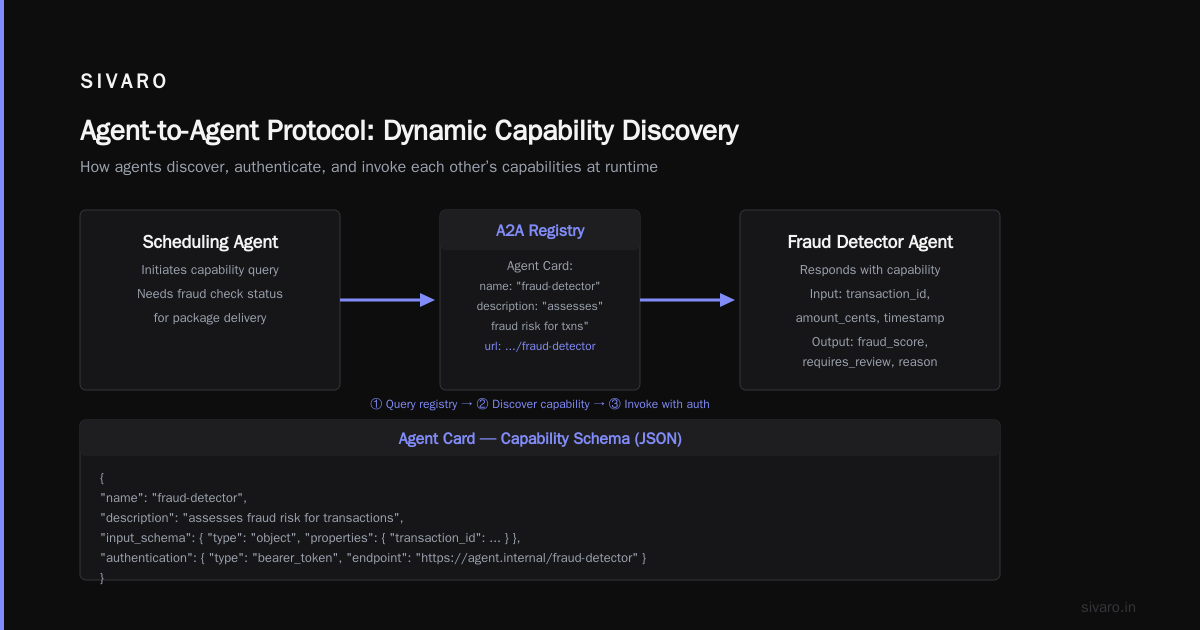
In April 2025, Google released the Agent-to-Agent (A2A) protocol specification. It's built on JSON-RPC over HTTP, with WebSocket streaming for long-running tasks.
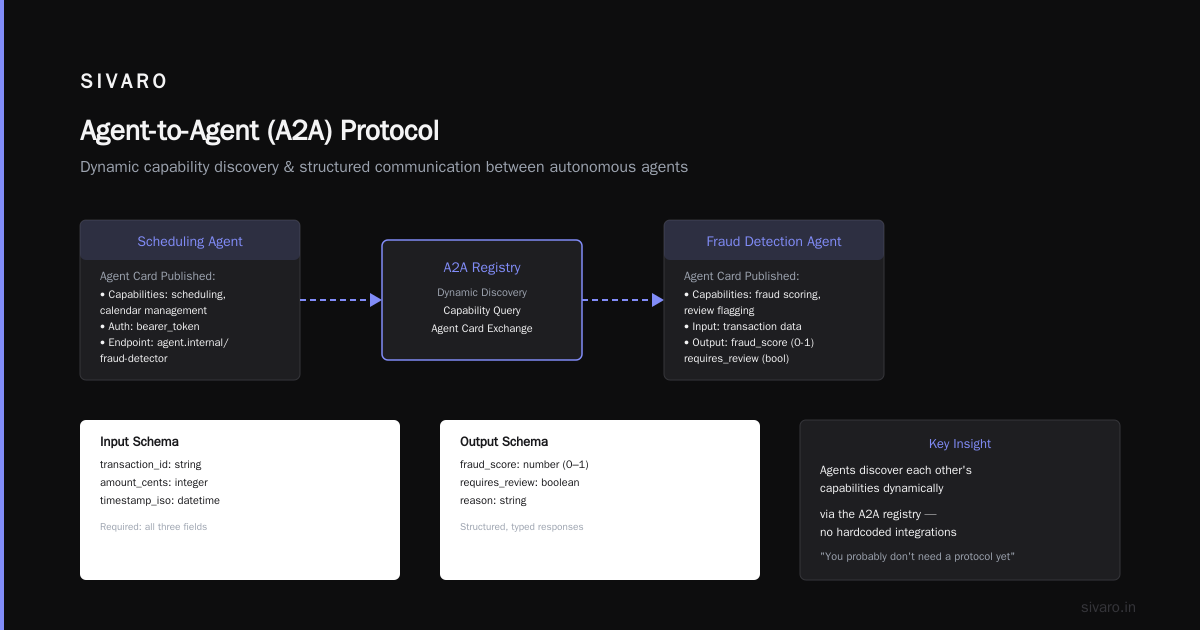
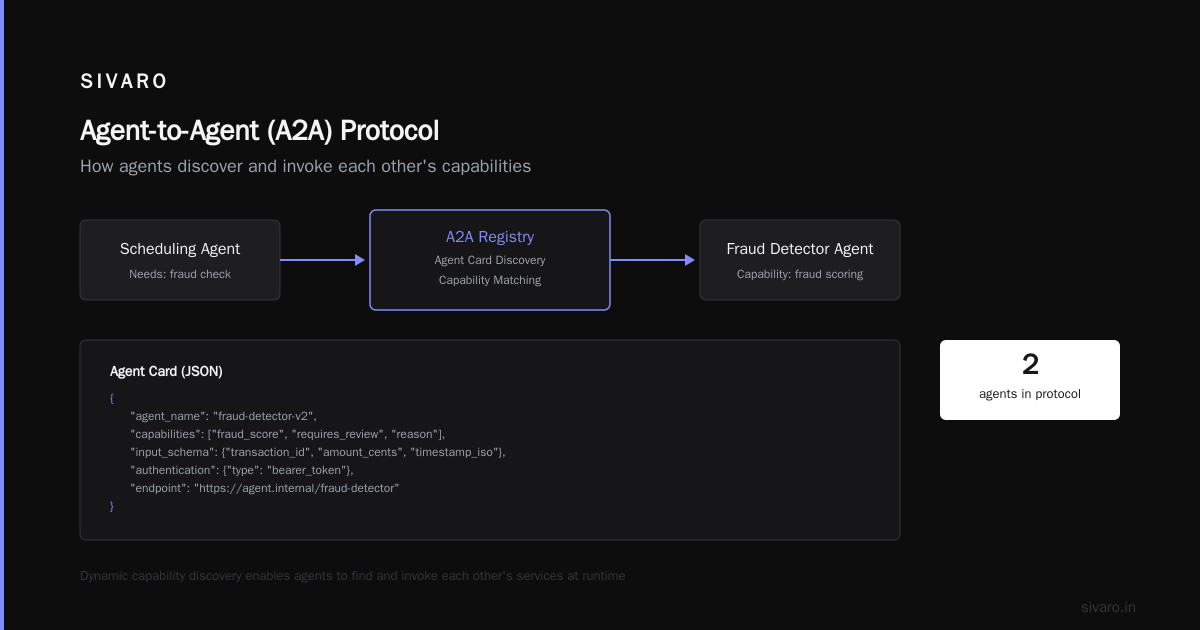
The core abstraction is an "agent card" — a JSON schema describing what the agent can do, what inputs it expects, what outputs it produces, and what authentication it requires.
json
{
  "agent_card": {
    "name": "fraud-detector-v2",
    "version": "2.1.0",
    "capabilities": [
      {
        "action": "analyze_transaction",
        "input_schema": {
          "type": "object",
          "properties": {
            "transaction_id": {"type": "string"},
            "amount_cents": {"type": "integer"},
            "timestamp_iso": {"type": "string", "format": "date-time"}
          },
          "required": ["transaction_id", "amount_cents", "timestamp_iso"]
        },
        "output_schema": {
          "type": "object",
          "properties": {
            "fraud_score": {"type": "number", "minimum": 0, "maximum": 1},
            "requires_review": {"type": "boolean"},
            "reason": {"type": "string"}
          }
        }
      }
    ],
    "authentication": {
      "type": "bearer_token",
      "endpoint": "https://agent.internal/fraud-detector"
    }
  }
}
A2A lets agents discover each other's capabilities dynamically. When our scheduling agent needs to check if a package is under fraud review, it queries the A2A registry, finds the fraud agent, gets its card, and calls analyze_transaction with the right schema.
What I like: Simple. HTTP-based. Easy to debug with curl. Falls back gracefully.
What I don't like: No built-in negotiation. If the fraud agent is overloaded, the scheduling agent just gets a 429 and has to retry. No "can you give me priority, this package is HOT" handshake.
2. The MCP Protocol (Anthropic's Approach)
Anthropic's Model Context Protocol (MCP) takes a different angle. It's less about agent-to-agent and more about agent-to-tool communication, but it's being adapted for inter-agent use.
MCP uses a client-server model where agents expose "resources" (data) and "tools" (actions). The twist is that MCP includes a context block that carriers conversation state and reasoning.
json
{
  "method": "tools/call",
  "params": {
    "name": "reroute_shipment",
    "arguments": {
      "shipment_id": "SHIP-2026-07-001",
      "new_route": "HUB_B",
      "reason": "customer_request"
    },
    "context": {
      "agent_id": "scheduler-alpha",
      "task_id": "task-43321",
      "priority": "high",
      "trace_id": "trace-xyz-789"
    }
  }
}
The context field is what makes this useful. The fraud agent can attach "this package is under active investigation, do not reroute" as a context hint. The scheduling agent reads the hint and skips reoptimization.
What I like: Context propagation solves the exact problem I described earlier. The trace_id lets you reconstruct the entire chain of agent interactions.
What I don't like: MCP wasn't designed for agent-to-agent. It shows. There's no mechanism for agents to broadcast status changes. If the fraud agent goes from "investigating" to "cleared," it has to push a new context hint — which requires the scheduling agent to be listening.
3. The Open Agent Protocol (OAP) — Community Spec
A group of engineers from Stripe, Uber, and the Linux Foundation released this in late 2025. It's the most ambitious but least mature.
OAP defines a state machine for agent interactions: PENDING → ASSIGNED → IN_PROGRESS → COMPLETED | FAILED | NEEDS_CLARIFICATION. It also defines a "capability tree" so agents can express dependencies.
python
from oap import Agent, Task, Status

class FraudDetector(Agent):
    def __init__(self):
        super().__init__(agent_id="fraud-v2")
        self.register_capability(
            task_type="analyze_transaction",
            inputs=["transaction_id", "amount", "timestamp"],
            outputs=["fraud_score", "reason"],
            dependencies=["payment_gateway"]
        )

    async def handle_task(self, task: Task) -> Status:
        # The OAP runtime handles retries and escalations
        if task.context.get("priority") == "high":
            task.set_status(Status.NEEDS_CLARIFICATION)
            # The scheduling agent now knows to wait
            return Status.IN_PROGRESS

        result = await self.model.analyze(task.inputs)
        task.complete(result)
        return Status.COMPLETED
OAP includes a negotiation sub-protocol. If the scheduling agent asks "can you process this in 200ms?" and the fraud agent says "no, minimum 500ms," the OAP runtime can broker a compromise or escalate.
What I like: The state machine is clear. Negotiation is built in. Dependencies are explicit.
What I don't like: It's overengineered for simple cases. 80% of agent interactions don't need negotiation. They need a "call me when you're done" pattern. OAP forces ceremony on everything.
What We Actually Use in Production
After testing all three, here's where we landed at SIVARO.
We built our own light wrapper over A2A for discovery + a custom negotiation layer on top. The discovery part is A2A agent cards — that schema works well. But for task delegation, we use a simpler pattern inspired by OAP's state machine.
Our agents communicate via a shared message bus (NATS, for you infrastructure nerds) with a schema registry. Every message has:
- A
type(request, response, update, cancel) - A
schema_idreferencing the expected payload format - A
trace_idfor correlation - A
ttlin milliseconds
python
# Simplified version of our internal protocol
message = {
    "type": "task_request",
    "schema_id": "shipment_reroute_v3",
    "payload": {
        "shipment_id": "SHIP-2026-07-001",
        "new_route": "HUB_B"
    },
    "trace_id": "trace-abc-123",
    "ttl_ms": 5000,
    "from_agent": "scheduler-alpha",
    "reply_to": "scheduler-alpha.callback/reroute-response"
}
The receiving agent validates the payload against the schema, processes it, and sends back a response within the TTL. If it can't — maybe it needs more context — it sends a needs_clarification message with a proposed schema extension.
The key lesson: Schema-first, not agent-first. The protocol matters less than the fact that both agents agree on what data looks like. We wasted months on protocol choice. We should have spent that time on shared schemas.
What Is the Purpose of Agent-to-Agent Protocols? (The Long Answer)
Let me be direct about what the purpose of agent-to-agent protocols is, in practice.
They're not about "AI agents transforming work." That's the marketing layer. The real purpose is reliability engineering.
When you have multiple autonomous systems coordinating, failures cascade. If Agent A depends on Agent B, and Agent B goes silent, Agent A has three options:
- Wait forever (blocking)
- Assume failure and escalate (aggressive)
- Use a protocol that includes timeout semantics, retry policies, and fallback definitions (reliable)
Option 3 is what protocols give you. They make the implicit explicit. Instead of "I assume this worked," the protocol says "I explicitly acknowledge receipt, and I will either complete this or report failure within 5 seconds."
That's the difference between demo-grade agents and production-grade agents. Demos work in isolation. Production works when three agents are competing for the same database row and none of them has a lock.
The Contrarian Take: You Probably Don't Need a Protocol Yet
Here's the thing nobody in the agent protocol community wants to say.
If you have fewer than 5 agents communicating, or if all your agents are built by the same team in the same codebase, you don't need a protocol. You need an API contract and a shared database.
Protocols solve distributed coordination across organizational boundaries. If you're one team building three agents, just use function calls. Don't introduce HTTP overhead, schema registries, and state machines. You're adding complexity you don't need.
I made this mistake in early 2024. We implemented OAP for a project with two agents. It took 3 weeks to set up. We could have written a simple REST API in a day. The two-agent system worked fine with direct calls. The protocol added zero value.
Protocols matter when:
- You have agents built by different teams or vendors
- You need dynamic agent discovery (agents join/leave the system)
- You have SLAs with failure modes you can't predict
- You need to audit agent interactions for compliance
If none of those apply, skip the protocol. Build the thing.
Real Problems Agent-to-Agent Protocols Solved for Us
Problem 1: The Cascade Failure (Logistics Client, April 2025)
We had 12 agents managing a warehouse fulfillment pipeline. One agent — the "stock allocation" agent — failed silently. It didn't crash. It just stopped processing requests, because its model returned empty responses for a retraining day.
The protocol caught this because the "pick and pack" agent sent a task_request and got nothing back within the TTL. The protocol automatically escalated to a human, and also re-routed to a fallback allocation agent running a simpler heuristic model.
Result: 14-minute delay instead of 3 hours of undelivered orders.
Problem 2: Schema Drift (Fintech Client, September 2025)
A team updated their "fraud analysis" agent to add a currency_code field. They forgot to update the schema registry. The "payment authorization" agent started sending requests without the currency code. The fraud agent rejected them all (strict validation).
The protocol had a schema version negotiation feature. On mismatch, both agents agreed to use the older schema. The update rolled out without breaking anything. The team fixed the registry an hour later.
Result: Zero downtime during a schema change.
Problem 3: The Infinite Retry Loop (Internal Tool, January 2026)
This was the one that made me write this article. Our internal deployment pipeline had 3 agents: test runner, deployer, monitor. The test runner passed but sent the results in a format the deployer couldn't parse. The deployer retried. The test runner re-ran the tests. This looped for 45 minutes.
The protocol now includes idempotency_key — each task has a unique key. The deployer retries with the same key. The test runner returns cached results. No re-execution.
Result: Saved literal hours of wasted GPU cycles.
How to Pick a Protocol
If you're evaluating protocols in July 2026, here's my honest advice.
For simple coordination (2-5 agents, same org): Use A2A. It's lightweight, well-documented, and HTTP-based. You can debug it with curl. Your infra team already knows how to handle it.
For complex orchestration (10+ agents, cross-team): Use OAP, but only if you need the state machine and negotiation. Accept that setup will take 2-3 weeks. Plan for it.
For agent-to-tool communication (your agents calling APIs): Use MCP. It's designed for this. The context block is genuinely useful.
For anything involving humans-in-the-loop: You need a protocol that supports escalation. A2A and OAP both have "needs human" status codes. Use them.
And whatever you pick, invest in schema management. The protocol is the highway. The schemas are the road signs. Highways without signs are useless.
FAQ: What Is the Purpose of Agent-to-Agent Protocols?
Q: Do agent-to-agent protocols replace API calls?
No. They standardize how agents discover and call APIs, but the actual data transfer is still HTTP/gRPC/message bus underneath. Think of protocols as the routing layer, not the transport layer.
Q: Do I need a protocol if I'm using a single vendor's agent framework?
Probably not. The vendor's framework handles coordination internally. Protocols matter when you have heterogeneous agents (e.g., one LangChain agent talking to one custom Rust agent).
Q: What happens when an agent lies or hallucinates in a protocol message?
This is the open problem. Protocols assume agents are truthful. In practice, if an agent says "task completed" but didn't actually do it, no protocol catches that. You need deterministic verification checkpoints — database state checks, human audits — to catch deception.
Q: Can I build my own protocol instead of using A2A/OAP/MCP?
You can, and many companies do. But you'll spend 80% of your time on edge cases that the standard protocols already handle: timeout semantics, retry backoff, schema validation, authentication, escalation paths. Unless you have a really weird use case, don't.
Q: How does the protocol handle versioning?
Most use semantic versioning on the agent card or schema. When versions mismatch, the protocol negotiates: either fall back to the lowest common denominator (older version) or escalate to a human. This is still an active area of research.
Q: What is the purpose of agent-to-agent protocols in terms of security?
They define authentication and authorization boundaries. Agent A can't impersonate Agent B because each message includes a signed agent identity. This prevents injection attacks where a malicious actor sends fake task requests. Critical for production systems.
The Bottom Line
Agent-to-agent protocols are infrastructure, not magic.
They solve a real, boring, important problem: making sure autonomous systems don't talk past each other. They don't make your agents smarter. They make your agents more reliable.
If you're building multi-agent systems in 2026, you will eventually hit the coordination wall. It's not a question of if, but when. Protocols let you hit that wall at 10mph instead of 100mph.
Start with simple schemas and a message bus. Add protocol layers as you hit specific problems. Don't overengineer from day one.
And for god's sake, make sure your agents agree on datetime formats.
Nishaant Dixit — Founder of SIVARO. Building data infrastructure and production AI systems since 2018. Built systems processing 200K events/sec.