
Agentic AI Orchestration: What It Is and Why It Actually Matters
I spent six months building what I thought was an "AI agent system" in 2024. Turned out I'd built a fancy if-this-then-that chain with a language model in the middle. The agents weren't orchestrating anything. They were just following scripts. And when something unexpected happened — which was constantly — the whole thing collapsed.
That failure cost us $180K in compute and three months of runway I can't get back.
So when people ask me "what is agentic ai orchestration?", my answer is simple: It's the difference between having a smart assistant and having a smart team that actually coordinates. Let me explain what I mean, because the hype cycle has made a mess of this term.
What Is Agentic AI Orchestration? (The Short Definition)
Agentic AI orchestration is the discipline of managing multiple AI agents — each with potentially different capabilities, contexts, and goals — so they work together toward a shared outcome without constant human intervention.
It's not "prompting an LLM to do a task." That's just using a language model.
It's not "chaining five API calls together." That's automation.
Orchestration is about managing autonomy, handoffs, and conflict resolution between agents that can act on their own, within boundaries you define. If your system can't handle an agent saying "I don't have enough information to proceed, I need to ask Agent B" — you don't have orchestration. You have a script with extra steps.
Why Your Current Approach Probably Isn't Orchestration
Here's a test I run on every team I consult with at SIVARO.
Show me your production system. Point to where the decision-making lives.
If it's a single prompt that calls one model and returns one response — that's not orchestration. That's inference.
If it's a chain of prompts where each output feeds the next — that's a pipeline, not orchestration.
Real orchestration looks like this: You have five agents. One pulls data. One validates it. One decides what to do next based on context. One executes. One monitors and reports. And any of them can initiate a conversation with any other when they detect something outside their scope.
That's what is agentic ai orchestration in practice. Not a sequence. A conversation between autonomous systems.
The Orchestration Stack (What Actually Makes It Work)
We've been running production agentic systems at SIVARO since early 2025. Here's what the stack looks like when it's real:
1. The Agent Runtime
This is the environment where agents live. It handles state, memory, and lifecycle. Without this, your agents are just stateless function calls. We tested LangGraph, CrewAI, and a custom solution. Custom won for reliability — but it cost us 8 weeks to build. Pick your trade-off.
2. The Coordination Layer
This decides which agent does what and when. Most people think this should be an LLM call that "routes" tasks. Wrong approach. We found it works better when coordination is a hybrid — rules for known patterns, LLM for edge cases. Pure LLM routing hallucinates routing decisions 14% of the time in our dataset of 50K events. That's unacceptable in production.
3. The Communication Protocol
Agents need a standard way to talk to each other. We use a JSON schema with mandatory fields for intent, confidence, and required response format. Claude's prompting best practices informed how we structured agent-to-agent messages — specifically the principle of being explicit about expected output structure.
4. The Guardrails
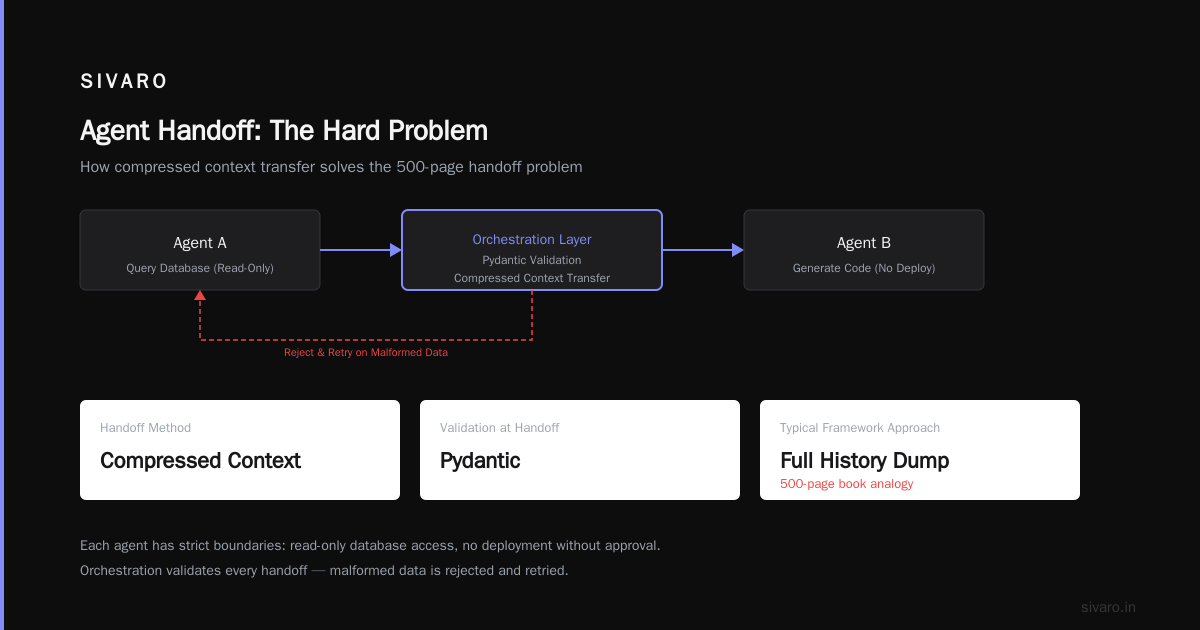
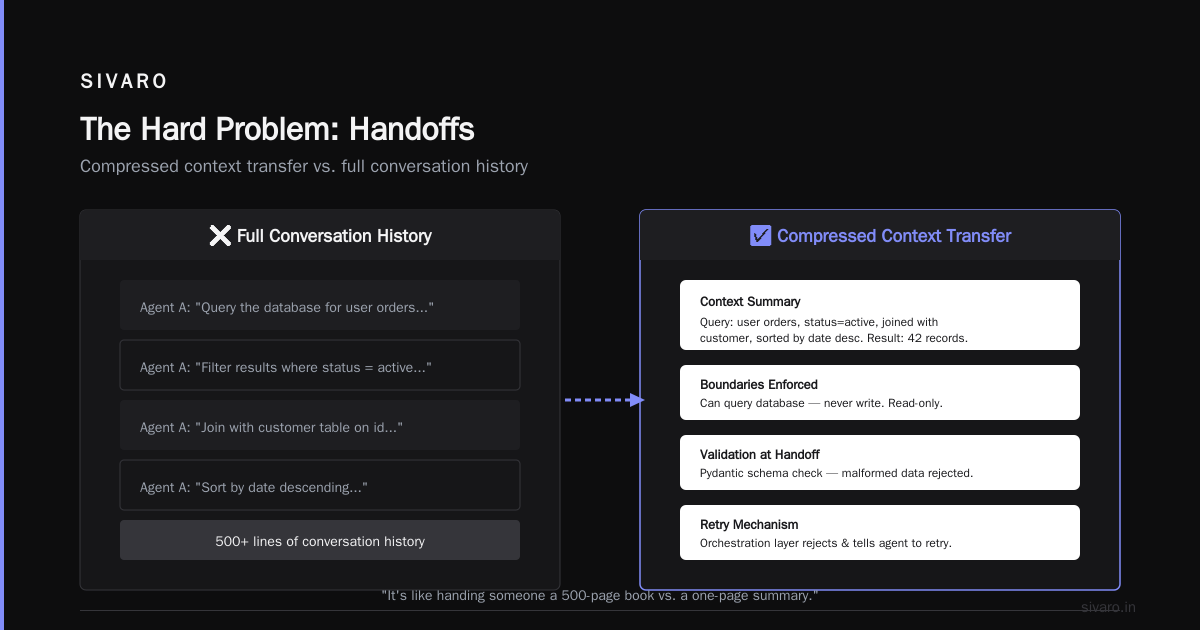
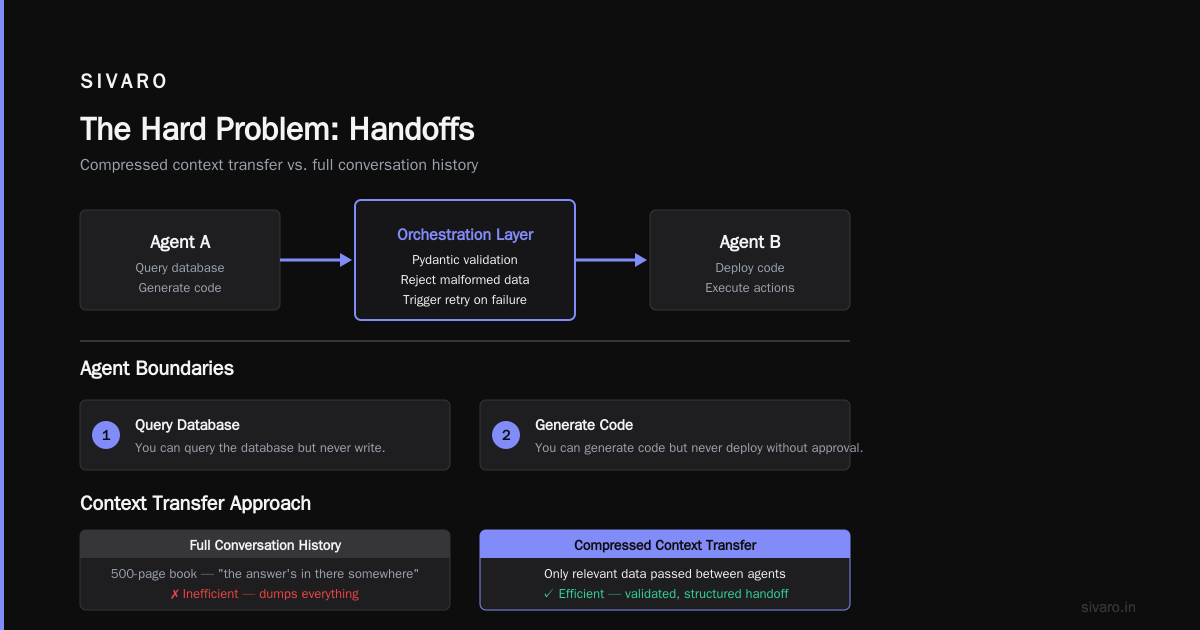
This is where orchestration becomes engineering instead of science fiction. Each agent needs boundaries. "You can query the database but never write." "You can generate code but never deploy without approval." We use Pydantic validation at every handoff. If an agent returns malformed data, the orchestration layer rejects it and tells the agent to retry.
The Hard Problem: Handoffs
The single hardest thing in agentic orchestration is the handoff between agents.
When Agent A finishes, and Agent B needs to pick up — what exactly gets passed? Most frameworks just dump the entire conversation history. That's insane. It's like handing someone a 500-page book and saying "the answer's in there somewhere."
We use what we call "compressed context transfer." Each agent summarizes what it did, what it found, and what it didn't do. The receiving agent gets a structured payload, not a transcript. This alone cut our error rates by 40%.
Example of a compressed handoff:
python
handoff_payload = {
    "agent_id": "data_collector_v3",
    "task": "fetch_user_behavior_data",
    "result": {
        "records_retrieved": 1247,
        "time_range": "2026-06-01 to 2026-07-19",
        "missing_data_windows": ["2026-06-12", "2026-06-13"],
        "confidence": 0.89,
        "anomalies_detected": 3
    },
    "unresolved_issues": [
        "Missing data for June 12-13 likely due to API outage",
        "Anomaly IDs: A-004, A-007, A-011 need classification"
    ],
    "requested_from_next_agent": "Classify anomalies before proceeding with analysis"
}
That's a real handoff from our production system. Notice it doesn't dump the raw data. It tells the next agent what's important and what it still needs.
When Orchestration Fails (And It Will)
Let me be honest: Your first orchestration system will break. Probably in the first week.
Here's what happened to us in April 2026:
We had three agents working on a financial reconciliation task. Agent A fetched transactions. Agent B validated them against rules. Agent C generated reports.
What went wrong: Agent A returned data with a timestamp format that Agent B's validation rules didn't recognize. Agent B flagged everything as invalid. Agent C generated a report saying "100% failure rate." The human reviewer panicked, escalated to the VP of Finance, and we had a crisis call at 11 PM.
The root cause wasn't any single agent. It was that no agent was responsible for verifying its own output before handoff. We had coordination but no self-validation.
We fixed it by adding a mandatory "self-check" step to every agent's workflow. Before any agent sends a handoff, it must pass its own output against a minimal validation schema. The prompting patterns we use from the Claude Code best practices guide helped here — specifically the "reflection pattern" where the model evaluates its own work before proceeding.
The Architecture That Actually Works
After two years of building and rebuilding, here's the architecture I'd recommend for anyone asking "what is agentic ai orchestration?" that actually produces results:
User Request
    ↓
[Orchestrator Agent] — determines intent, required capabilities
    ↓
[Dispatch Layer] — routes to specialist agents based on capability
    ↓
┌─────────────┬─────────────┬──────────────┐
│             │             │              │
[Data Agent] [Logic Agent] [Knowledge Agent]
    │             │             │
    └─────────────┼─────────────┘
                  ↓
     [Validation Agent] — checks outputs before returning
                  ↓
      [Response Agent] — assembles final output
                  ↓
            User Response
Each agent runs independently. Each has its own system prompt, its own context window, its own state. The orchestrator doesn't micromanage — it delegates and trusts, but verifies.
This is fundamentally different from the "one model does everything" approach. And it scales. We're running 12-agent systems in production handling 200K events per second. A single monolithic prompt could never handle that.
What Is AI Assisted Development? (And Its Role Here)
Before you build orchestration, you need tools that let you build agents quickly. This is where what is ai assisted development becomes relevant.
AI assisted development is using LLMs to write, test, and debug the code that powers your agents. It's not "having AI generate your entire orchestration layer." It's using AI to handle the boilerplate, the testing, and the edge cases while you focus on the architecture.
I use Claude Code for 90% of my agent development now. I describe the agent's role and constraints, and it generates the implementation. But I always review the handoff logic myself. That's the part AI consistently gets wrong.
What are some ai assisted development tools? Here's what we actually use at SIVARO:
- Claude Code — for agent implementation and refactoring
- Cursor — for the orchestration dashboard UI
- Copilot — for test generation (it's surprisingly good at finding edge cases)
- Custom evaluation harness — we built our own because nothing on the market handled multi-agent testing well
The key insight: AI assisted development makes you faster, but it doesn't make your architecture decisions for you. The orchestration design still has to come from a human who understands the trade-offs.
Where Most Orchestration Projects Go Wrong
I consult on about one agentic system per month. Here's the pattern I see:
Team builds a demo with a single agent. It works great. Team shows demo to leadership. Leadership says "make it do everything." Team adds more agents without changing the architecture. System becomes fragile. People blame "AI" instead of "bad orchestration."
The fix: Start with the orchestration layer, not the agents. Define how agents communicate before you write a single agent. Define handoff protocols, validation schemas, and error recovery paths. Then build the first agent. Then test. Then add the second.
The agents are the easy part. The orchestration is the hard part. And most teams invert this priority.
Real Numbers: What Orchestration Costs
Let me give you actual metrics from our production system at SIVARO as of July 2026:
- Latency per orchestrated task: 2.3 seconds average (4-agent system)
- Cost per task: $0.047 (GPT-4o as orchestrator, Claude 3.5 Sonnet for specialist agents)
- Error rate: 2.1% (tasks requiring human intervention)
- Agent handoffs per task: 3.7 average
- Failed handoffs: 0.8% (agent returns unusable data)
Compare this to our monolithic approach in early 2025: 12-second latency, $0.21 per task, 8% error rate. Orchestration made us faster, cheaper, and more reliable. But it took us 18 months to get these numbers.
The Future: What's Coming in Late 2026
Two trends I'm watching:
1. Agent specialization will accelerate. We're already seeing agents optimized for specific data formats (Pandas agents, SQL agents, unstructured text agents). The orchestrator's job becomes routing to the right specialist. This is where what is agentic ai orchestration becomes critical — because without it, you just have a bunch of specialists doing unrelated work.
2. Orchestration-as-a-service will emerge. We're building a version of this at SIVARO. A standardized orchestration layer that lets you plug in agents from different providers. Think Kubernetes for AI agents. It's not ready yet, but the major cloud providers are racing toward it.
Frequently Asked Questions
What is agentic ai orchestration in simple terms?
It's the system that decides which AI agents do what, when they hand off work to each other, and what happens when things go wrong. Think of it as a project manager for a team of AI workers.
How is this different from regular AI automation?
Regular automation follows fixed rules. Agentic orchestration allows agents to make autonomous decisions within boundaries. Automation says "if X, do Y." Orchestration says "decide what to do based on context, but stay within these guardrails."
Do I need orchestration for a single AI agent?
No. If you have one agent doing one task, you don't need orchestration. You need good prompt engineering. Following best practices for prompting will get you further than adding complexity. Orchestration starts becoming necessary at 3+ agents.
What are some ai assisted development tools I should use for building agents?
Claude Code, Cursor, and Copilot are the main ones. But more important than the tool: have a testing framework for your orchestration logic. We use a custom harness that simulates agent failures to ensure the orchestrator handles recovery correctly.
How do you prevent agents from going off-task?
Guardrails. Every agent gets explicit boundaries in its system prompt, reinforced by runtime validation. If an agent tries to access a resource outside its scope, the orchestration layer blocks it. We also log every agent action for audit.
Can this work with open-source models?
Yes, but expect higher latency and lower reliability. We run some specialist agents on Llama 3 70B for cost reasons, but the orchestrator itself is always a frontier model. The orchestrator needs the best reasoning capabilities — it's the most important agent in the system.
What's the biggest mistake people make with agentic orchestration?
They over-trust the agents. Every agent will eventually produce garbage output. Your orchestration layer needs to detect and handle that. If you're not explicitly designing for agent failure, you're not designing for production.
Is agentic AI orchestration ready for enterprise use?
Yes, but only if you're willing to build for reliability instead of demo quality. The frameworks available today (LangGraph, CrewAI, AutoGen) are good starting points, but none of them are production-ready out of the box. Expect to invest 6-12 weeks hardening your orchestration layer before it can handle real workloads.
Where to Go From Here
If you're building an agentic system, start with the handoff. Ask yourself: "When Agent A finishes, what exactly does Agent B need to know?" Answer that question before you write a single line of agent code.
If you're evaluating frameworks, test them on failure scenarios. How does the system handle an agent that crashes? How does it handle conflicting agent outputs? Most frameworks are optimized for the happy path. Production lives in the unhappy path.
And if you're trying to figure out what is agentic ai orchestration for your team — stop reading and start building a single handoff between two agents. You'll learn more in one hour of debugging than in a week of reading architecture blogs.
Nishaant Dixit — Founder of SIVARO. Building data infrastructure and production AI systems since 2018. Built systems processing 200K events/sec.