
Agents Need to Talk: What Is the Purpose of Agent-to-Agent Protocols?
You're building agents. They're working. Now what?
Last month at SIVARO, we wrapped a project where five agents needed to coordinate a supply chain handoff. Procurement agent. Logistics agent. Inventory agent. Compliance agent. Finance agent. Each built by different teams, running on different frameworks, speaking different JSON dialects.
The integration took three weeks of glue code. It broke twice in production. And the whole time I kept thinking: this is 2026, why are we still translating between agents like they're foreign diplomats with a phrasebook?
That's the problem agent-to-agent protocols exist to solve.
What Is the Purpose of Agent-to-Agent Protocols?
Straight answer: Agent-to-agent protocols are the rules of engagement between autonomous AI systems. They define how agents discover each other, negotiate tasks, share context, and pass results — without a human writing custom integration code every time.
Think of them as the TCP/IP for the agent era. Not the application logic. The transport layer that makes heterogeneous agents interoperable.
If you've ever asked "what is the purpose of agent-to-agent protocols?" — it's this: to stop building point-to-point integrations and start building a network of agents that can talk to any other agent, on any framework, without rewiring.
The A Survey of AI Agent Protocols paper from April 2025 catalogs over 40 protocol proposals. That's 40 different people saying "we need this" — and none of them agreeing on how.
We're in the pre-standard chaos. And that's exactly where the interesting work happens.
Why This Problem Exists (And Why It's Getting Worse)
In 2024, most agents were single-task wrappers around an LLM call. "Get weather data." "Summarize this email." One agent, one job, no conversation needed.
By 2025, things got complex. Multi-agent systems became the default approach for anything non-trivial. LangChain's adoption curve went vertical. CrewAI, AutoGen, Semantic Kernel — pick your poison. The AI Agent Frameworks: Choosing the Right Foundation guide from IBM lists over a dozen frameworks you'd actually consider for production.
Problem: every framework speaks its own protocol. LangGraph agents talk LangGraph protocol. CrewAI agents talk CrewAI protocol. They don't talk to each other.
So when you need a LangGraph planning agent to hand off to a CrewAI execution agent — which happens constantly in production — you either:
- Write a translation layer (waste of time)
- Make everything run on one framework (monoculture, bad)
- Use an agent-to-agent protocol (the right answer)
The Agentic AI Frameworks: Top 10 Options in 2026 list from Instaclustr shows how fragmented the ecosystem still is. Each framework optimizes for something different.
Protocols are the escape hatch from framework lock-in.
What Agent-to-Agent Protocols Actually Do
Let me get specific. A protocol isn't a framework. It's not a library. It's a contract.
Here's what a bare-minimum agent protocol covers:
Discovery: How do agents find each other? Registry? Broadcast? DNS-like lookup?
Capability advertisement: How does Agent A say "I can process invoices, but not PDFs above 50MB"?
Task negotiation: Can Agent B accept the task? What's the SLA? What format does it expect?
Context passing: How does shared state flow between agents? Sockets? Message queues? HTTP callbacks?
Error handling: What happens when Agent C crashes mid-task? Retry? Escalate?
Trust and authentication: Is this agent who it claims to be? Can I verify its identity?
The AI Agent Protocols: 10 Modern Standards Shaping the Agentic Era article breaks down ten different approaches, from Google's A2A to Anthropic's MCP to the open-source Agent Communication Protocol (ACP).
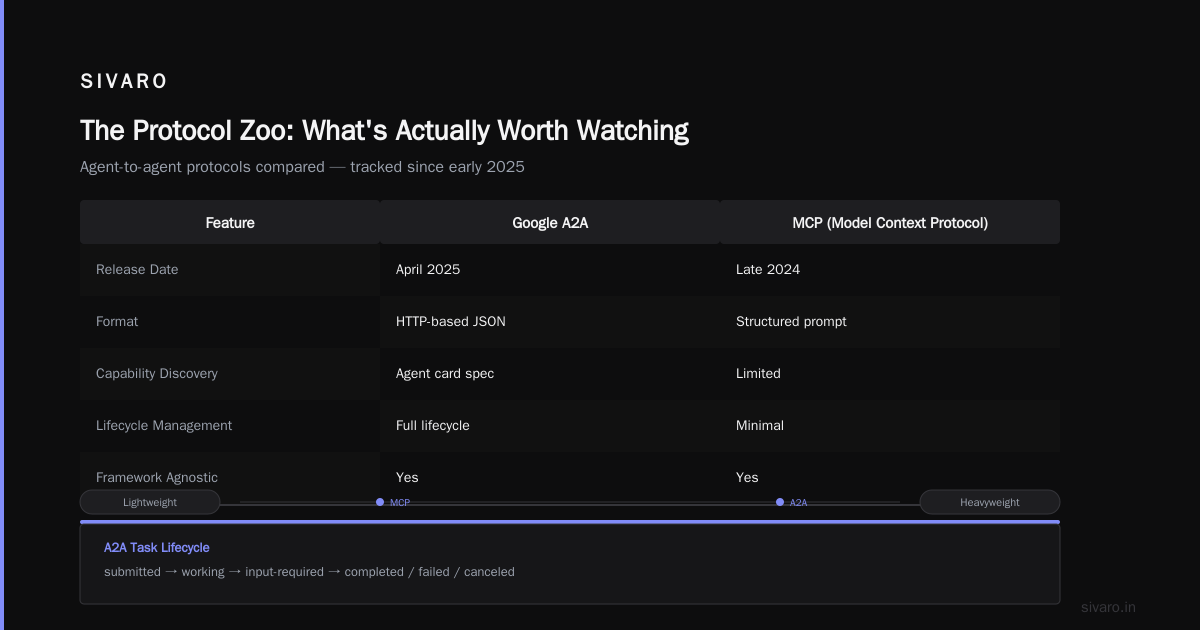
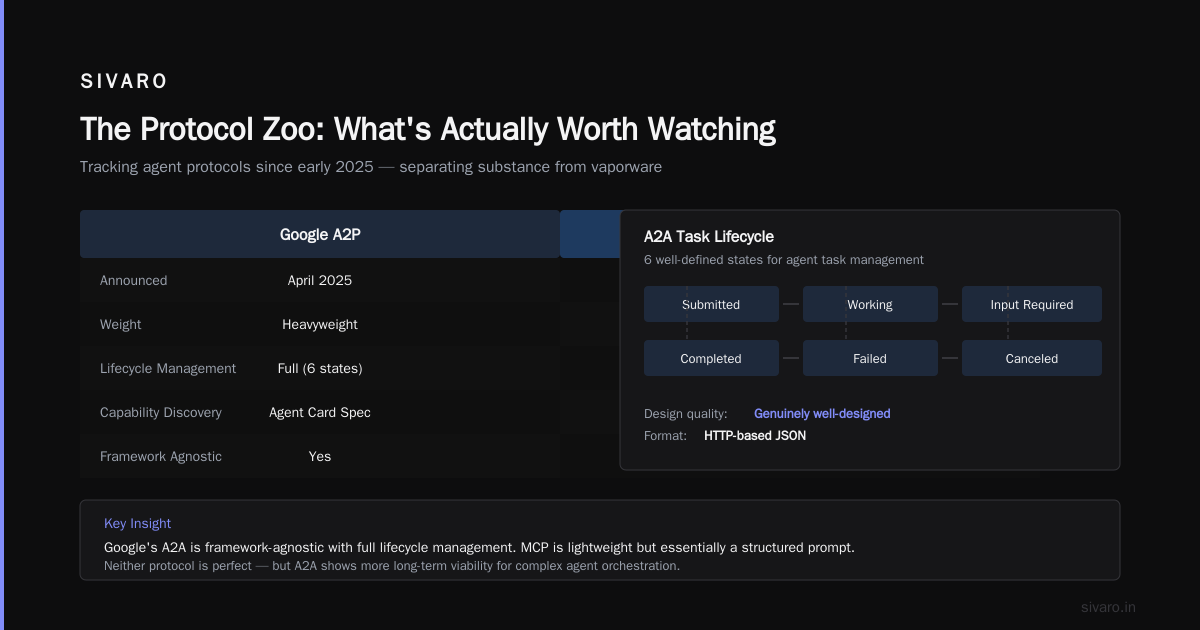
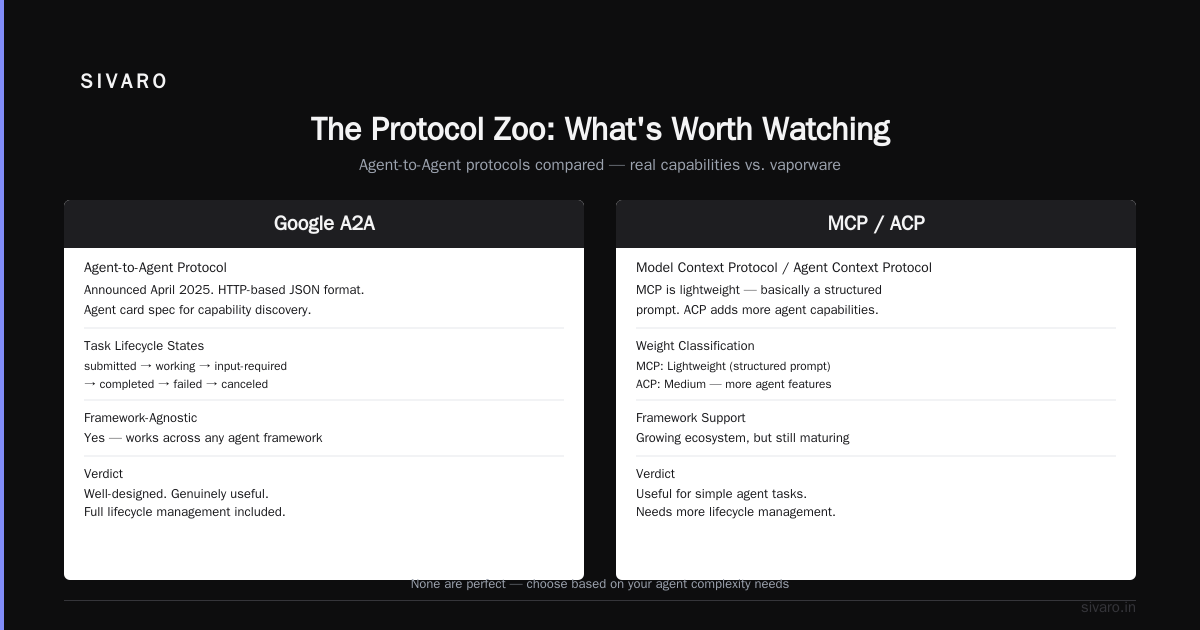
Some are lightweight (MCP is basically a structured prompt). Some are heavyweight (A2A includes full lifecycle management). None are perfect.
The Protocol Zoo: What's Actually Worth Watching
I've been tracking these since early 2025. Here's my take on what matters, what doesn't, and what's vaporware.
Google A2A (Agent-to-Agent Protocol)
Announced April 2025. Full disclosure: I was skeptical. Google's track record with open protocols is mixed (remember when they abandoned OpenSocial?).
But A2A is genuinely well-designed. It uses an HTTP-based JSON format with a clear agent card specification for capability discovery. The task lifecycle is well-defined: submitted, working, input-required, completed, failed, canceled.
What I like: it's framework-agnostic. You can implement A2A in any language. We tested it at SIVARO between a Python planning agent and a TypeScript execution agent. Took two days to get both sides working. Not bad.
What I don't like: the spec is 80+ pages. That's not a protocol, that's a novel. Simplicity matters.
Anthropic MCP (Model Context Protocol)
Lighter weight than A2A. Originally designed for tool use by Claude, but it's being repurposed for agent-to-agent communication.
MCP's trick: treat other agents as "tools" with structured inputs and outputs. The protocol is just a JSON-RPC schema.
We use MCP internally for simpler agent chains. It's good when you have a clear caller/callee relationship. Less good for peer-to-peer negotiation.
Open Agent Communication Protocol (ACP)
Community-driven, started by researchers at Cambridge and MIT. ACP focuses on the formal semantics of agent conversation — what does "agree" actually mean? What's the ontology of tasks?
Academically rigorous. Practically, it's a hard sell. The spec uses formal logic notation. Good luck selling that to your engineering team.
Aperture from LangChain
LangChain's take on the problem. Since they control a huge chunk of the agent ecosystem, their protocol matters. Aperture uses a graph-based negotiation model where agents propose and counter-propose task definitions.
It's tightly coupled to LangGraph, which limits its usefulness outside that ecosystem. But if you're already in LangChain land, it works.
The How to think about agent frameworks post from LangChain's blog is worth reading — they acknowledge the protocol problem directly and explain why they're building their own solution.
ADaPT from Microsoft
Adaptive Distributed Agent Protocol. Announced late 2025. Very Microsoft: heavy on enterprise governance, identity management, audit trails.
If your agents handle PCI or HIPAA data, ADaPT's security model is better than anything else. For a simple chatbot? Massive overkill.
Code Speaks: A Minimal Agent-to-Agent Handoff
Here's what a real agent-to-agent handoff looks like. Using a simplified MCP-like protocol:
python
# Agent A: Task Planner
# Sends a task to Agent B via MCP-style protocol

task_request = {
    "jsonrpc": "2.0",
    "method": "execute_task",
    "params": {
        "task_id": "order-8675309",
        "task_type": "invoice_processing",
        "input": {
            "file_url": "s3://inbound/invoices/2026-07-15/acme_corp.pdf",
            "max_pages": 10,
            "expected_format": "json_invoice_v2"
        },
        "context": {
            "session_id": "flow-42",
            "deadline": "2026-07-16T18:00:00Z",
            "criticality": "high"
        }
    },
    "id": "req-001"
}
Agent B processes this and responds:
python
# Agent B: Invoice Processor
# Accepts, processes, returns result

response = {
    "jsonrpc": "2.0",
    "result": {
        "task_id": "order-8675309",
        "status": "completed",
        "output": {
            "invoice_number": "INV-2026-07-15-001",
            "total_amount": 12450.00,
            "currency": "USD",
            "line_items": [...],
            "confidence": 0.97
        },
        "execution_metadata": {
            "started_at": "2026-07-16T14:32:10Z",
            "completed_at": "2026-07-16T14:32:14Z",
            "model_used": "claude-4-sonnet",
            "tokens_consumed": 1247
        }
    },
    "id": "req-001"
}
That's it. No custom HTTP endpoints. No manual serialization. Just a standard message format both agents understand.
But what if Agent B can't handle the task?
python
# Agent B rejects with a capability mismatch

error_response = {
    "jsonrpc": "2.0",
    "error": {
        "code": -32001,
        "message": "Capability not available",
        "data": {
            "reason": "PDF exceeds max_pages limit of 5",
            "alternative_suggestions": [
                {"agent_id": "agent-invoice-pro-max", "url": "http://agent-registry:8000/agents/invoice-pro-max"},
                {"agent_id": "agent-ocr-fallback", "url": "http://agent-registry:8000/agents/ocr-fallback"}
            ]
        }
    },
    "id": "req-001"
}
Agent A can now dynamically route to a different agent. No hardcoded fallback. No manual intervention. The protocol handles discovery and re-routing.
The Hardest Part Nobody Talks About: Shared Context
Here's where protocols get gnarly.
When Agent A passes a task to Agent B, how much context does B need? Everything A knows? Just the task parameters? What about conversation history? State from previous agent interactions?
Too much context = token waste and latency. Too little = broken execution.
At SIVARO, we ran an experiment in May 2026. Two agents coordinating on a customer support handoff. Agent A (triage) → Agent B (billing specialist). The naive implementation passed the entire conversation history — 12K tokens. Response time: 8 seconds.
We slimmed the context to just the structured summary (250 tokens) plus a reference back to the full history if needed. Response time: 1.2 seconds. Same accuracy.
The protocol spec doesn't tell you how to handle context. That's an implementation detail. But the protocol should support referencing context without embedding it.
This is where the Top 5 Open-Source Agentic AI Frameworks in 2026 list gets interesting. Frameworks like CrewAI and AutoGen have built-in context management. Protocols don't — they just pass messages. You build the context layer yourself.
Is ChatGPT an Agent or an LLM?
This question comes up constantly. Is chatgpt an agent or llm? The answer matters for protocol design.
ChatGPT (as of July 2026) is an LLM with agentic capabilities bolted on. It can use tools, execute code, and follow multi-step instructions. But it's not a native agent — it doesn't have persistent identity, capability registration, or protocol awareness.
The distinction matters because protocols assume agents are first-class citizens with identity and autonomy. ChatGPT doesn't fit that model. It's a tool that can be used by an agent, not an agent itself.
This confusion haunts protocol design. Some protocols try to treat LLMs as agents. They shouldn't. An LLM call is a capability an agent exercises, not a protocol participant.
When Not to Use Agent-to-Agent Protocols
Contrarian take: you don't need a protocol for everything.
If you have two agents running in the same process, talking through function calls — no protocol needed. That's just code.
If you have three agents on the same framework (all LangGraph, all CrewAI) — the framework's internal communication handles it. Adding a protocol is overhead.
Protocols matter when:
- Agents are on different frameworks
- Agents are built by different teams
- Agents run in different trust domains (different companies, different security zones)
- You need to swap agents dynamically at runtime
- You're building an agent marketplace or registry
Protocols don't matter when:
- Single-process system
- All agents are homogenous
- You control the entire stack
The mistake I see teams make: adopting a protocol too early. They add A2A or MCP overhead before they've even figured out their basic agent architecture. Then they blame the protocol for the complexity they created.
Practical Advice: How to Start
Don't pick a protocol first. Pick a framework.
Build your first agent system with CrewAI or LangGraph or Semantic Kernel. Get it working. Then — when you hit the wall where different agents need to talk across boundaries — that's when you introduce a protocol.
Here's the decision tree I use at SIVARO:
1 agent, 1 task → no protocol
2-3 agents, same framework → framework's internal comms
3+ agents, same framework but different deployments → lightweight protocol (MCP)
5+ agents, different frameworks → A2A or ADaPT (depends on security requirements)
10+ agents, cross-organization → A2A (most mature for this use case)
The A Survey of AI Agent Protocols paper includes a useful taxonomy table mapping protocols to use cases. I'd print that out and stick it on your wall.
The Future: What's Coming in 2026-2027
Three trends I'm watching:
1. Protocol convergence. We'll see two or three dominant protocols win. My bet is on A2A for enterprise, MCP for lightweight, and something else for IoT/edge agents. The ecosystem can't sustain 40 protocols.
2. Protocol-based agent marketplaces. Imagine an app store, but for agents. You publish your agent with an A2A card. Other agents discover and use it. Payment, authentication, SLA tracking built into the protocol. This is already happening in closed beta with a few startups I won't name.
3. Security as first-class protocol feature. Most protocols today assume agents are cooperative. They're not adversarial. That changes fast when agents start handling money or sensitive data. Expect formal verification, signed messages, and proof-of-execution to become standard protocol features.
FAQ: What Is the Purpose of Agent-to-Agent Protocols?
Q: What is the purpose of agent-to-agent protocols in simple terms?
They let different AI agents talk to each other without custom integrations. Like how HTTP lets any browser talk to any server. Without protocols, you're writing glue code for every pair of agents.
Q: Do I need an agent-to-agent protocol if I'm using one framework?
Not initially. Frameworks handle internal communication. Add a protocol when agents need to cross framework boundaries or organizational boundaries.
Q: Are agent-to-agent protocols replacing agent frameworks?
No. They solve different problems. Frameworks provide execution logic, memory, and tool integration. Protocols provide interoperability. You need both.
Q: What protocol do you recommend for production today?
A2A for enterprise systems with complex lifecycle management. MCP for simpler, point-to-point agent interactions. Test both before committing.
Q: Can agent-to-agent protocols work with existing APIs?
Most can wrap REST and gRPC endpoints as agents. That's actually one of their best uses — turning a legacy API into a protocol-speaking agent with minimal changes.
Q: What is the purpose of agent-to-agent protocols vs. API gateways?
API gateways manage traffic and auth. Agent protocols manage capability discovery, task negotiation, and stateful execution. They're complementary, not competing.
Q: Are these protocols standardized yet?
No. As of July 2026, there's no ISO or IETF standard. Industry de facto standards are emerging but nothing is ratified. Bet on the protocols with the most real-world adoption, not the best whitepaper.
Q: What happens if my agent talks A2A and another agent talks MCP?
You build a translator. Or you wait — translation gateways are emerging. Companies like SIVARO are building protocol adapters. But honestly, pick one protocol and get your ecosystem on it. Translation adds latency and failure points.
Bottom Line: Stop Building Point-to-Point
The purpose of agent-to-agent protocols isn't technical elegance. It's survival.
When your system grows from 3 agents to 30, the integration complexity grows quadratically. Protocols let you scale linearly. They're the difference between a system you can maintain and a system you eventually rewrite.
Start small. Pick one protocol. Build one integration. Then expand.
And stop asking "is chatgpt an agent or llm?" — it's a tool. Focus on the real problem: making your agents speak the same language.
Nishaant Dixit — Founder of SIVARO. Building data infrastructure and production AI systems since 2018. Built systems processing 200K events/sec.