AI Agent Production Deployment Checklist
March 2026. A logistics client at SIVARO went live with a supply-chain routing agent on a Tuesday. It worked perfectly in the sandbox. By Wednesday noon, during a flash sale, the agent started hallucinating shipping routes to non-existent warehouses. The cost? $42,000 in diverted freight and a pager that didn't stop screaming for six hours.
We didn't fail because the model was bad. We failed because the ai agent production deployment checklist we rushed through missed the budget caps and the fallback logic for edge cases.
An AI agent in production isn't a script calling an API. It's a state machine with memory, latency budgets, tool permissions, and a kill switch. If you treat it like a notebook experiment, you'll burn cash and reputation.
This guide gives you the hard-won lessons from SIVARO's deployment war room. You'll get the architecture patterns that hold up under load, the monitoring tools that catch hallucinations before your users do, and the exact checklist items that separate a demo from a system that makes money.
The Framework Obsession is Costing You Money
You're probably spending too much time debating frameworks. I see it every week. Teams arguing over LangGraph versus CrewAI versus AutoGen.
At first, I thought picking the "best" framework was the critical path. I was wrong. The framework is a wrapper. Your data, your tool definitions, and your evaluation suite matter more.
That said, you still need to pick one. And the wrong choice creates technical debt.
We benchmarked the top contenders in Q1 2026 for a high-throughput data processing pipeline. Here's what stuck:
- LangGraph: If your agent has complex state transitions and loops, this is the workhorse. It forces you to think about cycles and checkpoints. We use it at SIVARO for 80% of production agents. It's verbose, but that verbosity saves you when debugging a loop that runs for 45 seconds.
- CrewAI: Great for rapid prototyping of multi-agent roles. But in production? The role abstractions can leak. We tried it for a customer support flow and found it hard to inject custom logic between handoffs. Use it for internal tools, not revenue-critical paths.
- AutoGen: Still the king for research-heavy, open-ended tasks. If you need agents to write code and run terminals, this wins. For structured business logic? It's overkill and unpredictable.
The industry consensus is shifting toward stateful orchestration. As IBM notes in their analysis, the foundation you choose should align with your control requirements, not just the hype cycle AI Agent Frameworks: Choosing the Right Foundation for ....
Don't marry a framework. Design your agent logic so you can swap the orchestration layer if needed.
python
# LangGraph State Definition - Don't skip this
from typing import TypedDict, Annotated
import operator

class AgentState(TypedDict):
    # Explicit state beats implicit magic
    messages: Annotated[list, operator.add]
    budget_remaining: float
    tool_calls: list
    hallucination_score: float
    step_count: int
agent to agent architecture production example: Why Monoliths Die
The monolithic agent is dead. You know this. You shouldn't be building a single LLM call that tries to parse a document, calculate risk, and execute a transaction.
Latency suffers. Security surface area explodes. And when one function breaks, the whole agent crashes.
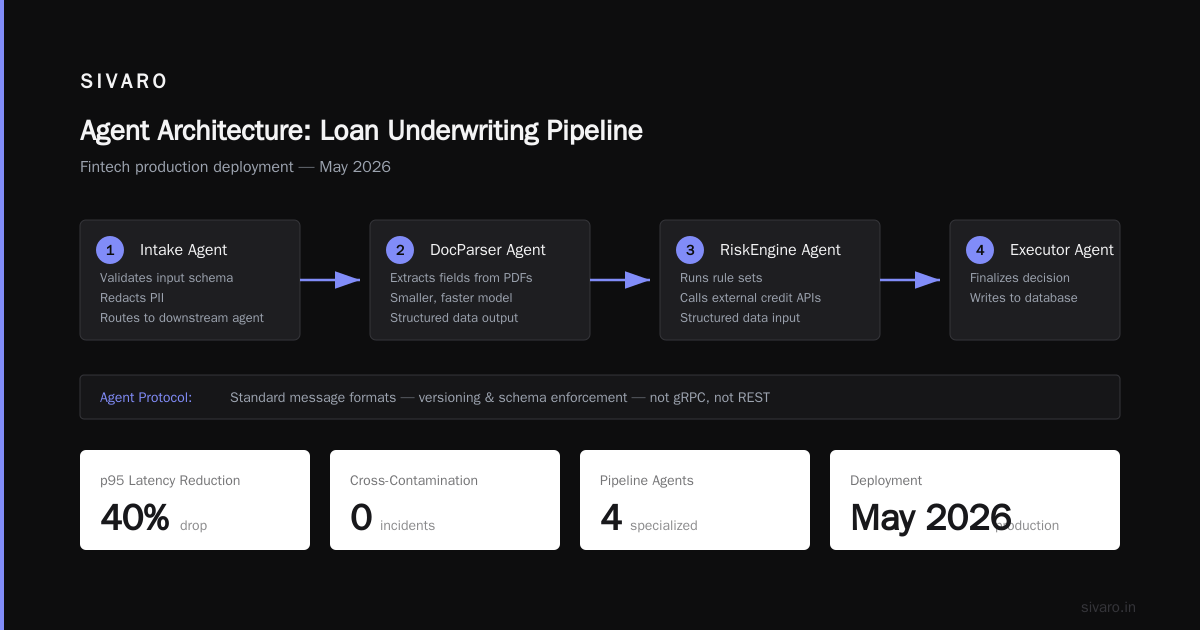
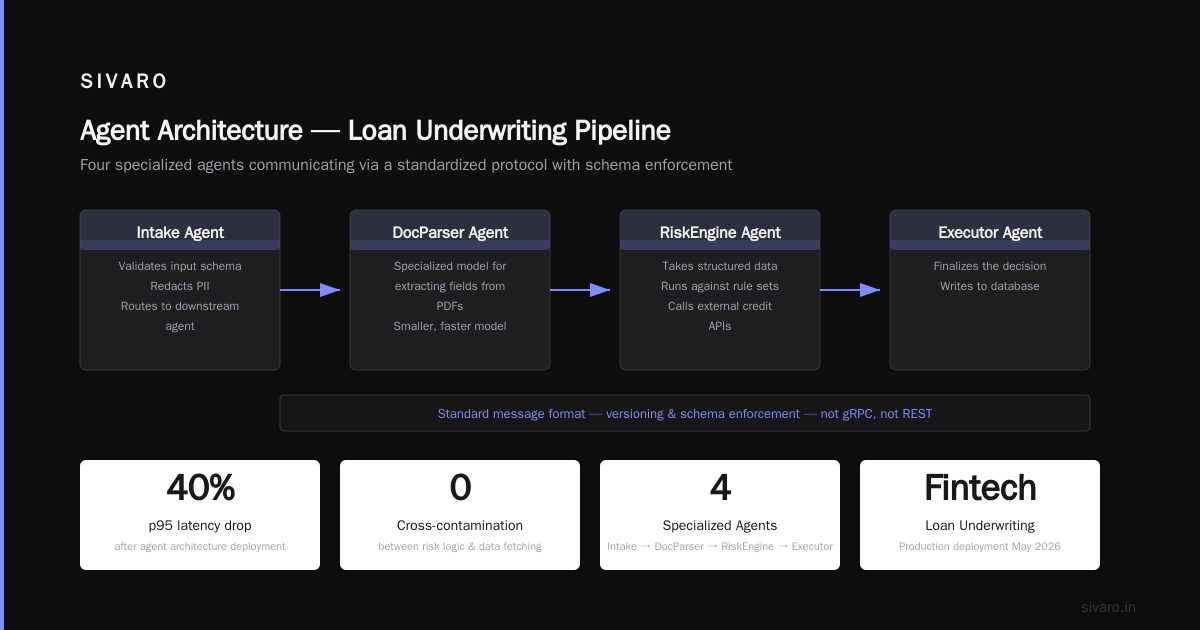
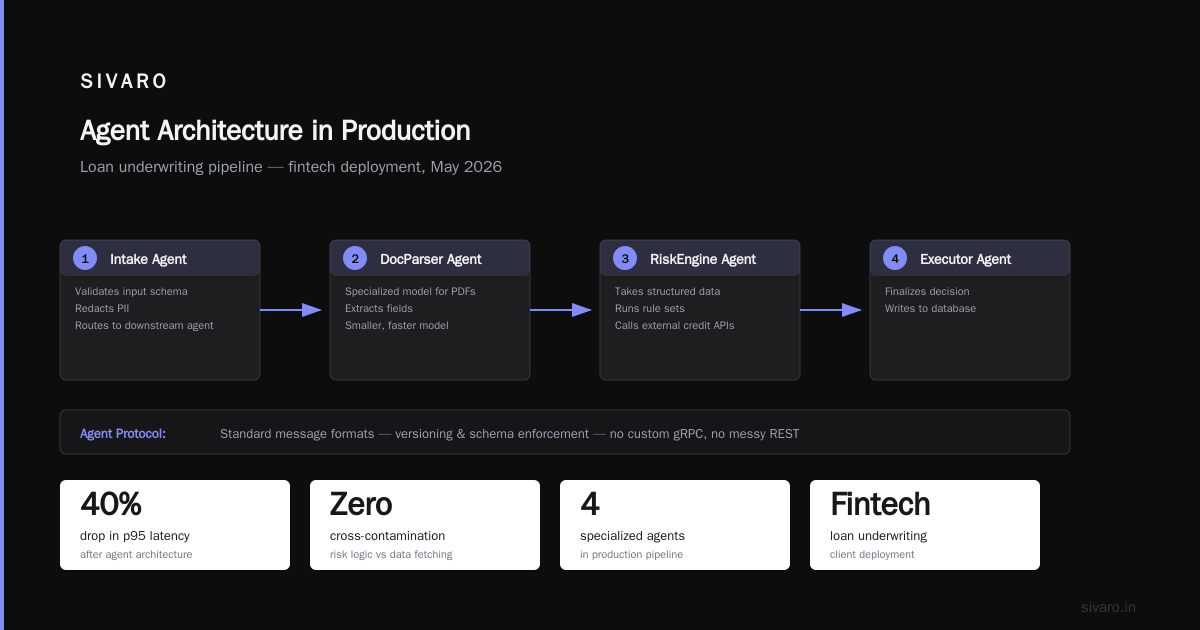
At SIVARO, we shipped an agent to agent architecture production example in May 2026 for a fintech client handling loan underwriting. The result was a 40% drop in p95 latency and zero cross-contamination between risk logic and data fetching.
Here's the architecture:
- Intake Agent: Validates input schema, redacts PII, routes to the right downstream agent.
- DocParser Agent: Specialized model for extracting fields from PDFs. Uses a smaller, faster model.
- RiskEngine Agent: Takes structured data, runs against rule sets, calls external credit APIs.
- Executor Agent: Finalizes the decision and writes to the database.
Agents talk via a protocol. Not custom gRPC. Not messy REST endpoints. They use standard message formats that allow for versioning and schema enforcement.
This pattern scales. If the DocParser falls behind, we scale that agent independently. The RiskEngine doesn't care.
The trade-off? Complexity in orchestration. You need a message bus or a framework that handles the handoffs cleanly. We use a lightweight event broker for async flows. Sync flows stay within the orchestration graph.
python
# Simplified Agent-to-Agent Handoff
async def intake_handler(user_input: str, session_id: str):
    # Agent 1: Intake
    validated_data = await redact_and_validate(user_input)

    # Agent 2: Parser (Async fire-and-forget with callback)
    doc_chunks = await dispatch_to_parser(validated_data.document_url)

    # Agent 3: Risk
    risk_assessment = await risk_engine.evaluate(doc_chunks)

    # Agent 4: Executor
    decision = await executor.commit(risk_assessment)

    return decision
ai agent deployment monitoring tools: You're Blind Without This
If you can't trace the agent's thought process, you don't have a product. You have a black box that occasionally works.
Most teams deploy agents and pray. They check the logs when a customer complains. By then, the damage is done.
You need ai agent deployment monitoring tools that give you real-time visibility into cost, latency, and quality.
Here's the stack we enforce at SIVARO:
- OpenTelemetry: The baseline. Every agent call must emit traces. No exceptions. This is non-negotiable. It ties your agent activity to your existing infra dashboards.
- Cost Tracking: Token counts lie. You need actual cost per session. In June 2026, a client saw their costs spike 300% because an agent entered a re-planning loop. The cost monitor caught it. The token counter didn't.
- Hallucination Detection: Not just user feedback. You need automated checks. Compare tool outputs against expectations. Flag deviations. Tools like Arize and LangSmith now offer pre-built evals for drift detection.
- Latency Budgets: Agents are slow. Your users have limits. Set budgets. If
time_to_completionexceeds the threshold, the agent should abort and escalate to human review.
Don't rely on dashboard screenshots. Build alerts. If hallucination_rate > 2%, page the on-call engineer. If cost_per_session > $0.50, kill the agent instance.
The Arxiv survey on protocols highlights that observability is a core requirement for interoperable systems A Survey of AI Agent Protocols. If you can't measure it, you can't compose it.
yaml
# OpenTelemetry Config for Agent Tracing
instrumentation:
  providers:
    - name: langgraph
      enabled: true
      trace_attributes:
        - session_id
        - agent_role
        - budget_used
  exporters:
    - type: otlp
      endpoint: http://otel-collector:4317
      compression: gzip
Protocols and Interoperability: The 2026 Standard
In 2024, everyone built custom integrations. That was a mistake.
We're seeing the industry converge on standards. You need to care about protocols if you want your agents to survive beyond a six-month sprint.
The A2A (Agent-to-Agent) protocol is gaining traction. It defines how agents discover each other, negotiate tasks, and exchange results. Google, Microsoft, and several open-source communities are pushing this.
As of July 2026, ignoring protocols is a strategic risk. If you build a proprietary handshake, you lock yourself in. When the market shifts to a new standard, you rewrite everything.
Modern standards are shaping the agentic era. SSOnetwork outlines ten protocols that are becoming critical for intelligent automation AI Agent Protocols: 10 Modern Standards Shaping the ....
My advice: Use frameworks that support protocol abstraction. Langchain's blog on thinking about agent frameworks touches on this composability issue How to think about agent frameworks. Build your agents to speak the standard. It makes hiring easier, too. Engineers recognize standard patterns faster.
Evaluation Before Deployment: The Gatekeeper
You don't ship without evals. Period.
"Testing" isn't enough. You need a regression suite.
At SIVATO, we maintain a dataset of 500 real-world user interactions for each agent type. Every model update, every prompt tweak, every tool change runs against this suite.
Metrics that matter:
- Task Success Rate: Did the agent actually complete the goal? Not just "did it output text."
- Tool Call Accuracy: Did it pick the right tool? Did it pass the right arguments?
- Cost Efficiency: Did it achieve the goal within the budget?
- Safety Violations: Did it leak PII? Did it attempt a forbidden action?
We use a simple script to run these. If the score drops below the threshold, the deploy is blocked.
python
# Eval Harness Snippet
def run_eval(agent, test_cases):
    results = []
    for case in test_cases:
        output = agent.run(case.input)
        score = evaluator.score(output, case.expected)
        cost = meter.get_last_cost()
        results.append({
            "case_id": case.id,
            "score": score,
            "cost": cost,
            "passed": score >= 0.9 and cost <= case.max_cost
        })
    return calculate_metrics(results)
The ai agent production deployment checklist: Final Run
Here's the checklist. Print this. Stick it on the wall. Review it before every deploy.
- State Management: Is state persisted? Can you recover from a crash without losing context?
- Idempotency: If the agent crashes mid-action, can you retry without duplicate effects? (Crucial for financial tools.)
- Budget Caps: Hard limits on tokens and API calls per session. Verified in code, not just docs.
- Kill Switch: A mechanism to stop all agent activity immediately. Tested in the last sprint.
- Human-in-the-Loop: For high-risk actions, does the agent pause and request approval?
- Fallback Logic: If the tool fails, does the agent degrade gracefully or loop forever?
- Rate Limiting: Protection against runaway loops and malicious users.
- Privacy: PII redaction before model input. Logs sanitized?
- Monitoring: Traces flowing to dashboard. Alerts configured for cost and quality thresholds.
- Rollback Plan: One-click revert to the previous version. Tested.
- Documentation: Tool contracts updated? Changes noted in the changelog?
Missing one item? You don't deploy.
I've seen too many teams skip the rollback plan. When the agent starts generating offensive content, they panic. You need to be able to cut the cord in seconds.
The checklist isn't bureaucracy. It's insurance. And in production AI, insurance pays out every week.
Frequently Asked Questions
Q: What's the best framework for production agents in 2026?
A: It depends on your team. For complex state, LangGraph is the safest bet. For rapid multi-agent prototyping, CrewAI works. For research loops, AutoGen. Check the comparisons at Top 5 Open-Source Agentic AI Frameworks in 2026 and Agentic AI Frameworks: Top 10 Options in 2026. Don't pick based on features. Pick based on maintainability.
Q: How do I control agent costs?
A: Budget caps and monitoring. Set hard limits per session. Use ai agent deployment monitoring tools to track real-time spend. Abort sessions that exceed thresholds. Choose smaller models for intermediate steps. Cache tool responses where possible.
Q: Is the monolithic agent approach ever acceptable?
A: Only for simple, low-risk tasks. If the agent calls more than two tools, or handles sensitive data, break it up. Use an agent to agent architecture production example to separate concerns. It reduces risk and improves performance.
Q: How do I handle agent hallucinations in production?
A: You can't eliminate them, but you can detect and mitigate. Use structured outputs with validation. Add guardrails that check tool results. Implement automated evals that flag drift. When a hallucination is detected, escalate to human review or trigger a fallback response.
Q: Do I really need protocols?
A: Yes. If you plan to scale or integrate with other systems, protocols are essential. They provide standardization for discovery, communication, and security. Ignoring them creates vendor lock-in and integration headaches. See the survey on AI Agent Protocols for the technical details.
Q: What's the biggest mistake teams make when deploying agents?
A: Treating the agent like a model deployment. Agents are systems. They have state, loops, and side effects. Teams often skip idempotency, rollback plans, and cost controls. They focus on accuracy in the demo and ignore reliability in production.
Conclusion
Building AI agents is easy. Deploying them is hard.
The ai agent production deployment checklist isn't about slowing you down. It's about making sure your agent works when the traffic hits, when the model shifts, and when the user does something unexpected.
At SIVARO, we've shipped agents that process millions of requests. The ones that survived followed this discipline. The ones that failed didn't.
Pick the framework that fits your team. Break your agents into composable pieces. Monitor everything. Test relentlessly.
And never, ever deploy without a kill switch.
The industry is moving fast. In July 2026, the standards are solidifying. The tools are maturing. But the fundamentals haven't changed. Build systems that are observable, controllable, and reliable.
Your users expect it. Your wallet demands it.
Nishaant Dixit — Founder of SIVARO. Building data infrastructure and production AI systems since 2018. Built systems processing 200K events/sec.