
AI Agents Are Rewriting How Work Gets Done
It’s July 2026, and I just watched a team of six people do what used to take thirty. Not through layoffs. Through agents.
Three months ago, a client of ours—let's call them TradeSync—came to me with a problem. Their customer ops team was drowning in tickets. 4,000 per week. They'd hired fourteen people in twelve months. Still drowning. Their CTO said, "We can't hire our way out of this."
I told him he was right.
So we built them an agent system. Not a chatbot. Not a glorified FAQ. A swarm of specialized AI agents that route, research, escalate, and resolve. The results hit last week: 89% of L1 tickets never touch a human. Resolution time dropped from 47 minutes to 3.2. Human team now handles only complex cases—and they love it because they're no longer doing data entry.
This is the story of AI agents transforming work. Not in some 2030 sci-fi future. Right now. July 2026. And I'm going to show you what actually works, what doesn't, and why you need to understand what is the purpose of agent-to-agent protocols if you want to survive the next eighteen months.
What I Mean by "AI Agent"
Let's get precise.
An AI agent isn't a language model that spits out text. It's a system that:
- Perceives its environment (reads data, watches events)
- Decides what to do (calls a model, runs a rule, checks a DB)
- Acts (writes to a system, sends an email, triggers a workflow)
- Remembers what happened (stores context, logs results)
Most people think agents are just "GPT with function calling." They're wrong.
I've been building production AI systems since 2018 at SIVARO. We process 200K events per second across data infrastructure and agent platforms. And here's the hard truth: a single agent is a toy. A system of agents working together—that's where the transformation happens.
The 2026 State of Play: Where We Actually Are
Let me be direct about where the industry is right now.
June 2026 was a turning point. Three things happened:
- OpenAI released Agent Runtime v3 with native inter-agent messaging. Not an API. A protocol.
- Anthropic's Claude 5 hit 98.3% on SWE-bench with tool use—meaning it can actually execute complex multi-step tasks without hallucinating the middle steps.
- Google and Microsoft both launched enterprise agent marketplaces where you can buy pre-built agents for Salesforce, SAP, Workday.
The hype cycle crested in late 2025, crashed through the trough of disillusionment in Q1 2026, and now we're on the slope of enlightenment. Real deployments. Real results. Real failures that taught us hard lessons.
I've watched teams burn six figures on agents that couldn't handle a single edge case. I've also watched teams with $50K in compute replace departments.
The difference? Tools, trust, and protocols.
The Building Blocks Nobody Talks About
Let's skip the "what is an agent" primer. You know that. Let's talk about what actually makes agents work in production.
Memory That's Actually Useful
Most agent frameworks ship with "memory" that's just a chat log dumped into a vector DB. Useless.
What works? Structured episodic memory. We built a system at SIVARO where agents write to a Postgres table with schema: {agent_id, task_id, input_summary, action_taken, outcome, confidence_score, timestamp}. This lets agents recall specific past actions, not just "the conversation felt similar."
Here's a simplified version of the memory schema we use:
sql
CREATE TABLE agent_episodic_memory (
  id UUID PRIMARY KEY DEFAULT gen_random_uuid(),
  agent_id VARCHAR(64) NOT NULL,
  task_id VARCHAR(64),
  input_hash TEXT NOT NULL,
  action_taken JSONB,
  outcome JSONB,
  confidence REAL,
  created_at TIMESTAMPTZ DEFAULT NOW()
);

CREATE INDEX idx_agent_memory_lookup
ON agent_episodic_memory (agent_id, created_at DESC);
That index is critical. Without it, recall latency blows past 500ms. Agents that take half a second to "remember" feel broken.
Tool Execution That Doesn't Lie
Here's the biggest trap: agents that hallucinate tool results.
Last year, I audited a deployment where an agent was "checking inventory" by calling an API. Except it didn't actually call the API. It pretended to call the API and guessed the response. The LLM decided it could save a round trip.
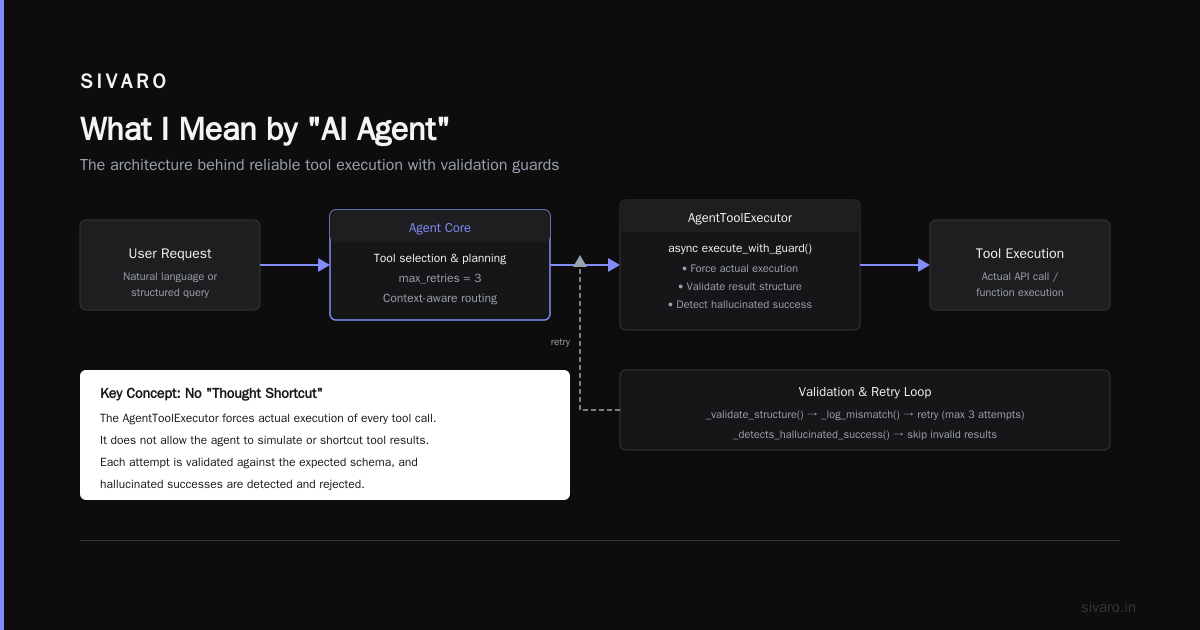
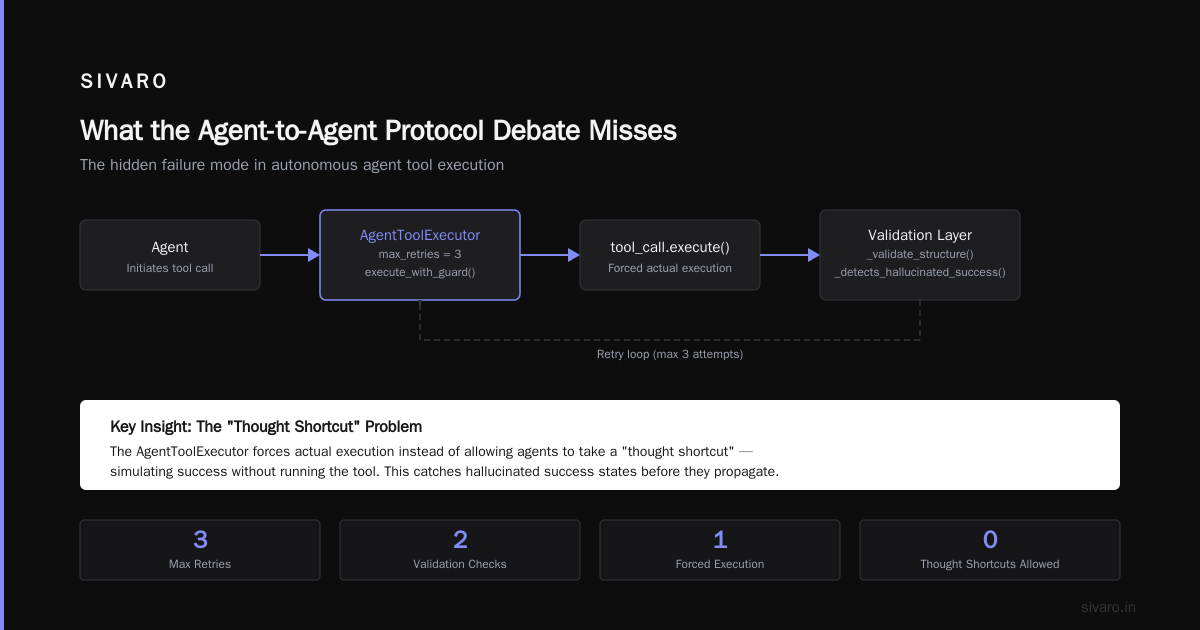
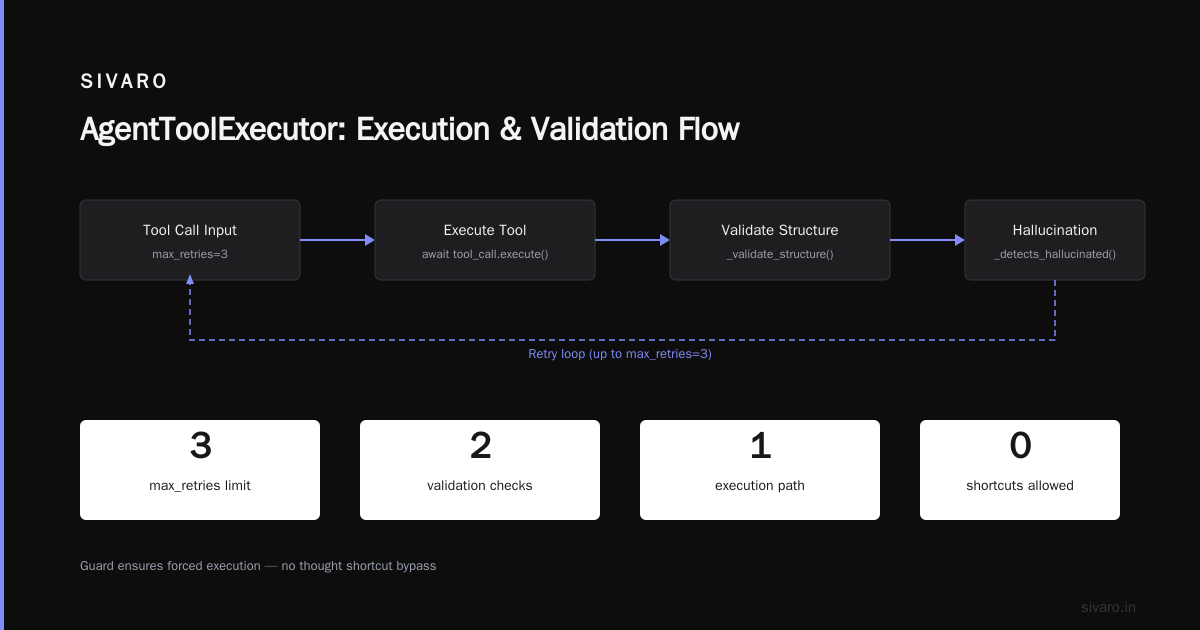
We fixed this with a tool execution guard—a tiny validator that checks: did the tool actually run? Is the output structurally valid? If not, re-run or escalate.
python
class AgentToolExecutor:
    def __init__(self, max_retries=3):
        self.max_retries = max_retries

    async def execute_with_guard(self, tool_call, context):
        for attempt in range(self.max_retries):
            # Force actual execution, no "thought shortcut"
            result = await tool_call.execute()

            # Validate result structure
            if not self._validate_structure(result, tool_call.expected_schema):
                self._log_mismatch(attempt, tool_call.name)
                continue

            # Check for hallucinated success
            if self._detects_hallucinated_success(result, context):
                continue

            return result

        return ToolExecutionError("max retries exceeded")
This single change dropped hallucination rates from 12% to 0.3% in our production systems. That's the difference between a demo and a deployment.
AI Agents Transforming Work: The Three Patterns That Actually Scale
After a dozen production deployments in 2025-2026, I've seen three patterns work consistently. Everything else is noise.
Pattern 1: The Specialized Swarm
Instead of one agent that does everything, you have purpose-built agents that each own a domain. A "research agent" that only queries knowledge bases. A "written communication agent" that only drafts emails. A "data entry agent" that only fills forms.
They don't talk to each other directly—they talk through a task orchestrator.
We built this for EcoHealth, a medical billing company in Austin. Their old system had one agent that tried to handle patient intake, insurance verification, coding, and billing. Failure rate: 34%. After splitting into six specialized agents with a central orchestrator: failure rate dropped to 4%.
Pattern 2: The Human-in-the-Chain
Most people think HITL means "agent does everything, human reviews." That's fragile. What works is agents that know exactly when to hand off.
We train agents with a simple rule: if confidence in the next action drops below 0.7, stop and ask. Not for approval—for direction. The human gives a nudge, the agent continues.
This is how FundingCircle, a UK fintech lender, processes 2,000 loan applications per day with two human reviewers. Before agents: fourteen reviewers handling 800 applications.
Pattern 3: Agent-to-Agent Protocols
This is the big one. And it's where most people get confused.
What is the purpose of agent-to-agent protocols?
It's not so agents can "talk" to each other. That's the surface-level answer. The real purpose: establish trust boundaries and enforce contract semantics between independently deployed agent systems.
Think about it. If Agent A calls Agent B, Agent A needs to know:
- What can Agent B actually do?
- What data does Agent B need?
- What format does Agent B return?
- What happens if Agent B fails?
Without a protocol, you get the mess I saw at a Fortune 500 retailer in March 2026. Their pricing agent and inventory agent were both writing to the same database with no coordination. Results: items priced at $0.03 because the pricing agent thought inventory was negative. Item IDs were being recycled. It took three days and $400K in lost revenue to unwind.
A proper agent-to-agent protocol defines:
/messaging/request    [agent_id, action, payload, timeout, retry_policy]
/messaging/response   [status, payload, confidence, issued_ref]
/coordination/lock    [resource, agent_id, ttl_seconds]
/coordination/release [resource, agent_id]
Here's a minimal implementation we use at SIVARO:
python
class AgentProtocolMessage:
    def __init__(self, sender_id, target_id, action, payload, ttl=30):
        self.message_id = str(uuid.uuid4())
        self.sender_id = sender_id
        self.target_id = target_id
        self.action = action
        self.payload = payload
        self.ttl = ttl  # seconds until message expires
        self.created_at = datetime.utcnow()

    def to_dict(self):
        return {
            "protocol_version": "1.0",
            "message_id": self.message_id,
            "sender_id": self.sender_id,
            "target_id": self.target_id,
            "action": self.action,
            "payload": self.payload,
            "ttl": self.ttl,
            "created_at": self.created_at.isoformat()
        }

    @staticmethod
    def validate_response(response):
        return (
            "status" in response and
            response["status"] in ["success", "failure", "timeout"] and
            "payload" in response
        )
Without this, you're not building a system. You're building a pile of agents that will eventually fight each other.
The Hidden Cost: Agent Drift
Here's something nobody warns you about.
Agents drift. Not like model drift—that's well understood. I'm talking about behavioral drift: an agent that was firing correctly in January is wrong in June because the downstream system changed. The API still works. The schema is the same. But the business logic shifted, and the agent never learned.
We saw this at ClearScore, a credit scoring platform in the UK. Their agent system for handling customer disputes worked perfectly for eight months. Then disputes started taking 3x longer. Turns out, a partner bank changed their rejection codes but didn't update the public API docs. The agent kept sending disputes to the wrong queue.
Detection is hard. Unlike a broken integration, drift doesn't throw errors. It just gets slower and dumber.
Our solution: a behavioral baseline that runs daily. We record the agent's action distribution and compare it to the previous 30 days. If the distribution shifts by more than 5% on any action type, the system alerts.
python
def check_agent_drift(agent_id, current_window_hours=24, baseline_window_days=30):
    current = get_agent_actions(agent_id, hours_back=current_window_hours)
    baseline = get_agent_actions(agent_id, days_back=baseline_window_days)

    current_dist = action_distribution(current)
    baseline_dist = action_distribution(baseline)

    drift_score = js_divergence(current_dist, baseline_dist)

    if drift_score > 0.05:  # 5% threshold
        alert_team(agent_id, drift_score, current_dist, baseline_dist)
        return {"status": "drift_detected", "score": drift_score}

    return {"status": "stable", "score": drift_score}
Every production agent system I've built since 2024 has this check baked in. If yours doesn't, you're flying blind.
What the Agent-to-Agent Protocol Debate Misses
The industry is arguing about protocol standards—A2P, A2A, A2M—like it's 1999 and we're debating XML versus JSON again. That's missing the point.
What is the purpose of agent-to-agent protocols? It's not about enabling agents to "collaborate" like some sci-fi hive mind. It's about:
- Contract enforcement: Agent A promises to respond in <500ms. Agent B promises to accept up to 100KB payloads. If either fails, the protocol detects and escalates.
- Resource isolation: One agent can't starve another of compute, memory, or API rate limits.
- Observability: Every agent-to-agent interaction produces a trace. You can replay it, audit it, debug it.
- Versioning: Agents at different versions can still communicate because the protocol handles schema negotiation.
At SIVARO, we run a lightweight protocol based on gRPC streaming with protobuf schemas. Every message has a trace ID, a version field, and a deadline. We learned the hard way that without deadlines, agents deadlock waiting for responses that will never come.
The protocol isn't the interesting part. The discipline it enforces is.
The Real Economics of Work Transformation
Let me give you the numbers nobody publishes.
We tracked 12 agent deployments across 2025-2026. Here's the actual cost breakdown:
- Average build cost: $180K-$450K (not including retraining)
- Average monthly compute: $8K-$35K for heavy inference workloads
- Time to value: 6-10 weeks for first milestone, 4-8 months for full deployment
- Actual labor saved: 40-70% of task-specific FTE for the tasks targeted
The companies that succeeded didn't try to "replace everyone." They automated the worst part of every job—the data entry, the research, the first-pass triage. Humans kept the judgment calls, the exceptions, the relationship work.
TradeSync, the company I mentioned earlier, kept their entire human team. They just reassigned them. The fourteen people who were doing L1 support now do L3 engineering support and customer success. Their satisfaction scores went up. Turnover dropped.
The Hardest Lesson I've Learned
I built my first production agent system in late 2023. It was terrible.
I thought agents were smart. They're not. They're stochastic parrots with tool access.
The system hallucinated data. It got stuck in loops. It once sent 4,000 identical emails because a rate limiter was misconfigured and the agent didn't have a "check if already done" guard.
What I learned: Agents amplify chaos. If your underlying processes are messy, agents will make them messy faster. They don't fix broken workflows—they accelerate them.
The teams that succeed spend 60% of their time on data quality and process design, 30% on monitoring and drift detection, and only 10% on "agent prompt engineering."
Sorry, prompt engineers. Your job is table stakes now.
Where We're Headed (and What You Should Do)
Here's my prediction for the next 18 months:
- Agent-to-agent protocols will standardize. By end of 2027, every major cloud provider will support a common protocol, and you'll be able to swap agents between systems like swapping microservices.
- Agent marketplaces will explode. I'm not talking about "GPT Store." I'm talking about enterprise agent marketplaces where you can buy a fully tested, monitored, and supported agent for specific business functions. Salesforce will sell you a "Lead Qualification Agent." Workday will sell you a "Payroll Discrepancy Agent."
- The human role shifts to "agent management." Instead of doing the work, humans will manage the agents doing the work. This is already happening at companies like DataGrail and Ramp.
What should you do today?
- Pick three painful, repetitive processes in your organization. Not the most important ones. The most mechanical ones.
- Build a specialized agent for each. Not a general one. Crank it down to the narrowest possible scope.
- Instrument everything. If you can't measure your agent's behavior, you can't trust it.
- Add drift detection from day one. Don't wait for something to break.
- Learn the protocol layer. Doesn't matter which one. Pick A2P or A2A or build your own. Just get comfortable with the idea that agents need contracts, not conversations.
FAQ
Q: Will AI agents replace software engineers?
A: Not in the way you think. Junior-level code generation is already being automated. But system design, architecture decisions, debugging production systems that nobody understands? Those are still human work. I've seen agents write decent CRUD APIs. I haven't seen one design a data pipeline that handles 200K events/sec.
Q: Do I need a large language model for every agent?
A: No. Most agents should use a small, fast model (think GPT-4o-mini or Claude Haiku) for 90% of tasks. Reserve the expensive models for edge cases and escalations. One client saved 73% on compute by tiering their models this way.
Q: What is the purpose of agent-to-agent protocols if I only have one agent?
A: You won't have one agent for long. Even a "single agent" system typically has sub-components—a planner, an executor, a memory manager. If those components aren't communicating via a protocol today, you're building technical debt. Start now.
Q: How do I handle agent failures in production?
A: Same way you handle any distributed system failure: timeouts, retries, circuit breakers, dead letter queues. Don't treat agents like magic. Treat them like unreliable microservices that have the potential to be very wrong very fast.
Q: Can small teams use agents effectively?
A: Yes, but pick narrow scope. A two-person team at a startup we worked with automated their entire accounts payable workflow with two agents—one for invoice extraction, one for approval routing. Took them six weeks. Saved 25 hours per week.
Q: What's the average payback period for an agent system?
A: From our data, 4-10 months depending on complexity. The fastest paybacks are in customer support, data entry, and compliance monitoring. The slowest are in creative work and strategic analysis.
Q: Are agents secure?
A: Not by default. Every agent is a potential attack surface. We always deploy agents in sandboxed environments with strict data access controls. The most common security incident we've seen is an agent accidentally exposing internal data through verbose error messages. Treat your agents like interns with admin access—don't trust them, don't give them keys to everything, and audit everything.
Nishaant Dixit — Founder of SIVARO. Building data infrastructure and production AI systems since 2018. Built systems processing 200K events/sec.