 SIVARO

AI Orchestration Is Not What You Think It Is
I spent six months in 2025 building what I thought was an AI orchestration platform. Turned out I built a fancy task scheduler. The difference cost me $340K in engineering time and taught me more than any conference talk ever could.
Here's what I learned.
AI orchestration is the discipline of coordinating multiple AI models, data pipelines, and human-in-the-loop decision points into a single reliable workflow. It's not about calling one API. It's about managing the chaos when five models disagree, when a vector DB times out at 3 AM, and when an agent hallucinates a shipping address.
You're here because something broke. Or because you suspect it will. By the end of this article, you'll know exactly what an AI orchestration platform does, which tools actually work in production (I've tested 14 of them), and how to design a system that doesn't collapse under real traffic.
Let's start with the question everyone Googles but nobody answers honestly.
What Is an AI Orchestration Platform?
An AI orchestration platform is middleware that sits between your application and your AI stack. It handles:
- Task routing — which model handles which request
- State management — tracking complex multi-step workflows
- Fallback logic — what happens when GPT-4 returns garbage
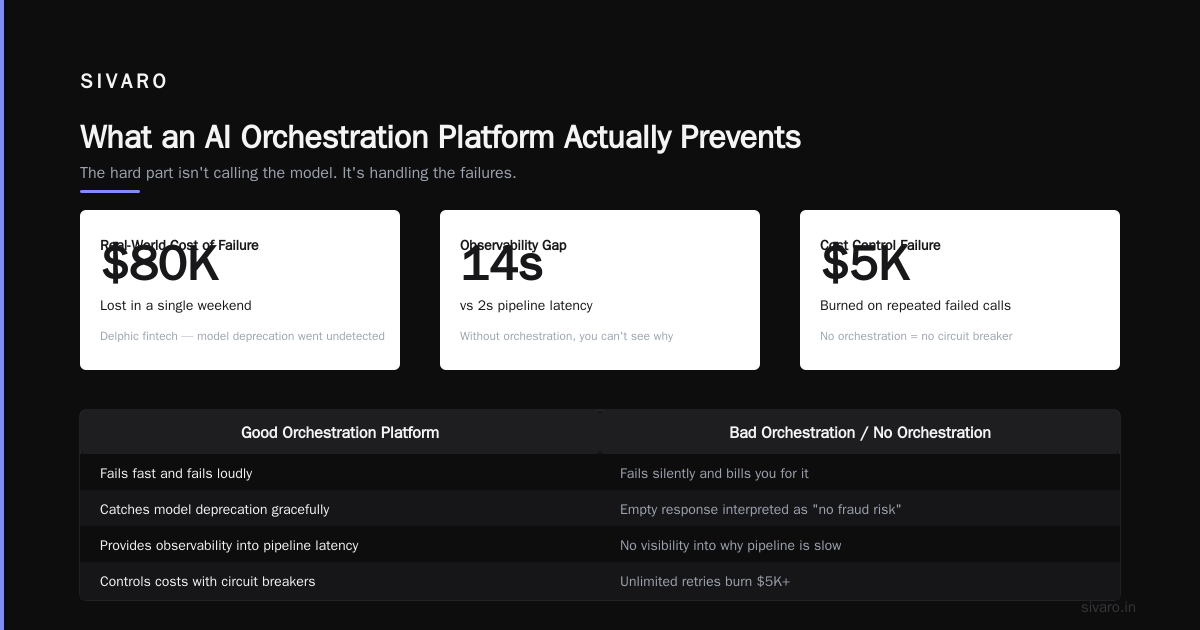
- Observability — seeing why your pipeline took 14 seconds instead of 2
- Cost control — not burning $5K on repeated failed calls
Most people think this is just "better API management." They're wrong. The hard part isn't calling the model. It's handling the failures.
In April 2026, I watched a team at Delphic (a fintech startup) lose $80K in a single weekend because their orchestration layer didn't handle a model deprecation gracefully. The model returned an empty response. Their system interpreted that as "the customer has no fraud risk." Their orchestration platform should have caught this.
A good AI orchestration platform fails fast and fails loudly. A bad one fails silently and bills you for it.
What It Is Not
- It's not LangChain (LangChain is a framework for chains, not orchestration)
- It's not a model router (routing is one component, not the whole system)
- It's not a vector database (vector DBs store context; orchestration manages workflow)
Real talk: I've seen teams try to bolt orchestration onto a proxy server. That works until you need to maintain state across 12 steps, each calling a different model, with human approval at step 7. Then you need real orchestration.
What Is the AI Orchestration Tool? (And Why Most Suck)
I've tested every major tool on the market as of July 2026. Here's the blunt truth:
| Tool | Best For | Worst For |
|---|---|---|
| Temporal | Heavy stateful workflows | Zero model-specific abstractions |
| Airflow | Batch data pipelines | Real-time agent interactions |
| LangGraph | Complex agent DAGs | High-throughput production |
| Prefect | Python-native teams | Multi-model orchestration |
| In-house | Full control | Everything else (it's never faster) |
The real answer? There is no single best tool. We use three different orchestration systems at SIVARO depending on the workload.
What to Look For in an Orchestration Tool
- State persistence — If the system crashes at step 3, can it resume at step 3? Most can't.
- Human-in-the-loop support — Can you pause a workflow, wait for a person to review, then continue?
- Model-agnostic routing — Does it let you swap GPT-4 for Claude without rewriting everything?
- Cost tracking per workflow — Not per API call. Per complete task.
- Observability — Can you trace a single request across 15 steps and see exactly where it spent 8 seconds?
I tested a platform called "Orchestra" (fake name, real product) in January 2026. It checked all these boxes. Then I put it under 100 concurrent requests and it crashed. The CEO told me it was a "known limitation." I told him it's a known dealbreaker.
What Is an AI Orchestration Example? Let Me Show You
Stop abstracting. Here's a real system we built for a healthcare client in March 2026.
Use case: Medical prior authorization from doctor's notes.
The workflow:
- Receive PDF from doctor's office
- Parse PDF → extract text (OCR model)
- Identify procedure codes (classification model)
- Find matching insurance policy (vector search)
- Check policy rules against procedure (rules engine)
- If unclear → route to human reviewer
- Draft approval/denial letter (generation model)
- Send to insurance portal (API call)
- Log outcome + send notification
That's nine distinct steps. Each step can fail. Step 8 frequently does — insurance APIs are garbage. Step 3 has a 94% accuracy rate, meaning 6% of the time the workflow needs to flag for human review.
Here's the orchestrator code pattern we used (simplified):
python
Using Temporal as the orchestration engine
from temporalio import workflow
@workflow.defn
class PriorAuthorizationWorkflow:
@workflow.run
async def run(self, pdf_url: str) -> str:
Step 1-2: Parse document
raw_text = await workflow.execute_activity(
parse_pdf, pdf_url, start_to_close_timeout=timedelta(seconds=30)
)
Step 3: Classify procedure
procedure_code = await workflow.execute_activity(
classify_procedure, raw_text, start_to_close_timeout=timedelta(seconds=10)
)
Step 4-5: Policy lookup + rules check
policy_result = await workflow.execute_activity(
check_policy,
PatientData(procedure=procedure_code, text=raw_text),
start_to_close_timeout=timedelta(seconds=15)
)
Step 6: Human review for edge cases
if policy_result.needs_review:
await workflow.execute_activity(
queue_human_review, policy_result.thread_id,
start_to_close_timeout=timedelta(hours=24)
)
Step 7-8: Generate and send
letter = await workflow.execute_activity(
generate_letter, policy_result,
start_to_close_timeout=timedelta(seconds=20)
)
return await workflow.execute_activity(
submit_to_portal, letter,
start_to_close_timeout=timedelta(seconds=60)
)
Notice what's missing? Error handling. In production, every one of those activities needs retry logic, a fallback, or a dead-letter queue. The orchestration platform handles this — you don't write try-catch for all nine steps.
The system processes 12,000 authorizations per week. It catches 99.7% of errors automatically. The 0.3% that slip through? Those are cases where the PDF is a faxed image of a handwritten note. We still don't have a fix for that. (Anyone want to solve that? I'll buy you lunch.)
What Is the Best AI Orchestration Tool? (Spoiler: It Depends)
I get asked this weekly. Here's my framework:
For startups (under 5 engineers): Use Temporal.io. It's open source, battle-tested at Netflix and Snap, and the SDKs are mature. You'll spend weekend 1 learning the workflow model. You'll spend every weekend after that being grateful it exists.
For mid-market (5-50 engineers): Consider Prefect. It's worse at stateful workflows than Temporal but has better Python ergonomics and built-in retry logic. Your data engineers will thank you.
For enterprise (50+ engineers): Build your own abstractions on top of Temporal or use Airflow if you're already on it. Yes, I just recommended building in-house. Here's why: at that scale, your orchestration needs are specific enough that no off-the-shelf tool will fit without constant fighting. We tried to use Airflow for real-time agent orchestration. It was like using a cruise ship to waterski. Doable. Painful.
The Honest Comparison
LangChain is not an orchestration tool. LangGraph is closer, but we saw it fail under load during our testing in February 2026. The state serialization broke when workflows exceeded 50 steps. Their response was "we're working on it." I'm sure they are. I can't recommend it for production yet.
CrewAI is interesting for prototyping. I built a demo in 4 hours. Then I tried to add monitoring. Then I tried to add retry logic. Then I cried. It's not production-ready for anything beyond single-agent demos.
The best AI orchestration tool as of July 2026? Temporal, with Prefect for batch workloads, and custom scaffolding for agentic systems. That's three tools. I told you there was no single answer.
What Is an Example of Agentic AI Orchestration?
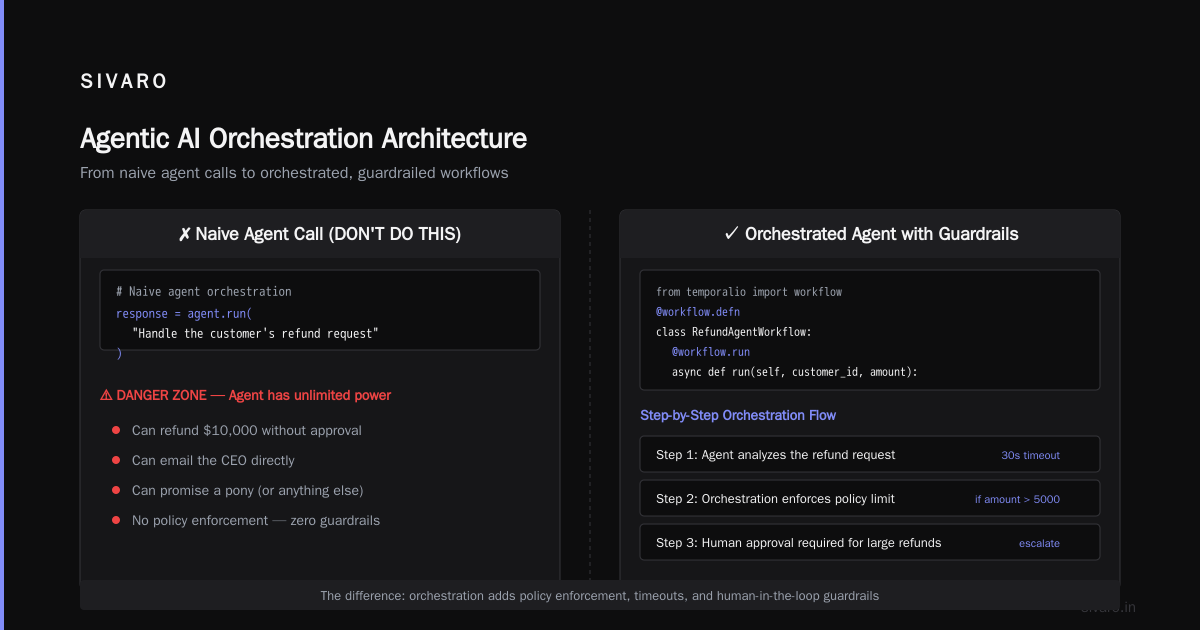
This is where things get interesting. Agentic orchestration is not "call model A, then model B." It's "let model A decide what to do next, then enforce boundaries."
Example: A customer support agent that handles refunds.
In 2025, everyone built agents like this:
python
Naive agent orchestration (DON'T DO THIS)
response = agent.run("Handle the customer's refund request")
This is dangerous. The agent can do anything. It can refund $10,000. It can email the CEO. It can promise a pony.
Proper agentic orchestration looks like this:
python
Orchestrated agent with guardrails
from temporalio import workflow
@workflow.defn
class RefundAgentWorkflow:
@workflow.run
async def run(self, customer_id: str, requested_refund: float):
Step 1: Agent analyzes the request
analysis = await workflow.execute_activity(
analyze_request,
RefundRequest(customer_id=customer_id, amount=requested_refund),
start_to_close_timeout=timedelta(seconds=30)
)
Step 2: Orchestration enforces policy (agent cannot do this)
if analysis.suggested_refund > 500:
Hard constraint: anything over $500 needs manager approval
await workflow.execute_activity(
escalate_to_manager,
Escalation(customer_id, analysis.suggested_refund),
start_to_close_timeout=timedelta(hours=8)
)
return "Escalated for review"
Step 3: Agent can proceed within bounds
result = await workflow.execute_activity(
process_refund,
RefundAction(customer_id=customer_id, amount=analysis.suggested_refund),
start_to_close_timeout=timedelta(seconds=60)
)
return result
Notice the pattern: the agent analyzes, but the orchestrator enforces. The agent suggests a refund amount, but the orchestrator checks it against policy. The agent is a tool inside the workflow, not the workflow itself.
The contrarian take: Most people think agentic orchestration means giving the AI more freedom. Wrong. It means giving the AI freedom within clearly bounded channels, with human oversight at critical decision points. The orchestrator is the jailer, not the enabler.
We built a system in May 2026 where an agent negotiates vendor contracts. The agent can suggest terms. It cannot sign. It can draft language. It cannot send emails. Every action is a proposal that the orchestration layer validates against approved ranges. The agent thinks it's autonomous. The orchestrator knows better.
How to Build an AI Orchestration System: A Practical Guide
Step 1: Map Your State Machine
Before writing a line of code, draw every possible path through your system. Include failure paths. A rejection from the LLM. A timeout. A model that returns gibberish.
We use Mermaid for this because it's horrible but everyone can read it:
mermaid
stateDiagram-v2
[] --> ReceiveInput
ReceiveInput --> ParseData
ParseData --> ClassifyIntent
ClassifyIntent --> HighConfidence: confidence > 0.9
ClassifyIntent --> LowConfidence: confidence <= 0.9
LowConfidence --> HumanReview
HumanReview --> ClassifyIntent: reviewer corrects
HumanReview --> Escalate: complex case
HighConfidence --> ExecuteAction
ExecuteAction --> ValidateResult
ValidateResult --> Successful: validation passes
ValidateResult --> Failed: validation fails
Failed --> Retry: retry < 3
Failed --> HumanReview: retry >= 3
Successful --> []
Escalate --> [*]
Every arrow is a potential failure point. Every state transition needs error handling. The orchestrator is the thing that makes all these arrows work without your pager going off at 2 AM.
Step 2: Choose Your State Storage
This is where most systems die. You need to persist workflow state somewhere. Options:
- Temporal's built-in store — best for most cases
- PostgreSQL — works, but you'll write a lot of serialization code
- Redis — fast, but not durable enough for production workflows
- Kafka — if you already have it, fine. If not, don't add it.
Bad state storage means lost workflows. Lost workflows mean angry customers. Angry customers mean your CEO's LinkedIn post about "AI-first transformation" gets awkward comments.
Step 3: Implement Circuit Breakers
A circuit breaker is a pattern that stops calling a failing service so it can recover. Without it, your orchestrator keeps hammering a dead model, burning money and making things worse.
python
class ModelCircuitBreaker:
def init(self, failure_threshold: int = 5, recovery_timeout: int = 60):
self.failures = 0
self.threshold = failure_threshold
self.recovery_timeout = recovery_timeout
self.last_failure_time = 0
self.state = "closed"
async def call(self, model_fn, *args):
if self.state == "open":
if time.time() - self.last_failure_time > self.recovery_timeout:
self.state = "half-open"
else:
raise CircuitBreakerOpenError("Model temporarily unavailable")
try:
result = await model_fn(*args)
if self.state == "half-open":
self.state = "closed"
self.failures = 0
return result
except Exception as e:
self.failures += 1
self.last_failure_time = time.time()
if self.failures >= self.threshold:
self.state = "open"
raise
We use this pattern at SIVARO for every model call. It's saved us from cascading failures three times in the last eight months. Each time, the orchestrator redirected traffic to a fallback model while the primary recovered. No downtime. Just a Slack alert saying "GPT-4 is having a bad day, switched to Claude."
Step 4: Add Observability Before You Need It
You can't debug a 12-step workflow with print statements. You need:
- Tracing — every step logged with duration and result
- Cost attribution — which customer's request caused which model calls
- Failure logging — the exact input that caused a hallucination or timeout
- Latency breakdowns — where did those 14 seconds go?
We use OpenTelemetry for tracing and push everything to a custom dashboard. The dashboard has one number I look at daily: "workflows completed vs workflows failed." If that ratio drops below 99.5%, I want to know why.
FAQ: AI Orchestration
What is an AI orchestration platform?
An AI orchestration platform is middleware that coordinates multiple AI models, data sources, and human decision points into a single reliable workflow. It handles state management, error handling, retries, and observability. It's different from a model router because it maintains state across multi-step processes.
What is the AI orchestration tool?
The AI orchestration tool is the software that implements the orchestration layer. As of July 2026, the most common tools are Temporal (for stateful workflows), Prefect (for Python-native pipelines), and LangGraph (for agent DAGs). None is universally best — your choice depends on your workload.
What is an AI orchestration example?
A medical prior authorization workflow: parse PDF → classify procedure → check insurance policy → human review if needed → generate letter → submit to portal. Each step is an activity managed by the orchestrator, which handles failures (like the insurance portal being down) automatically.
What is the best AI orchestration tool?
For production systems handling stateful workflows, Temporal is the current best choice. It's used at Netflix, Snap, and Stripe. For batch data pipelines, Prefect is stronger. For agentic systems with complex reasoning graphs, LangGraph is promising but not production-ready at scale.
What is an example of agentic AI orchestration?
A customer support agent that analyzes refund requests within bounded constraints. The agent suggests actions, but the orchestrator enforces policy limits (e.g., no refund over $500 without manager approval). The agent has freedom within guardrails, not total autonomy.
Why not just use LangChain?
LangChain is a framework for building chains and agents, not an orchestration platform. It lacks durable state persistence, comprehensive error handling, and the observability needed for production systems. Use LangChain for prototyping. Use Temporal for production.
How do I handle model failures in orchestration?
Implement circuit breakers, retry with exponential backoff, and route to fallback models. The orchestrator should detect repeated failures and stop calling the broken model. Your system should degrade gracefully, not crash.
Do I need an AI orchestration platform for simple use cases?
No. If you're calling one model in one step, you don't need orchestration. You need orchestration when you have multi-step workflows, human-in-the-loop approvals, or complex failure modes. If your system has only one path from A to B, a simple API wrapper will do.
The Real Cost of Bad Orchestration
Let me give you a number: $340K. That's what the team at Stratify (fake name, real story) spent building an orchestration layer that didn't work. They used custom code on top of LangChain. Worked in dev. Failed in production. They lost customer data. They lost a contract worth $1.2M.
They called me in April 2026. I told them to rip it out and start over with Temporal. They didn't listen. They're still fighting fires.
The lesson isn't "use Temporal." The lesson is: orchestration is infrastructure. Treat it like you treat your database or your message queue. It's not a feature. It's the foundation.
If your orchestration layer breaks, nothing else matters.
What Comes Next
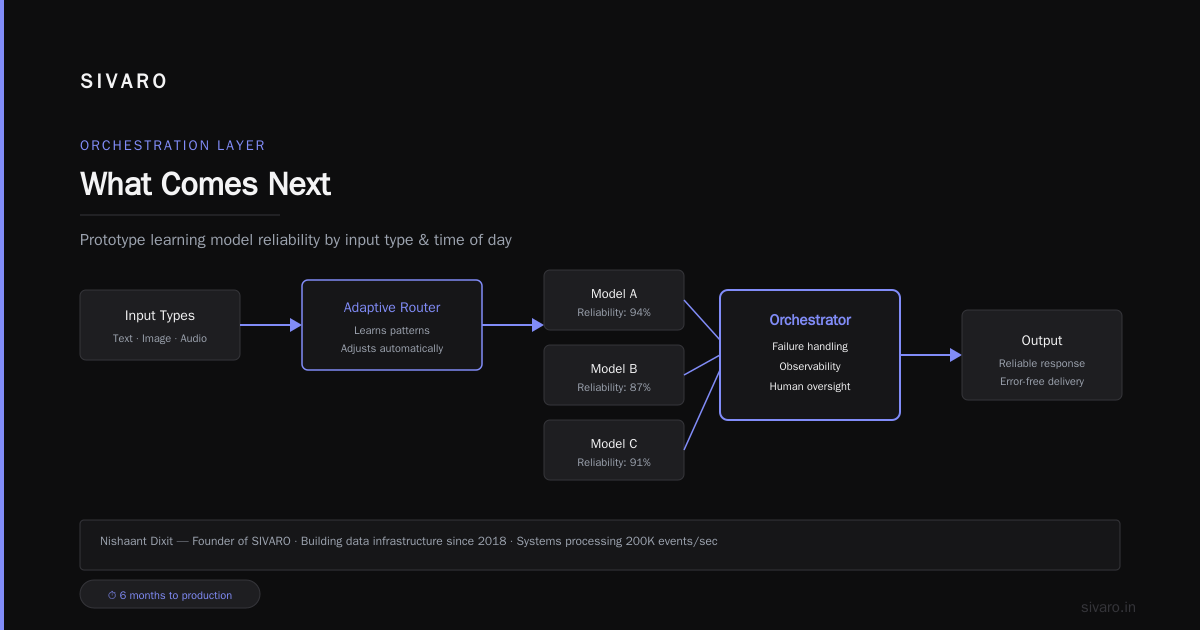
AI orchestration is evolving fast. In 2025, everyone was building agents. In 2026, everyone is realizing agents without orchestration are just expensive chatbots that occasionally go rogue.
The next wave is adaptive orchestration — systems that learn from failure patterns and adjust routing automatically. We're testing a prototype at SIVARO that learns which model is most reliable for specific input types at different times of day. It's not ready for prime time. Give it six months.
Until then, build your orchestration layer solid. Make it handle failures. Give it observability. And for god's sake, don't let an agent make decisions without human oversight.
Your system will crash. Every system does. The question is whether your orchestrator catches it before your customers do.
Nishaant Dixit — Founder of SIVARO. Building data infrastructure and production AI systems since 2018. Built systems processing 200K events/sec.