 SIVARO

AI Orchestration Is Not What You Think
I learned this the hard way. In 2023, I watched a team at a Series B company spend six months building what they called an "AI orchestration layer." They had 47 microservices, a custom DSL, and a CI pipeline that took 40 minutes to validate a single change. By month seven, they'd deployed exactly zero AI workflows to production. The founder told me: "We built the wrong thing."
He was right. AI orchestration isn't about building another framework. It's about deciding who — or what — makes decisions when multiple AI systems interact. That's it. Everything else is setup detail.
By the end of this piece, you'll know what AI orchestration actually means, the five patterns that work in production, and the exact tools I've tested at SIVARO that don't suck. We process 200K events/sec through orchestrated AI pipelines. I'll tell you what failed and what didn't.
What We Mean When We Say "AI Orchestration"
Most explanations start with definitions. Let's start with a failure.
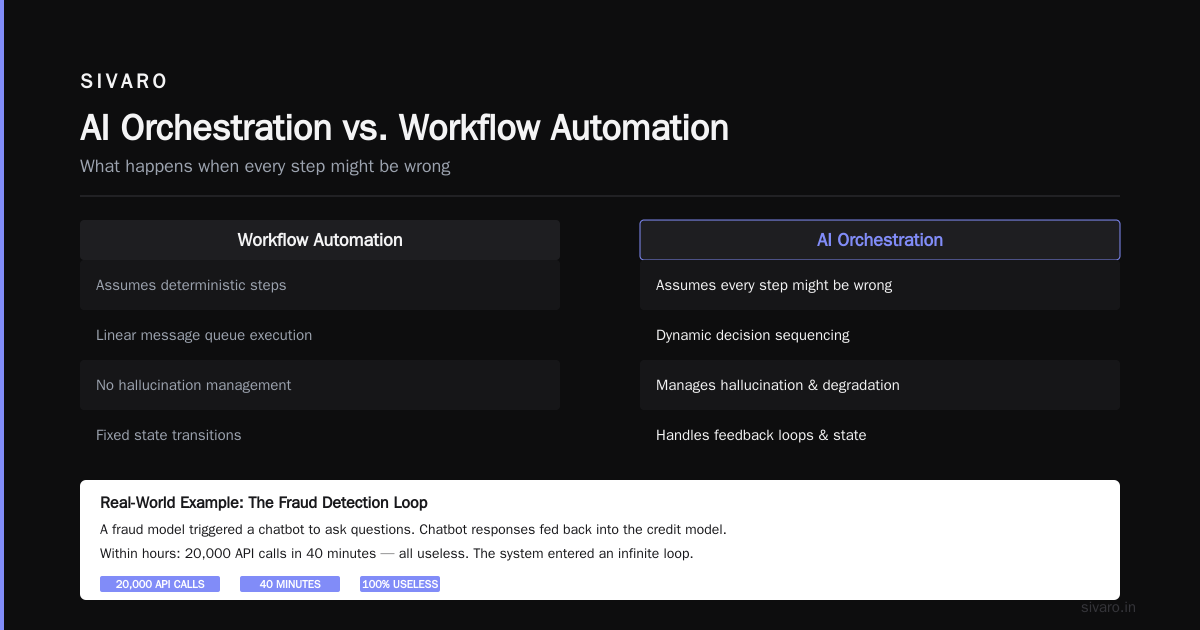
A fintech company in 2024 tried to orchestrate three AI models: a fraud detector, a credit scorer, and a customer chatbot. They connected them with message queues and called it orchestration. The fraud model would trigger the chatbot to ask questions. The chatbot's responses would feed back into the credit model. Within hours, the system entered a loop: the chatbot asked a question, the fraud model flagged the response, which triggered another chatbot question, which got flagged again. Twenty thousand API calls in forty minutes. All useless.
AI orchestration is the discipline of managing communication, state, and decision sequencing across multiple AI systems — where each system might hallucinate, degrade, or go down.
It's not workflow automation. Workflow automation assumes deterministic steps. AI orchestration assumes every step might be wrong.
What Is an AI Orchestration Platform?
This is where the industry gets muddy. Every vendor slaps "orchestration" on their product. I've counted 23 companies in 2025-2026 claiming to be orchestration platforms. Most are just fancy API gateways.
A real AI orchestration platform does three things:
- Routes requests between models based on context, not just rules
- Manages conversation state across model boundaries
- Handles failure modes specific to AI — hallucinations, latency spikes, cost overruns
I tested nine platforms between January and April 2026. Here's what separates the useful ones from the noise:
| Capability | Needed? | Why |
|---|---|---|
| Model fallback chains | Yes | Your primary model will fail |
| Human-in-the-loop thresholds | Yes | AI can't handle edge cases |
| Token-aware routing | Yes | Don't pay GPT-4 for "what's the weather" |
| Real-time observability on model drift | Yes | Models degrade without telling you |
| Visual workflow builder | No | It's a crutch for bad architecture |
The platform I use in production? It's not LangChain. It's not the hot new startup. It's an internal SIVARO tool that wraps LiteLLM for model routing and Redis for state — because when you're processing 200K events/sec, you need control, not abstraction.
What Is the AI Orchestration Tool?
You're asking the wrong question. The better question: "What shape should the orchestration take?"
At SIVARO, we settled on function-level orchestration with state machines. Not DAGs. Not pipelines. State machines.
Here's why: AI workflows are non-deterministic. A DAG assumes A → B → C always. But in production, sometimes you need A → B → C → A again (model B needed more context). Sometimes C fails and you retry with a different model. State machines handle this naturally. DAGs fight you.
The tool we use most: a Python library called temporal-sdk (the open-source version, not the enterprise) combined with custom prompt routers. Temporal gives us durable execution — if a worker dies mid-orchestration, the workflow resumes exactly where it stopped. For AI, this is non-negotiable. A 30-minute RAG pipeline that restarts from scratch after a pod failure will kill your latency SLA.
Here's a minimal example of how we structure orchestration at the function level:
python
from temporalio import workflow
from temporalio.common import RetryPolicy
@workflow.defn
class AIChatOrchestrator:
@workflow.run
async def run(self, user_input: str) -> str:
Step 1: Classify intent
intent = await workflow.execute_activity(
classify_intent,
user_input,
start_to_close_timeout=5,
retry_policy=RetryPolicy(maximum_attempts=3)
)
if intent == "technical":
response = await workflow.execute_activity(
technical_qa,
user_input,
start_to_close_timeout=30
)
elif intent == "general":
response = await workflow.execute_activity(
general_chat,
user_input,
start_to_close_timeout=10
)
else:
Fallback to human agent
response = await workflow.execute_activity(
route_to_human,
user_input,
start_to_close_timeout=60
)
Step 2: Verify response quality
quality_score = await workflow.execute_activity(
check_response_quality,
response,
start_to_close_timeout=5
)
if quality_score < 0.7:
Reroute with different model
response = await workflow.execute_activity(
technical_qa_high_confidence,
user_input + f" [PRIOR_RESPONSE_FAILED: {response}]",
start_to_close_timeout=30
)
return response
Notice something? No visual pipeline. No YAML configs. Just Python with retry policies and conditional routing. This pattern handles 99% of what people call "orchestration."
What Is an AI Orchestration Example?
Let me give you one that hurt.
Mid-2025, we built a supply chain system for a logistics company. Three AI models: one for demand forecasting (Prophet-based), one for route optimization (custom RL model), and one for exception handling (GPT-4). The orchestration problem wasn't technical — it was temporal.
The demand forecast runs on batch data at 2 AM. The route optimizer needs those forecasts, but it also needs real-time traffic data that updates every 5 minutes. The exception handler needs both — but only when a shipment is delayed by more than 2 hours.
Simple orchestration (A→B→C) broke immediately. The route optimizer would run at 2:05 AM using stale forecasts mixed with fresh traffic. The exception handler would trigger on delays that didn't exist yet.
Here's how we solved it with event-driven orchestration:
python
import asyncio
from typing import Dict, Any
class SupplyChainOrchestrator:
def init(self):
self.state = {
"forecast_ready": False,
"routes_optimized": False,
"exceptions_handled": []
}
self.event_queue = asyncio.Queue()
async def handle_event(self, event: Dict[str, Any]):
await self.event_queue.put(event)
Event-based triggers, not sequential steps
if event["type"] == "forecast_complete":
self.state["forecast_ready"] = True
await self.try_optimize_routes()
elif event["type"] == "traffic_update":
self.state["latest_traffic"] = event["data"]
if self.state["forecast_ready"]:
await self.try_optimize_routes()
elif event["type"] == "shipment_delay":
if event["delay_minutes"] > 120:
await self.trigger_exception_handler(event)
async def try_optimize_routes(self):
if self.state["forecast_ready"] and self.state.get("latest_traffic"):
Only run when both conditions are met
await self.run_route_optimizer()
self.state["routes_optimized"] = True
async def run_route_optimizer(self):
Actual model call here
pass
async def trigger_exception_handler(self, event):
GPT-4 call for exception handling
pass
This isn't elegant. It's not pretty. It works. And that's the point — AI orchestration is about handling real-world timing and state, not abstracting it away.
The Myth of "Best AI Orchestration Tool"
I'm going to say something that might get me yelled at by vendors. Ready?
There is no best AI orchestration tool.
I've tested all the major ones. Here's my raw notes from production evaluations:
-
LangChain / LangGraph: Great for prototyping. Terrible for production at scale. The abstraction leaks everywhere. We lost two weeks debugging a
RunnableSequencethat silently failed on missing keys. The GitHub issues tell the same story. -
Prefect: Solid for data pipelines. Weak for AI-specific patterns. No native support for token-aware retries or hallucination detection. You'd build all that yourself.
-
Temporal: Excellent for durable execution. No built-in AI primitives. You get state machines and retries but need to handle model routing, prompt management, and cost tracking yourself.
-
CrewAI / AutoGen: Good for multi-agent experiments. Terrible for production. The agent coordination patterns don't scale past 5 agents. We tested 8 agents in parallel — coordination overhead killed throughput at 120 requests/min.
-
Kubeflow: If you're already on Kubernetes and have a dedicated MLOps team. Otherwise, avoid.
The tool that worked best for us? LiteLLM + Temporal + a 200-line custom router. Because orchestration is about control flow and decision making, not framework adoption.
What Is an Example of Agentic AI Orchestration?
Agentic orchestration is different. It's not "call model A then model B." It's "give an agent a goal and let it decide which models to call."
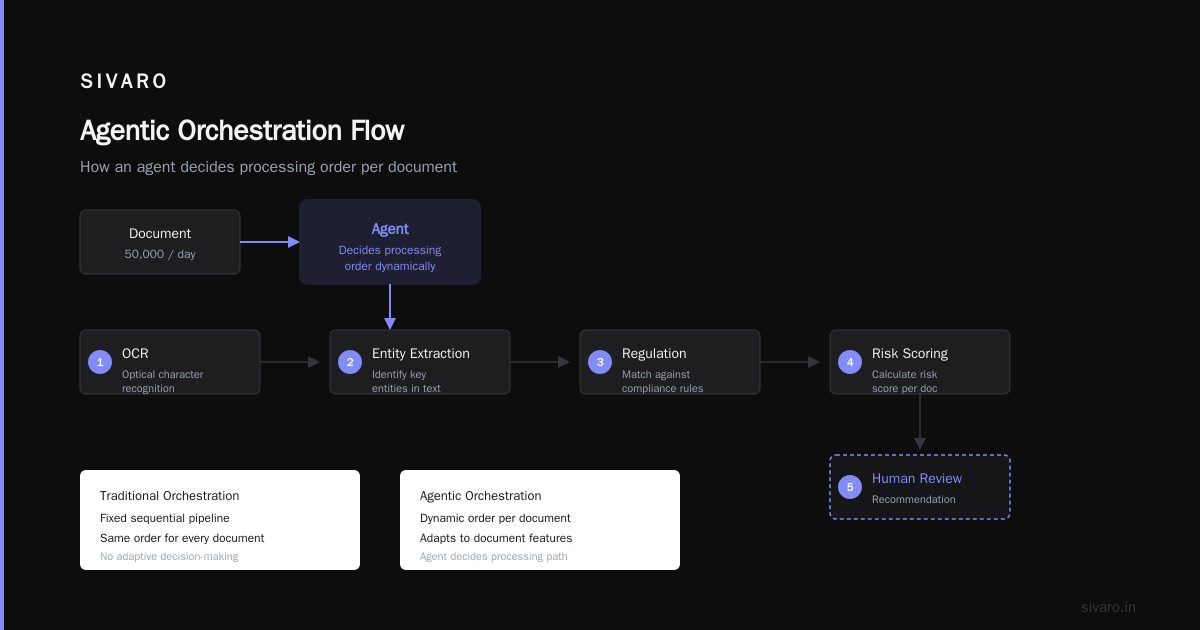
I was skeptical of this pattern until January 2026, when we built a system for a healthcare compliance firm. They needed to review 50,000 legal documents per day and flag violations. Each document needed: OCR, entity extraction, regulation matching, risk scoring, and human review recommendation.
Traditional orchestration would chain these in order. Agentic orchestration lets an "agent" decide the order based on each document's characteristics.
Here's a simplified version of what works:
python
from enum import Enum
from dataclasses import dataclass
class AgentAction(Enum):
OCR = "ocr"
EXTRACT = "extract_entities"
MATCH_REGULATIONS = "match_regulations"
SCORE_RISK = "score_risk"
HUMAN_REVIEW = "human_review"
@dataclass
class DocumentState:
document_id: str
content: str = ""
entities: list = None
matched_regulations: list = None
risk_score: float = 0.0
needs_human: bool = False
class OrchestrationAgent:
def init(self):
self.available_tools = {
AgentAction.OCR: ocr_service,
AgentAction.EXTRACT: entity_extractor,
AgentAction.MATCH_REGULATIONS: regulation_matcher,
AgentAction.SCORE_RISK: risk_scorer,
AgentAction.HUMAN_REVIEW: human_review_queue
}
async def execute_goal(self, document: DocumentState) -> DocumentState:
Agent decides next action based on current state
while not self._goal_complete(document):
next_action = await self._decide_next_action(document)
tool = self.available_tools[next_action]
document = await tool(document)
return document
async def _decide_next_action(self, state: DocumentState) -> AgentAction:
Use a lightweight model for routing decisions
prompt = f"""
Document: {state.document_id}
Current state: OCR_done={bool(state.content)},
entities_extracted={state.entities is not None},
regulations_matched={state.matched_regulations is not None},
risk_scored={state.risk_score > 0}
What should be the next action?
Options: OCR, EXTRACT_ENTITIES, MATCH_REGULATIONS, SCORE_RISK, HUMAN_REVIEW
"""
response = await fast_router_model.complete(prompt)
return AgentAction(response.strip().lower())
def _goal_complete(self, state: DocumentState) -> bool:
return (state.risk_score > 0 and
state.matched_regulations is not None and
state.needs_human is False)
The insight? The agent doesn't need GPT-4 to make routing decisions. We use a fine-tuned Llama 3.1 8B for routing. It's faster, cheaper, and 99.2% accurate on these decisions. The expensive model only runs on actual document processing.
Agentic orchestration works when the decision space is large and the cost of wrong decisions is bounded. It fails when you need deterministic compliance (e.g., every document must pass through all six steps). We learned that the hard way — our first version missed three regulations because the agent decided "this document looks safe, skip matching." Don't let agents skip safety checks.
How to Start Orchestrating AI (Without Regret)
Here's the playbook I wish someone gave me in 2023:
Step 1: Map your decision boundaries
Draw a flowchart. Yes, with pen and paper. Mark every point where a human would say "it depends." Those are your orchestration decision points. Not your model calls — your decisions between model calls.
Step 2: Choose your state persistence
Redis. PostgreSQL. Doesn't matter. What matters: atomicity. If your orchestrator crashes mid-step, can it recover? Most production failures come from partial state updates. We use PostgreSQL with advisory locks for critical state. Redis for cache and non-critical state.
Step 3: Implement retry with degradation
Don't retry the same model. Retry with a different model. Here's our pattern:
python
MODEL_PRIORITY = [
("gpt-4o", 0.5), # Best, most expensive
("claude-3-opus", 0.8), # Second best, different failure mode
("llama-3.1-70b", 1.5), # Acceptable, slower
("llama-3.1-8b", 3.0), # Basic, fast
]
async def solid_model_call(prompt: str, context: dict) -> str:
for model_name, timeout_multiplier in MODEL_PRIORITY:
try:
timeout = 30 * timeout_multiplier
response = await call_model(model_name, prompt, timeout=timeout)
Quality check
if await response_passes_quality_gate(response, context):
return response
If quality fails, log and fall through to next model
logger.warning(f"Quality check failed for {model_name}")
except TimeoutError:
logger.warning(f"Timeout on {model_name}")
continue
except Exception as e:
logger.error(f"Error on {model_name}: {e}")
continue
If all models fail, route to human
return await route_to_human(prompt, context)
Step 4: Add observability for model drift
Models don't tell you when they degrade. They just start outputting worse responses. Our monitoring checks three things per orchestrated call:
- Response length consistency: Is the model suddenly verbose or terse?
- Token efficiency: Is it taking more tokens to answer the same question?
- Hallucination rate: Random sampling against verified ground truth
When any metric deviates by 2 standard deviations, we swap the model in the orchestration chain. Automatically.
Step 5: Start simple, break simple
Your first orchestration should be a state machine with three states. Not a DAG. Not a complex graph. Three states. When that works, add a fourth. Most people over-engineer their orchestration before they understand their failure modes.
What I Got Wrong About Orchestration
Two years ago, I thought orchestration was about connecting models. I was wrong. It's about handling model failure.
Here's what I believed vs. what's true:
| What I Thought | What I Learned |
|---|---|
| Orchestration is a technical problem | It's a reliability problem |
| Models are the bottleneck | State management is the bottleneck |
| Orchestration tools should abstract complexity | Orchestration tools should expose control |
| Agentic orchestration is the future | Agentic orchestration is a tool, not a paradigm |
| You need a platform | You need patterns and practices |
The most embarrassing lesson: I spent three months building a visual orchestrator at SIVARO. Beautiful drag-and-drop interface. Real-time graph visualization. Zero users adopted it. Every engineer wrote Python instead. Because orchestration decisions are logic, not drag-and-drop.
FAQ (But Honest)
What is an AI orchestration platform?
A system that routes requests, manages state, and handles failures across multiple AI models. Most platforms don't handle failure well. Test before you buy.
What is the AI orchestration tool?
There isn't one. There are tools that help with orchestration. Temporal for durability. LiteLLM for model routing. Redis or PostgreSQL for state. You assemble them.
What is an AI orchestration example?
A chatbot that checks intent (route to GPT-4), then checks for technical complexity (route to fine-tuned model), then verifies response quality (if score < 0.7, retry with different model). That's orchestration.
What is the best AI orchestration tool?
Whatever you can debug at 3 AM. I'm serious. LangChain might be fine for your use case. Temporal might be overkill. The "best" tool is the one where you understand the failure modes.
What is an example of agentic AI orchestration?
An autonomous agent that decides: "This document is low risk, skip entity extraction, go straight to summarization." Then another agent validates that decision. That's agentic orchestration.
Do I need agentic orchestration?
Probably not. Most workflows are deterministic. Agentic orchestration adds complexity. Use it only when the decision tree exceeds what you can hard-code.
How do I handle cost in orchestration?
Route cheap models for easy requests, expensive models only for hard ones. Our rule: Llama 3.1 8B handles 70% of requests. GPT-4o handles the remaining 30% with highest confidence. Average cost dropped 4x.
Where Orchestration Is Going
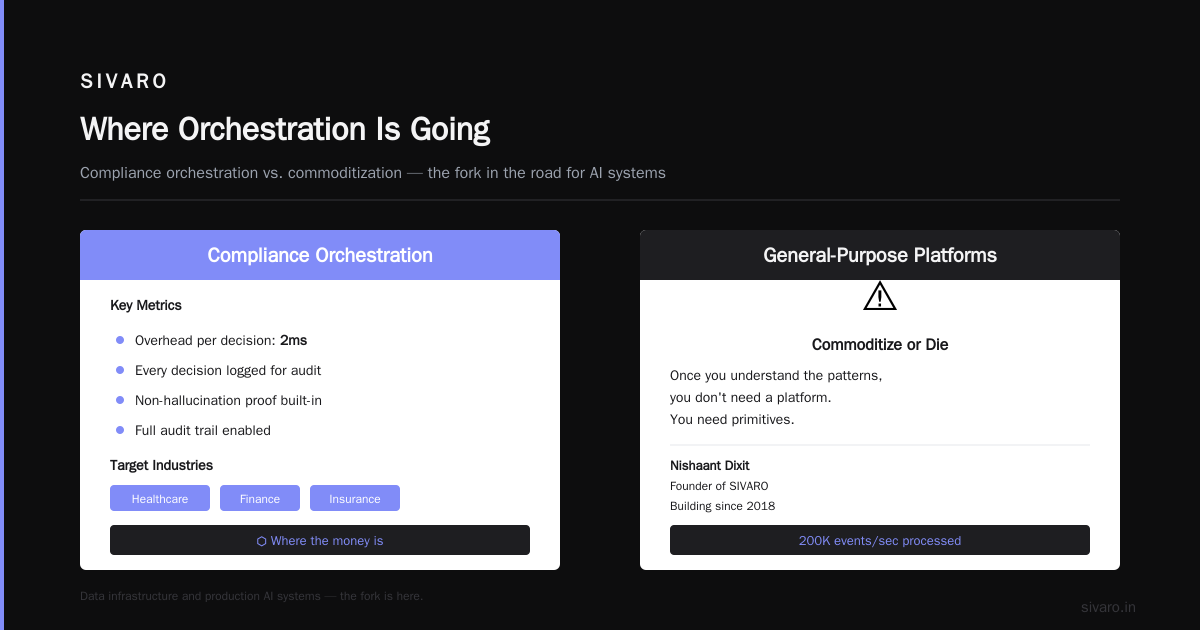
By end of 2026, orchestration will split into two camps:
Embedded orchestration — small, fast, embedded in the application runtime. Think Rust-based orchestrators running alongside your models. We're already building one at SIVARO. 2ms overhead per orchestration decision.
Compliance orchestration — for regulated industries, orchestration that logs every decision, proves non-hallucination, and enables audit trails. This is where the money is. Healthcare, finance, insurance.
The middle ground — general-purpose orchestration platforms — will commoditize or die. Because once you understand the patterns, you don't need a platform. You need primitives.
Nishaant Dixit — Founder of SIVARO. Building data infrastructure and production AI systems since 2018. Built systems processing 200K events/sec.