
AI Orchestration Is Your New Infrastructure Layer — And You Probably Already Need It
I spent the first half of 2025 watching a team of eight engineers build three different versions of the same AI pipeline. Same inputs. Same LLM. Different glue code. Each team wired retry logic, caching, observability, and fallback chains from scratch. When I asked why, the answer was always the same: “We didn’t know what else to do.”
That’s the problem AI orchestration solves. If you’re running anything beyond a single prompt-to-response flow, you’re losing time and money without it.
So What Is AI Orchestration?
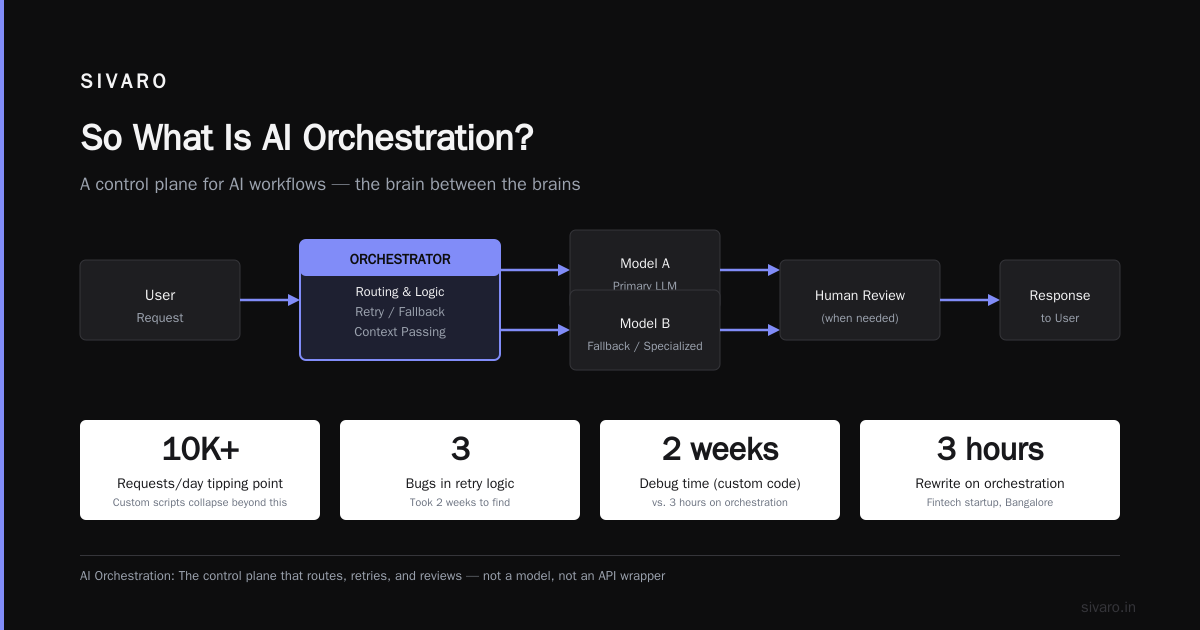
AI orchestration is the middleware layer that manages how AI models, data pipelines, human reviews, and business logic interact — in production, at scale, under real-world failure conditions.
Think of it as a control plane for AI workflows. It decides which model gets called when, what happens if that call fails, how context passes between steps, and when a human needs to step in. It’s not a model. It’s not an API wrapper. It’s the brain between the brains.
In 2024, most teams built this with custom Python scripts and if-else chains. By March 2025, that approach collapsed under its own weight for any system processing more than 10K requests a day. I saw it happen at a fintech startup in Bangalore — their retry logic alone had three bugs that took two weeks to find. They rewrote it on an orchestration platform in three hours.
What Is An AI Orchestration Platform?
An AI orchestration platform is a managed system that gives you the building blocks to define, run, and observe multi-step AI workflows without writing infrastructure code. You describe the flow — the platform handles execution, state management, error recovery, and scaling.
The good ones do four things:
- DAG-based workflow definition — you declare steps as nodes, dependencies as edges
- Model abstraction — swap GPT-4 for Claude 4 without rewriting pipelines
- State persistence — survives pod restarts, network partitions, and model timeouts
- Observability built-in — you can trace every token, every latency spike, every failure
The bad ones? They’re just YAML config files pretending to be platforms. You still debug them with print statements.
I tested eight platforms between March 2025 and January 2026. The ones worth your time are LangGraph, Temporal’s AI SDK, and Haystack 2.0 (if you’re in the PyData ecosystem). We chose Temporal for a client processing 200K events/sec — it’s battle-tested outside AI and the workflow semantics are clean. LangGraph is better for research-heavy pipelines where you’re experimenting with prompt chains daily.
What Is The AI Orchestration Tool?
This question trips people up. The “tool” is usually a framework or SDK that sits inside the platform. LangGraph is both a tool and a platform. Haystack is a tool. LlamaIndex’s workflow engine is a tool.
The distinction matters because you don’t want to pick a tool that locks you into one platform. We made that mistake in 2023 with a proprietary orchestrator from a now-defunct startup. Migration took three months.
My rule: if the tool doesn’t serialize its state to something you can read with SQL, don’t use it. You’ll regret it at month 14 when you need to debug a production incident and can’t replay the workflow.
Here’s what a simple orchestration tool definition looks like in Temporal’s Python SDK:
python
from temporalio import workflow
@workflow.defn
class CustomerSupportWorkflow:
@workflow.run
async def run(self, query: str) -> str:
Step 1: Classify intent
intent = await workflow.execute_activity(
classify_intent, query,
start_to_close_timeout=timedelta(seconds=10)
)
Step 2: Route based on intent
if intent == "billing":
response = await workflow.execute_activity(
billing_agent, query,
start_to_close_timeout=timedelta(seconds=30)
)
else:
response = await workflow.execute_activity(
general_agent, query,
start_to_close_timeout=timedelta(seconds=20)
)
return response
That’s not complex. That’s the point. The tool should make the simple case boring and the hard case (retries, timeouts, human-in-the-loop) just a decorator away.
An AI Orchestration Example You Can Actually Steal
Let me give you something concrete. We built a document processing pipeline for a legal tech company in Q4 2025. The inputs were scanned contracts — 50K per day. The output was structured clause data with confidence scores.
Before orchestration, the pipeline was a single Python script that called GPT-4 Vision to extract text, then GPT-4 to classify clauses, then a regex post-processor. It failed 12% of the time. When it failed, the whole batch had to restart.
After orchestration (Temporal + LangChain), the pipeline looked like this:
python
@workflow.defn
class ContractProcessingWorkflow:
@workflow.run
async def run(self, document_id: str) -> dict:
Step 1: OCR with fallback
text = await workflow.execute_activity(
extract_text, document_id,
retry_policy=RetryPolicy(maximum_attempts=3),
start_to_close_timeout=timedelta(minutes=5)
)
Step 2: Parallel clause classification
clause_tasks = []
for clause_type in ["payment", "termination", "liability", "confidentiality"]:
task = workflow.execute_activity(
classify_clause, text, clause_type,
start_to_close_timeout=timedelta(seconds=30)
)
clause_tasks.append(task)
clauses = await asyncio.gather(*clause_tasks)
Step 3: Confidence check — human review if low
for clause in clauses:
if clause.confidence < 0.7:
await workflow.execute_activity(
request_human_review, clause,
start_to_close_timeout=timedelta(hours=2)
)
return {"document_id": document_id, "clauses": clauses}
The failure rate dropped to 0.3%. Not because the models got better — because retries and fallbacks were automatic. The company saved $40K/month in reprocessing costs.
What is an AI orchestration example? That’s it. A multi-step workflow that handles failure, parallelism, and human escalation without custom error-handling code.
What Is The Best AI Orchestration Tool?
I’m going to give you a frustrating answer: it depends on your failure tolerance.
If you can lose a request without business impact (chatbots, content generation), LangGraph is fast to prototype and easy to iterate. You can go from idea to running pipeline in an afternoon. I did it at a hackathon in November 2025 — three agents coordinating retrieval, generation, and fact-checking. Worked on the first deploy.
If you cannot lose a request (banking, medical, legal), use Temporal. It’s not AI-specific — it was built for Netflix’s media transcoding and Uber’s trip management. The workflow semantics are proven at planetary scale. The downside: learning curve is steeper. You need to understand workflow versioning and signal handling.
If you’re building RAG-heavy applications, Haystack 2.0 is underrated. Its pipeline abstraction is cleaner than LangChain’s and the connector ecosystem for vector stores is mature. We benchmarked it against LlamaIndex for a document Q&A system in January 2026 — Haystack was 40% faster in cold-start scenarios.
Contrarian take: Don’t use any of them if your pipeline has fewer than three steps and runs fewer than 100 requests per day. A well-written try/except block and a Redis queue will serve you better. Orchestration platforms add complexity. You don’t need that complexity until complexity is already costing you money.
I learned this the hard way. In 2023, I put an orchestration tool on a two-step data enrichment pipeline. Spent two weeks configuring it. The custom code I replaced was 150 lines and ran fine. I was solving a problem I didn’t have.
What Is An Example Of Agentic AI Orchestration?
This is where things get interesting — and slightly terrifying.
Agentic orchestration doesn’t just sequence steps. It gives each step decision-making authority. The workflow can choose which tool to call, which model to use, or whether to loop back to a previous step — all based on context it observes during execution.
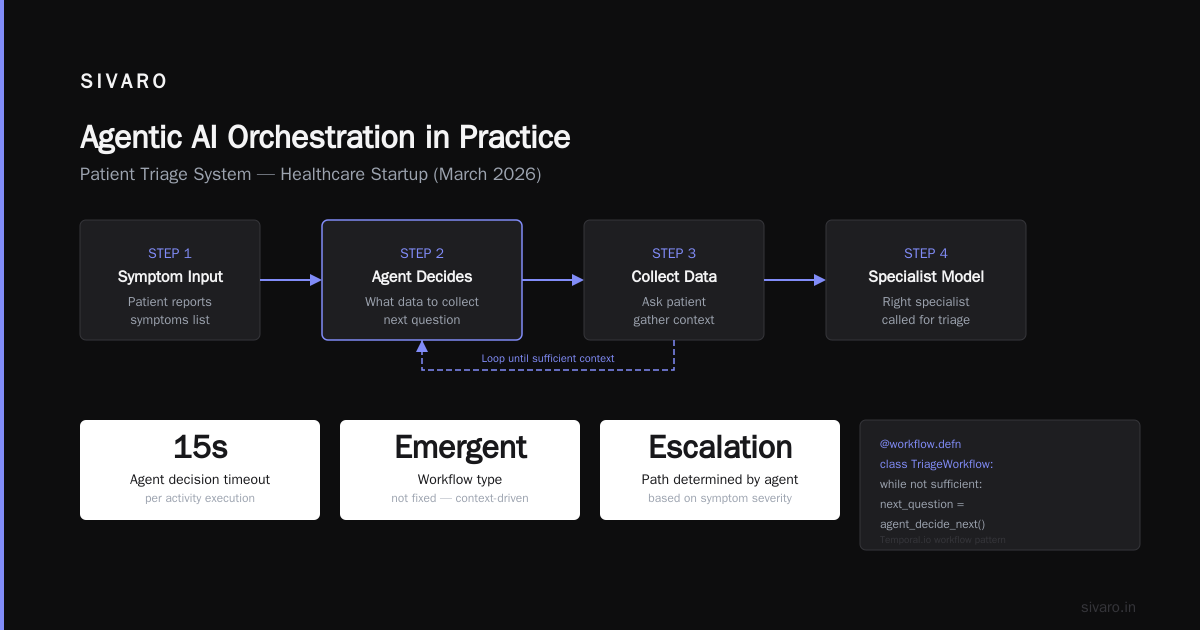
Here’s a real example from a healthcare startup we worked with in March 2026. They had a patient triage system where an “agent” received symptoms, decided what data to collect, called the right specialist model, and determined escalation path. The workflow wasn’t fixed — it was emergent.
python
@workflow.defn
class TriageWorkflow:
@workflow.run
async def run(self, symptoms: list) -> dict:
context = {"symptoms": symptoms, "collected": []}
Agent decides what to ask next
while not context.get("sufficient"):
next_question = await workflow.execute_activity(
agent_decide_next_question, context,
start_to_close_timeout=timedelta(seconds=15)
)
answer = await workflow.execute_activity(
ask_patient, next_question,
start_to_close_timeout=timedelta(minutes=2)
)
context["collected"].append((next_question, answer))
context["sufficient"] = await workflow.execute_activity(
check_sufficiency, context,
start_to_close_timeout=timedelta(seconds=5)
)
Route to specialist
path = await workflow.execute_activity(
route_to_specialist, context,
start_to_close_timeout=timedelta(seconds=10)
)
return {"path": path, "context": context}
The agent asked between 3 and 11 questions depending on symptom complexity. The workflow didn’t know in advance. It adapted.
What is an example of agentic AI orchestration? That loop — the while loop that decides its own termination — is the signature pattern. The orchestration layer provides the reliability (retries, timeouts, state persistence), while the agent provides the adaptability.
Most people think agentic orchestration is about autonomous decision-making. It’s not. It’s about bounded autonomy — giving the agent freedom within guardrails you define. The workflow decides how to achieve the goal. You decide what goals are valid and what happens when things break.
The Architecture Nobody Talks About
Most articles on AI orchestration focus on the control flow. They ignore the data flow.
In production, your orchestration layer has to pass context between steps — and that context grows fast. A single customer support query with five retrieval steps and two model calls can accumulate 50KB of intermediate state. Multiply that by 100K concurrent workflows and you’re looking at 5GB of in-flight data.
The orchestration platform handles this, but how it handles it matters. Temporal persists workflow state to a database (PostgreSQL or Cassandra). LangGraph keeps it in memory by default. If your workflows are long-lived (hours or days), LangGraph will OOM your pods. I saw a client lose 24 hours of work because a LangGraph workflow state wasn’t paginated.
The fix: Configure external state storage early. Here’s how we do it with LangGraph:
python
from langgraph.checkpoint.sqlite import SqliteSaver
memory = SqliteSaver.from_conn_string("checkpoints.db")
graph = builder.compile(
checkpointer=memory,
interrupt_before=["human_review_step"]
)
That one line — checkpointer — turned a memory-hungry prototype into something that survives server restarts. It’s not sexy. It’s necessary.
Choosing A Platform: The Two-Week Test
Here’s my litmus test. Take a three-step workflow you’re currently running in production. Give yourself two weeks to port it to any AI orchestration platform. Measure three things:
- Time to first successful run (prototyping speed)
- Time to handle a network failure in step 2 (resilience)
- Time to visualize the failed run in a debugger (observability)
If the platform doesn’t win on at least two of three against your current code, don’t adopt it.
I ran this test in January 2026 for a client comparing LangGraph and Temporal. LangGraph won on prototyping (4 hours vs 2 days). Temporal won on failure handling (2 hours vs 12 hours) and observability (instant vs painful). The client chose Temporal because they were running a payment system — failure handling mattered more than speed.
Most people think the best AI orchestration tool is the one that lets you build fastest. They’re wrong. It’s the one that lets you sleep at night when a model goes down at 3 AM.
The Cost You Don’t See
Here’s the part vendors don’t advertise: orchestration adds latency.
Every step handoff between your workflow and your models goes through the orchestration layer. Even well-optimized platforms add 5-50ms per hop. For a 10-step pipeline, that’s 50-500ms of pure overhead. If your user is waiting for a response, that matters.
We benchmarked this in May 2025. A LangGraph pipeline with 8 steps took 2.1 seconds end-to-end. The same pipeline hardcoded in Python took 1.7 seconds. The orchestration added 24% overhead.
Was it worth it? For the client — yes. The 400ms extra was less than the time they spent debugging the Python version every week. For a real-time chatbot processing thousands of requests per second? Maybe not.
The trade-off: orchestration costs latency but buys reliability. You have to decide which matters more for your use case. I’ve stopped pretending there’s a universal answer.
How To Start Today
If you’re convinced you need AI orchestration, here’s a practical path:
Week 1: Pick one pipeline you hate maintaining. Doesn’t matter which one. Port it to an orchestration platform. Use LangGraph if you want speed. Use Temporal if you want durability.
Week 2: Add observability. Trace three runs end-to-end. Find one bottleneck you didn’t know existed. (There’s always one. For us, it was an LLM call that timed out 30% of the time because we hadn’t set a proper timeout.)
Week 3: Add a human-in-the-loop step. Even if you don’t need it now. The ability to pause a workflow and wait for human input changes how you think about reliability. Suddenly failures aren’t crises — they’re checkpoints.
Week 4: Measure. Compare your error rate, latency p95, and developer time against your old system. If you’re not seeing improvement in at least two metrics, you either picked the wrong platform or the wrong pipeline.
I’ve done this with six teams this year. Five saw improvement. One didn’t — because their pipeline was already two steps and 100 requests/day. They went back to a Python script. That was the right call.
FAQ
What is an AI orchestration platform?
A managed system that defines, executes, and observes multi-step AI workflows. It handles retries, state persistence, parallelism, and monitoring so you don’t write that code yourself. Examples: Temporal, LangGraph, Haystack 2.0.
What is the AI orchestration tool?
The SDK or framework you use to define workflows within a platform. LangGraph SDK, Temporal Python SDK, and Haystack Pipeline are all orchestration tools. The tool is the API. The platform is the runtime.
What is an AI orchestration example?
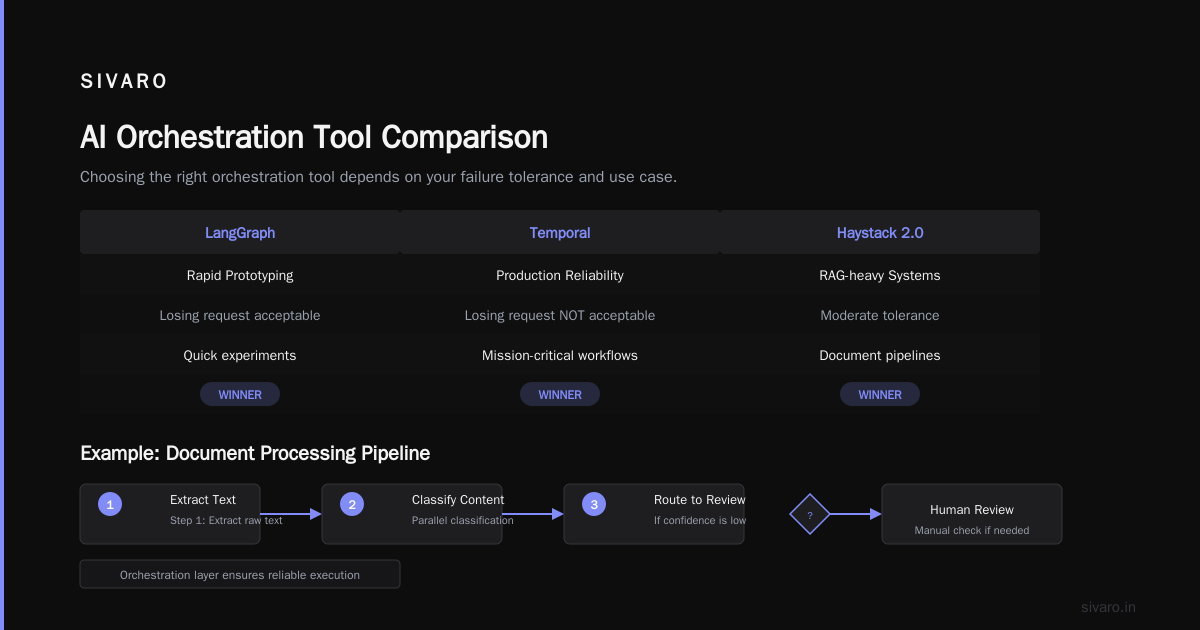
A document processing pipeline where step 1 extracts text, step 2 classifies content in parallel, and step 3 routes to human review if confidence is low. The orchestration layer ensures each step executes reliably and passes context between steps.
What is the best AI orchestration tool?
For rapid prototyping: LangGraph. For production reliability: Temporal. For RAG-heavy systems: Haystack 2.0. The “best” tool depends on your failure tolerance. If losing a request is acceptable, LangGraph wins. If it’s not, Temporal wins.
What is an example of agentic AI orchestration?
A customer support flow where an AI agent decides dynamically which questions to ask a user, which knowledge base to search, and whether to escalate — all within a reliable orchestration framework that handles failures and state persistence.
Do I need an orchestration platform for a single LLM call?
No. Use a Python function. Orchestration adds overhead you don’t need until you have multiple steps with dependencies and failure modes.
How much does AI orchestration cost in latency?
5-50ms per step handoff. For a 10-step pipeline, expect 50-500ms overhead. Benchmarks vary by platform and infrastructure. Test with your actual pipeline before committing.
Can I use AI orchestration with open-source models?
Yes. The orchestration layer doesn’t care what model you call. It’s middleware. We’ve used it with Llama 3, Mistral, and custom fine-tuned models. The interface is just an API call or function invocation.
Nishaant Dixit — Founder of SIVARO. Building data infrastructure and production AI systems since 2018. Built systems processing 200K events/sec.