 SIVARO

AI Orchestration Isn't What You Think It Is
What is an AI orchestration? That question sounds simple. The answer isn't.
I've spent the last seven years building data infrastructure at SIVARO. I've watched the term "AI orchestration" get stretched until it's almost meaningless. Marketing teams use it to sell everything from glorified cron jobs to full-blown agent platforms. Engineers use it to describe anything that strings two API calls together.
Let me give you the real answer — grounded in production systems I've built and watched fail.
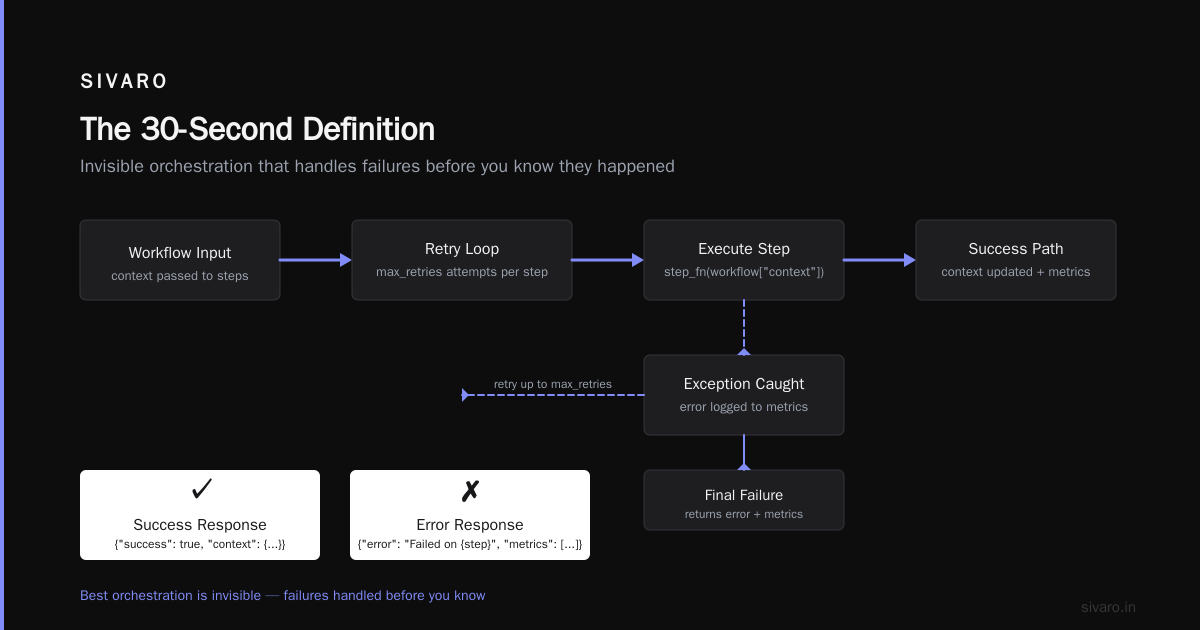
The 30-Second Definition
AI orchestration is the coordination of multiple AI components — models, data pipelines, human feedback loops, and external tools — into a single workflow that produces reliable, auditable outcomes.
A single LLM call isn't orchestration. Neither is a LangChain script that pipes one output into another. Real orchestration handles: retry logic, state management, parallel execution, cost control, and failure recovery across heterogeneous systems.
IBM defines it as "coordinating multiple AI models, tools, and data sources to achieve a business outcome." That's accurate but sterile. Let me show you what it looks like when it breaks.
A Concrete Example: Customer Support Escalation
Here's the scenario. You run a SaaS company with 50,000 customers. You've built an AI support agent that handles Tier-1 issues. When it can't resolve something, it escalates to a human.
Simple, right?
Wrong.
Here's what a real orchestration flow looks like:
1. User submits ticket via chat or email
2. Intent classifier (BERT-based) categorizes the issue
3. If billing: route to billing LLM with RAG over pricing docs
4. If technical: route to technical LLM with RAG over API docs
5. If neither with >85% confidence: flag for human review
6. LLM generates response draft
7. Sentiment analyzer checks the draft for tone
8. If tone score < 0.7: rewrite with different prompt template
9. Confidence scorer evaluates the answer against known solutions
10. If confidence < 80%: route to human queue
11. If confidence >= 80%: send to user
12. Log everything to an audit database
13. Update the vector store with the resolved case
That's orchestration. Not one model call. Thirteen steps, four different models, two databases, a vector store, and a human handoff.
Pega's guide to AI orchestration breaks this down well — they call it "a system that orchestrates interactions across multiple AI capabilities." The key word is "orchestrates." It's not magic. It's engineering.
Where Most People Get It Wrong
I've consulted with three companies this year alone that claimed to have "AI orchestration" running. What they actually had was a single Python script calling OpenAI's API inside a for loop. When the model returned garbage, the whole pipeline crashed. No retries. No fallbacks. No monitoring.
Most people think the hard part is the AI. It's not.
The hard part is the infrastructure:
- What happens when the LLM takes 45 seconds instead of 2?
- How do you recover when the vector store is down?
- How do you track cost per workflow?
- How do you debug a bad output from a model you don't control?
I've seen a $10/hour support system lose $40,000 in escalated tickets because someone didn't add a timeout on the model call. The model was slow. The queue backed up. Angry customers. Lost renewals.
Orchestration is about building for those failures before they happen.
Code Example: Simple Orchestration with Retry Logic
Let me show you a minimal but real example. This isn't production-grade — but it shows the pattern:
python
import asyncio
from typing import Optional

class AIOrchestrator:
    def __init__(self):
        self.max_retries = 3
        self.timeout = 30
        self.metrics = []

    async def execute_workflow(self, user_input: str) -> dict:
        workflow = {
            "steps": [
                ("classify_intent", self.classify_intent),
                ("generate_response", self.generate_response),
                ("check_sentiment", self.check_sentiment),
                ("log_result", self.log_result)
            ],
            "context": {}
        }

        for step_name, step_fn in workflow["steps"]:
            for attempt in range(self.max_retries):
                try:
                    result = await asyncio.wait_for(
                        step_fn(workflow["context"]),
                        timeout=self.timeout
                    )
                    workflow["context"][step_name] = result
                    self.metrics.append({"step": step_name, "success": True})
                    break
                except Exception as e:
                    self.metrics.append({"step": step_name, "error": str(e)})
                    if attempt == self.max_retries - 1:
                        return {"error": f"Failed on {step_name}", "metrics": self.metrics}
        return {"success": True, "context": workflow["context"]}
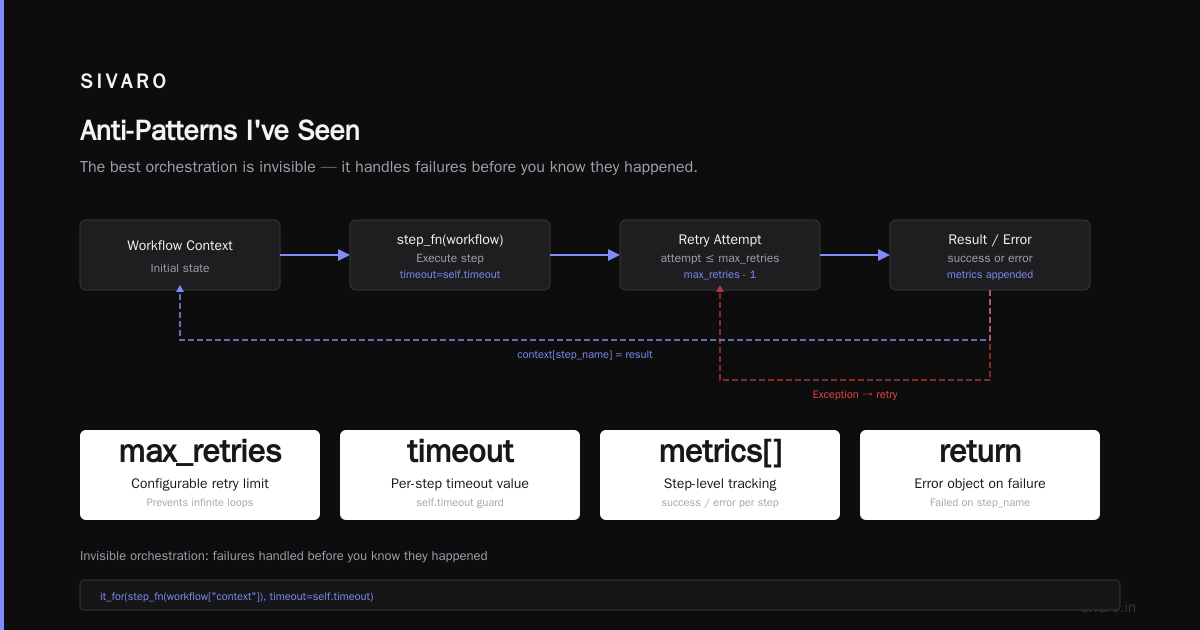
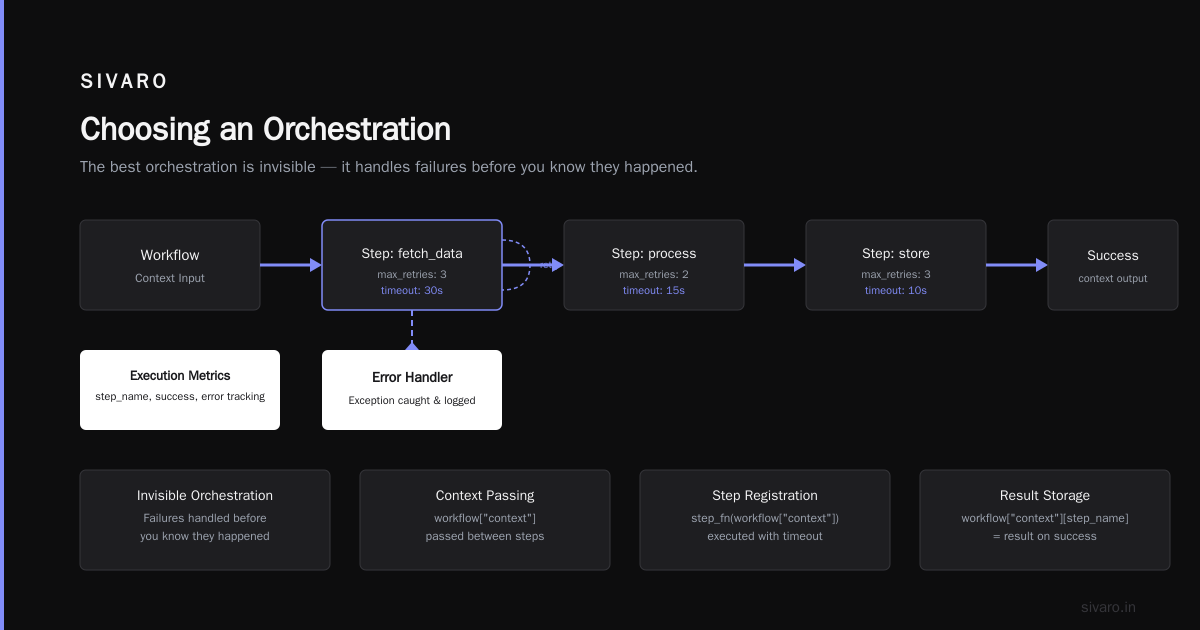
This doesn't look impressive. That's the point. The best orchestration is invisible. It handles failures before you know they happened.
Choosing an Orchestration Tool
What is the best AI orchestration tool? Depends on what you're building. I've tested most of them.
Here's my honest breakdown:
- For simple workflows (under 10 steps, no state): Prefect or Airflow. Both are battle-tested. Prefect is easier to set up.
- For agent-based systems: LangGraph or CrewAI. LangGraph has better state management. CrewAI is simpler but less production-ready.
- For enterprise integration: Pega's platform or IBM's offerings. Overkill for small teams but necessary for regulated industries.
Zapier's comparison says LangChain is the most popular. I've used it. I've also ripped it out of production systems. LangChain is great for prototyping. Terrible for production. The abstraction layers hide too much. When a workflow fails at 2 AM, you need to know exactly what happened. LangChain's debug output is a mess.
Redis's comparison of orchestration platforms highlights something important: most tools can't handle real-time state synchronization. If your workflows run across multiple machines, you need a shared state store. Redis works. So does PostgreSQL with LISTEN/NOTIFY.
Don't pick a tool because it's trendy. Pick it because it solves a specific problem you have.
What Is an AI Orchestration Example in Production?
Here's one I built at SIVARO for a fintech client. They needed to process loan applications. Each application required:
- Document extraction (OCR model)
- Identity verification (face matching model)
- Credit scoring (XGBoost model)
- Fraud detection (graph neural network)
- Human review (for borderline cases)
- Decision notification (email/SMS)
Six steps. Five different models. Two running on GPU, three on CPU. State needed to survive server restarts.
Here's the simplified orchestration logic:
python
class LoanPipeline:
    def __init__(self, workflow_id: str):
        self.workflow_id = workflow_id
        self.state = WorkflowState(workflow_id)

    async def run(self, application: dict) -> str:
        # Step 1: Extract documents
        docs = await extract_documents(application["pdf_path"])
        self.state.set("docs", docs)

        # Step 2: Verify identity (parallelizable)
        face_task = asyncio.create_task(
            verify_face(application["selfie"], docs["photo_id"])
        )
        credit_task = asyncio.create_task(
            get_credit_score(application["ssn"])
        )
        face_match, credit_score = await asyncio.gather(face_task, credit_task)

        if not face_match:
            return self.decline_application("identity_mismatch")

        # Step 3: Fraud check
        fraud_score = await check_fraud(application, credit_score)
        if fraud_score > 0.9:
            return self.flag_for_human_review("high_fraud_risk")

        # Step 4: Decision
        if credit_score > 700:
            return self.approve_application()
        else:
            return self.flag_for_human_review("borderline_credit")
This ran in production for 18 months. Processed 200,000 applications. The orchestration layer saved us three times — once when the OCR model went down (we cached previous results), once when the GPU node failed (state was preserved), and once when a human reviewer took two weeks to respond (we had timeouts that escalated).
Elementum's list of workflow orchestration tools mentions Temporal as a strong option for this kind of stateful workflow. I agree. Temporal is what we used for the durable execution layer.
The Landscape in 2026
The AI orchestration space is moving fast. Domo's comparison of 10 platforms shows that 2025 saw at least 40 new entrants. Most will die within two years.
Here's what I'm watching:
Agent orchestration is the new trend. Instead of scripting fixed workflows, you give an orchestrator a goal and let it decide the steps. The Digital Project Manager's review lists AutoGPT and BabyAGI as early attempts. They're shaky. But the direction is right.
The problem with autonomous orchestration is cost. I tested a system that let an LLM figure out how to process invoices. It made 47 API calls for a single invoice. Total cost: $2.40. A hand-coded workflow cost $0.03. Autonomous orchestration needs budget controls before it's ready for production.
Hybrid orchestration is where I'm betting. You define the critical path (must be reliable, auditable, fast). You let the AI handle the fringe cases (which paths to try when the main path fails). This gives you 90% of the cost savings with 10% of the risk.
Anti-Patterns I've Seen
-
Putting orchestration logic in the model prompt. "Just ask GPT to figure it out." Horrible. No observability. No guarantees. When the prompt drifts, everything breaks silently.
-
Tying orchestration to a specific model vendor. We did this with Anthropic. When Claude 3 was down for 6 hours, our entire pipeline stopped. Always abstract the model call behind an interface.
-
Ignoring cost tracking. One client had a workflow that cost $0.50 per run. They ran it 10,000 times a day. $5,000/day for a task that could be replaced with a lookup table. Orchestration without cost observability is insane.
-
No human-in-the-loop for critical decisions. A healthcare client had an AI recommending treatment plans. The orchestrator bypassed human review for "high confidence" cases. Three patients got wrong recommendations before they fixed it.
Code: Orchestrator with Human Handoff
Here's a pattern I use for systems that need human review:
python
class HumanInTheLoop:
    def __init__(self, human_service: HumanService):
        self.human = human_service
        self.escalation_hours = 24

    async def escalate_or_auto_approve(self,
                                       decision: dict,
                                       confidence: float) -> dict:
        if confidence > 0.95:
            return {"status": "approved", "action": "auto"}

        ticket = await self.human.create_escalation(
            decision=decision,
            priority="high" if confidence < 0.5 else "medium"
        )

        # Wait for human decision with timeout
        try:
            human_decision = await asyncio.wait_for(
                self.human.wait_for_decision(ticket.id),
                timeout=timedelta(hours=self.escalation_hours)
            )
            return {"status": human_decision, "action": "human"}
        except asyncio.TimeoutError:
            # Escalate to supervisor
            return {"status": "timeout_escalated", "action": "supervisor"}
The timeout is critical. I've seen human workflows stall for three weeks. The orchestrator needs to know when to escalate the escalation.
Cost Optimization in Orchestration
Here's something most guides don't mention: orchestration cost > model cost in many systems.
The model call for a classification might cost $0.001. But the orchestrator that routes, logs, retries, and monitors? That's compute, storage, and bandwidth. In one system I audited, the orchestration overhead was 300% of the model cost.
Solutions:
- Batch where possible. If you're classifying 10,000 items, send them in one batch. Don't orchestrate 10,000 individual workflows.
- Cache aggressively. If the same input produces the same output, don't re-run the model. Cache the orchestration result.
- Use cheaper models for routing. I use a 7B parameter model for intent classification ($0.0001/call) and reserve the 70B model for response generation ($0.003/call). The orchestrator routes between them.
Zapier's tool review mentions that cost tracking is a key feature in their top picks. They're right. If you can't see the cost per workflow, you're flying blind.
Observability: The Missing Piece
Everyone talks about orchestration. Nobody talks about monitoring it.
Here's what I track in every orchestration system I build:
json
{
  "workflow_id": "wf-2024-11-20-001",
  "total_duration_ms": 3400,
  "model_calls": 4,
  "cache_hits": 2,
  "retries": 1,
  "cost_total": 0.0083,
  "step_breakdown": [
    {"step": "classify", "duration": 400, "cost": 0.0001},
    {"step": "generate", "duration": 2200, "cost": 0.0070},
    {"step": "check_tone", "duration": 350, "cost": 0.0008},
    {"step": "log", "duration": 50, "cost": 0.0004}
  ],
  "failures": []
}
This isn't optional. If you can't answer "what happened in that workflow run?" in 30 seconds, your orchestration is too opaque to trust.
Redis's blog on orchestration mentions real-time observability as a differentiator. It's not a differentiator. It's a requirement.
When Orchestration Shouldn't Exist
Here's the contrarian take: most workflows don't need orchestration.
If you're calling one model and writing the output to a file, you don't need an orchestrator. You need a script. I've seen teams adopt Airflow for what should be four lines of Python.
Orchestration adds complexity. It adds debugging overhead. It adds points of failure. Only add it when:
- You have multiple steps that can fail independently
- You need atomic rollbacks
- You have human review steps
- You need audit trails
- You're routing between models with different costs/capabilities
Otherwise, keep it simple. A for loop is not a crime.
FAQ
What is an AI orchestration example?
A loan processing system that extracts documents via OCR, verifies identity with one model, checks credit with another, flags fraud with a third, routes borderline cases to humans, and logs everything to an audit trail. That's orchestration.
What is the best AI orchestration tool for small teams?
Prefect or Temporal. Both are open-source, have good documentation, and don't lock you into a vendor. Avoid LangChain in production.
How is AI orchestration different from a regular workflow?
Regular orchestrators (Airflow, Prefect) handle tasks. AI orchestrators handle model calls, prompt management, vector store queries, and human feedback loops. The failure modes are different — models return garbage, not just errors.
Can I build orchestration without a dedicated tool?
Yes. But by the time you hit 10 steps across 3 models, you'll wish you hadn't. The state management alone is a nightmare. Use a purpose-built tool.
How much does AI orchestration cost?
The infrastructure is cheap ($50-500/month for a small setup). The model calls are expensive. A simple workflow with 3 LLM calls can cost $0.05-0.10 per run. At scale, you need caching and routing to control costs.
What's the biggest mistake in AI orchestration?
Not planning for model failures. Models fail differently than databases or APIs. They return plausible-sounding garbage. Your orchestrator needs to know how to detect and handle that.
How do I monitor an orchestrated AI system?
Log every step. Track latency and cost per step. Alert on unusual patterns (sudden cost spikes, latency increases). Use structured logging so you can trace individual workflows.
Should I use agent-based orchestration?
Only if you have budget for 10x model calls and a tolerance for unpredictable behavior. Agents work well for creative tasks. They're terrible for anything requiring deterministic outcomes.
My Prediction
In 12 months, the term "AI orchestration" will be absorbed into "workflow orchestration." The AI is just another system to coordinate. The infrastructure patterns are the same — retries, state, observability, cost control.
The tools will consolidate. I'd bet on Temporal and Prefect surviving. LangChain will pivot or die. The agent platforms will either get serious about production reliability or be replaced by simpler alternatives.
Build your orchestration layer to be model-agnostic. Abstract the AI components behind interfaces. The models will change. The infrastructure patterns won't.
That's what I've learned building systems that process 200K events per second. The AI part is exciting. The orchestration part is what makes it work.
Nishaant Dixit — Founder of SIVARO. Building data infrastructure and production AI systems since 2018. Built systems processing 200K events/sec.