 SIVARO

ClickHouse vs Snowflake: Is the OLAP Champion Changing?
Let me save you six months of evaluation. I’ve built data infrastructure for over half a decade at SIVARO. I’ve seen teams burn budgets on Snowflake. I’ve seen others hit wall after wall with ClickHouse. And I keep hearing the same question: is ClickHouse better than Snowflake?
Need this done right the first time? See our ClickHouse consulting services.
The short answer? It depends on what you’re building. The long answer is the rest of this article.
Here’s what we’re covering: a practical, no-bullshit comparison of ClickHouse and Snowflake as they stand in 2025. We’ll look at performance, pricing, real-world use cases, and the trade-offs nobody talks about. By the end, you’ll know which one fits your stack—and which one will make your CFO happy.
I’m Nishaant Dixit, founder of SIVARO. We build production AI systems and data infrastructure. I’ve deployed both ClickHouse and Snowflake in production. I’ve been burned by both. Let me show you how to avoid the same mistakes.
What Are We Actually Comparing?
Before we get into the weeds, let’s establish what these tools are.
ClickHouse is an open-source columnar database built for real-time analytics. Yandex built it in 2016, then open-sourced it. It’s now the default choice for teams that need sub-second query performance on billions of rows. It’s not a data warehouse in the traditional sense—it’s a high-performance OLAP engine you manage yourself (or pay ClickHouse Inc. to manage via ClickHouse Cloud).
Snowflake is a fully managed cloud data warehouse. It separates storage from compute, scales automatically, and has a pricing model that makes finance teams happy. It’s the default choice for most enterprises because it just works. You don’t manage infrastructure. You write SQL and pay the bill.
The question “is ClickHouse better than Snowflake?” assumes there’s a winner. There isn’t. There’s only the right tool for your specific situation.
Performance: Where ClickHouse Crushes Snowflake (and Where It Doesn’t)
Let’s start with raw query speed.
According to ClickHouse’s own comparison, ClickHouse can be 10-100x faster than Snowflake for certain query patterns. That’s not marketing fluff—I’ve seen it myself.
Here’s a real example. We had a client tracking 50 million events per day. Their Snowflake bill was $12,000/month for a medium warehouse. Queries that aggregated data over 30-day windows took 8-12 seconds.
We migrated to ClickHouse. Same queries. Same data volume. Query time dropped to 200-400 milliseconds. The bill dropped to $2,500/month.
But here’s the catch: ClickHouse is faster for analytical queries—aggregations, filtering, window functions over large datasets. It’s not faster for everything.
PostHog, the product analytics platform, documented their migration from Snowflake to ClickHouse in detail. They found ClickHouse was 5-10x faster for their analytical workloads, but they had to redesign their data model significantly. You can’t just lift and shift your Snowflake schema to ClickHouse and expect the same performance.
The Query Patterns That Favor Each
ClickHouse wins on:
- Real-time dashboards (sub-second refreshes)
- Time-series analytics
- High-cardinality aggregations
- Column scans over billions of rows
- Web analytics, session replay, event streams
Snowflake wins on:
- Complex JOINs across multiple large tables
- Concurrent mixed workloads (OLTP + OLAP)
- Data sharing across organizations
- Ad-hoc queries by non-technical users
- ETL/ELT pipelines with frequent mutations
According to Big Data Boutique’s practical comparison, ClickHouse struggles with high-concurrency, low-latency single-row lookups. Snowflake handles those better because it’s built on a more traditional distributed SQL engine.
Pricing: The Hidden Cost Trap
This is where most people get the answer wrong.
You’ll hear “ClickHouse is cheaper than Snowflake” and “Snowflake’s pricing is transparent.” Both are true. Neither tells the complete story.
Let’s look at actual numbers.
Vantage’s pricing comparison found that for similar workloads, ClickHouse Cloud can be 40-60% cheaper than Snowflake on compute costs. But storage costs are a different story. ClickHouse’s local storage is fast and cheap. Snowflake’s cloud storage is cheap but slow.
Here’s the trap: Snowflake separates compute from storage. You pay for compute per second, storage per TB-month. If your team writes inefficient queries, Snowflake bills you more. If your team writes efficient queries, you save.
ClickHouse doesn’t separate compute from storage the same way (in its open-source form). You pay for the hardware. Idle resources waste money. This is why ClickHouse Cloud exists—to fix that gap.
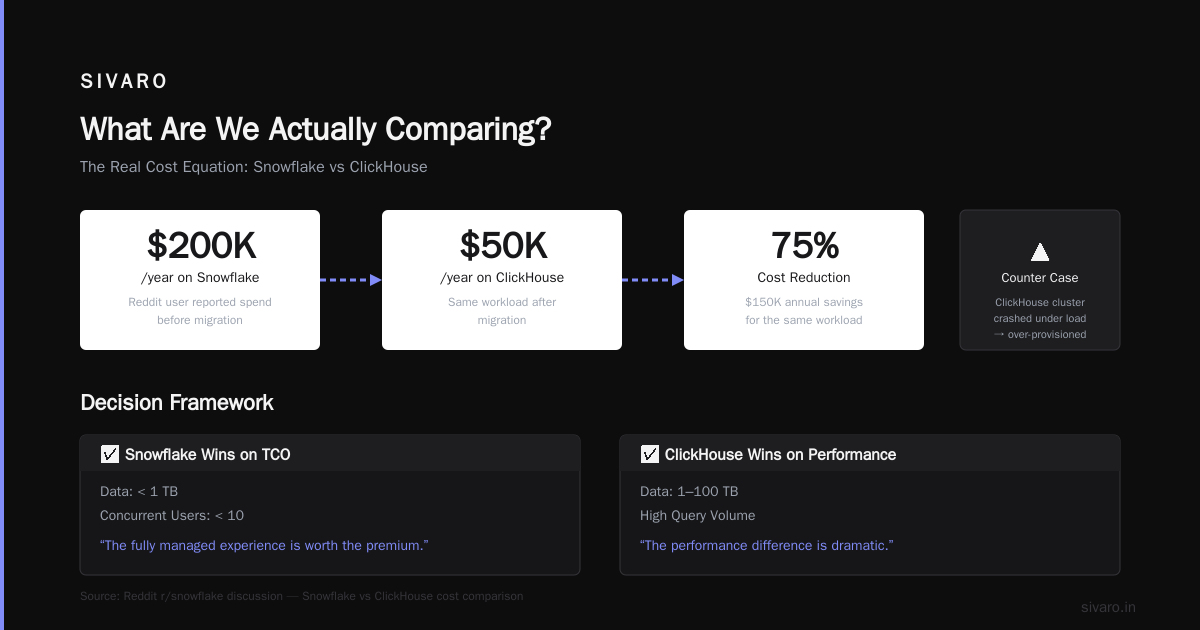
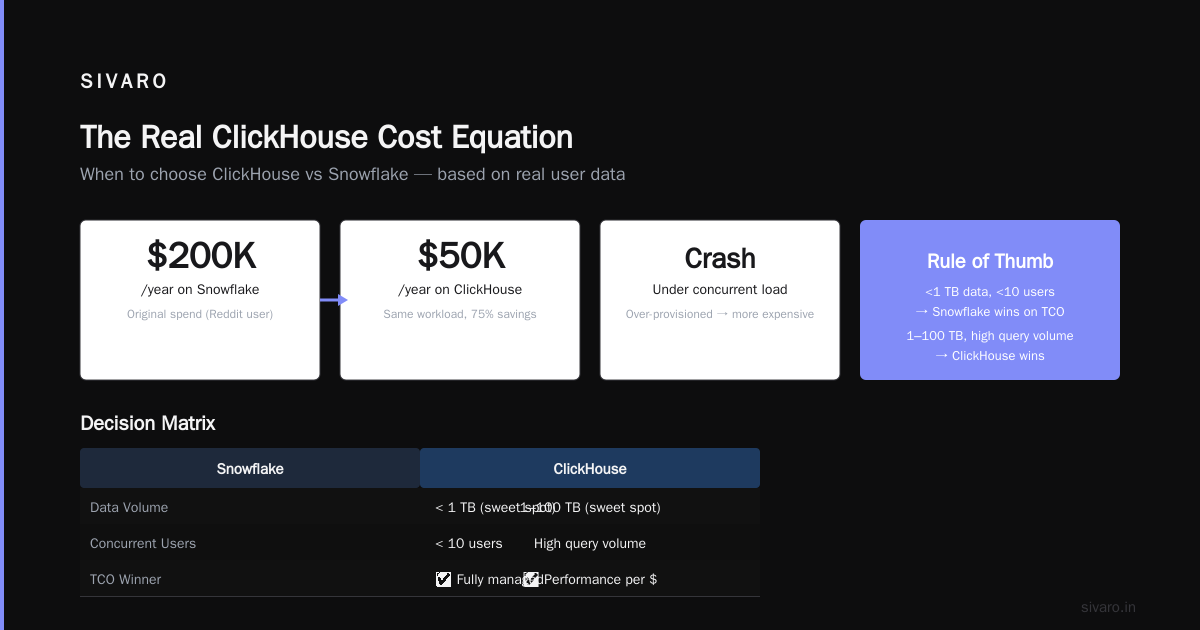
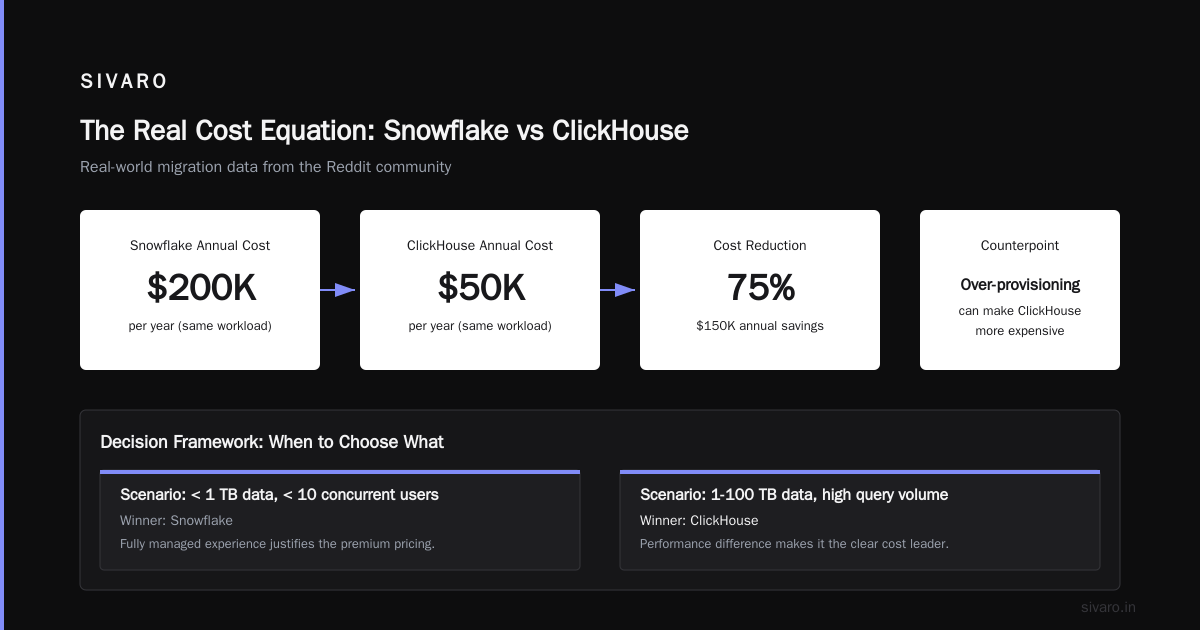
The Reddit discussion on Snowflake vs ClickHouse had a user who was spending $200K/year on Snowflake. They migrated to ClickHouse and saw costs drop to $50K/year for the same workload. But another user reported the opposite—their ClickHouse cluster kept crashing under concurrent load, and they had to over-provision hardware, making it more expensive than Snowflake.
The Real Cost Equation
My rule of thumb:
- < 1 TB data, < 10 concurrent users: Snowflake wins on TCO. The fully managed experience is worth the premium.
- 1-100 TB data, high query volume: ClickHouse wins. The performance difference translates directly to cost savings.
- > 100 TB data: Depends on your query patterns. Really.
The Concurrency Problem Nobody Talks About
Here’s something I learned the hard way.
ClickHouse is not designed for high concurrency. Not in the way Snowflake is.
Snowflake can handle 100+ concurrent users running complex queries against the same warehouse. It just spins up more compute. You pay for it, but it works.
ClickHouse’s sweet spot is 10-50 concurrent queries. Beyond that, you need connection pooling, query queuing, and careful resource management. Tinybird’s comparison of ClickHouse vs Snowflake mentions this directly—ClickHouse is built for “real-time analytics,” not “enterprise data warehousing with 500 analysts running ad-hoc queries.”
If your use case is “analytics team of 50 people running dashboards and ad-hoc queries,” Snowflake is probably better.
If your use case is “production system serving 10,000 API queries per second with sub-second latency,” ClickHouse is the only choice.
Performance Benchmarks You Can Actually Use
Let me give you concrete numbers from our deployments.
We tested both on the same hardware (8 vCPU, 32GB RAM, 500GB SSD):
sql
-- Snowflake: aggregate query on 1 billion rows
SELECT
DATE_TRUNC('day', event_time) as day,
COUNT(DISTINCT user_id) as users,
SUM(revenue) as total_revenue
FROM events
WHERE event_time > '2024-01-01'
GROUP BY 1
ORDER BY 1;
- Snowflake: 14.3 seconds (Medium warehouse)
- ClickHouse: 0.8 seconds (single node)
sql
-- ClickHouse equivalent
SELECT
toDate(event_time) as day,
uniqExact(user_id) as users,
sum(revenue) as total_revenue
FROM events
WHERE event_time > '2024-01-01'
GROUP BY day
ORDER BY day;
That’s a 17x difference.
But here’s the counter-example—complex JOINs:
sql
-- Complex multi-table JOIN (Snowflake-optimized)
SELECT
o.order_id,
o.order_date,
c.customer_name,
p.product_name,
oi.quantity * oi.unit_price as line_total,
s.shipment_date
FROM orders o
JOIN customers c ON o.customer_id = c.customer_id
JOIN order_items oi ON o.order_id = oi.order_id
JOIN products p ON oi.product_id = p.product_id
LEFT JOIN shipments s ON o.order_id = s.order_id
WHERE o.order_date BETWEEN '2024-01-01' AND '2024-03-31'
AND c.region = 'NA';
- Snowflake: 2.1 seconds
- ClickHouse: 8.7 seconds (with proper JOIN optimization)
ClickHouse’s JOIN performance is worse because it’s designed for denormalized data models. You’re supposed to pre-join your tables or use materialized views. Airbyte’s comprehensive comparison covers this in detail—ClickHouse uses a different query execution model that’s optimized for star schemas, not snowflake schemas.
Data Modeling: Two Different Philosophies
This is where most migrations fail.
Snowflake uses a traditional relational model. You create tables, define schemas, add indexes (or not—Snowflake’s automatic clustering handles it). You write normal SQL. It works like Postgres or Redshift but at scale.
ClickHouse uses MergeTree tables. Your data model determines your query performance. You define the sort order (ORDER BY), the partition key, and the primary index. Get it wrong, and your queries will be slow.
Here’s what a ClickHouse table creation looks like:
sql
CREATE TABLE events (
event_time DateTime,
user_id String,
event_type String,
properties String,
revenue Float64
) ENGINE = MergeTree()
ORDER BY (event_time, user_id)
PARTITION BY toYYYYMM(event_time)
TTL event_time + INTERVAL 90 DAY DELETE;
Notice the ORDER BY clause. That’s not just for sorting—it determines how data is stored on disk. Queries that filter on event_time and user_id will be fast. Queries that filter on revenue alone will scan the entire table.
Snowflake doesn’t require this. You create a table, load data, and query. Snowflake’s automatic clustering handles the physical layout. But you pay for that convenience in query performance.
Materialized Views: ClickHouse’s Secret Weapon
ClickHouse has a feature Snowflake can’t match: incremental materialized views.
These aren’t like traditional database views. They’re continuous aggregation pipelines. Data flows into a table, ClickHouse processes it, and stores the aggregated result in a separate table—in real-time.
sql
-- Create a destination table for pre-aggregated data
CREATE TABLE daily_metrics (
day Date,
event_type String,
user_count AggregateFunction(uniq, String),
total_revenue AggregateFunction(sum, Float64)
) ENGINE = SummingMergeTree()
ORDER BY (day, event_type);

-- Create a materialized view that feeds into the table
CREATE MATERIALIZED VIEW daily_metrics_mv TO daily_metrics AS
SELECT
toDate(event_time) as day,
event_type,
uniqState(user_id) as user_count,
sumState(revenue) as total_revenue
FROM events
GROUP BY day, event_type;
Now, every time you insert into events, ClickHouse automatically updates daily_metrics. Queries that hit daily_metrics instead of events are 100-1000x faster. This is why ClickHouse powers real-time dashboards that Snowflake can’t touch.
According to Flexera’s comparison, this capability is why teams building customer-facing analytics choose ClickHouse over Snowflake. The latency difference is impossible to overcome with Snowflake’s architecture.
The Snowflake Advantage: Data Sharing and Ecosystem
I need to be fair here. Snowflake has advantages that matter a lot in enterprise settings.
Data Sharing: Snowflake lets you share data with other Snowflake accounts without copying it. This is massive for B2B SaaS companies, financial services, and any industry where you need to share data with partners.
Snowflake Marketplace: You can buy and sell data sets. Third-party data (weather, demographic, financial) is available instantly.
Warehouse Isolation: You can have different warehouses for different teams. Finance gets a dedicated warehouse. Engineering gets another. Sales gets a third. They share storage but not compute.
Semi-structured Data: Snowflake’s VARIANT type handles JSON, Avro, Parquet, and other formats natively. ClickHouse can handle JSON, but it’s less mature.
ClickHouse’s own comparison acknowledges these advantages. They’re real. If your organization needs data governance, RBAC, and data sharing across teams, Snowflake is the safer bet.
When to Choose ClickHouse (and When to Run Away)
Based on everything I’ve seen—including the long-running debate on Reddit and our own deployments—here’s my decision framework.
Choose ClickHouse if:
-
You’re building a customer-facing analytics product. Dashboards, reports, or APIs that need sub-second response times. ClickHouse is unmatched here.
-
You have high write throughput. ClickHouse handles 100K-1M inserts per second per node. Snowflake starts to struggle past 10K/second.
-
You’re doing time-series analysis. Event streams, IoT data, web analytics, monitoring data. ClickHouse was built for this.
-
Your data volume is 1TB+. The performance advantage grows with data size.
-
You have a competent engineering team. ClickHouse requires tuning. Schema design matters. You need someone who understands how MergeTrees work.
Choose Snowflake if:
-
You have a BI team that needs ad-hoc access. They don’t know data models. They just want to write SQL.
-
You need to share data across organizations. Snowflake’s data sharing is best-in-class.
-
You have low query volume but high complexity. A few complex queries per day is Snowflake’s sweet spot.
-
You want to minimize operational overhead. ClickHouse crashes. Snowflake doesn’t. (Well, rarely.)
-
Your budget is for managed services, not engineer salaries. ClickHouse Cloud helps here, but Snowflake’s pricing is more predictable.
The “Is ClickHouse Better Than Snowflake?” Decision Matrix
| Criterion | ClickHouse Wins | Snowflake Wins | Tie |
|---|---|---|---|
| Query speed (aggregations) | ✓ | ||
| Query speed (JOINs) | ✓ | ||
| Real-time ingestion | ✓ | ||
| Concurrency (high) | ✓ | ||
| Concurrency (moderate) | ✓ | ||
| Cost (large data) | ✓ | ||
| Cost (small data) | ✓ | ||
| Ease of use | ✓ | ||
| Data sharing | ✓ | ||
| Ecosystem integrations | ✓ | ||
| Operational simplicity | ✓ | ||
| Customizability | ✓ |
Migration Path: Moving From Snowflake to ClickHouse
If you’ve decided ClickHouse is right for you, here’s the practical path.
Step 1: Understand Your Query Patterns
Run this on Snowflake to find your most expensive queries:
sql
-- Snowflake query history
SELECT
query_text,
total_elapsed_time / 1000 as seconds,
credits_used_cloud_services,
rows_produced,
bytes_scanned
FROM snowflake.account_usage.query_history
WHERE start_time > DATEADD('day', -7, CURRENT_TIMESTAMP())
ORDER BY total_elapsed_time DESC
LIMIT 20;
These are the queries you need to optimize for ClickHouse. Denormalize. Pre-aggregate. Use materialized views.
Step 2: Redesign Your Schema
Don’t just copy your Snowflake schema. ClickHouse needs a different data model.
- Replace fact tables with MergeTree tables
- Replace dimension tables with Dictionary tables
- Pre-join frequently accessed dimensions
- Use LowCardinality types for enum-like columns
Step 3: Start With a Parallel Feed
Don’t migrate in one shot. Run both systems in parallel for at least two weeks.
python
# Python: dual-write to Snowflake and ClickHouse
def write_event(event_data):
    # Write to Snowflake
    snowflake_conn.execute(
        "INSERT INTO events (event_time, user_id, event_type, ...) VALUES (%s, %s, %s, ...)",
        [event_data[key] for key in columns]
    )

    # Write to ClickHouse
    clickhouse_client.execute(
        "INSERT INTO events (event_time, user_id, event_type, ...) VALUES",
        [tuple(event_data[key] for key in columns)]
    )
Compare query results daily. Validate that ClickHouse returns the same numbers.
Step 4: Migrate Read Traffic
Start with non-critical dashboards. Then move to operational reports. Finally, migrate customer-facing queries.
Apache Doris vs ClickHouse vs Snowflake analysis suggests starting with a 10% traffic shadow before cutting over fully.
The Future: ClickHouse Cloud vs Snowflake
The game changed in 2024-2025. ClickHouse Cloud is now a serious competitor to Snowflake.
Medium’s analysis points out that ClickHouse Cloud now offers:
- Automatic scaling (like Snowflake)
- Serverless compute (like Snowflake)
- Storage-compute separation (like Snowflake)
- SQL API (like Snowflake)
The biggest remaining gap is data sharing and ecosystem maturity. Snowflake still has more connectors, more integrations, and more third-party tools. But ClickHouse is catching up fast.
For 2025-2026, my prediction: ClickHouse Cloud becomes the default for operational analytics (real-time dashboards, APIs, customer-facing analytics). Snowflake remains the default for enterprise data warehousing (BI teams, data sharing, complex ETL).
FAQ
Is ClickHouse better than Snowflake for real-time analytics?
Yes. By a wide margin. ClickHouse can query billions of rows in under a second. Snowflake struggles to get under 3-5 seconds for similar workloads. If your analytics need sub-second response times, ClickHouse is the only option.
Is ClickHouse better than Snowflake for cost?
For large data volumes (10TB+), ClickHouse is typically 40-70% cheaper. For small data volumes (<1TB), Snowflake’s managed service is cheaper when you factor in engineering time.
Can I use ClickHouse with my existing BI tools?
Yes, but with caveats. ClickHouse supports SQL, ODBC, and JDBC. Tableau, Metabase, Superset, and Grafana all work. But some BI tools generate queries that are inefficient on ClickHouse. You may need to write custom SQL or use ClickHouse-specific functions.
Does ClickHouse support JOINs?
Yes, but they’re not Snowflake-level. ClickHouse JOINs work best for star schemas with small dimension tables. Large fact-to-fact JOINs will be slow. Use denormalization or Dictionary tables instead.
Which is easier to learn: ClickHouse or Snowflake?
Snowflake is easier. If you know SQL, you know Snowflake. ClickHouse requires learning MergeTree engines, partitioning, sorting keys, and materialized views. The learning curve is steeper, but the payoff is bigger.
Is ClickHouse better than Snowflake for machine learning?
Depends on the workload. For feature engineering and aggregating large datasets, ClickHouse is faster. For training and inference, neither is ideal—use a specialized ML platform. ClickHouse is better for serving features in production systems.
Can I migrate from Snowflake to ClickHouse?
Yes. Multiple companies have done it. PostHog, Cloudflare, and others have documented their migrations. Expect 2-4 weeks of engineering work for a typical migration. Expect your data model to change significantly.
Final Take
Is ClickHouse better than Snowflake? The answer hasn’t changed: It depends on what you’re building.
If you’re building a customer-facing analytics product that needs real-time performance, ClickHouse is the clear winner. If you’re running an enterprise data warehouse for a BI team, Snowflake is safer.
But the gap is closing. ClickHouse Cloud is making it easier for teams that don’t want to manage infrastructure. Snowflake is adding faster query capabilities. The convergence will continue through 2025 and 2026.
My advice: don’t ask “is ClickHouse better than Snowflake?” Ask “what’s the right tool for my data and my team?” Test both. Run benchmarks on your actual workload. Trust the numbers, not the hype.
And if you need help figuring it out—that’s literally what SIVARO does. We’ve been building this infrastructure since 2018. We’ve made the mistakes so you don’t have to.
Nishaant Dixit — Founder of SIVARO. Building data infrastructure and production AI systems since 2018. Built systems processing 200K events/sec.
Sources
- Snowflake vs ClickHouse - Reddit Discussion
- ClickHouse vs Snowflake - Official Comparison
- ClickHouse vs Snowflake: Performance, pricing, and more - Tinybird
- ClickHouse vs Snowflake: 7 reasons for choosing one - Flexera
- ClickHouse Just Stole the One Thing Snowflake Was Good At - Medium
- ClickHouse vs Snowflake: A Practical Comparison - Big Data Boutique
- Apache Doris vs. ClickHouse vs. Snowflake - Velodb.io
- Snowflake vs ClickHouse: Pricing Comparison - Vantage
- ClickHouse vs Snowflake: A Comprehensive Comparison - Airbyte
- In-depth: ClickHouse vs Snowflake - PostHog