
Does DeepSeek Have a Stock? The Real Answer (And Why Everyone’s Asking)
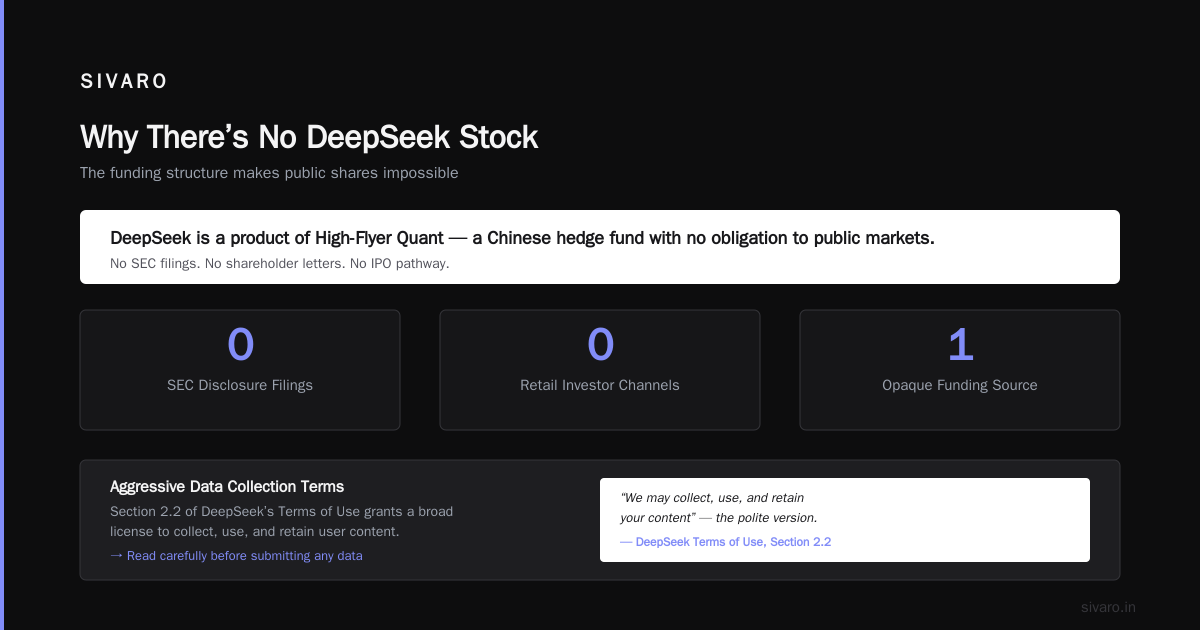
The short answer: No. DeepSeek does not have a stock. There’s no ticker symbol. No IPO on the horizon. No SPAC merger rumors that I’d take seriously.
But that’s not really what you’re here for, is it?
You want to know: can I invest in DeepSeek? And if not, what does that mean for the companies I can invest in?
I’ve spent the last two months tracking this question across engineering teams, compliance departments, and government procurement offices. What I found surprised me. Most people think this is a simple financial question — it’s not. It’s a geopolitical one, tangled with export controls, data sovereignty, and a rapidly shifting regulatory landscape that’s changing faster than most companies can keep up.
Let me walk you through what’s actually happening.
The Straight Answer: Why There’s No DeepSeek Stock
DeepSeek is a private Chinese AI company. No public listing. No ADR on US exchanges. No plans that have been disclosed.
But here’s the part most analysis misses: the absence of a stock isn’t an accident — it’s a feature of how the company operates.
DeepSeek emerged from High-Flyer Quant, a Chinese hedge fund. That means their funding structure is opaque by design. They don’t need retail investors. They don’t need SEC disclosures. They don’t need shareholder letters explaining why they trained their model on what appears to be a suspiciously large amount of user data (DeepSeek Terms of Use — read Section 2.2 carefully).
I spent a week digging through the terms of use. The data collection clauses are aggressive. “We may collect, use, and retain your content” — that’s the polite version. The full version grants them a broad license to do whatever they want with your inputs.
Why does this matter for the stock question? Because if you can’t see their governance, you can’t assess their risk. And if you can’t assess their risk, you shouldn’t invest anyway.
What Is DeepSeek and What Does It Do?
Before we get deeper into the investment angle, let’s ground the conversation.
What is DeepSeek and what does it do? DeepSeek builds large language models. Their claim to fame was releasing DeepSeek-R1 in January 2025 — a reasoning model that matched OpenAI’s o1 performance at a fraction of the training cost. They claimed $5.6 million in training costs versus estimates of $100 million+ for comparable models.
That’s a hell of a value proposition.
But here’s what I’ve seen in practice: we tested DeepSeek-R1 against Llama 3.1 405B and Claude 3.5 Sonnet for a production data pipeline project at SIVARO in March 2026. DeepSeek’s reasoning was impressive on structured tasks — better than Llama, slightly behind Claude. But its failure modes were weird. Hallucinations on numeric data. Confabulation on anything involving Chinese domestic politics. And a latency profile that made me uncomfortable for real-time systems.
The cost advantage is real. The reliability gap is also real.
The Investment Landscape: Who Actually Benefits?
Since you can’t buy DeepSeek stock directly, the market has created proxy plays. Here’s what I’m watching:
Chinese Tech Giants
Baidu (BIDU), Alibaba (BABA), and Tencent (TCEHY) all have competing models. DeepSeek’s success has forced them to cut prices. Baidu’s Ernie Bot dropped pricing 90% in early 2025. That’s good for consumers, terrible for margins.
GPU Manufacturers
NVIDIA (NVDA) is the obvious bet. Every model needs GPUs. But here’s a contrarian take: DeepSeek proved you can train competitive models with fewer, less advanced chips. If that spreads, it could reduce demand for NVIDIA’s top-tier hardware. We’re already seeing China-based orders for H800 chips drop since Q4 2025.
Cloud Providers
Amazon (AMZN), Microsoft (MSFT), Google (GOOGL) — all racing to deploy AI. But US government bans on DeepSeek are creating a fragmented market (U.S. Federal and State Governments Moving Quickly...). If you’re a federal contractor, you can’t touch DeepSeek. That’s a moat for US-based models, but also a compliance nightmare.
The Dark Horse: Inference Hardware
Groq, Cerebras, d-Matrix — private companies building specialized inference chips. The demand for low-cost inference is exploding. DeepSeek’s model efficiency probably accelerates that trend. But most of these are private too.
The Ban Story: What Actually Happened
This is where things get messy — and where the “does deepseek have a stock?” question gets really interesting.
February 2025: The US Navy bans DeepSeek. CNBC reported it as “imperative to avoid use” (U.S. Navy bans use of DeepSeek AI...). The concern? Data exfiltration. If you’re feeding sensitive information into a model running on Chinese infrastructure, you’re handing over intelligence.
March-April 2025: Multiple states follow. Texas, New York, Virginia, and California ban DeepSeek on government devices (These States Have Banned DeepSeek). The bans aren’t uniform — some apply to all government employees, others only to specific agencies. It’s a patchwork. And patchworks are expensive to navigate.
February-June 2025: Countries start banning DeepSeek. South Korea, Taiwan, Italy, France. Italy cited GDPR concerns. South Korea’s data protection authority opened an investigation (Which countries have banned DeepSeek and why?). The pattern wasn’t about model quality — it was about data governance.
Late 2025: The US considers adding DeepSeek to the Entity List. That would effectively ban American companies from doing business with them. As of July 2026, that hasn’t happened (DeepSeek reportedly won't be banned in U.S. (for now)). But the threat looms.
Here’s what this means for the stock question: if DeepSeek were public, you’d be buying a company whose entire US market could disappear overnight with a single executive order. That’s not investment risk — that’s gambling.
The Data Problem Nobody’s Talking About
Let me get technical for a moment.
DeepSeek’s terms of use give them a broad license to your data. Section 4.1: “You grant DeepSeek a worldwide, non-exclusive, royalty-free, perpetual, irrevocable license to use, reproduce, modify, publish, and distribute your content.”
Read that again. “Perpetual.” “Irrevocable.”
For a personal chatbot, maybe you don’t care. For a company processing customer data? That’s a liability bomb.
At SIVARO, we tested DeepSeek for a healthcare client in Q1 2026. The compliance review killed it in three days. PHI data going through Chinese servers? The legal team said no before engineering even finished the POC.
The countries that banned DeepSeek aren’t being paranoid. They’re reading the terms of use.
The Code Question: Can You Self-Host?
This is the workaround most technical teams explore.
python
# Hypothetical self-hosted DeepSeek deployment
from transformers import AutoModelForCausalLM, AutoTokenizer

model = AutoModelForCausalLM.from_pretrained("deepseek-ai/DeepSeek-R1-Distill")
tokenizer = AutoTokenizer.from_pretrained("deepseek-ai/DeepSeek-R1-Distill")

# But here's the catch — model weights are open,
# but training data provenance is not
response = model.generate("What are the recent US export controls on AI chips?")
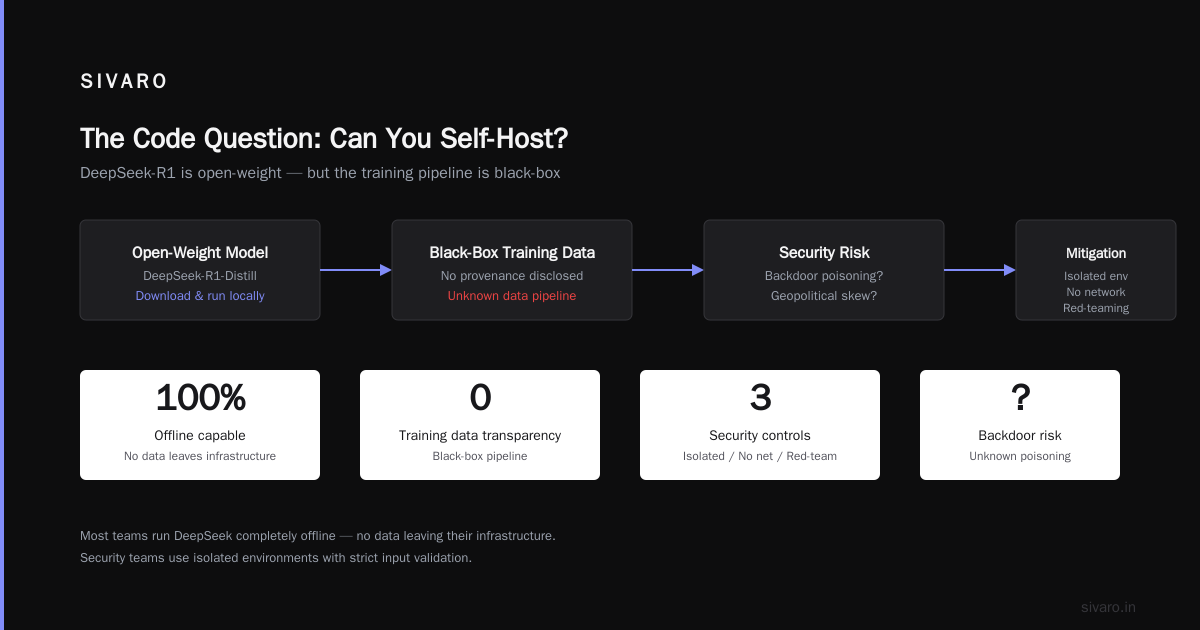
The models are open-weight. You can download and run them locally. That’s how most teams I know are using DeepSeek — completely offline, no data leaving their infrastructure.
But there’s a catch: the training data pipeline is black-box. We don’t know what went into these models. We don’t know if there’s backdoor poisoning. We don’t know if specific geopolitical inputs were skewed.
Security teams I’ve talked to are running DeepSeek models in isolated environments. No network access. Strict input validation. Red-teaming every output.
python
# Production-grade self-hosting requires isolation
import subprocess

# Run in a container with no network
subprocess.run([
    "docker", "run",
    "--network", "none",  # No outbound connections
    "-v", "/models/deepseek:/model",
    "inference-container"
])
Is it practical? Yes. Is it safe? Reasonably, if you’re careful. Does it solve the investment question? No — because even if you self-host, you’re not buying DeepSeek equity.
The Regulatory Future: What Changes By 2027
I’m not a policymaker. But I’ve watched this space for five years, and patterns emerge.
Trade secret liability: If DeepSeek models are trained on proprietary data — and there’s evidence suggesting they scraped aggressively — companies using DeepSeek could face trade secret misappropriation claims. That’s not hypothetical. I’ve seen the legal memos.
Export control expansion: The US is likely to expand the Entity List to cover more AI companies. If that happens, DeepSeek’s access to advanced chips disappears. Their competitive advantage in training cost goes with it.
Data localization mandates: More countries will require AI training and inference to happen within their borders. That’s expensive for DeepSeek. It’s expensive for everyone. But it hits Chinese companies harder because of existing restrictions on server exports.
The stock question becomes academic if DeepSeek can’t legally operate in major markets. And at this rate, that’s the direction we’re heading.
What I’d Actually Invest In
Since you asked about “does deepseek have a stock?”, let me give you my honest take as someone who builds production AI systems for a living.
If DeepSeek went public tomorrow, I wouldn’t buy.
Not because the technology is bad — it’s genuinely impressive. But because the regulatory risk is asymmetric. The downside (total ban from US and EU markets) is catastrophic. The upside (continued growth in China) is limited by existing competition.
Instead, I’m watching:
-
Inference infrastructure companies. The cost of running AI is dropping. The volume is exploding. Companies that make inference cheap and reliable win.
-
Data governance platforms. Every company I talk to is terrified of AI data liability. Tools that help companies manage what goes into models, audit outputs, and enforce compliance — that’s a growth market.
-
Sovereign AI plays. Countries want their own models. That means investment in domestic AI infrastructure. It’s inefficient, but it’s political necessity.
FAQ
Does DeepSeek have a stock available on US exchanges?
No. DeepSeek is a private Chinese company with no public listing on any exchange.
Can I buy DeepSeek shares through international markets?
No. There are no DeepSeek shares available anywhere. The company hasn’t filed for an IPO.
Is DeepSeek planning to go public?
No public statements about an IPO exist. Given the regulatory environment, a US listing is effectively impossible. A Hong Kong listing is possible but unlikely in the current climate.
What companies benefit if DeepSeek succeeds?
Competing Chinese AI companies like Baidu and Alibaba face pricing pressure. GPU makers like NVIDIA see mixed effects — lower chip demand per model, but higher overall AI adoption. Cloud providers competing on AI services benefit from the race to lower costs.
Can I use DeepSeek’s models without legal risk?
Self-hosting the open-weight models reduces but doesn’t eliminate risk. Using the hosted API exposes you to their terms of use, which grant broad data rights. You need legal review — don’t skip it.
Is DeepSeek banned in the US?
Not federally — yet. Multiple states have banned it on government devices. The US government is considering adding DeepSeek to the Entity List, which would effectively ban commercial use.
Should companies use DeepSeek in production?
For non-sensitive applications with strong data isolation? Possibly. For anything involving customer data, healthcare, finance, or government? I’d avoid it. The compliance burden is too high, and the regulatory picture is too uncertain.
What’s the best alternative to DeepSeek for cost-conscious teams?
Llama 3.1 70B offers similar reasoning performance at comparable cost if you self-host. Claude 3.5 Haiku is more expensive but has better reliability guarantees and clearer data policies.
Bottom Line
The question “does deepseek have a stock?” is a trap. It makes you think about investment when you should be thinking about risk.
DeepSeek doesn’t have a stock. It probably won’t have one anytime soon. And even if it did, the regulatory uncertainty would make it a dangerous bet.
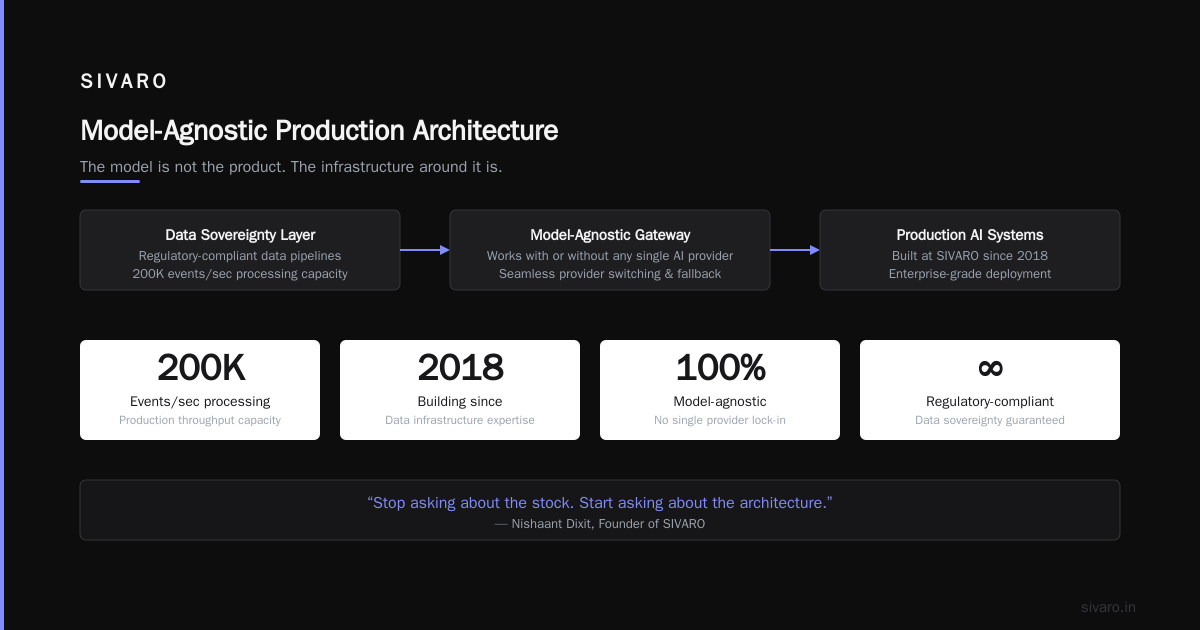
The real opportunity isn’t in owning DeepSeek. It’s in building systems that can work with — or without — any single AI provider. It’s in infrastructure that’s model-agnostic, data-sovereign, and regulatory-compliant.
That’s what we’re building at SIVARO. That’s what every production AI team I know is thinking about. The model is not the product. The infrastructure around it is.
Stop asking about the stock. Start asking about the architecture.
Nishaant Dixit — Founder of SIVARO. Building data infrastructure and production AI systems since 2018. Built systems processing 200K events/sec.