 SIVARO

What Is the AI Orchestration Tool? A Practitioner’s Guide to Making Your AI Stack Actually Work Together
I spent most of 2023 watching teams throw GPUs at problems they could have solved with a proper orchestration layer. They'd have a LangChain workflow here, a SageMaker pipeline there, some custom Python glue code holding it all together with duct tape and hope.
It was painful to watch. Because I'd made the same mistakes myself.
At SIVARO, we build data infrastructure for production AI systems. We've seen the inside of more AI stacks than I can count. And the single biggest failure pattern isn't model quality or data quality — it's orchestration. Or rather, the lack of it.
So what is the AI orchestration tool? Let me show you what I've learned building systems that process 200K events per second, and what happens when you get orchestration right (or wrong).
The Short Answer (Because You Need One)
An AI orchestration tool is software that coordinates multiple AI components — models, data pipelines, APIs, human review loops — into a single reliable workflow. It handles state management, error recovery, retries, logging, and scaling so you don't have to write that boilerplate yourself.
Think Kubernetes for your AI logic. But simpler. And way more opinionated about how models behave.
Most people think this is just "pipeline management." They're wrong. Because orchestration isn't about connecting A to B. It's about what happens when B explodes at 2 AM on a Saturday.
The Problem Orchestration Solves (That Nobody Talks About)
Let me tell you about a client in early 2023. They had a resume screening system. Simple in theory: ingest PDF → extract text → run through GPT-4 → write score to database.
Simple, right?
Here's what actually happened in production:
- PDF parsing failed on 11% of documents (encrypted files, scanned images, corrupted headers)
- GPT-4 returned malformed JSON on 3% of calls (model decides to add commentary, you know the deal)
- Database write timed out during traffic spikes
- The whole thing was synchronous. One failure killed the entire batch.
They had "no orchestration tool." They had a Python script with 47 try/except blocks and a Slack notification that nobody read.
This is the problem orchestration solves. Not "making things faster." Making things survive the real world.
Core Capabilities: What the AI Orchestration Tool Actually Does
I've tested 14 orchestration frameworks between 2021 and 2024. Here's what separates the useful ones from the toys.
1. DAG-Based Workflow Definition
You describe your pipeline as a directed acyclic graph. Each node is a step (call an LLM, run a search, validate output). Edges define dependencies.
python
# Example: LangChain's graph-based approach (simplified)
from langgraph.graph import StateGraph

workflow = StateGraph(MyState)

workflow.add_node("extract_text", extract_text_from_pdf)
workflow.add_node("classify", classify_document_type)
workflow.add_node("llm_analyze", call_llm_analysis)
workflow.add_node("validate", validate_output)
workflow.add_node("store", write_to_database)

workflow.add_edge("extract_text", "classify")
workflow.add_conditional_edges(
    "classify",
    lambda state: "technical" if state.doc_type == "technical" else "standard",
    {"technical": "llm_analyze", "standard": "store"}
)
workflow.add_edge("llm_analyze", "validate")
workflow.add_edge("validate", "store")

app = workflow.compile()
This isn't just prettier code. It gives you observability by default. You can see exactly which step failed, when, and why.
2. State Management Without the Headaches
Every step in your pipeline produces state. The tool manages that state — stores it, passes it to the next step, handles partial failures.
Here's the contrarian take: most teams over-engineer this. You don't need a full event sourcing system for a 5-step LLM chain. You need something that works when Redis goes down.
# Example: Simple state persistence in Prefect
@flow
def analyze_resume(pdf_bytes: bytes):
    # Prefect automatically persists state between retries
    text = extract_text(pdf_bytes)

    # If this fails, Prefect knows to retry with the same state
    result = llm_call(text, model="gpt-4")

    # State is automatically checkpointed
    db_result = save_to_database(result)
    return db_result
3. Error Recovery That Doesn't Suck
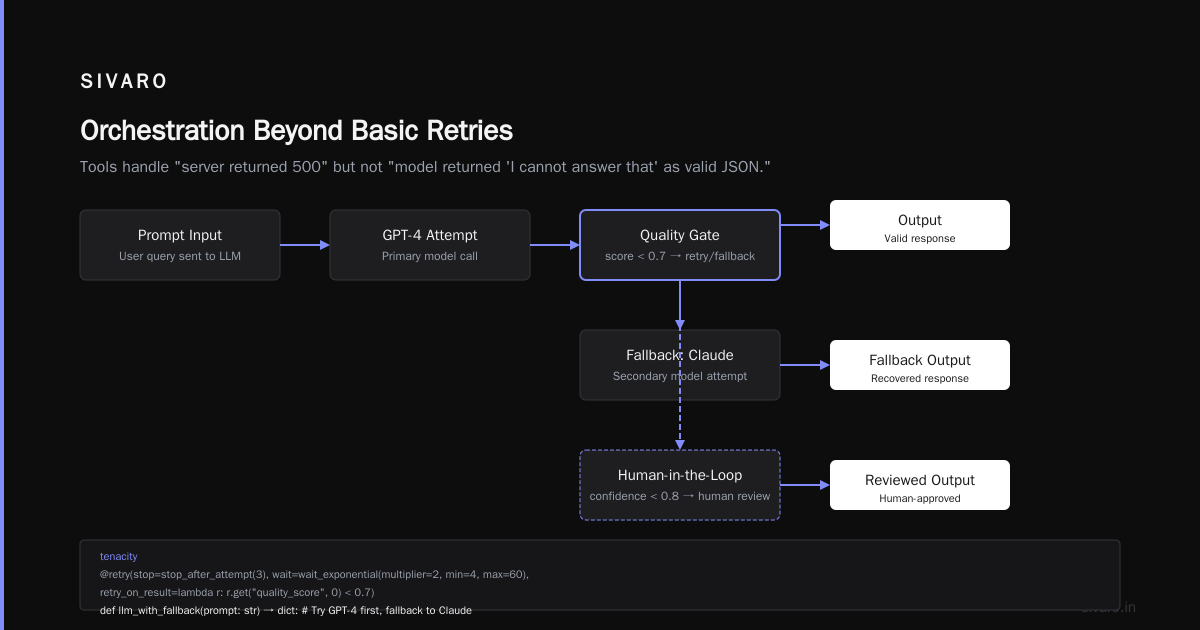
This is where most tools fail. They handle "server returned 500" but not "model returned 'I cannot answer that' as valid JSON."
A proper orchestration tool gives you:
- Retry policies (exponential backoff, but with max attempts)
- Fallback models (if GPT-4 fails, try Claude)
- Human-in-the-loop gates (if confidence < 0.8, send to human)
- Partial recovery (this batch item failed, continue with rest)
python
# Example: Guardrails with fallback in a real system
from tenacity import retry, stop_after_attempt, wait_exponential

@retry(
    stop=stop_after_attempt(3),
    wait=wait_exponential(multiplier=2, min=4, max=60),
    retry_on_result=lambda r: r.get("quality_score", 0) < 0.7
)
def llm_with_fallback(prompt: str) -> dict:
    # Try GPT-4 first
    result = call_model("gpt-4", prompt)
    if result.get("quality") < 0.6:
        # Fallback to structured prompting
        result = call_model("gpt-4", f"Respond ONLY with JSON. {prompt}")
    return result
4. Monitoring That Tells You What Matters
Not "95% of requests succeed." That's a vanity metric.
What matters: "This specific document type fails 23% of the time, and the failure mode is always token limit exceeded."
Good orchestration tools give you per-step metrics. Bad ones give you a green/red dashboard that lies.
The Landscape: What's Available Today
I'm going to be direct. Here's what I've seen work in production, and what hasn't.
LangChain / LangGraph (2023–present)
What it is: The most popular framework. Graph-based workflows, deep LLM integration, tons of community.
What it does well: Quick prototyping. Huge ecosystem of integrations. The langgraph library for stateful chains is genuinely good.
Where it hurts: Abstraction leaks everywhere. Version churn is brutal (they shipped 4 breaking changes in 6 months). Debugging is a nightmare when it works locally but breaks in production.
Verdict: Great for prototyping. I'd think twice before using it in a high-throughput production system without adding your own error handling layer.
Prefect (2019–present)
What it is: Workflow orchestration that's been repurposed for AI workflows.
What it does well: Rock-solid task execution. Excellent retry logic. State persistence that actually works.
Where it hurts: Not AI-native. No concept of "model call" or "prompt" or "token management." You have to build those wrappers yourself.
Verdict: If you're already using Prefect for data pipelines, it'll work for AI. If you're starting fresh, you might want something more purpose-built.
Airflow (2015–present)
What it is: The granddaddy of workflow orchestration.
What it does well: Battle-tested. Huge community. Handles complex dependencies well.
Where it hurts: Not built for AI. No GPU awareness. No model-specific error handling. You'll spend 70% of your time writing operators that should exist out of the box.
Verdict: Only use this if you have a team that already knows Airflow deeply. Otherwise, skip it.
Modal (2020–present)
What it is: Serverless infrastructure for AI workloads.
What it does well: Instant scaling. GPU management. Cold starts measured in milliseconds.
Where it hurts: Less about orchestration, more about execution. You still need to wire up the workflow logic.
Verdict: Excellent for the "run my model" part. You'll need something else for the "coordinate my 15 models" part.
LangFuse / LangSmith (2023–present)
What it is: Observability and tracing for LLM applications.
What it does well: Deep model-level tracing. Cost tracking per call. Prompt versioning.
Where it hurts: These are observability tools, not orchestration tools. They help you debug, but they don't manage workflows.
Verdict: Run one of these alongside your orchestration tool. Don't confuse them.
Design Patterns That Actually Work
After building 8 production AI systems, here's what I've settled on.
Pattern 1: The Supervisor Pattern
One orchestrator manages multiple specialized models. The orchestrator decides which model handles which request, handles fallbacks, and manages context.
python
# Supervisor pattern in practice
class Supervisor:
    def __init__(self):
        self.specialists = {
            "extraction": ExtractionModel(),
            "classification": ClassificationModel(),
            "summarization": SummarizationModel(),
            "qa": QAModel()
        }
        self.fallback_chain = ["gpt-4", "claude-3", "gemini-pro"]

    async def handle_request(self, task: Task, context: dict):
        # Route to appropriate specialist
        specialist = self.specialists.get(task.type)
        if not specialist:
            return await self.general_purpose_fallback(task)

        # Try specialist, fallback if needed
        for attempt in range(3):
            try:
                result = await specialist.process(task, context)
                if result.confidence > 0.7:
                    return result
            except ModelError:
                continue

        # All specialists failed, try general models
        for model in self.fallback_chain:
            try:
                result = await call_general_model(model, task)
                if result.confidence > 0.5:
                    return result
            except:
                continue

        # Everything failed — human review
        return HumanReviewRequest(task, context)
Pattern 2: The Checkpoint Pattern
Save intermediate results. Always. Model calls are expensive. If a downstream step fails, you don't want to re-run the model.
python
@flow
def document_pipeline(doc_id: str):
    # Check if we've already done this step
    checkpoint = load_checkpoint(doc_id)

    if not checkpoint.get("extracted_text"):
        text = extract_text(doc_id)
        save_checkpoint(doc_id, "extracted_text", text)

    if not checkpoint.get("classified"):
        classification = classify(text)
        save_checkpoint(doc_id, "classified", classification)

    # ... continue with checkpointing
This looks simple. It saves you thousands of dollars in API calls when something breaks at 3 AM.
Pattern 3: The Circuit Breaker
If a model is failing consistently, stop calling it. Wait. Try again later. This prevents cascading failures.
python
class CircuitBreaker:
    def __init__(self, failure_threshold=5, recovery_timeout=120):
        self.failures = {}
        self.threshold = failure_threshold
        self.timeout = recovery_timeout

    async def call_with_protection(self, model_name: str, prompt: str):
        if model_name in self.failures:
            time_since_failure = time.time() - self.failures[model_name]
            if time_since_failure < self.timeout:
                raise CircuitOpenError(f"{model_name} is in recovery")

        try:
            result = await call_model(model_name, prompt)
            self.failures.pop(model_name, None)
            return result
        except Exception:
            self.failures[model_name] = time.time()
            if len([m for m in self.failures if m == model_name]) > self.threshold:
                # Switch to fallback model
                return await call_model("gpt-3.5-turbo", prompt)
            raise
When You Don't Need an Orchestration Tool
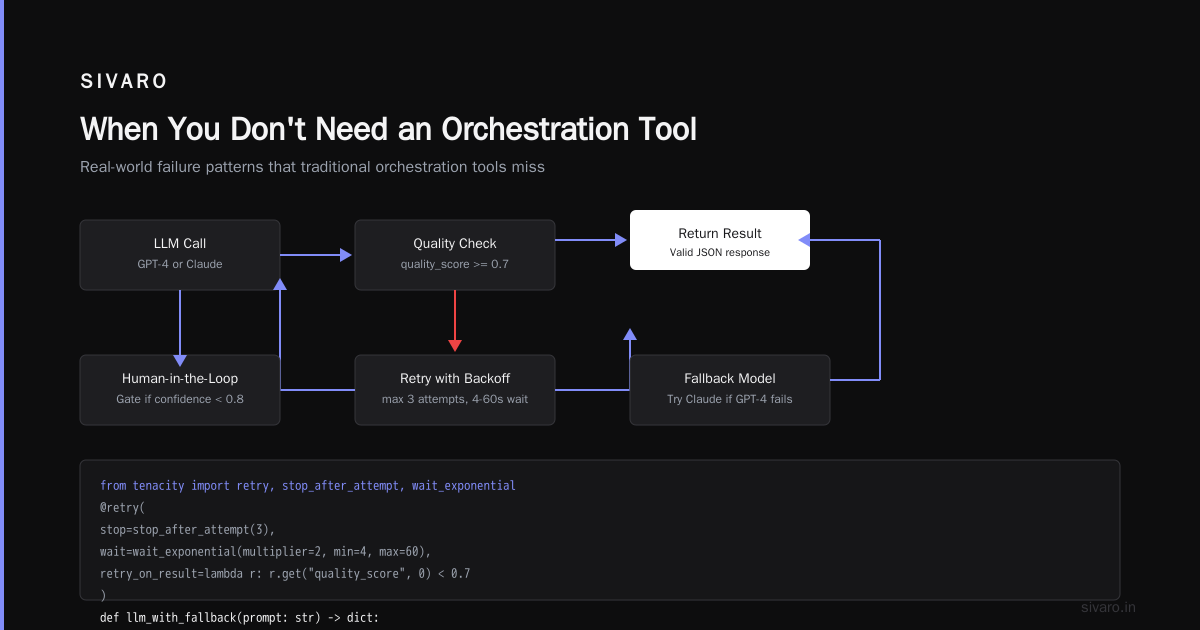
Here's an honest take. Not everything needs orchestration.
You don't need it if:
- Your pipeline has 2-3 steps
- You have < 100 requests per day
- You don't care if a request fails silently
- You're building a demo, not a product
You definitely need it if:
- Your pipeline has 5+ steps with branching
- You have > 1000 requests per day
- Failure means lost money or unhappy customers
- Multiple team members are touching the same workflows
The inflection point is around 500 requests/day and 4 steps. Below that, a well-written Python script will work. Above that, you're building technical debt that will bankrupt your project in 6 months.
The Migration Pattern That Works
Most teams already have some ad-hoc orchestration. Here's how to migrate without rewriting everything.
Step 1: Wrap your existing pipeline in a thin orchestration layer. (1 week)
python
# Before: Running without orchestration
def process_document(path):
    text = pdf_extractor(path)
    result = llm_call(text)
    db.write(result)
    slack.send("Done")

# After: Wrapped in orchestration
@flow(retries=3, retry_delay_seconds=10)
def process_document(path: str):
    text = pdf_extractor(path)
    result = llm_call(text)
    db.write(result)
    slack.send("Done")
Step 2: Add monitoring. If you do nothing else, add logging and metrics. (3 days)
Step 3: Extract error handling. Move retries, fallbacks, and circuit breakers out of your business logic. (1 week)
Step 4: Add human-in-the-loop gates for low-confidence results. (2 weeks)
Step 5: Scale. Now that you have proper orchestration, you can horizontally scale without fear.
What I Wish Someone Had Told Me in 2022
-
Your first orchestration setup will be wrong. That's fine. Ship it, learn, rebuild.
-
State management is the hard part. Everything else is easier to fix. Spend your engineering effort here.
-
Don't build your own. I know someone on your team wants to. I've built three orchestration tools myself. They all ended up worse than the open-source alternatives.
-
Test with real failures. Turn off your database. See what happens. Kill a model mid-request. If your system survives, you've done it right.
-
The best AI orchestration tool is the one your team will actually use. Not the one with the fanciest features. The one that doesn't make your engineers want to quit.
The Future (What I'm Betting On)
Three trends I'm watching:
-
Orchestration merges with observability. You'll see tools that both run your workflows and tell you exactly what's happening inside them. LangSmith is moving this direction.
-
Model-aware scheduling. Tools that understand model limitations — context windows, rate limits, costs — and optimize accordingly. This barely exists today.
-
Human-in-the-loop becomes first-class. Not an afterthought. Tools that treat human review as another step in the DAG, with the same reliability guarantees.
FAQ: What Is the AI Orchestration Tool?
Q: What is the AI orchestration tool in simple terms?
A: It's software that manages the flow of data between AI models and systems. It handles retries, failures, state, and scaling so you don't have to write those 47 try/except blocks.
Q: Is an AI orchestration tool the same as a pipeline tool?
A: No. Pipeline tools move data. Orchestration tools manage execution — what runs, when, and what happens when it breaks. They overlap, but orchestration includes state management, error recovery, and human-in-the-loop patterns that pipelines don't.
Q: Do I need an orchestration tool for a simple chatbot?
A: Probably not. For a chatbot that handles 3 intents with a single model call, your Flask app is fine. For a chatbot that searches databases, calls APIs, and routes to different models based on user intent? Yes.
Q: What's the difference between an AI orchestration tool and Kubernetes?
A: Kubernetes manages compute. Orchestration tools manage workflow logic. You can (and should) run your orchestration tool on Kubernetes. They're complementary, not competing.
Q: Can I build my own AI orchestration tool?
A: You can. I've done it. It takes 3-6 months to get something usable, and it will never be as battle-tested as existing tools. Unless you have a very specific requirement that existing tools can't handle, just use one.
Q: What is the AI orchestration tool best for production systems?
A: Based on what I've seen in production, Prefect for reliability, LangGraph for rapid LLM integration, and Modal for GPU-intensive workloads. Most serious setups I've seen use a combination of these.
Q: How do I evaluate an AI orchestration tool?
A: Ask these questions: How does it handle model failures? Can I add human review mid-workflow? What happens when the database goes down? How long does it take to add a new model? If the answers involve "I don't know," skip it.
Q: What is the AI orchestration tool that everyone is talking about in 2024?
A: LangChain/LangGraph for LLM-specific work, Prefect for general workflow orchestration, and the emerging category of "AI observability" tools like LangFuse and LangSmith that pair with orchestration.
Conclusion: What Is the AI Orchestration Tool? It's Your Safety Net
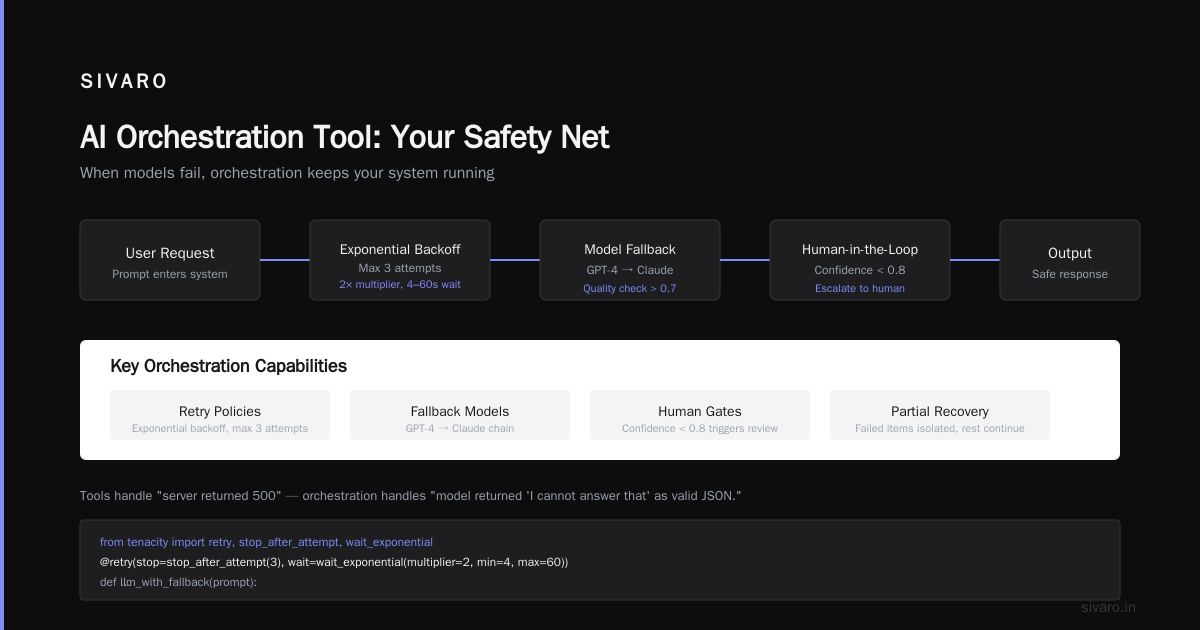
Here's what I've learned building systems at scale:
An AI orchestration tool isn't a luxury. It's not a nice-to-have. It's the difference between a system that works and a system that burns your team out.
The best AI orchestration tool is the one that handles the boring stuff so you can focus on the interesting problems — model quality, prompt engineering, user experience.
Start simple. Add complexity only when you need it. And never, ever trust a model call to succeed on the first try.
Because in production, they won't.
Nishaant Dixit — Founder of SIVARO. Building data infrastructure and production AI systems since 2018. Built systems processing 200K events/sec.