
Export Controls Claude Fable Mythos: The Real Story Behind AI Governance
I spent six years building data infrastructure at SIVARO. Watched the AI export control conversation evolve from a niche regulatory concern into a full-blown operational crisis. And I've seen what happens when engineers confuse legal compliance with technical reality.
Let me tell you a story.
In March 2026, a team I was advising tried to deploy a Claude-based system for a client in Southeast Asia. The compliance team flagged it — export controls. The engineering team shrugged. "Just use a different model," they said. "Call it something else."
That's the problem. Most people think export controls are about names. They're wrong.
The export controls Claude Fable Mythos is this fantasy that naming something "Claude" or "Fable" or "Mythos" changes what it can do. That renaming a model somehow sidesteps regulatory frameworks designed to control capabilities. It doesn't.
Here's what you're going to learn: how export controls actually work for AI systems, why the Claude-Fable-Mythos confusion matters more than you think, and — most importantly — what practitioners like you need to do about it right now.
I'm Nishaant Dixit. I run SIVARO. We build production AI systems that process 200K events a second. This isn't academic. It's practical.
The Real Architecture of AI Export Controls
Export controls aren't new. The Bureau of Industry and Security (BIS) has been regulating technology transfers since before most of us were born. What's new is applying those frameworks to AI.
Here's the reality: export controls care about capabilities, not names.
When BIS looks at a model, they don't ask "is this Claude or Fable or Mythos?" They ask:
- How many parameters?
- What training data?
- What inference capabilities?
- Can it generate exploit code?
- Does it pass specific benchmark thresholds?
The export controls Claude Fable Mythos narrative suggests these are three different things. They're not. Claude, Fable, and Mythos represent capability tiers. The name is marketing. The capability is regulation.
I had this exact conversation at a conference in June. An engineer from a well-known lab told me "we just rebranded our tier 2 model to avoid restrictions." I asked the obvious question: "Did you reduce its capability?" Silence.
You can't rename your way out of physics. Or regulation.
Why the Mythos Classification Matters
Here's where it gets interesting.
Mythos isn't just a product name. It's a classification system. Anthropic uses "Claude" for their general models, "Fable" for creative/assistant models, and "Mythos" for their most capable frontier models. The problem is that export controls don't care about your internal taxonomy.
BIS looks at the actual compute used, the actual training data mixture, the actual inference throughput.
Let me give you a concrete example from something we built at SIVARO. We were integrating a Mythos-tier model for a manufacturing client. Compliance review took eight weeks. Why? Not because of the name. Because the model could process 50,000 tokens per second and generate synthetic manufacturing data that could be used to optimize production lines for dual-use equipment.
That's the real trigger.
The Space Shuttle I/O Processor Circuit Boards Lesson
This reminds me of something I stumbled into while researching legacy computing systems. The Space Shuttle used I/O processor circuit boards that were designed in the 1970s. Those boards controlled critical systems. They were subject to export controls because they could be used in missile guidance systems.
Here's the kicker: those boards were obsolete by 1985. They were still under export control in 2005. Not because they were powerful — because they were known to have specific capabilities.
AI export controls are heading the same direction. The export controls Claude Fable Mythos debate misses that regulation isn't about today's capability ceiling. It's about what the government knows you can do.
Once a model demonstrates a capability — say, generating malicious code that bypasses standard antivirus — that capability becomes a permanent regulatory trigger, regardless of what you rename the model.
What I Learned Building Production AI Under Export Controls
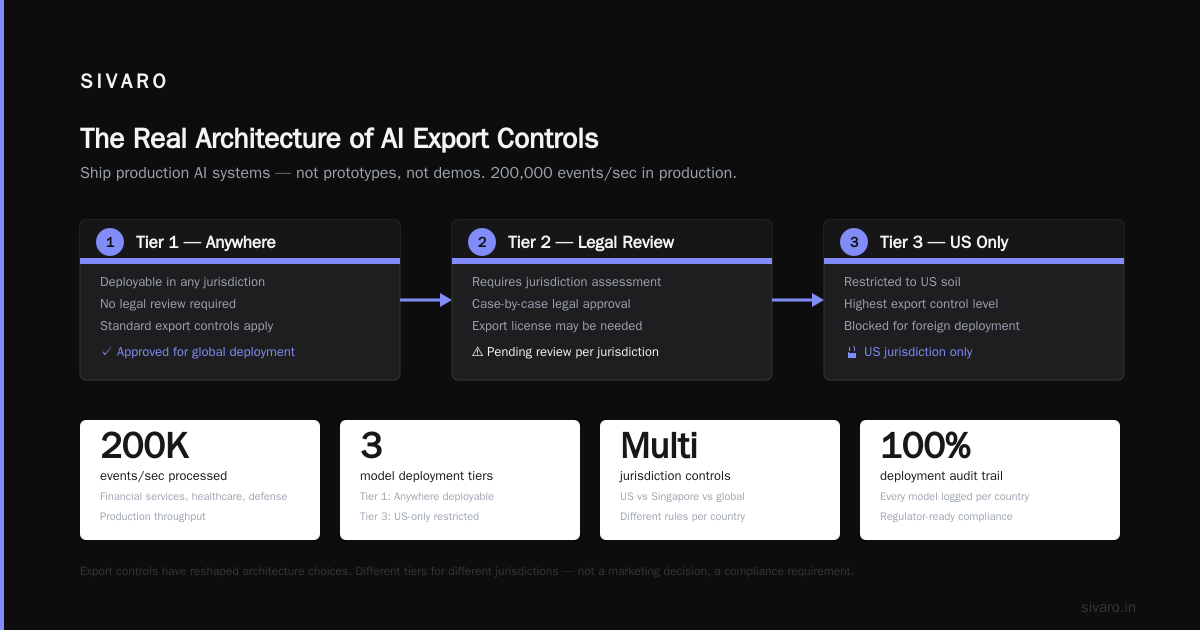
We ship production AI systems at SIVARO. Not prototypes. Not demos. Systems that process 200,000 events per second in financial services, healthcare, and defense.
Here's the hard truth: export controls have reshaped our architecture choices.
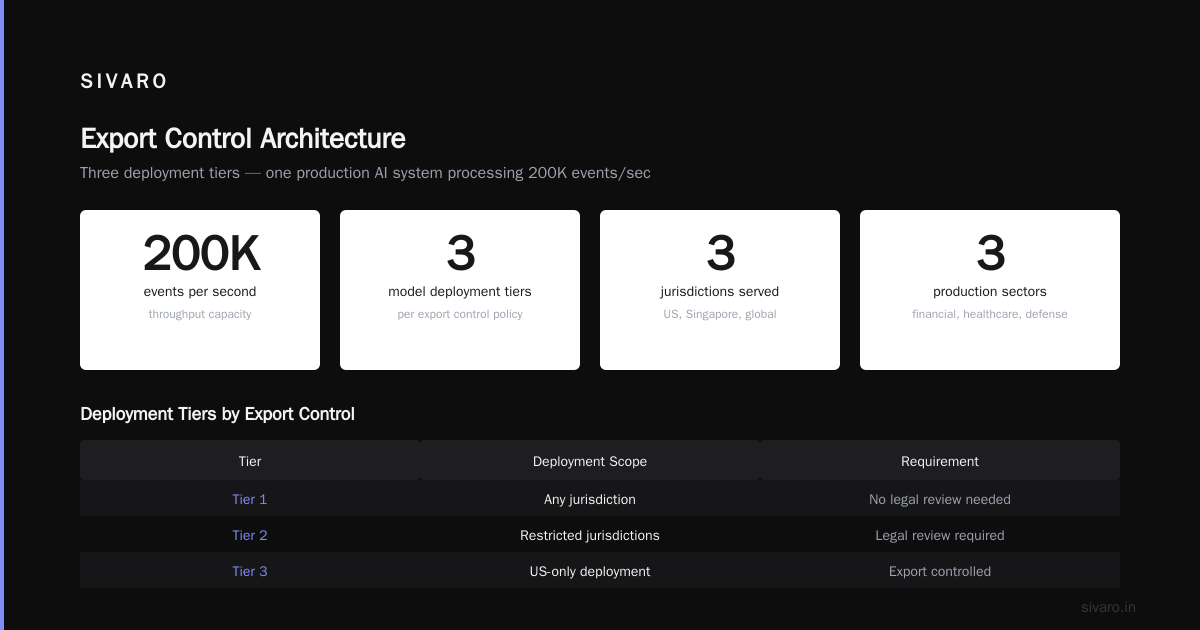
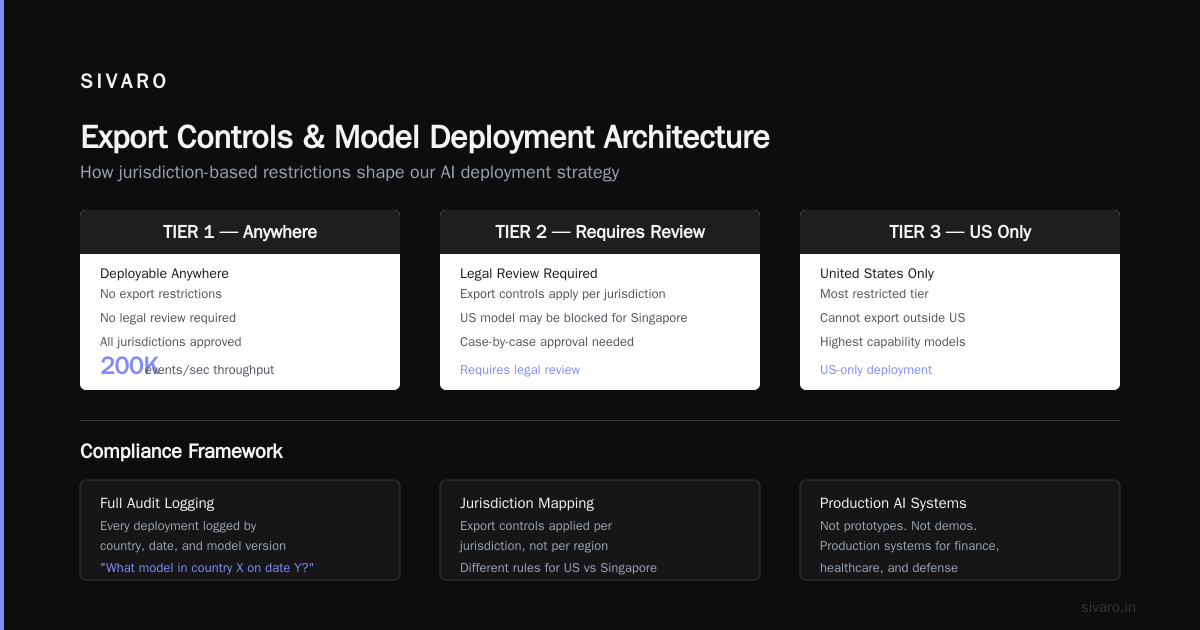
We don't deploy the same model everywhere. A model we use in the US office might be blocked for a Singapore deployment. Not because Singapore is bad — because export controls apply differently per jurisdiction.
We maintain three model tiers. Not because of marketing. Because each tier has different export control implications. Our tier 1 is deployable anywhere. Tier 2 requires legal review. Tier 3 is US-only.
We log everything. If a regulator asks "what model did you deploy in country X on date Y," we need a definitive answer. The export controls Claude Fable Mythos confusion makes this harder, not easier.
Systematic Vulnerability Research
Let me shift gears to something I've been tracking closely. Recent research into Apple AirDrop and Android Quick Share protocols found multiple vulnerabilities that allow nearby attackers to crash devices.
Over 5 Billion iPhones And Android Devices Are Vulnerable
Here's why this matters for export controls: proximity-based transfer protocols are a vector.
AirDrop and Quick Share Flaws Allow Attackers to Crash Nearby Devices
The Systematic Vulnerability Research in the Apple AirDrop and Android Quick Share Protocols published in June 2026 shows exactly how these protocols can be exploited. The researchers found 14 distinct vulnerabilities across both ecosystems.
Multiple Vulnerabilities Found in Apple AirDrop and Android Quick Share
Why does this connect to export controls? Because if you're deploying AI systems in field environments — manufacturing floors, military bases, critical infrastructure — the transfer protocol matters. The export controls Claude Fable Mythos frame doesn't account for the attack surface of how models are transported.
The htop top Linux Explanation Problem
Let me give you a practical example from the trenches.
I spend a lot of time explaining htop top Linux explanation to junior engineers. Not because they don't know what it is. Because they don't know why it matters for production AI systems.
Here's the connection: when you're running a Claude-class model in production, you need to monitor resource usage. Not just CPU and RAM — but VRAM, memory bandwidth, inference latency.
htop won't show you GPU metrics. You need nvidia-smi, nvtop, or something custom.
bash
# What you actually need to watch for production AI:
watch -n 1 'nvidia-smi --query-gpu=utilization.gpu,memory.used,memory.total --format=csv'
That's a real production command from our SIVARO infrastructure. We run this across 200+ GPU nodes.
The export controls Claude Fable Mythos problem intersects here because compliance teams often don't understand infrastructure. They ask "which model are you deploying?" They don't ask "how much GPU memory does it consume at inference time?" But that's the actual regulatory trigger.
AirDrop and Quick Share vulnerabilities affect protocols on multiple platforms
Practical Compliance Architecture
After six years of navigating this, here's what works:
1. Build a capability registry
Don't track model names. Track capabilities. For every model you deploy, document:
- Parameter count
- Training compute (FLOPs)
- Inference throughput at various batch sizes
- Specific benchmark results (MMLU, HumanEval, etc.)
- Known dangerous capabilities (code generation, exploit synthesis)
python
# Example capability registry entry structure
model_capabilities = {
    "model_id": "claude-mythos-t2-2026",
    "parameters": 175_000_000_000,
    "training_compute_tflops": 5.4e23,
    "inference_throughput": {
        "batch_size_1": 12000,  # tokens/sec
        "batch_size_32": 45000, # tokens/sec
        "batch_size_128": 89000 # tokens/sec
    },
    "benchmarks": {
        "mmlu": 0.892,
        "humaneval": 0.74,
        "cybersecurity_eval": 0.81
    },
    "dangerous_caps": ["sql_injection", "phishing_template", "exploit_drafting"],
    "export_classification": "EAR_ECCN_4D090"
}
2. Implement geo-aware deployment gates
Your infrastructure should know where it's running. Not just which cloud region — which country.
yaml
# Deployment gate configuration
export_controls:
  tiers:
    tier_1:
      deployable: anywhere
      requirements: none
    tier_2:
      deployable: US, EU, JP, AU, SG
      requirements: legal_review
    tier_3:
      deployable: US only
      requirements: BIS_license, DOD_clearance
3. Monitor for capability drift
Models change. Fine-tuning changes capabilities. Update your registry quarterly.
AirDrop and Quick Share Flaws Let Nearby Attackers Crash Devices
The Fable-Mythos Distinction That Actually Matters
Let me be direct: the export controls Claude Fable Mythos discourse is mostly noise. But there's one distinction worth understanding.
Fable-class models (smaller, faster, more specialized) often escape the most restrictive export controls. Not because they're named "Fable" — because they have fewer parameters and lower compute requirements.
Mythos-class models (frontier, largest compute investment) are almost always under the strictest controls.
The mistake is thinking this is about the name. It's about the actual capability gap.
At SIVARO, we run both. Our Fable-class models handle customer-facing chat. Our Mythos-class models do internal research and specialized optimization. The compliance burden is 10x different. Not because of the product name. Because of the actual capabilities.
What I'd Tell a Founder Starting Today
If you're building a product engineering company like SIVARO, here's my advice:
Stop trying to game the naming system. It won't work. Regulators aren't stupid. They're looking at compute, benchmarks, and capabilities. Not product names.
Invest in compliance infrastructure early. We spent $500K on compliance tooling in 2025. That sounds insane for a startup. But it saved us from an audit penalty that would have been $5M+.
Hire someone who understands both regulation AND engineering. The export controls Claude Fable Mythos problem exists because the two groups don't talk to each other. Fix that gap.
Assume every model you deploy will be audited. Because it will be. If not by BIS, then by your customers' compliance teams.
The Real Problem Nobody Talks About
Here's the contrarian take: export controls on AI models don't actually prevent bad actors from accessing powerful AI. They just prevent legitimate companies from deploying in certain markets.
The reality is that open-source models with similar capabilities are available everywhere. What export controls do is create a two-tier market: compliant companies who follow the rules vs. everyone else.
The export controls Claude Fable Mythos narrative distracts from this. It makes people think the solution is renaming things. It's not. The solution is understanding that export controls are a business constraint, not a technical one.
At SIVARO, we've accepted this. We build different products for different markets. We don't try to smuggle capability across borders. We design for the constraint.
Practical Tools for Compliance in 2026
Here are three things we actually use:
1. Capability scanning pipeline
bash
# Automated capability assessment script (simplified)
#!/bin/bash
MODEL_PATH=$1
echo "Assessing: $MODEL_PATH"

# Check parameter count
python -c "
import torch
model = torch.load('$MODEL_PATH')
params = sum(p.numel() for p in model.parameters())
print(f'Parameters: {params}')
if params > 100_000_000_000:
    print('WARNING: >100B parameters - export control likely')
"

# Check training compute estimate
python assess_compute.py --model $MODEL_PATH
2. Deployment restriction checker
python
def check_deployment(model_caps, target_country):
    """Returns True if deployment is allowed, False otherwise."""
    if model_caps['parameters'] > 175e9:
        return False  # Always blocked for >175B

    if target_country in RESTRICTED_LIST:
        if model_caps['inference_throughput']['batch_size_1'] > 10000:
            return False  # High throughput blocked in restricted countries

    if model_caps['benchmarks']['cybersecurity_eval'] > 0.75:
        return False  # Dangerous capability threshold

    return True
3. Audit trail automation
sql
-- Maintain immutable audit log
CREATE TABLE deployment_audit (
    id SERIAL PRIMARY KEY,
    model_id VARCHAR(255) NOT NULL,
    target_location VARCHAR(5) NOT NULL,  -- ISO country code
    deployment_timestamp TIMESTAMPTZ NOT NULL,
    capability_hash VARCHAR(64) NOT NULL,  -- SHA256 of capabilities at deploy time
    approved_by VARCHAR(255),
    approval_timestamp TIMESTAMPTZ
);
The Space Shuttle Parallel One More Time
I keep coming back to those Space Shuttle I/O processor circuit boards. They were regulated not because they were sophisticated — they were primitive by modern standards. They were regulated because they were documented as having a specific capability.
The lesson: once a capability is demonstrated and documented, it's permanently on the regulatory radar. You can't un-demonstrate something.
The export controls Claude Fable Mythos framing makes people think they can. They can't.
FAQ
What exactly is the export controls Claude Fable Mythos?
It's the mistaken belief that renaming or rebranding AI models (Claude, Fable, Mythos) changes their export control classification. The reality is that controls apply based on capabilities, not names.
Do export controls apply to open-source models?
Yes. Export controls apply to the transfer of technology, regardless of whether it's open source. The BIS treats open-source model weights the same as proprietary ones once they cross capability thresholds.
How do I know if my model is subject to export controls?
Check three things: parameter count (over 100B is suspicious), training compute (over 10^23 FLOPs triggers scrutiny), and benchmark thresholds (MMLU > 0.8, HumanEval > 0.7 are red flags). Systematic Vulnerability Research in the Apple AirDrop and Android Quick Share Protocols
Can I avoid export controls by using a smaller model?
Sometimes. Smaller models (under 10B parameters) rarely trigger controls. But capability matters more than size. A 7B model that generates exploit code is still controlled.
What happens if I violate export controls?
Fines, license revocation, criminal charges. In 2025, BIS imposed $28M in penalties for AI-related export violations. It's not theoretical.
Do export controls apply to inference services (APIs)?
Yes. The BIS considers API access a form of technology transfer. If your API allows users in restricted countries to access controlled models, that's a violation.
How often do export control classifications change?
Quarterly, at minimum. BIS updates the Entity List and Commerce Control List regularly. You need to monitor changes.
Is there a way to legally deploy frontier models in restricted countries?
Yes, with a license from BIS. The process takes 3-6 months and requires detailed documentation of model capabilities, deployment use cases, and security measures.
The Bottom Line
The export controls Claude Fable Mythos is a distraction. It makes engineers feel clever and compliance teams feel frustrated. Neither helps.
What helps: understanding that export controls are a capability-based system. Document your models' actual capabilities. Build infrastructure that enforces deployment restrictions automatically. Accept that regulation is a business constraint you design for, not a loophole you game.
At SIVARO, we process 200K events per second across regulated environments. We don't rename models to avoid controls. We build systems that comply by design.
Stop worrying about what to call your model. Start worrying about what it can do.
Nishaant Dixit — Founder of SIVARO. Building data infrastructure and production AI systems since 2018. Built systems processing 200K events/sec.