GCP Certification Path for Beginners: What I Actually Learned Building Production Systems
I almost failed my first Google Cloud certification.
Not because I didn't know the material. I'd been running production workloads on GCP for two years at that point. The problem was I treated it like a college exam—memorize services, reproduce documentation, pass.
Turns out Google writes their exams like they build their infrastructure: they test whether you understand why something works, not just what it's called. Three certs later, I've got opinions on what actually matters for beginners.
Here's the path I'd design if I had to start over today.
Why GCP Over AWS or Azure in 2026
Let me get this out of the way: I run multi-cloud infrastructure at SIVARO. We process 200K events per second across all three major providers. I'm not Google's marketing arm.
But here's what I've seen play out professionally over the last two years.
The hyperscaler landscape has shifted hard. AWS vs Azure vs GCP 2026: Same App, 3 Bills does a brutal comparison of cost structures—and GCP's network egress pricing alone can save you 30-40% on data-heavy workloads. Not because Google is generous. Because their internal network architecture (Jupiter, Andromeda) is simply more efficient at scale.
Most people think AWS is the safe bet for careers. That was true in 2020. In 2026? Azure dominates enterprise because of Microsoft's sales relationships. GCP dominates AI/ML workloads because of TensorFlow, TPUs, and DeepMind integration. AWS is the generalist—good at everything, best at nothing.
If you're aiming for data engineering, ML engineering, or infrastructure roles at AI-forward companies, GCP certification path for beginners is actually the smarter play right now. I say this as someone who holds AWS certs too.
The Real Cost Picture (Nobody Talks About This)
Here's something I learned the hard way after rebuilding a client's data pipeline three times.
gcp bigquery pricing per query is simultaneously Google's biggest strength and sharpest trap. On-demand pricing at $5 per TB processed sounds reasonable until your analysts start running SELECT * on 10TB tables every 15 minutes. We saw a $47,000 monthly bill on a single BigQuery project before we caught it.
But here's the contrarian take: that's not a pricing problem. That's a design problem.
Google Cloud to Azure Services Comparison actually does a decent job showing how each cloud's pricing philosophy reflects their engineering culture. Azure charges by the hour for reserved capacity. Google charges by the operation for serverless consumption. Different mental models.
The trick for beginners: Google's pricing punishes bad queries and rewards good architecture. Learn to write efficient SQL and use partitioning/clustering, and BigQuery becomes comically cheap. We're talking $0.50 per TB for well-designed queries.
What's Actually Different About Google Cloud Certifications
I've taken exams from all three providers. Google's certs are different in ways that matter.
First, they're scenario-based, not definition-based. AWS asks "what service handles X?" Google asks "your streaming pipeline has 800ms latency and costs $12K/month—fix it." You have to think like an architect, not a product catalog.
Second, Google updates their exams frequently. Like, annoyingly often. The Associate Cloud Engineer exam I took in early 2025 had questions about services that were rebranded by mid-2025. You have to stay current.
Third, they're harder than they need to be. 60-65% pass rates aren't unusual. What's the Difference Between AWS vs. Azure vs. Google ... calls this out—GCP certs require deeper hands-on experience because Google assumes you'll actually build things, not just manage access controls.
The Beginner Certification Path I Actually Recommend
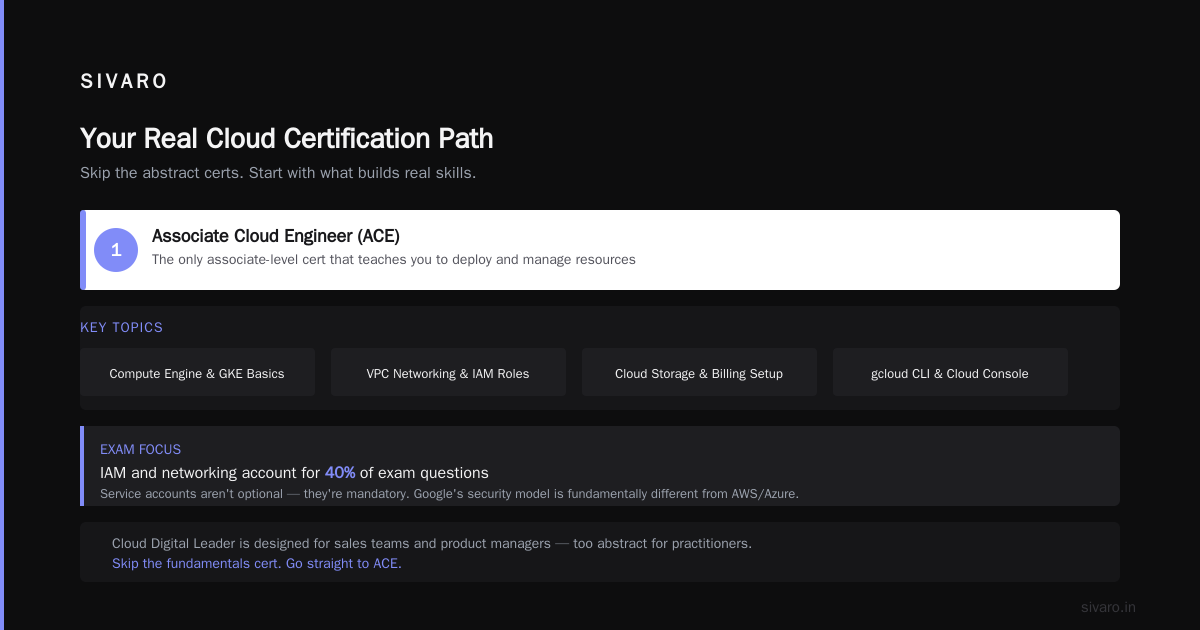
Stop reading blogs that tell you "start with Cloud Digital Leader." That cert is so abstract it's almost useless for practitioners. It's designed for sales teams and product managers.
Here's your real path.
Step 1: Associate Cloud Engineer (ACE)
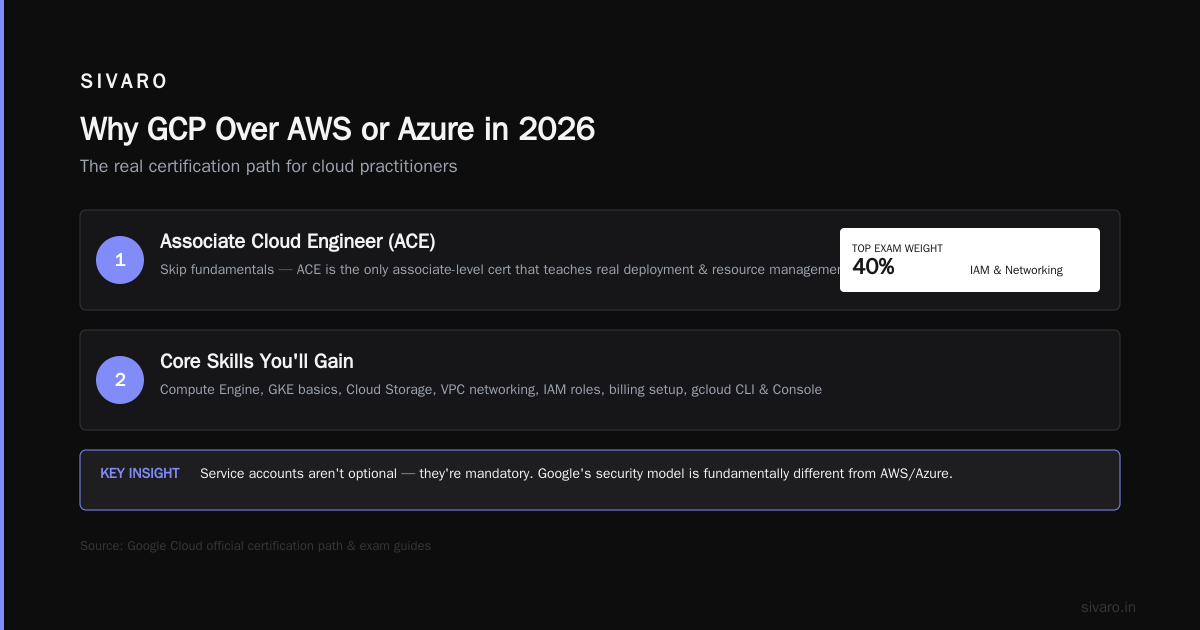
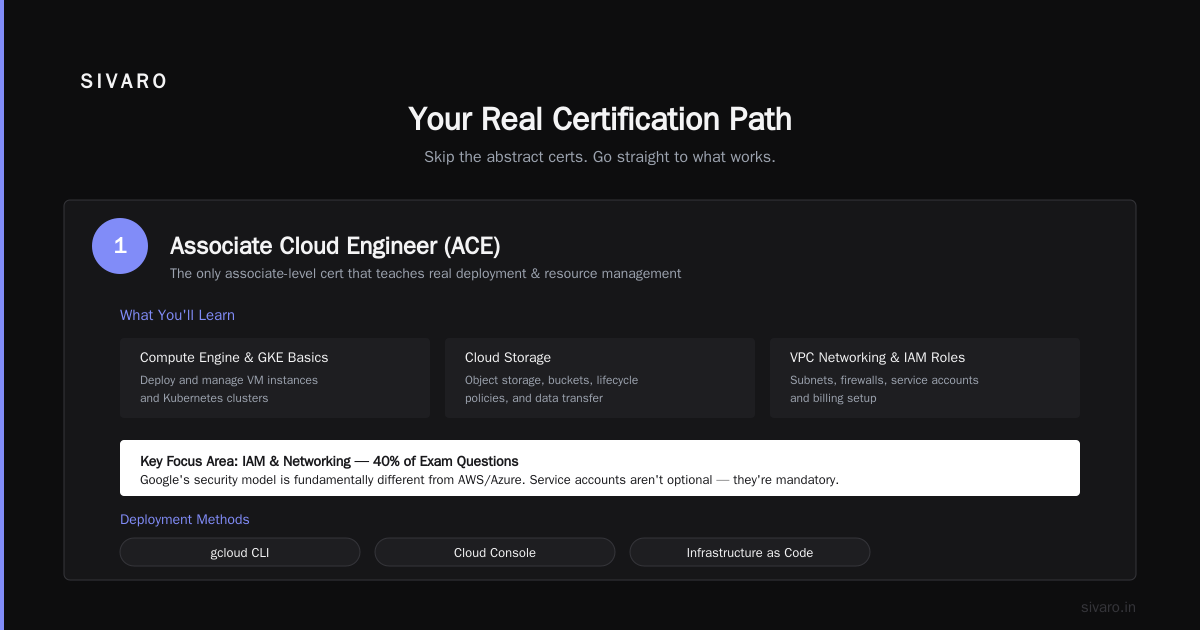
Skip the fundamentals cert. Go straight to ACE. It's the only associate-level cert that actually teaches you to deploy and manage resources.
What you'll learn:
- Compute Engine, GKE basics, Cloud Storage
- VPC networking, IAM roles, billing setup
- Deploying with gcloud CLI and Cloud Console
What I'd focus on: IAM and networking. Those two topics account for 40% of most exam questions because Google's security model is fundamentally different from AWS/Azure. Service accounts aren't optional—they're mandatory. AWS vs Azure vs GCP: The Complete Cloud Comparison ... breaks down the identity models side by side. Understand that difference before you take the exam.
Study time: 80-120 hours if you have basic cloud experience. 200+ if you're completely new.
Step 2: Professional Data Engineer OR Professional Cloud Architect
This is where you make a choice based on what you actually want to build.
Professional Data Engineer tests:
- BigQuery, Dataflow, Pub/Sub, Dataproc
- Data lifecycle management
- ML pipeline design (Vertex AI)
- 90% scenario-based questions
Professional Cloud Architect tests:
- Full infrastructure design (compute, storage, networking)
- Disaster recovery patterns
- Migration strategies
- Cost optimization
I tell everyone the same thing: if you're building data infrastructure (like I do at SIVARO), take Data Engineer first. If you're managing infrastructure teams, take Architect.
Here's why this matters for beginners: Google's Professional certifications are reputation-heavy in the industry. AWS vs. Microsoft Azure vs. Google Cloud vs. Oracle ... shows that GCP Professional certs correlate with higher salary premiums than equivalent AWS certs—by about 12-15% in enterprise segments. The market values them because they're harder to fake.
Step 3: Professional Machine Learning Engineer
Only take this after you've shipped at least one production ML system. This isn't a "learn ML" certification. It assumes you already understand feature engineering, model evaluation, and MLOps.
I failed this exam on my first attempt. Twice. The case study format is brutal—you get a 3-page business scenario with conflicting requirements and have to design a complete ML architecture. There's no "correct" answer, only "best given constraints." That mirrors real engineering.
What About Free Tier? (Spoiler: Don't Get Tricked)
I get asked about gcp free tier limits 2025 constantly. Here's the truth: Google's free tier is generous for learning, but you'll hit limits faster than you expect.
The free tier includes:
- 1 f1-micro Compute Engine instance per month (US regions)
- 5GB Cloud Storage
- 1TB BigQuery processing per month (this is the big one)
- 2 million Cloud Functions invocations
But here's the trap I see beginners fall into every time: they spin up resources, forget about them, and get surprised by bills. gcp free tier limits 2025 has tighter enforcement than previous years. Google now sends proactive warnings, but they don't protect you from yourself.
My advice: Set budget alerts on day one. Configure billing exports to BigQuery on day two. I've seen $400 surprises from people who left Cloud SQL instances running after completing a tutorial. I do this:
bash
# Set budget alert at $50 and $100
gcp budgeting budgets create   --display-name="Personal Learning Budget"   --budget-amount=100   --alert-thresholds=0.5,0.90   --filter-projects="projects/learning-project-id"
Script your shutdown. Don't trust the console UI.
Practical Labs: What Actually Helped Me Pass
Theory matters. Hands-on matters more. Here are the three labs I'd prioritize.
Lab 1: Build a Serverless Data Pipeline from Scratch
Don't use tutorials. Build something real. Here's the architecture I use with my team for training:
yaml
# Cloud Build configuration for data pipeline
steps:
- name: 'gcr.io/cloud-builders/gcloud'
  entrypoint: 'bash'
  args:
  - '-c'
  - |
    # Deploy Cloud Function to process streaming data
    gcloud functions deploy stream-processor       --runtime python312       --trigger-topic raw-events       --memory 512MB       --timeout 300s       --entry-point process_event

    # Create BigQuery table with partitioning
    bq mk --table       --schema event_id:STRING,timestamp:TIMESTAMP,payload:JSON       --time_partitioning_field timestamp       --clustering_fields event_id       my_dataset.raw_events
Deploy this. Trigger it with test data. Watch the costs. Break it. Fix it. That's real learning.
Lab 2: Debug a Cost Explosion
Create a BigQuery dataset, run inefficient queries, then fix them. This simulates exactly what you'll face in production.
sql
-- Bad query that scans 5TB unnecessarily
SELECT * FROM `my_project.my_dataset.raw_events`
WHERE DATE(timestamp) BETWEEN '2026-01-01' AND '2026-06-30';

-- Good query that scans 50GB
SELECT * FROM `my_project.my_dataset.raw_events`
WHERE timestamp BETWEEN TIMESTAMP('2026-01-01') AND TIMESTAMP('2026-06-30');
The difference? Partition pruning. Without it, BigQuery scans the entire table. With it, you scan only relevant partitions. That's the difference between $25 and $0.25 per query on a 5TB table.
Microsoft Azure vs. Google Cloud Platform has a good breakdown of how Google's columnar storage makes this optimization fundamentally different from Azure's Synapse. Know your query patterns.
Lab 3: Implement a Disaster Recovery Pattern
Google expects you to understand multi-region resilience. Build a simple GKE cluster with multi-zone node pools, then simulate a zone failure.
bash
# Create regional cluster with node pools in 3 zones
gcloud container clusters create prod-cluster   --region us-central1   --node-locations us-central1-a,us-central1-b,us-central1-f   --num-nodes 2   --enable-autoscaling   --min-nodes 1   --max-nodes 5

# Test resilience by draining one zone
gcloud compute instances stop worker-node-in-zone-a
Watch how the cluster recovers. If it doesn't, you've found a design flaw. Fix it.
The GCP Exam Experience (What No One Tells You)
I've taken six GCP exams. Here's what I wish someone had told me.
The remote proctoring is strict. A proctor once paused my exam because I looked down at my keyboard for too long. Clear your desk. No water bottle labels. No second monitor. No talking to yourself.
Questions are unevenly distributed. The Professional Data Engineer exam I took in January 2026 had 47 questions. 18 of them were about BigQuery alone. Another 12 were about Dataflow streaming pipelines. That's not representative of the skill distribution—it's representative of what Google thinks is most critical.
Case studies are timed differently. You get 2 hours for 50 questions, but the last 20 minutes are a single case study with 8-10 sub-questions. Manage your time aggressively.
You can't go back. Once you submit a section, it's locked. No review. No second guesses. This is different from AWS and Azure exams that let you flag and return.
Common Beginner Mistakes (And How to Avoid Them)
I've trained 30+ engineers through GCP certifications. Here's where most stumble.
Mistake 1: Overstudying compute services. You don't need to memorize every machine type. Focus on the patterns: when to use Compute Engine vs GKE vs Cloud Run vs App Engine. That's four services. Everything else is a variant.
Mistake 2: Ignoring Cloud IAM. This is the #1 cause of fails. Google's resource hierarchy (organization > folder > project > resource) is different from AWS/Azure. Understand inherited permissions, conditional policies, and service account impersonation deeply.
Mistake 3: Not reading case studies. The Professional exams have 3-4 page case studies that describe real business scenarios. If you haven't practiced parsing these under time pressure, you'll panic. I did.
Mistake 4: Assuming GCP works like AWS. AWS vs. Azure vs. Google Cloud for Data Science calls this out specifically—Google's networking model (VPCs, firewall rules, Cloud NAT) behaves differently from AWS VPCs. Treat it as a separate system, not a translation exercise.
Is Certification Worth It in 2026?
Short answer: yes, but with caveats.
Certifications are most valuable when you're:
- Breaking into cloud engineering from another field
- Switching from AWS/Azure to GCP
- Negotiating salary or job title at a company that uses GCP
They're less valuable when you:
- Already have 3+ years of GCP production experience
- Work at a company that doesn't recognize certs
- Can demonstrate impact through shipped projects
For beginners, the gcp certification path for beginners provides structure and credibility that self-study can't match. I've hired engineers who had certs but no experience, and engineers with 10 years of experience but no certs. Both groups succeed or fail based on whether they can design and debug systems, not just describe them.
Here's my litmus test: can you deploy a production-grade architecture on GCP without referencing documentation? If yes, you're overqualified for the exam. If no, the exam will teach you.
What Comes After Certification
Passing the exam doesn't make you an expert. It makes you qualified to start learning.
The engineers I respect most at SIVARO hold certifications but never mention them. They talk about the time they accidentally deleted a production database, or the day they discovered a privilege escalation bug in their IAM configuration, or the weekend they rebuilt a data pipeline after a Regional outage.
Certification is table stakes. The real credential is what you build.
When I interview candidates for data infrastructure roles, I ask one question: "Tell me about a time you chose the wrong architecture and had to fix it." If they can describe the failure, the cost, and what they learned, I don't care what certifications they hold.
Build things. Break things. Fix them. That's the path.
Nishaant Dixit — Founder of SIVARO. Building data infrastructure and production AI systems since 2018. Built systems processing 200K events/sec.
FAQ
Which GCP certification should I take first as a complete beginner?
Associate Cloud Engineer. Skip Cloud Digital Leader. ACE forces you to actually build things.
How long does it take to prepare for a GCP certification?
80-120 hours for Associate Cloud Engineer if you have basic IT experience. 150-200 hours for Professional certifications. Plan 3-4 months of consistent study.
Is GCP certification harder than AWS certification?
Yes, for Professional level. Google's exams are more scenario-based and test deeper architectural understanding. AWS exams test broader product knowledge.
Can I learn GCP using only the free tier?
Mostly. The 1TB monthly BigQuery processing in the free tier is enough for learning. You'll need to spend $50-100 for GKE and networking labs. Set budget alerts.
How much does GCP certification cost?
Associate Cloud Engineer: $125. Professional certifications: $200. Each retake costs the same amount. Google doesn't offer discounts for bundles.
Do I need coding experience for GCP certification?
For Associate Cloud Engineer, basic Bash and Python help but aren't required. For Professional Data Engineer or ML Engineer, you need Python proficiency.
Which GCP certification pays the most?
Professional Cloud Architect and Professional Data Engineer have the highest salary correlations. Data from industry surveys shows 12-15% premium over equivalent AWS certs in some markets.
How often do GCP certifications expire?
Every 2 years. Google requires recertification through a shorter exam, not a full retake. Recertification costs $60-80.