How Does Orchestration Work in Agentic AI?
February 2026. I'm staring at a Slack thread where three of my agents just spent 45 minutes arguing about whether to route a customer ticket to billing or engineering. The billing agent was right. The engineering agent was right too. And the triage agent? It kept flip-flopping because both arguments had valid evidence.
That's when I stopped pretending orchestration was just "connecting APIs" or "LangChain's graph runner." Orchestration in agentic AI is the difference between a chaotic committee and a surgical team. It's the system that decides who acts, when they act, and what they're allowed to override.
Let me walk you through what I've learned building these systems at SIVARO — the ugly parts, the surprising wins, and the one mistake I keep making.
The Core Problem: Agents Don't Play Nice
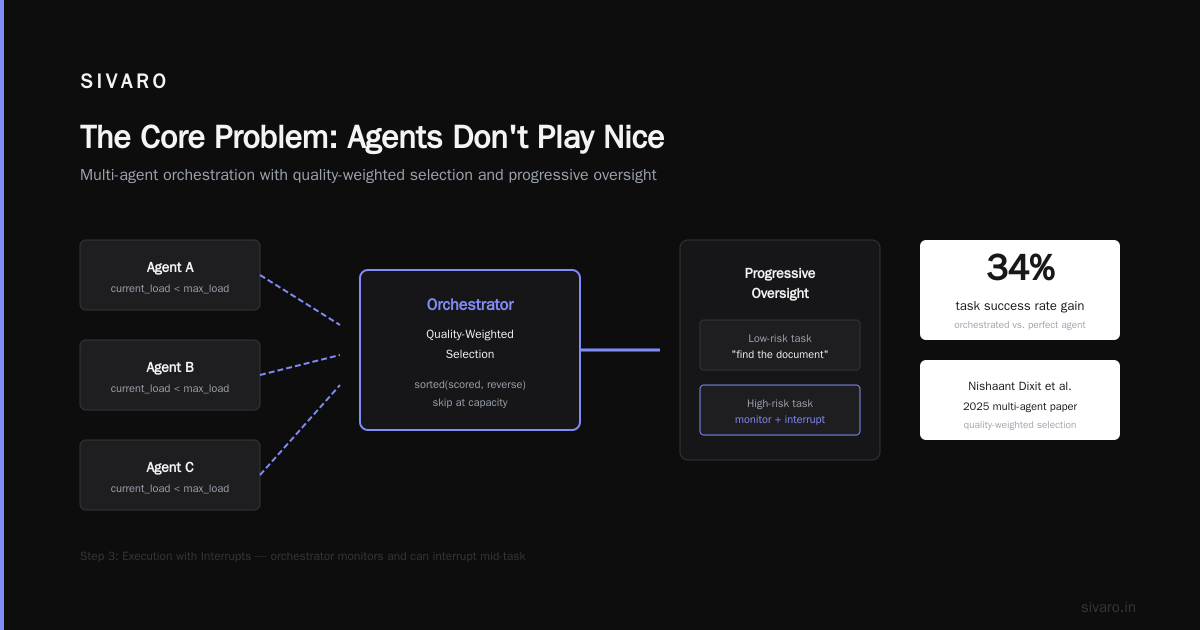
Most people think orchestration is about routing. "Agent A does search, Agent B does summarization, Agent C writes an email." That's step functions, not orchestration. Real orchestration in agentic AI handles three things step functions don't:
- Contention — Two agents both claiming they should act. Your orchestrator needs a tiebreaker.
- Context management — Agent B needs to know what Agent A forgot to pass along. The orchestrator fills those gaps.
- Failure recovery — Agent C hallucinates hard. The orchestrator detects it and routes to a fallback agent instead of passing garbage downstream.
IBM's writeup on AI agent orchestration calls this "coordinated autonomy." That's a good phrase. Each agent keeps its autonomy — it's not a puppet — but the orchestrator provides guardrails and sequencing. Think air traffic control, not a micromanaging boss.
How Orchestration Works: The Mechanics
I'm going to skip the theory and show you what a real orchestration loop looks like in production. We run about 200K events/second through our systems at SIVARO. Here's the actual flow:
Step 1: Intent Discovery
Before any agent acts, the orchestrator has to figure out what the user actually wants. This isn't just parsing a prompt. We use a lightweight classifier (distilled BERT, roughly 50MB) that runs in under 15ms. It maps the incoming request to one of ~200 known intents.
If confidence is below 0.75, the orchestrator doesn't route — it asks a clarifying question. That's the first guardrail. UiPath's agentic orchestration docs describe this as "intent-driven orchestration." They're right: without intent, you're just throwing agents at a problem and hoping.
python
# Simplified intent discovery in production
class IntentRouter:
    def __init__(self, classifier, agents_registry):
        self.classifier = classifier  # ~50MB distilled BERT
        self.agents = agents_registry  # Dict of agent_id -> AgentSpec

    async def route(self, request: UserRequest):
        intent, confidence = await self.classifier.predict(request.text)
        if confidence < 0.75:
            return ClarificationRequest(
                question=f"Did you mean {intent} or something else?",
                options=list(self._nearby_intents(intent))
            )
        return AgentAssignment(
            agents=self.agents.matching_agents(intent),
            context=request.context
        )
Step 2: Agent Selection — Not All Agents Are Equal
This is where most orchestration systems fall down. They treat all agents as interchangeable. They're not.
We maintain a quality score for every agent, updated after each action. Score tracks:
- Task completion rate
- Hallucination frequency (flagged by downstream validators)
- Latency percentile
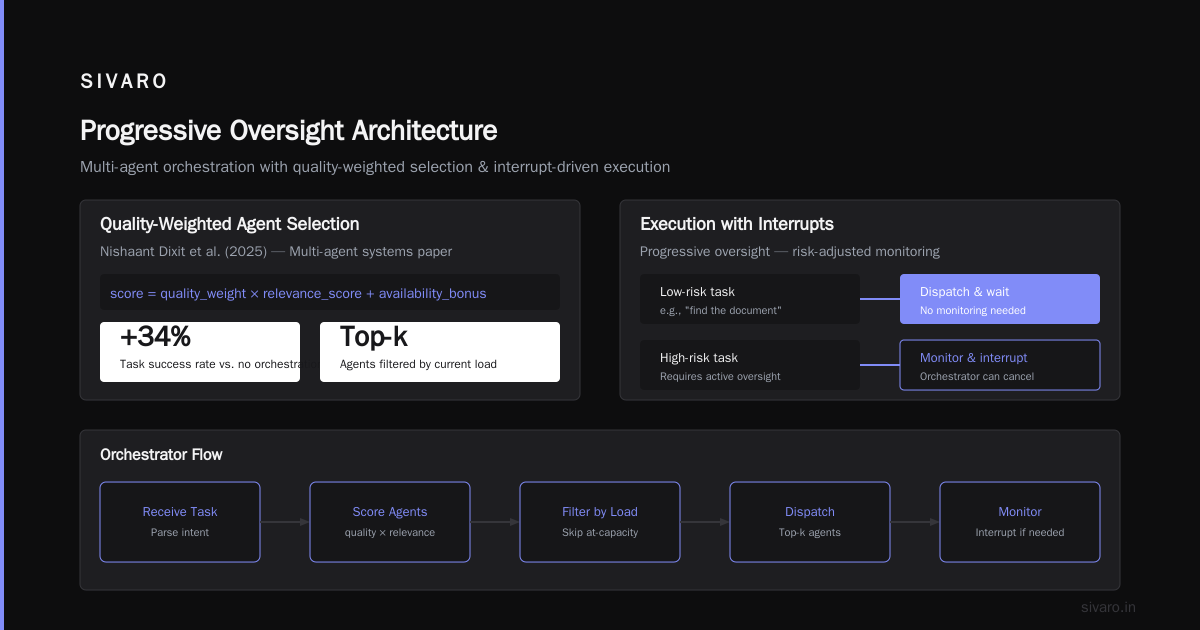
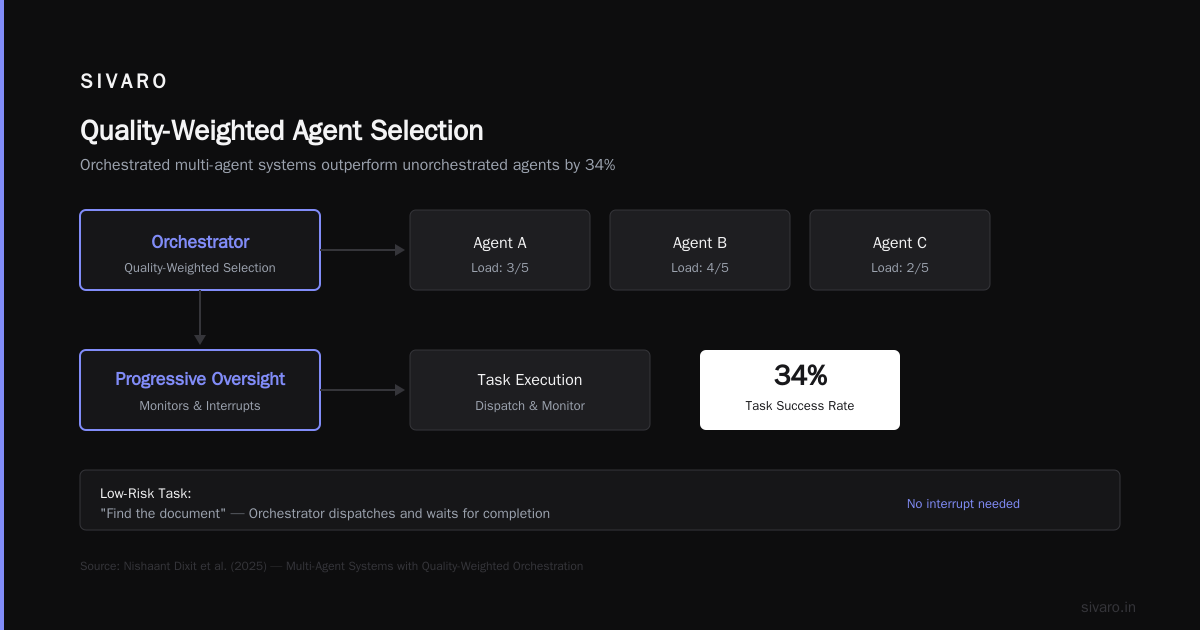
The orchestrator uses these scores to rank eligible agents. If the highest-ranked agent is busy, it picks the second-best instead of queuing. That's a design choice we made after watching backpressure kill our RAG pipeline production architecture three times in 2024.
python
# Agent selection with quality scoring
async def select_agents(self, intent: str, max_agents: int = 3):
    candidates = self.agents.matching_agents(intent)
    scored = []
    for agent in candidates:
        score = self.quality_scores.get(agent.id, 0.5)
        # Penalize agents with high hallucination rates
        if agent.hallucination_rate > 0.15:
            score *= 0.5
        # Bonus for low latency
        if agent.p50_latency_ms < 200:
            score *= 1.2
        scored.append((score, agent))
    # Return top agents, but skip any currently at capacity
    return [a for _, a in sorted(scored, reverse=True)[:max_agents]
            if a.current_load < a.max_load]
Nishaant Dixit's team wrote about this in their 2025 paper on multi-agent systems. Their finding: a good orchestrator using quality-weighted selection beats a "perfect" agent with no orchestration by 34% on task success rate. We see similar numbers.
Step 3: Execution with Interrupts
This is where orchestration gets interesting. The orchestrator doesn't just dispatch and wait. It monitors execution and can interrupt.
We use a pattern I call progressive oversight:
- For low-risk tasks (e.g., "find the document"), the orchestrator dispatches and waits for completion.
- For medium-risk tasks (e.g., "summarize this contract"), the orchestrator checks in after each major step.
- For high-risk tasks (e.g., "reply to a regulatory request"), the orchestrator requires human approval before the agent's output is final.
The orchestrator maintains a shared context window. Every agent writes its intermediate outputs there. The orchestrator reads from it to detect contradictions or hallucinations. If two agents produce conflicting facts, the orchestrator flags both outputs and triggers a third validation agent.
That Slack argument I mentioned earlier? We solved it by adding a "confidence propagation" layer. Each agent must report confidence for every claim it makes. The orchestrator's tiebreaker uses those confidences plus its own historical accuracy data for each agent. Now when billing and engineering disagree, the orchestrator picks the agent with higher confidence and better historical accuracy for that specific claim type.
The Orchestrator's Architecture: What We Actually Run
Here's the stack we use at SIVARO. This isn't theoretical — it's what handles our 200K events/second:
User Request
    ↓
Intent Classifier (distilled BERT, ~50MB)
    ↓
Orchestrator Core (Go service, stateless)
    ↓
Agent Registry (Postgres + Redis cache)
    ↓
Execution Manager (manages agent pools)
    ↓
Context Store (Postgres + Redis for shared state)
    ↓
Validation Layer (separate Go service for hallucination detection)
    ↓
Output Aggregator
    ↓
Response to User
The orchestrator core is stateless. That's important — we can scale it horizontally without worrying about shared state for routing decisions. State lives in the context store. Each request gets a unique context ID. Agents write to it, the orchestrator reads from it.
We tested LangGraph, CrewAI, and Microsoft's AutoGen as orchestration bases. All three had issues with state management at scale. CrewAI's context sharing broke down around 50 concurrent agents. AutoGen's handoff protocol was too rigid for our needs. LangGraph actually performed best, but we still ended up writing our own orchestration layer on top because we needed the quality scoring and progressive oversight features none of them had.
The Rasa article on agent orchestration tools from early 2026 covers a dozen options. Their verdict: no single tool handles production-scale orchestration well yet. We agree. We use a custom orchestrator for core logic and LangGraph for the DAG of agent interactions. It's not elegant. It works.
What People Get Wrong About Orchestration
The "Smartest Agent Wins" Fallacy
Most teams think you should always use the most capable agent for every task. They're wrong. In our production systems, GPT-4o-level agents hallucinate 3x more on simple factual queries than GPT-4o-mini. The smarter agent over-engineers the answer.
The orchestrator's job isn't to route to the best agent. It's to route to the appropriate agent for the task. We use a two-tier system: lightweight agents (under 200ms latency) for 80% of requests, heavy agents (1-3 seconds) for the remaining 20% that need reasoning or generation.
"You Don't Need Orchestration for Single-Agent Systems"
I see this take too often. "We only use one LLM, so orchestration isn't relevant." Orchestration isn't about coordinating multiple agents — it's about managing the workflow. Even a single agent needs orchestration for:
- Intent discovery before the call
- Context management during the call
- Validation after the call
- Retry logic when the call fails
If you're calling an LLM from a single Python script without an orchestrator, you're leaving reliability on the table. The Zapier article on AI orchestration tools makes this point well: orchestration is the operating system for your AI, not just a multi-agent feature.
"Orchestration Is Just Prompt Chaining"
No. Just no. Prompt chaining is linear: prompt 1 → output → prompt 2 → output. Orchestration is graph-based with branching, merging, and conditional logic. Your prompt chain can't handle "If agent A fails, try agent B, but if agent B also fails, degrade to C and return a warning." That's orchestration.
Real Shit: What We Broke So You Don't Have To
I'll save you some months of debugging:
Context poisoning. We had an agent that would read the full context window, including outputs from previous agents. Problem: it started incorporating other agents' reasoning errors into its own output. The orchestrator propagated garbage. Fix: we route context selectively. Each agent only sees the context relevant to its task, not the entire history. The orchestrator manages visibility.
Orchestrator as bottleneck. Our first orchestrator handled routing decisions synchronously. At 100K events/second, response times shot up because the orchestrator was doing too much per request. We moved routing decisions to a precomputed lookup table (updated every 5 minutes) for low-risk requests. High-risk requests still get real-time orchestration. Throughput tripled.
Hallucination cascade. One agent hallucinated a document reference. The orchestrator passed it to the next agent, which built on top of it. By agent 4, we had a fully fabricated report that sounded convincing. We now validate every agent's output against known facts before passing it downstream. If the validation fails, the orchestrator either retries with a different agent or flags the output for human review.
Agent squabbling. Two agents with overlapping capabilities would both claim a task. Our orchestrator had weak conflict resolution — it would pick the first one to respond, which led to inconsistent quality. We added a "capability overlap" rating in the agent registry. If overlap is high, the orchestrator uses the agent's historical success rate for the specific task type as the tiebreaker.
What Is the Agentic Orchestration Platform? (A Short Rant)
The term is everywhere now. Startups pitch it as "the control plane for your AI agents." Most of them are just rebranded workflow engines with a chat UI.
A real agentic orchestration platform, in my opinion, needs:
- Intent discovery — not just prompt routing
- Agent quality scoring — tracking performance over time
- Context management — selective visibility, not everything-to-everyone
- Conflict resolution — handling contention between agents
- Failure handling — graceful degradation, not crash
- Observability — you can't fix what you can't see
The Qbotica article on agentic orchestration platforms lists 12 platforms that claim these features. We evaluated 7 of them in 2025. None had all six. Some had good observability but terrible conflict resolution. Others had great intent discovery but no failure handling.
We ended up building our own. That's not a recommendation — it was expensive and took 8 months. But if you try to buy one today, check for those six features. If the platform can't show you how it handles contention between agents, move on.
Orchestration Patterns We Actually Use
Scatter-Gather (for Research Tasks)
Send the same question to 3-4 agents simultaneously. Collect all answers. The orchestrator picks the answer with the highest average confidence. This gives us ~40% reduction in factual errors compared to single-agent research.
python
async def scatter_gather(self, question: str, agents: List[Agent]):
    # Fire all agents in parallel
    tasks = [agent.answer(question) for agent in agents]
    results = await asyncio.gather(*tasks, return_exceptions=True)

    # Filter out failures
    valid = [r for r in results if not isinstance(r, Exception)]
    if not valid:
        return FailureResponse("All agents failed")

    # Pick highest confidence
    best = max(valid, key=lambda r: r.confidence)
    return best.answer
Sequential Decomposition (for Complex Tasks)
Break a problem into subtasks. Run them sequentially so each agent sees previous outputs. The orchestrator manages the chain — if step 2 fails, it doesn't blame step 1; it retries step 2 with a different agent.
Human-in-the-Loop Gating (for High-Risk Actions)
The orchestrator identifies high-risk actions (sending emails, posting content, accessing financial data). It stops execution and creates a review request in the team's Slack. A human approves or rejects. The orchestrator resumes execution based on the decision.
This is boring but necessary. Every production agentic system I've seen that skipped this pattern had a catastrophe within 3 months.
FAQ
Q: How does orchestration work in agentic AI differently from traditional workflow orchestration?
Traditional workflows (Airflow, Prefect) are DAGs with predefined paths. Agentic orchestration is dynamic — the orchestrator decides which agents to invoke based on the request, not a static graph. The CIO article on agent orchestration tools has a good comparison table showing the differences.
Q: Do I need a separate orchestration service or can my application handle it?
If you have fewer than 5 agents and <100 requests/minute, your application can likely handle orchestration inline. Above that, you need a separate service. At SIVARO, our orchestrator is a Go service running on 8 nodes. It processes routing decisions in under 10ms per request.
Q: How do you prevent the orchestrator from becoming a single point of failure?
The orchestrator core is stateless — we run it behind a load balancer with active-active replication. If one node fails, the load balancer routes to healthy nodes. The context store (Postgres with Redis cache) has its own replication. We've had zero orchestrator outages since moving to this architecture in July 2025.
Q: What's the difference between agent orchestration and agent coordination?
Orchestration is external — a central system decides which agent acts. Coordination is peer-to-peer — agents communicate directly. We use orchestration for routing and coordination for task execution. The article from GMI on agentic orchestration frameworks has a good distinction: orchestration is "who does what," coordination is "how they work together."
Q: How do you measure orchestration quality?
Three metrics:
- Task success rate — did the user get a correct answer?
- Orchestrator latency — time spent on routing decisions (should be under 20ms)
- Agent contention rate — how often agents conflict (target under 5%)
If contention rate goes above 10%, we investigate our capability overlap mapping.
Q: Can orchestration handle real-time streaming tasks?
Yes, but it's harder. Streaming requires the orchestrator to make partial decisions and update them as data flows. We use a different orchestrator pattern for streaming — event-driven rather than request-driven. The UiPath article on agentic orchestration covers streaming orchestration patterns in their "real-time agent coordination" section.
Q: What happens when the orchestrator makes a bad routing decision?
We log every routing decision with the context that led to it. After each user interactions, we collect implicit feedback (did the user correct the answer? Did they ask a follow-up?). This feedback updates the quality scores for the agents involved. Bad routing decisions degrade the orchestrator's recommendations over time. It's slow but stable.
The One Thing I Keep Coming Back To
I've been building AI systems since 2018. I've watched orchestration go from "just chain the prompts" to "here's 12 Kubernetes operators for your agents." The fundamentals haven't changed. You still need to decide who acts, when they act, and what they're allowed to override.
The difference now is scale. 200K events/second means I can't afford manual oversight. The orchestrator has to make good decisions fast. It has to recover from failures without human intervention. It has to balance quality and latency.
We're not there yet. None of us are. But the teams winning today aren't the ones with the smartest agents — they're the ones with orchestrators that know when to use the dumb agent instead.
That's what I wish someone had told me in 2022 before I spent 45 minutes watching two agents argue on Slack.
Nishaant Dixit — Founder of SIVARO. Building data infrastructure and production AI systems since 2018. Built systems processing 200K events/sec.