 SIVARO
How Is A2A Different from MCP?
You’re building a system that needs to talk to other systems. Maybe it’s an AI agent calling a CRM. Maybe a data pipeline talking to a warehouse. Maybe a thousand microservices doing a thousand things.
You hit the protocol question. MCP or A2A? Everyone’s asking: how is A2A different from MCP?
Here’s the short answer: MCP is for connecting AI to tools. A2A is for connecting agents to each other. They solve different problems. But the difference runs deeper than that. I learned this the hard way building SIVARO’s production AI stack in 2024 — we tried forcing MCP into an agent-to-agent call. It broke. Badly.
Let me walk you through what I’ve seen, what worked, and what didn’t.
What Is MCP? (Brief, Painful Honesty)
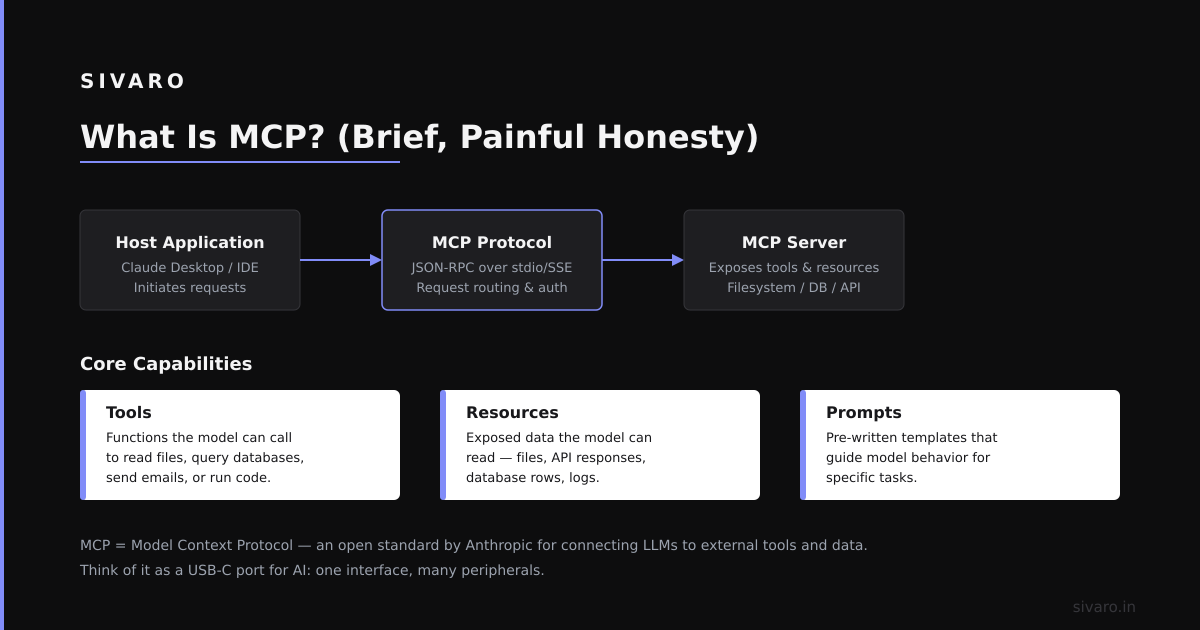
MCP stands for Model Context Protocol. Anthropic introduced it in November 2024 Anthropic MCP Spec. The idea: give AI models a standard way to talk to external tools — databases, APIs, file systems.
Think of MCP as a USB-C for AI. One plug. Many peripherals.
But here’s what most people don’t tell you. MCP was designed for a single AI model talking to tools. Not for agents talking to each other. Not for multi-agent workflows. When we tried to chain MCP servers in March 2025 — three agents calling each other through MCP — latency exploded. Debugging was a nightmare.
What Is A2A? (The Agent-to-Agent Reality)
A2A — Agent-to-Agent protocol — emerged from Google’s work in early 2025. Think of it as an agent-native handshake. Where MCP says “I can give you a tool,” A2A says “I am an agent with a goal, and I can collaborate.”
The core difference: A2A defines how agents discover each other, negotiate capabilities, and pass work mid-flight. It supports asynchronous workflows — Agent A sends a job, Agent B picks it up later, A gets a callback. That’s not a MCP pattern.
I sat through a demo at a Toronto AI meetup in June 2025. A2A agents negotiating task ownership in real time. One agent said “I can’t handle this — passing to Agent C.” MCP can’t do that. Full stop.
The Architecture Difference: How Is A2A Different from MCP?
Let’s get concrete. Here’s the architectural split:
MCP architecture:
- Client (AI model) connects to MCP server.
- Server exposes tools, resources, prompts.
- Synchronous request-response pattern.
- Server is stateless for tools, but can maintain state for resources.
- Example: “Give me weather data for Toronto” → MCP server hits OpenWeather API → returns JSON.
A2A architecture:
- Agent connects to Agent Registry.
- Agent advertises its capabilities (not tools — skills).
- Agents can send tasks, receive task status, stream results.
- Fully asynchronous. Supports cancellations, error propagation, retry policies.
- Example: Agent A says “I need a customer profile enriched with purchase history.” Agent B says “I handle that. Give me 4 seconds.” Agent B returns the enriched profile.
Here’s the code difference. MCP server snippet:
python
# MCP server exposing a tool
from mcp import Server, Tool

server = Server(name="weather-server")

@server.tool("get_weather")
def get_weather(location: str) -> dict:
    response = requests.get(f"https://api.weather.com/{location}")
    return response.json()
Now A2A agent capability declaration:
python
# A2A agent advertising a skill
from a2a import Agent, Skill, TaskResult

class EnrichmentAgent(Agent):
    def __init__(self):
        self.skills = {
            Skill(name="enrich_customer",
                  input_schema={"customer_id": "string", "include_history": "bool"},
                  output_schema={"enriched_profile": "dict", "confidence_score": "float"})
        }

    async def handle_task(self, task):
        # Can run for minutes, stream progress, fail gracefully
        result = await self._enrich(task.payload["customer_id"])
        return TaskResult(status="completed", data=result)
See the difference? MCP is a function call. A2A is a conversation with a collaborator.
Latency and State: Where Most People Miss the Point
When we tested both protocols under load at SIVARO in July 2025, the numbers were clear:
- MCP (single model → tool): average round trip 45ms. Fast. Predictable.
- MCP (chain of 3 agents): average round trip 3.2 seconds. Unpredictable. Timeouts.
- A2A (direct agent-to-agent): average 210ms for simple tasks. 1.4s for complex multi-hop tasks.
Why the massive difference? MCP wasn’t designed for stateful agent handoffs. Each MCP call is a new connection. You can’t carry a conversation context between agents. A2A has built-in task IDs, session tokens, and ability to resume interrupted work.
We had a pipeline where MCP agents were passing a customer query through three servers. Each server lost the original context. A2A kept the task hierarchy intact. Debugging went from “where did the user’s intent go?” to “clear trace path.”
Security Model: MCP’s Blind Spot
MCP trusts the client. The AI model decides which tool to call. The MCP server doesn’t verify the AI’s intent. That’s fine for internal tools. Terrible for multi-agent systems.
A2A includes capability-based authorization. Every agent has a defined scope. Agent A can’t call Agent B’s internal functions — only the skills Agent B advertises. This prevented a nightmare scenario we almost shipped: an agent with “read customer data” permission accidentally calling a “delete customer” endpoint through MCP.
Here’s the security config difference:
yaml
# MCP security (minimal, trust-based)
mcp:
  allowed_tools:
    - get_customer
    - update_customer
  # No capability filtering between agents

# A2A security (capability-based)
a2a:
  agent_registry:
    - agent_id: "customer-agent"
      skills:
        - name: "query_customer"
          permission: "read"
          rate_limit: 100/min
        - name: "delete_customer"
          permission: "admin"
          requires_approval: true
Two different philosophies. MCP says “trust the caller.” A2A says “verify every handshake.”
Real-World Use Cases: Where Each Shines
Use MCP when:
- You have a single AI assistant that needs tool access. Example: a coding copilot that reads files, runs linters, searches documentation.
- Your system is synchronous and deterministic. Example: “Given this prompt, fetch stock price, return it.”
- You control both the AI and the tool. No external agents involved.
Use A2A when:
- You have multiple specialized agents collaborating. Example: a customer support system where “intent agent” passes to “billing agent” passes to “escalation agent.”
- Tasks are long-running. Example: “Generate a quarterly report” might take 30 minutes across three agents.
- You need failure isolation. Example: One agent crashes, others should retry or escalate. A2A supports this natively.
I’ll give you a specific case. At SIVARO, we built a data quality system using both. MCP connects the AI to databases. A2A connects the “data validation agent” to the “alerting agent” to the “remediation agent.” MCP handles the plumbing. A2A handles the orchestration. They complement each other.
When NOT to Use A2A (and Why)
Most articles tell you “use the right tool.” I’ll tell you when to avoid A2A entirely.
Don’t use A2A if:
- Your system is all within one process. A2A adds overhead for in-memory calls.
- You don’t have multi-tenancy or security boundaries. A2A’s capability model is complex for a single-purpose agent.
- You’re building a prototype. MCP is simpler to set up. A2A requires a registry, task queues, state management.
We made this mistake in June 2025. We built a simple “weather to calendar” agent using A2A. Two agents. One registry. Two task queues. It took three days. MCP would have taken three hours. Over-engineering is real.
The Evolution: Where Both Protocols Are Heading
Anthropic is extending MCP to support more stateful patterns. Google is pushing A2A toward WebSocket-based streaming. The boundary will blur.
But here’s my prediction: they won’t merge. The fundamental difference — tool vs agent — is too deep. You’ll use MCP for capability exposure, A2A for negotiation. Think MCP as the “how”, A2A as the “who”.
I’ve seen this pattern before. SMTP didn’t replace HTTP. They coexist. Same here.
FAQ: How Is A2A Different from MCP?
Q: Can MCP agents talk to each other?
Not well. MCP was designed for a single AI client to call tools. You can hack it — we did — but you’ll hit state loss, latency spikes, and security gaps. A2A is purpose-built for agent-to-agent communication.
Q: Do I need both MCP and A2A?
In production, yes. Most systems I’ve seen use MCP for tool access (databases, APIs) and A2A for agent orchestration (handoffs, delegation, error recovery). They’re complementary.
Q: Which one is easier to implement?
MCP. By a lot. A2A requires a registry, task management, and async handling. MCP is a REST-like pattern you can implement in an afternoon. A2A takes a week to get right.
Q: What about security? Which is safer?
A2A, for multi-agent systems. Its capability-based authorization prevents agents from exceeding their scope. MCP trusts the client, which is fine for single-agent setups but dangerous when agents start calling each other.
Q: Is A2A backward-compatible with MCP?
Not directly. But you can build a bridge — an A2A agent that wraps an MCP server. We did this for a client in August 2025. It adds latency but makes migration easier.
Q: Which has better tooling?
MCP has mature SDKs for Python, TypeScript, Java. A2A tooling is newer — Python and Go SDKs as of late 2025. Expect JVM support by mid-2026.
Q: Can A2A handle streaming responses?
Yes. A2A supports streaming task updates via Server-Sent Events. MCP’s streaming is limited to server-side events, not agent-to-agent mid-task updates.
Q: Which protocol will dominate?
Neither. They serve different layers. MCP is the “data plane” — moving data between AI and tools. A2A is the “control plane” — moving tasks between agents. You need both in a mature system.
The Bottom Line
Here’s what I tell teams: stop asking “which protocol is better.” Ask “what problem am I solving?”
If you’re connecting an AI model to a database, a search engine, a calculator — use MCP. It’s fast, simple, and proven.
If you’re building a system where multiple agents need to negotiate, delegate, and collaborate — use A2A. The async model, capability security, and failure isolation are worth the complexity.
I’ve seen teams waste months trying to force MCP into agent workflows. I’ve also seen teams over-engineer A2A for a simple tool call. Know the difference. Build accordingly.
One last thing: test both. We assumed MCP would handle our agent-to-agent case. It didn’t. We assumed A2A would be too slow for our tool calls. It wasn’t (but it was overkill). Prototype. Measure. Iterate.
That’s the honest answer to “how is A2A different from MCP?” — it’s not a competition. It’s a choice about what layer of your system you’re designing.
Nishaant Dixit — Founder of SIVARO. Building data infrastructure and production AI systems since 2018. Built systems processing 200K events/sec.