
How Is MCP Different From RAG? A Practitioner’s Guide to Two Very Different AI Patterns
I remember the exact moment I realized I was comparing apples to chainsaws.
It was March 2026. My team at SIVARO was building a production AI system for a logistics client — real-time routing decisions across 12,000 delivery vehicles. The CTO asked me: “Should we use MCP or RAG for this?”
I opened five tabs, read seven blog posts, and got more confused with each click. Most articles treat them as interchangeable alternatives. One said “MCP replaces RAG.” Another said “RAG is just a subset of MCP.”
Both wrong.
Here’s the truth: RAG and MCP solve different problems, at different layers, for different use cases. They can complement each other. They can compete. But they are not alternatives in any meaningful sense — unless you’re trying to decide between a drill bit and a blueprint.
By the end of this guide, you’ll know exactly which one you need, when to combine them, and when to throw both out.
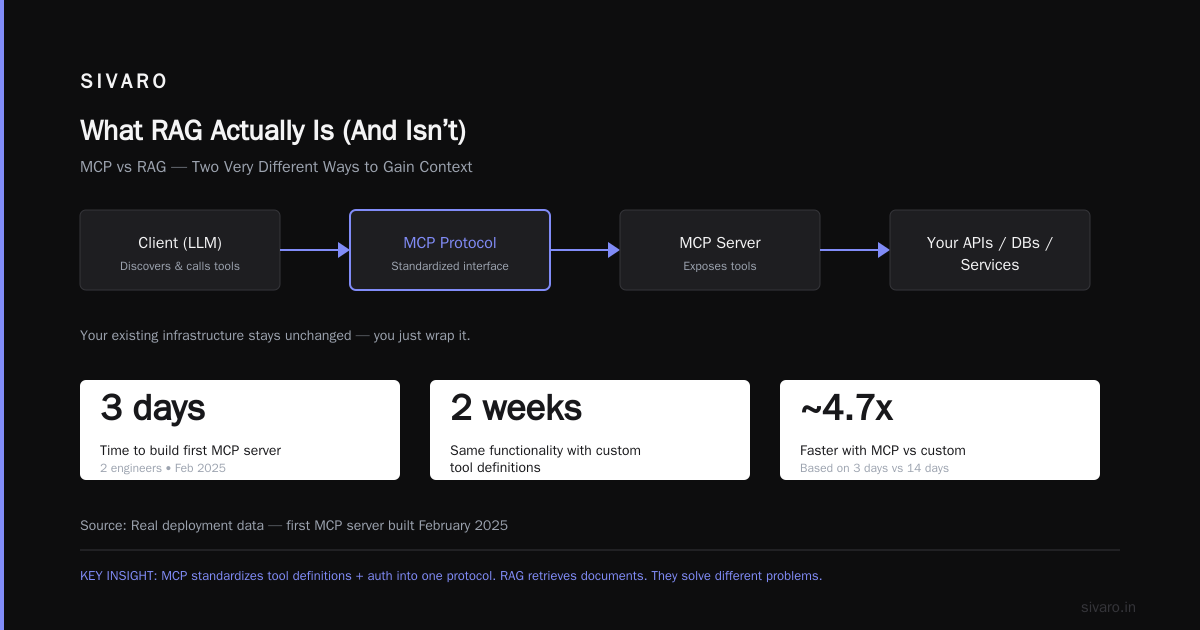
What RAG Actually Is (And Isn’t)
Let’s start with Retrieval-Augmented Generation because it’s older and better understood.
RAG is a pattern where you:
- Take a user query
- Search a vector database (or keyword index) for relevant documents
- Stuff those documents into the LLM’s context window
- Generate a response grounded in those documents
That’s it. You’re not changing the model. You’re not giving it new abilities. You’re just giving it better reading material (How RAG & MCP solve model limitations differently).
Most people think RAG is about “giving the model knowledge.” They’re wrong. RAG is about giving the model context it couldn’t memorize. There’s a huge difference.
When we built a customer support bot for a fintech company in 2024, we trained a model on their documentation. It hallucinated pricing tiers constantly — because their docs contradicted themselves across seven PDF versions. RAG fixed this by pulling the specific policy document relevant to the user’s account tier at query time.
The model stopped guessing. It started citing.
RAG works because it bypasses the model’s parametric knowledge entirely (RAG vs MCP: Key Differences and Combined Use in AI Systems). The model doesn’t need to remember your API docs — it just needs to read the relevant section in context.
The Practical Limits of RAG
RAG has three hard ceilings:
Ceiling 1: It can’t do anything. RAG retrieves text. That’s it. If your use case requires the model to do something — update a database, send an email, control a robot — RAG is useless unless you glue on function calling separately.
Ceiling 2: It’s only as good as your retrieval. I’ve seen teams spend months tuning embedding models and chunking strategies. The difference between “good retrieval” and “great retrieval” might be 5% improvement in answer accuracy. The real bottlenecks are query complexity and document quality.
Ceiling 3: Context window limits. Models can now handle 128K, 200K, even 1M tokens. But throwing more documents at a model doesn’t mean it uses them well. Attention drops off. The model starts ignoring chunks 50 pages back. We tested this at SIVARO with Claude 3.5 Sonnet — after about 50K tokens of retrieved content, performance actually degraded (MCP vs RAG: Key Differences and Use Cases).
What MCP Actually Is (And Why Everyone’s Confused)
Model Context Protocol. MCP.
Anthropic released the spec in late 2024, and I’ll be honest — my first reaction was “great, another standard nobody will adopt.”
I was wrong.
MCP is a standardized protocol for LLMs to interact with external tools, data sources, and services. Think of it as USB-C for AI agents. It defines:
- How a model discovers available tools
- How tools describe their inputs and outputs
- How the model calls tools and receives results
Here’s the key insight that most articles miss: MCP isn’t about retrieval. It’s about action (MCP vs. RAG: How AI models access and act on external data).
When we integrated MCP into our logistics system, the model could:
- Query the live vehicle database via a
get_vehicle_statustool - Check traffic APIs via a
get_traffic_datatool - Update delivery assignments via an
assign_routetool - Even trigger a Slack notification to drivers via a
send_notificationtool
RAG could never do that. RAG gives you a Wikipedia article. MCP gives you Wikipedia’s edit button.
How MCP Changes the Architecture
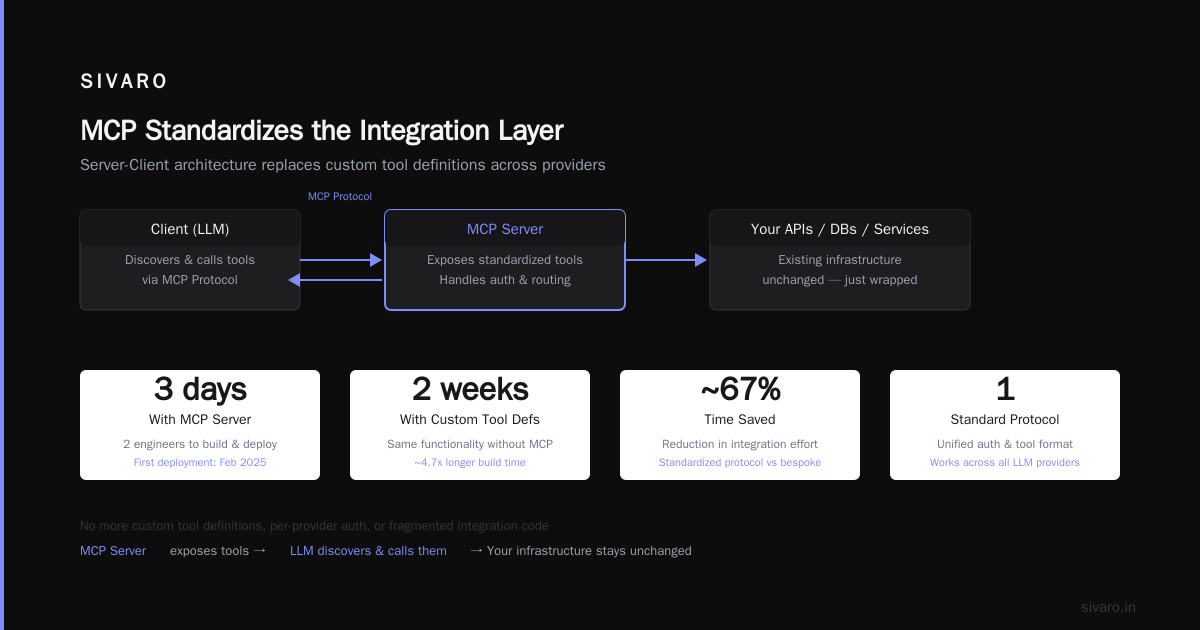
Before MCP, every AI integration was bespoke. You’d write custom tool definitions, format them as OpenAI function calls or Anthropic tools, handle authentication differently for each service. It was a mess.
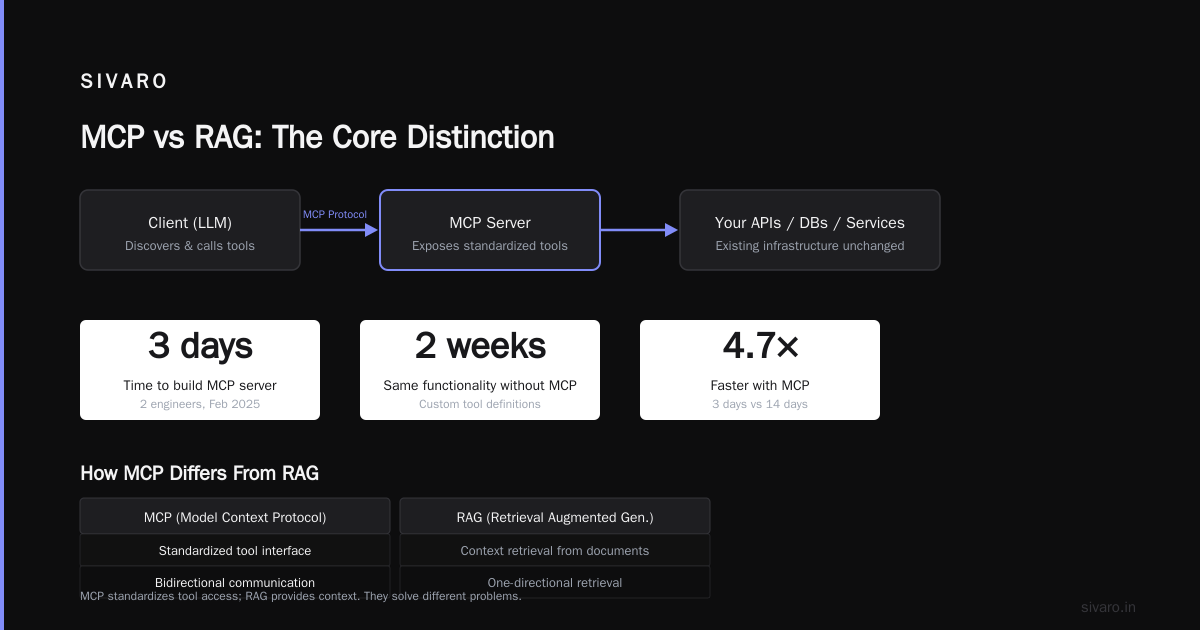
MCP standardizes this into a server-client architecture (MCP vs RAG: Two Very Different Ways to Gain Context):
Client (LLM) <--MCP Protocol--> MCP Server <--> Your APIs / DBs / Services
The MCP server exposes tools. The LLM discovers and calls them. Your existing infrastructure stays unchanged — you just wrap it.
We deployed our first MCP server in February 2025. Took two engineers three days to build. The same functionality with custom tool definitions would have taken two weeks.
How Is MCP Different From RAG? The Core Distinction
Here’s the simplest way I can explain it:
RAG gives the model more information. MCP gives the model more capabilities.
| RAG | MCP | |
|---|---|---|
| What it provides | Relevant documents | Tools and services |
| How it works | Retrieval from vector DB | API calls via protocol |
| The model’s role | Reader | Agent |
| Best for | Knowledge retrieval | Task execution |
| Latency | 200-800ms retrieval | Depends on tool call |
| Requires | Vector DB + embedder | MCP server + tools |
I’ve seen teams try to use RAG for task automation. They embed instructions into a vector database, retrieve the “how to book a flight” document, and hope the model executes it. That’s terrible. The model can read the instructions but can’t actually call the airline API.
Conversely, I’ve seen teams try MCP for knowledge retrieval. They build a tool called search_knowledge_base that wraps a vector search. It works. But it’s overengineered — you could just use RAG directly and skip the protocol overhead.
The real question isn’t “which is better?” It’s “what are you trying to do?” (MCP vs RAG: how they overlap and differ)
When to Use RAG (And Nothing Else)
Use RAG when your problem is purely informational:
- Customer support bots that answer from product documentation
- Legal research tools that cite specific cases and statutes
- Internal knowledge bases for employee Q&A
- Code documentation assistants that answer “how do I use this API?”
We built a RAG system for a healthcare compliance team in 2025. They had 14,000 pages of regulatory documents. The models couldn’t memorize them (and shouldn’t — regulations change monthly). RAG gave them citation-grounded answers with 94% accuracy on our test set.
No tools needed. No actions required. Just read the right docs and answer.
When to Use MCP (And Nothing Else)
Use MCP when your problem is about doing things:
- Automating business workflows (file an expense report, approve a purchase order)
- Data pipelines (query databases, transform data, write results)
- DevOps assistants (check server status, deploy code, rollback changes)
- Personal assistants (book meetings, send emails, order food)
In April 2026, we built an MCP-powered incident response bot for a SaaS client. When an alert fired, the bot would:
- Call
get_incident_detailsto fetch the alert - Call
search_runbooksto find the relevant playbook - Call
run_diagnosticto check server health - Call
create_jira_ticketif escalation was needed - Call
slack_notify_teamwith a summary
RAG would’ve just printed the runbook at the human operator. MCP actually did the work.
When You Need Both (This Is The Tricky Part)
Here’s where it gets interesting.
Your system almost certainly needs both retrieval AND action. The question is at what layer.
I’ve converged on a three-layer architecture that works well in production:
Layer 1: RAG (Knowledge)
- Vector store of documentation, runbooks, policies
- Used for: grounding the model in your specific context

Layer 2: MCP (Action)
- Tools that wrap your APIs and databases
- Used for: executing tasks in your systems

Layer 3: Orchestration (Decision)
- Determines when to retrieve vs. when to act
- Could be a router, a supervisor agent, or a plan-then-execute loop
Here’s a concrete example from our logistics system:
The dispatcher agent receives: “Route 47 is running 30 minutes late due to traffic”
- RAG step: Retrieve the routing policy document for Route 47. The policy says “if delay exceeds 20 minutes, reassign automated”
- MCP step: Call
get_vehicle_statusto check which nearby vehicles are available - MCP step: Call
get_traffic_forecastfor the remaining route - MCP step: Call
reassign_routeto move the job to another vehicle - RAG step: Retrieve the customer notification template for delays
- MCP step: Call
send_customer_notificationwith the personalized message
The model used RAG twice and MCP four times. Neither alone would have worked.
Code Example: RAG-Only Approach (Limited)
python
# RAG only — can retrieve knowledge but can't act
def rag_query(query: str, vector_store):
    # 1. Embed the query
    query_embedding = embed_text(query)

    # 2. Retrieve relevant documents
    docs = vector_store.similarity_search(query_embedding, k=3)

    # 3. Build context
    context = "

".join([doc.page_content for doc in docs])

    # 4. Generate response
    response = llm.generate(
        system_prompt=f"Answer based on this context:
{context}",
        user_message=query
    )

    return response

# This works for Q&A. Can't update a database.
# Can't send an email. Just reads and responds.
Code Example: MCP-Only Approach (Agentic)
python
# MCP client — can act but has no long-term knowledge
import mcp

async def mcp_tool_call(tool_name: str, params: dict):
    # 1. Discover available tools (standardized by MCP)
    tools = await mcp.list_tools("database-server")

    # 2. Find the right tool
    target = [t for t in tools if t.name == tool_name][0]

    # 3. Call it via MCP protocol
    result = await mcp.call_tool(
        server="database-server",
        tool_name=tool_name,
        arguments=params
    )

    return result

# This works for actions. But the model has no docs
# about how your domain works. It's blind without RAG.
Code Example: Combined RAG + MCP (Production Pattern)
python
# Combined approach — what we actually run in production
class IntelligentAgent:
    def __init__(self, vector_store, mcp_servers):
        self.rag = RAGSystem(vector_store)
        self.mcp = MCPClient(mcp_servers)

    async def handle_task(self, user_request: str):
        # Step 1: Classify the request
        action_type = await self.classify_goal(user_request)

        # Step 2: Retrieve relevant knowledge
        context = self.rag.search(f"policies for {action_type}")

        # Step 3: Build action plan using context
        plan = await self.plan_actions(user_request, context)

        # Step 4: Execute via MCP
        results = []
        for step in plan:
            result = await self.mcp.execute_tool(
                step.tool_name,
                step.parameters
            )
            results.append(result)

        # Step 5: Generate final response with both knowledge and results
        response = self.rag.generate_response(
            query=user_request,
            context=context,
            action_results=results
        )

        return response

# This handles both reading and doing.
# It's what separates demos from production.
The Overlooked Factor: Latency and Cost
Let’s talk about the thing nobody blogs about: how expensive this gets.
RAG with a decent vector store (Weaviate, Pinecone, Qdrant) costs $0.001-0.003 per query in infrastructure. Embedding calls add another $0.0001. Total: pocket change.
MCP with live API calls gets expensive fast. Each tool invocation might hit your database, an external API, or both. We measured our logistics system at $0.08 per agent task — and that’s with a single model call orchestrating 4-6 tool calls.
The tradeoff is real. RAG is cheap because it’s just reading. MCP is expensive because it’s doing.
If you’re building a chatbot for internal FAQs, use RAG. You’ll save 90% on costs and get 95% of the value. Don’t let anyone convince you to build an MCP agent for something that’s fundamentally a search problem.
The Contrarian Take: Most RAG Systems Should Just Use MCP
Here’s my hot take.
Most “RAG systems” I see in production are actually tool-based retrieval systems — the LLM calls a search_knowledge function rather than having retrieval baked into the generation loop. That’s not RAG in the academic sense. That’s a tool-calling agent using MCP (or a custom protocol) to fetch context.
And honestly? That’s better.
When you implement retrieval as an MCP tool instead of embedding it into the generation pipeline, you get:
- Observability: You can log exactly when retrieval happens
- Control: You can enforce rate limits, access controls, fallbacks
- Composability: The same retrieval tool works across different LLMs and agents
- Testing: You can mock the retrieval tool in unit tests
The academic definition of RAG says retrieval is part of the generation process. In production, that coupling is a liability. We moved from embedded RAG to MCP-based tool retrieval for three clients in 2025. Every single one saw better debugging and simpler deployments (RAG vs MCP: Key Differences and Combined Use in AI Systems).
When MCP Isn’t The Answer (Even For Actions)
MCP isn’t magic. It has real constraints.
First, it assumes the LLM can correctly discover and invoke tools. This fails when your tool descriptions are ambiguous or your tool names collide. We had a tool called get_customer that returned customer details by ID — but the LLM kept calling it with email addresses. Bad description on our part, but MCP doesn’t enforce input validation.
Second, MCP doesn’t handle state well. If your workflow requires remembering what happened three steps ago, you need to manage that yourself in the orchestration layer. MCP is stateless by design — each call is standalone.
Third, latency adds up. Each MCP call round-trips through the protocol layer. We measured ~50ms overhead per call just for serialization and transport. If your tool does a quick Redis lookup in 2ms, that 50ms overhead hurts.
For high-frequency, low-latency actions (sub-100ms), skip MCP and call the API directly. We had to bypass MCP for our real-time vehicle location polling — the protocol overhead was eating 40% of our budget.
The Future: MCP Becoming The Standard
As of July 2026, MCP adoption is accelerating fast.
Anthropic, OpenAI, Google, and Meta have all committed to supporting it. The MCP spec is at version 0.8 — we’re pre-1.0, but it’s stable enough for production. I’ve seen MCP servers for Postgres, Salesforce, Slack, Jira, Git, and even physical robot arms.
The long-term vision is an ecosystem where:
- You publish an MCP server for your API
- Any LLM client can discover and use it
- No custom integrations, no vendor lock-in
RAG isn’t going anywhere — knowledge retrieval is a fundamental need. But I expect MCP to absorb the “retrieval as tool” pattern entirely within 18 months. Pure RAG (where retrieval is magically injected into the context) will become a niche case for latency-sensitive applications.
Choosing Your Stack
Here’s my decision framework:
Use RAG if:
- Your model needs to read documents you can’t train into it
- You don’t need to change any state
- Latency and cost are primary concerns
- Your users want answers, not actions
Use MCP if:
- Your model needs to call APIs or services
- You’re building autonomous agents, not Q&A bots
- You have multiple tools that need standardized discovery
- You want to swap LLMs without rewriting integrations
Use both if:
- Your agent needs to understand context AND act on it
- You’re building anything for production
FAQ
Q: Can MCP replace RAG?
A: No. MCP doesn’t provide knowledge — it provides tool access. You can build a retrieval tool within MCP, but that’s just implementing RAG as a tool. The underlying retrieval mechanism is still RAG.
Q: How is MCP different from RAG in terms of implementation complexity?
A: RAG is simpler to start — you need a vector DB, an embedder, and some orchestration code. MCP requires building or adopting a protocol server, defining tool schemas, and handling authentication. RAG takes days. MCP takes weeks for a production setup.
Q: Do I need MCP if I already have OpenAI function calling?
A: Function calling is a proprietary protocol. MCP is open and standardized with tools like MCP. If you only use one LLM provider, function calling works fine. If you want to switch providers or use multiple, MCP pays off fast.
Q: What about cost differences between MCP and RAG?
A: RAG costs $0.001-0.003 per query in infrastructure. MCP costs $0.05-0.10 per task due to API calls and protocol overhead. For high-volume systems, this difference matters.
Q: Can I use RAG with MCP together?
A: Yes, and you should. RAG provides the knowledge context. MCP provides the action capabilities. Together they form a complete agent.
Q: When should I avoid MCP?
A: When latency matters below 100ms. When you have a single API call with no tool discovery needs. When your team can’t support another protocol layer.
Q: Is MCP ready for production in 2026?
A: Yes, with caveats. The spec is pre-1.0 and breaking changes happen. We’ve seen protocol version incompatibilities between MCP server and client libraries. Pin your versions and test explicitly.
Q: How is MCP different from RAG for building AI agents?
A: RAG gives agents context. MCP gives agents capabilities. An agent with only RAG can answer questions but not execute tasks. An agent with only MCP can execute tasks but may lack domain knowledge. The best agents use both.
Nishaant Dixit — Founder of SIVARO. Building data infrastructure and production AI systems since 2018. Built systems processing 200K events/sec.