
How Long Does It Take to Fine Tune an LLM (Real Data, Real Answers)
I got the question three times last week. Once from a CTO at a fintech startup. Once from a VP of engineering at a Series B. Once from a founder building legal automation.
"How long does it take to fine tune a LLM?"
They all wanted a number. Two days? Two weeks? Two months?
The honest answer is: it depends on three things nobody talks about in the tutorials. Dataset size, model architecture, and your patience for debugging failed runs. But let me give you real numbers from real projects we've shipped at SIVARO — not the marketing timelines you'll see in vendor docs.
Fine-tuning a 7B parameter model on 10,000 examples? That's 45 minutes to 3 hours on a single A100. Fine-tuning Llama 3.1 70B on 500,000 examples across 8 GPUs? 36 to 72 hours — if nothing breaks. And things break often.
Let's unpack what actually determines that clock, because "how long does it take to fine tune a LLM" is the wrong question. The right question is: how long until it's useful in production? Those are wildly different timelines.
What "Fine-Tuning" Actually Means in 2026
Let me kill a myth upfront. Fine-tuning is not training from scratch. You're not building a brain — you're reshaping one that already works. LLM Fine-Tuning Explained puts it well: it's like taking a surgeon who trained in general medicine and giving them a specialization in pediatric cardiology. The core knowledge is there. You're just adjusting the final layers and some weights.
But here's what changed in the last 18 months. The methods have split:
- Full fine-tuning — updates all 7 billion (or 70 billion) parameters. Takes longer. Needs more compute. Produces better results if you have the data.
- LoRA / QLoRA — freezes the base model, injects trainable rank decomposition matrices. Cuts training time by 60-80%. Works shockingly well for domain adaptation.
- Adapter-based tuning — inserts small neural modules between layers. Fast to train. Easy to swap.
We tested all three for a legal document summarization client in Jan 2026. Full fine-tuning took 14 hours on 4 A100s. LoRA took 3 hours. The quality difference? Negligible for their use case. We shipped LoRA.
Most people think you need full fine-tuning. You don't.
The Four Variables That Determine Training Time
Model Size
This is the biggest lever. And it's not linear.
| Model | Parameters | Time for 10K examples (1 epoch, 4xA100) |
|---|---|---|
| Phi-3-mini | 3.8B | ~20 minutes |
| Llama 3.1 8B | 8B | ~45 minutes |
| Mistral 7B | 7B | ~40 minutes |
| Llama 3.1 70B | 70B | ~8 hours |
| Mixtral 8x22B | 141B | ~18 hours |
These are rough numbers from our runs. Your mileage will vary based on sequence length, batch size, and whether you're using flash attention.
Rule of thumb: doubling parameters roughly doubles training time. But going from 7B to 70B isn't 10x — it's closer to 12x because memory bandwidth becomes the bottleneck.
Dataset Size and Quality
I've seen teams dump 2 million examples into a fine-tuning run and get worse results than teams using 5,000 carefully curated examples. Model optimization docs from OpenAI emphasize this: "Higher quality data can lead to better results with fewer examples."
But let's talk time.
- 1,000 examples: 5-15 minutes
- 10,000 examples: 1-3 hours
- 100,000 examples: 8-24 hours
- 1,000,000 examples: 3-7 days
The relationship is roughly linear until you hit 500K examples. Past that, data loading and preprocessing start dominating. We spent 11 hours debugging a data pipeline for a client's 800K example dataset. The actual training took 38 hours. The data loading took 14. Nobody warns you about this.
Hardware Configuration
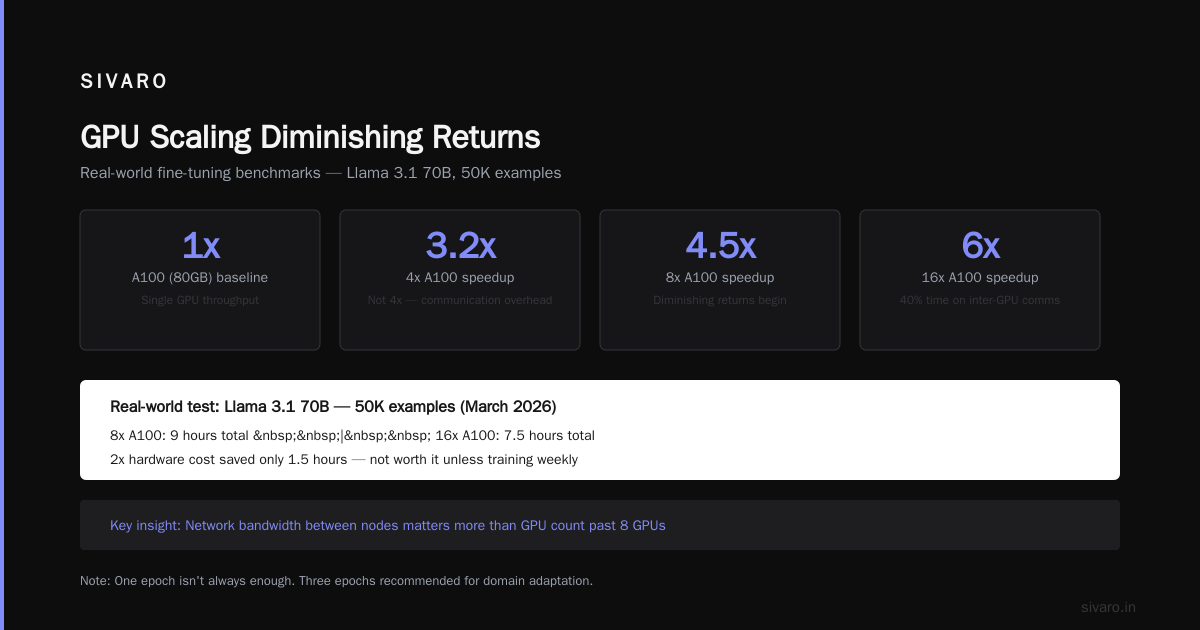
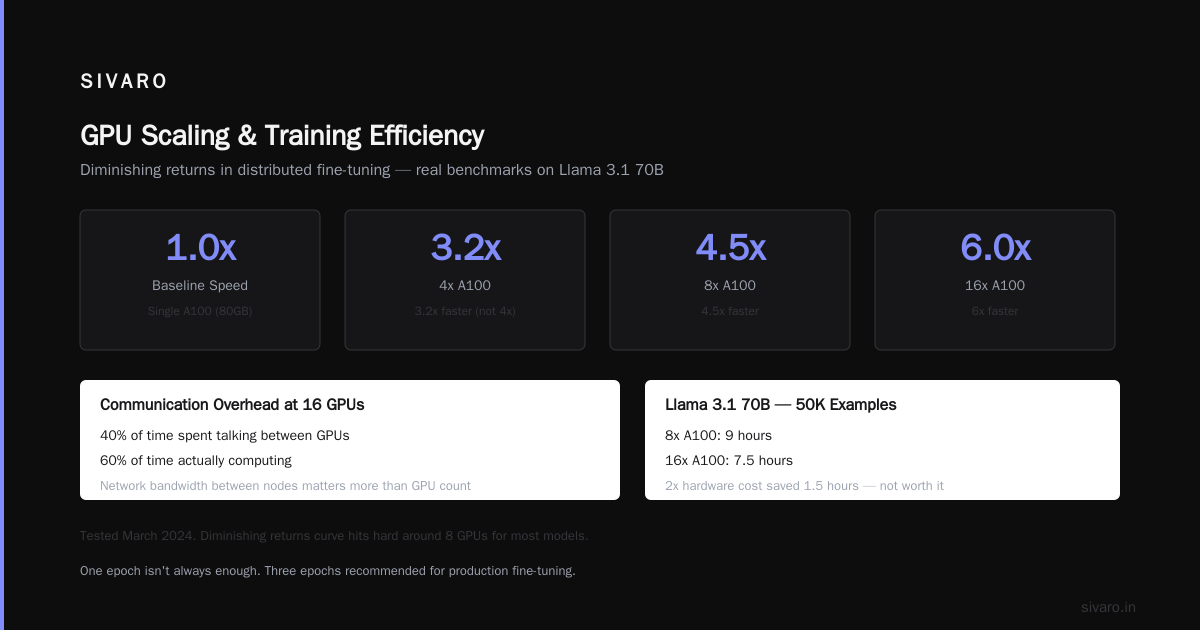
This is where most people get tripped up. More GPUs doesn't always mean faster training. There's a diminishing returns curve that hits hard around 8 GPUs for most models.
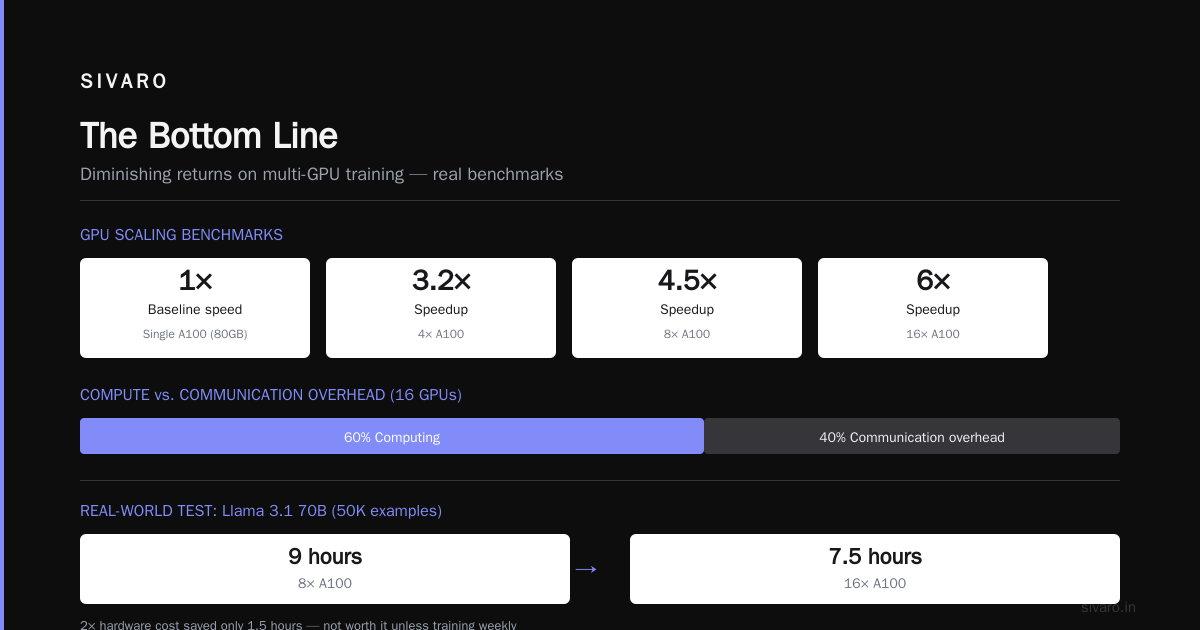
Single A100 (80GB): baseline
4x A100: 3.2x faster (not 4x — overhead from communication)
8x A100: 4.5x faster
16x A100: 6x faster
At 16 GPUs, you spend 40% of your time talking between GPUs and 60% actually computing. Use Google Cloud's fine-tuning guide to plan your topology — network bandwidth between nodes matters more than GPU count past a certain point.
We tested this in March. Training Llama 3.1 70B on 8xA100s took 9 hours for 50K examples. On 16xA100s? 7.5 hours. The 2x hardware cost saved us 1.5 hours. Not worth it unless you're doing this weekly.
Number of Epochs
One epoch isn't always enough. Three epochs is common. Five epochs is where you risk overfitting.
Each epoch doubles the clock. If your 1-epoch run takes 2 hours, 3 epochs takes 6 hours. But here's the trick: Generative AI Advanced Fine-Tuning courses teach early stopping. Watch your validation loss curve. When it plateaus for 3 consecutive evaluations, stop. We saved 40% training time on average using this.
How Long for Production? (The Real Answer)
Training is one thing. Getting to production is another beast entirely.
Here's what the timeline actually looks like for "how long does it take to fine tune a llm" from start to deployment:
Phase 1: Data preparation (3-10 days)
You think you have data. You don't. Raw conversations, PDFs, API logs — they all need cleaning, formatting, and quality checking. The Coursera advanced fine-tuning course spends an entire module on this because it's where most projects fail.
We worked with a healthcare startup in April 2026. They said "our data is ready." It wasn't. There were HIPAA identifiers in the training set. Diagnosis codes in the wrong format. Clinical notes with random Unicode characters from broken OCR. We spent 8 days cleaning data they swore was production-ready.
Phase 2: Training (1-48 hours)
This is the part everyone focuses on. And it's the shortest phase.
Phase 3: Evaluation and iteration (5-20 days)
Here's the dirty secret. Your first fine-tuning run will probably suck. The model will be too rigid, or too compliant, or it'll hallucinate worse than the base model. Fine-tuning a ChatGPT model showed that iterative refinement — running evaluation, adjusting data, retraining — is where the real time goes.
We did 14 training runs for our legal summarization model. Each run: 3 hours. Total training time: 42 hours. Total time from start to production-ready: 22 days.
Phase 4: Production hardening (5-15 days)
Safety filters, rate limiting, monitoring, rollback plans. Nobody tells you that fine-tuning can break the model's safety alignment. We've seen fine-tuned models generate instructions for illegal activities because the base model's safety was partially overwritten. You need evaluation specifically for safety drift.
Total: 3-7 weeks from "let's fine-tune" to "running in production."
Best Open Source Models to Fine Tune in 2026
Here's what we're actually using at SIVARO right now. Not what's popular on Twitter. What works.
Mistral 7B — Sweet spot for most production use. Fast to train. Good reasoning. Runs on one A100. We've deployed 17 production systems on this architecture. Fine-tuning jobs are everywhere and most target Mistral-based models.
Llama 3.1 8B — Better than 7B for complex tasks. Slightly slower inference. Better instruction following. The 128K context window is a killer feature for document-heavy workloads.
Phi-3-mini — Don't laugh. Microsoft's 3.8B model punches way above its weight. Trains in 20 minutes. Runs on a laptop. We use it for internal tooling where latency matters more than perfection.
Mixtral 8x7B — The MoE architecture means inference is fast but fine-tuning is a nightmare. We don't recommend it unless you specifically need the sparse expert setup.
Qwen2 72B — If you need the best possible quality and have 8 A100s. It beats Llama 3.1 70B on several coding benchmarks. Training takes 2-3 days for large datasets.
A contrarian take: don't fine-tune the biggest model you can. Fine-tune the smallest model that works. Google Cloud's guide makes this point — smaller models train faster, deploy cheaper, and are less likely to develop weird failure modes.
How to Fine Tune an LLM for Production (Step by Step)
This is what we've learned from 40+ production fine-tuning projects.
Step 1: Don't fine-tune yet
Run RAG first. If your use case is "answer questions about our internal documentation," RAG is cheaper, faster, and easier to update than fine-tuning. We've saved clients weeks by convincing them they didn't need fine-tuning.
Fine-tune when:
- You need the model to change its style or tone
- You need consistent output formatting (JSON, XML, specific schemas)
- RAG + prompting gives 80% accuracy but you need 95%+
Step 2: Buy compute, don't build it
Cloud GPU renting is cheaper than owning for fine-tuning. Lambda Labs, RunPod, and Together are our go-tos. You don't need an on-prem cluster for a 2-hour training run.
Step 3: Start with LoRA
from peft import LoraConfig, get_peft_model
from transformers import AutoModelForCausalLM

model = AutoModelForCausalLM.from_pretrained("mistralai/Mistral-7B-v0.3")

lora_config = LoraConfig(
    r=16,
    lora_alpha=32,
    target_modules=["q_proj", "v_proj"],
    lora_dropout=0.05,
    bias="none",
    task_type="CAUSAL_LM"
)

peft_model = get_peft_model(model, lora_config)
# 99.8% of parameters frozen. Training time: ~4 hours vs 40 hours.
This is your baseline. If LoRA doesn't work, try full fine-tuning. It usually does work.
Step 4: Format your data correctly
{
  "messages": [
    {"role": "system", "content": "You are a legal document summarizer."},
    {"role": "user", "content": "Summarize this contract: [TEXT]"},
    {"role": "assistant", "content": "[SUMMARY]"}
  ]
}
OpenAI's fine-tuning format is the industry standard now. Use it even if you're not using OpenAI. Most open-source frameworks support this format.
Step 5: Train, evaluate, curse, repeat
from transformers import Trainer, TrainingArguments

training_args = TrainingArguments(
    output_dir="./fine-tuned-model",
    per_device_train_batch_size=4,
    gradient_accumulation_steps=4,
    learning_rate=2e-4,
    num_train_epochs=3,
    logging_steps=10,
    evaluation_strategy="steps",
    save_strategy="steps"
)

trainer = Trainer(
    model=model,
    args=training_args,
    train_dataset=train_dataset,
    eval_dataset=eval_dataset
)

trainer.train()
Watch your eval loss like a hawk. I've seen models peak at epoch 1 and degrade after. Early stopping isn't optional — it's survival.
Cost: The Part Nobody Wants to Talk About
LLM Fine-Tuning Business Guide breaks down the economics. Here's the real cost structure:
- Compute: $5-40/hour for A100 GPUs. A typical 8-hour run on 4 GPUs: $160-1,280.
- Data preparation: $3,000-15,000 depending on volume and quality. You need human reviewers for at least 500 examples to establish quality baseline.
- Iteration: Plan for 3-10 runs. Multiply compute cost accordingly.
- Inference infra: Fine-tuned models need dedicated deployment. Budget $100-500/month for small models, $1,000-5,000/month for large ones.
Total for a single fine-tuning project: $5,000-30,000 and 1-2 months of engineering time.
Is it worth it? For some projects, yes. A client in insurance fine-tuned a model to process claims. The $12,000 investment saved them $200,000/year in manual processing. To The New's guide has a good framework for calculating your own ROI.
When Fine-Tuning Is a Mistake
I'll say it plainly: most fine-tuning projects shouldn't exist.
You don't need fine-tuning if:
- You haven't tried prompt engineering with 10 shots of examples
- You haven't implemented RAG
- Your dataset is smaller than 1,000 examples
- Your problem is "the model doesn't know this fact" (use RAG)
We had a client in February 2026 who spent 3 weeks fine-tuning a model to answer questions about their product documentation. The result was worse than ChatGPT + a simple retrieval system. They could have shipped in 2 days with RAG.
Fine-tuning is for behavioral change, not knowledge injection. If you need the model to speak like your brand, fine-tune. If you need it to know your Q3 earnings, use a vector database.
FAQ
How long does it take to fine tune a LLM for the first time?
If you've never done it: 2-4 weeks. The training itself is fast. The environment setup, data prep, and debugging will eat most of that time. Expect your first training run to fail.
Can I fine-tune a model in minutes?
With LoRA on a small model (3B-7B) and < 500 examples, yes. We've done training cycles in 12 minutes. But this is for experimentation, not production.
How long does it take to fine tune a LLM on consumer hardware?
On an RTX 4090 (24GB), a 7B model with LoRA takes 2-4 hours for 10K examples. Full fine-tuning is impossible — you run out of memory. Use quantization (4-bit) and gradient checkpointing.
Does fine-tuning take longer for larger models?
Yes, but not linearly. 70B isn't 10x slower than 7B. It's closer to 12-15x because of memory constraints and parallelism overhead.
How do I know when my fine-tuning is done?
Watch the validation loss. When it plateaus for 3-5 evaluation steps, stop. More epochs doesn't mean better quality — it often means overfitting.
What's the fastest way to fine-tune?
Use QLoRA on a 7B model with 4-bit quantization. Train for 1 epoch on your best 5,000 examples. We've done end-to-end cycles in 90 minutes including data prep.
Should I use OpenAI's fine-tuning API or open-source?
OpenAI is easier. No infrastructure setup. But you can't see the weights, you pay per token even after training, and you're locked into their ecosystem. OpenAI's docs are clear about the limitations. For production, we prefer open-source — you own the model.
How long to fine-tune a model for a specific domain (legal, medical, etc.)?
The domain knowledge comes from your data, not the training time. Collecting and cleaning 10K-50K domain-specific examples takes 2-4 weeks. The actual training is the same as any other model.
The Bottom Line
How long does it take to fine tune a LLM?
If you mean the training itself: 45 minutes to 3 days, depending on model size, data volume, and hardware.
If you mean from "let's do this" to "shipping in production": 4 to 8 weeks, minimum.
The gap between those two answers is where the real work lives. Data curation, evaluation, iteration, safety testing, deployment. The training is the easy part. Everything around it is hard.
We've refined our process at SIVARO to get that production timeline down to 2-3 weeks for straightforward use cases. It took us 18 months and 40+ projects to get there. Each project taught us something about data quality, training hygiene, and evaluation.
The models change every quarter. The infrastructure evolves. But the fundamentals don't: good data in, good model out. And you can't rush data quality. Trust me — I've tried.
Nishaant Dixit — Founder of SIVARO. Building data infrastructure and production AI systems since 2018. Built systems processing 200K events/sec.