
Is Apache Kafka a Language? No, and Here's Why You're Asking the Wrong Question
I was sitting in a hotel bar in Bangalore two weeks ago when a VP of Engineering asked me this exact question. Not as a joke. He was serious. "Is Apache Kafka a language?" He'd been telling his team they needed to "learn Kafka" for six months, and somewhere between the Jira tickets and the production outages, he'd started confusing the tool with the skill.
He's not alone. The question "is apache kafka a language?" gets searched thousands of times a month. And I get it — the name is confusing. Franz Kafka wrote novels about bureaucratic nightmares. Apache Kafka is a distributed event streaming platform. The connection? The original creator, Jay Kreps at LinkedIn in 2011, named it after the writer because "it's a system optimized for writing." A pun. That's it.
Let me be direct: Apache Kafka is not a programming language. It's a distributed commit log — a system for publishing, subscribing to, storing, and processing streams of records in real time. You don't write Kafka. You write to Kafka. You configure Kafka. You deploy Kafka. But you don't code in Kafka the way you code in Python or Java or Rust.
But the question isn't stupid. It reveals something deeper about how we think about infrastructure today. And that's what this guide is actually about.
What Does Kafka Stand For? (Spoiler: Nothing)
"What does kafka stand for?" is the second most common question I get after the language thing. The answer disappoints people.
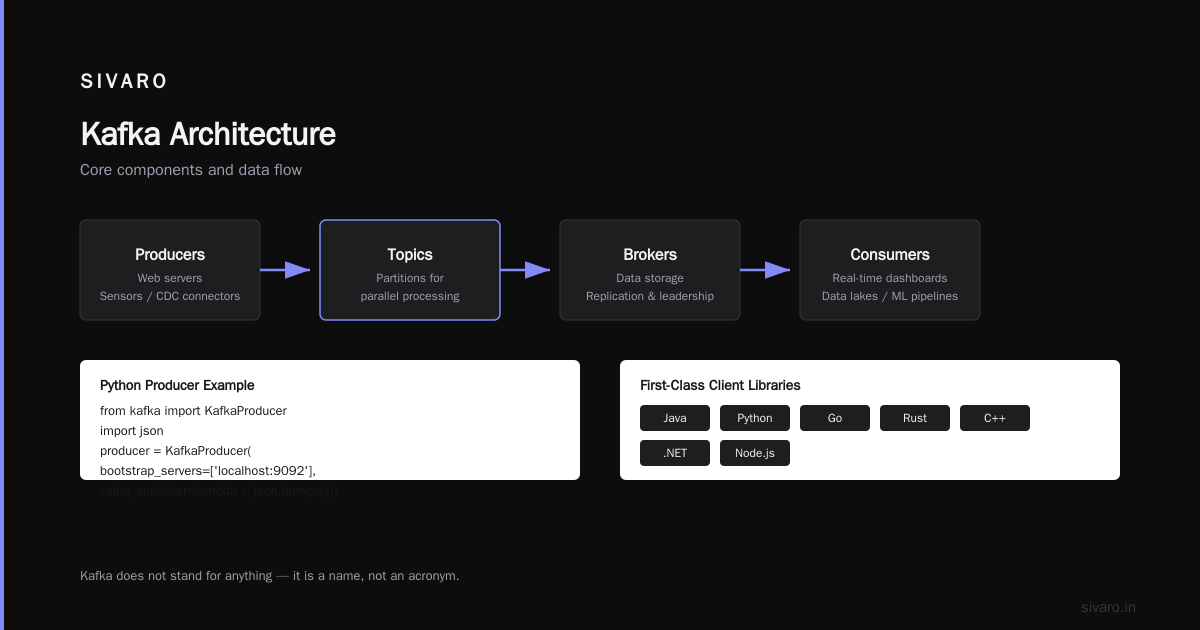
Kafka doesn't stand for anything. It's not an acronym. It's a name — straight up borrowed from Franz Kafka, the early 20th-century Czech writer who died in 1924. The project started at LinkedIn, internally code-named after the author, and it stuck.
This matters because naming conventions signal intent. When you name something after a person known for existential dread and absurd bureaucracy, you're either making a joke or you're trying to tell you something about the complexity you're dealing with. Kreps was doing both.
The Kafkaesque nature of distributed systems is real. I've seen pipelines that turn into labyrinths. Topics that spawn into infinite regressions. Configurations that feel like Kafka's The Trial — you never quite know if you're winning or losing until the whole thing collapses.
Is Kafka a Frontend or Backend?
"Is kafka a frontend or backend?" — another common search. The answer is backend. Exclusively backend. Kafka lives in your data center, on your cloud VMs, in your Kubernetes clusters. Users never touch it directly. Browsers don't load it. It's infrastructure.
But here's the nuance: Kafka is increasingly becoming the middle — not front, not back, but the nervous system connecting both. Your frontend app sends events to Kafka through an API gateway. Your backend services consume those events. Kafka sits in between, decoupling everything.
At SIVARO, we built a system for a fintech client last year where Kafka became the backend of the backend. Every microservice wrote to Kafka. Every read came from Kafka. The "backend" was just stateless transformations sitting on top of event streams. That's how deep it goes.
The Anatomy of Apache Kafka
Let's get technical. Because if you're going to ask if Kafka is a language, you need to understand what it actually does.
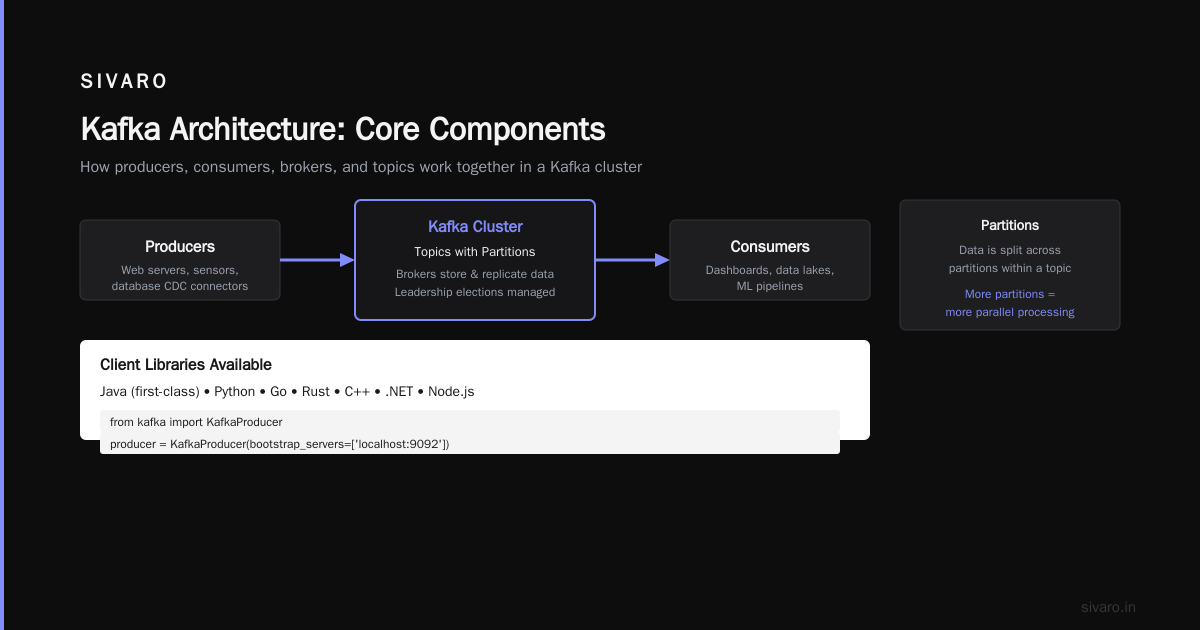
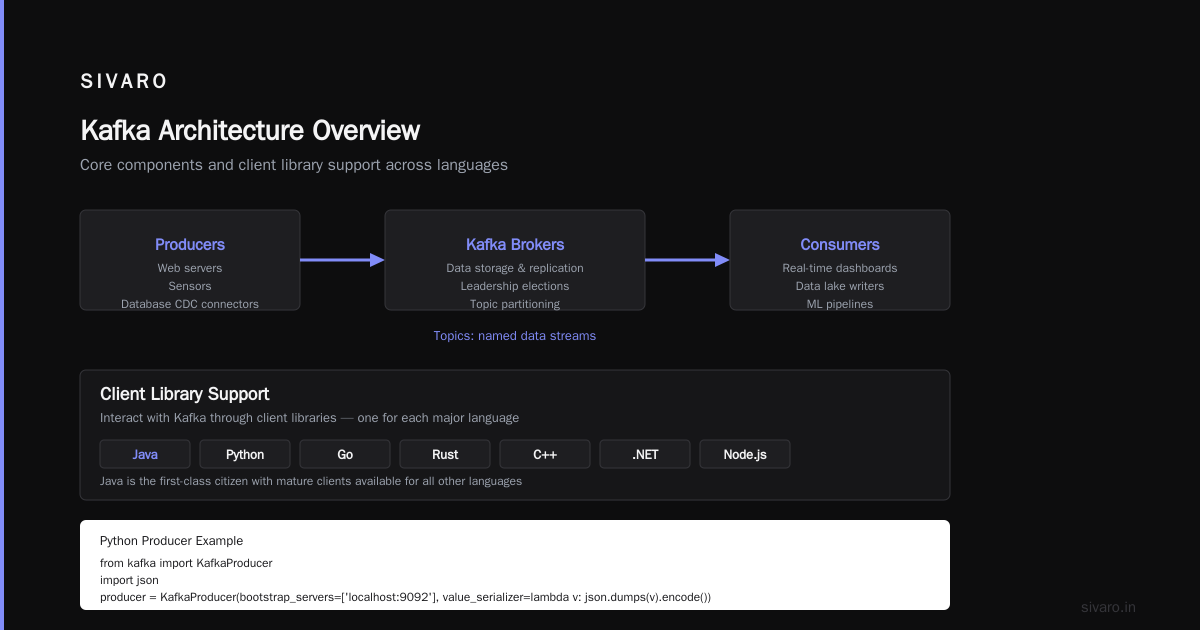
Kafka is built around five core abstractions:
- Topics — Named channels where data flows. Think of them like database tables, but for events.
- Partitions — Each topic splits into partitions. This is how Kafka scales. More partitions = more parallel processing.
- Producers — Anything that writes data to a topic. Could be a web server, a sensor, a database CDC connector.
- Consumers — Anything that reads from a topic. Could be a real-time dashboard, a data lake writer, a machine learning pipeline.
- Brokers — The Kafka servers themselves. They store data, handle replication, manage leadership elections.
You interact with Kafka through client libraries — one for each major language. Java is the first-class citizen. But you'll find mature clients for Python, Go, Rust, C++, .NET, and Node.js.
Here's what a producer looks like in Python:
python
from kafka import KafkaProducer
import json

producer = KafkaProducer(
    bootstrap_servers=['localhost:9092'],
    value_serializer=lambda v: json.dumps(v).encode('utf-8')
)

for i in range(100):
    producer.send('order-events', {'order_id': i, 'amount': 100.0 * i})

producer.flush()
And here's the consumer side:
python
from kafka import KafkaConsumer
import json

consumer = KafkaConsumer(
    'order-events',
    bootstrap_servers=['localhost:9092'],
    auto_offset_reset='earliest',
    value_deserializer=lambda v: json.loads(v.decode('utf-8'))
)

for message in consumer:
    print(f"Order {message.value['order_id']}: ${message.value['amount']}")
These are not Kafka code. They're Python code using Kafka. The distinction matters.
Why People Think Kafka Is a Language
Three reasons. All of them make sense.
First, the name. Franz Kafka's writing is dense, layered, and requires interpretation. When you hear "learn Kafka," it sounds like learning a new way to express logic. And honestly? Kafka's configuration system is a kind of language — a declarative DSL for defining how data flows. Look at this Kafka Streams topology:
java
KStream<String, Order> orders = builder.stream("orders");
KTable<String, Double> revenueByStore = orders
    .groupBy((key, order) -> order.getStoreId())
    .aggregate(
        () -> 0.0,
        (key, order, total) -> total + order.getAmount(),
        Materialized.<String, Double, KeyValueStore<Bytes, byte[]>>as("revenue-store")
    );
That's not a language. But it reads like one. It has a grammar. A vocabulary. A compiler-like processing pipeline.
Second, the ecosystem. When you adopt Kafka, you end up learning Kafka Streams, ksqlDB, Kafka Connect, Schema Registry, REST Proxy, and a dozen other tools. The ecosystem is so large that it feels like a platform — or a language runtime. Confluent, the company behind Kafka, has built an entire commercial product around this ecosystem.
Third, the cognitive load. You don't just "use" Kafka. You model your entire system around it. Your mental model shifts from request-response to event-driven. You start thinking in offsets, partitions, consumer groups, exactly-once semantics. That mental model shift feels like learning a new paradigm — which is what learning a new programming language does to you.
The Real Question Nobody Asks
"Is apache kafka a language?" is the wrong question. The right question is: "Is Kafka the right tool for my problem?"
Most people should not run Kafka. I mean that.
Kafka was designed for specific use cases: high-throughput event streaming, data pipeline buffering, log aggregation, metrics collection. If you're processing fewer than 10,000 events per second, Kafka is overkill. A simple Redis queue or RabbitMQ will serve you better with lower operational cost.
I learned this the hard way. In 2019, we deployed Kafka for a client's analytics pipeline doing 500 events/second. The operational overhead — Zookeeper management, partition rebalancing, disk sizing, consumer lag monitoring — ate up two full-time engineers. We switched to Redis Streams. Problem solved. Costs dropped 70%.
But when you do need Kafka, nothing else works. We're currently operating a pipeline for a logistics company that processes 200,000 events per second — GPS coordinates, delivery status updates, inventory changes. Kafka handles it with 12 brokers and 99.99% uptime. RabbitMQ would melt. Redis would run out of memory. Kafka's disk-based persistence and partition model make it the only viable choice.
Kafka and the Kafkaesque
Franz Kafka's work — The Metamorphosis, The Trial, The Castle — explores themes of alienation, bureaucratic absurdity, and the impossibility of understanding the systems we're trapped in. Reading Franz Kafka's personal writings reveals a man obsessed with systems that work in theory but fail in practice.
Sound familiar?
Kafka the system has its own Kafkaesque qualities. Consumer lag that grows inexplicably. Rebalances that take 30 minutes. Disk failures that cascade into cluster outages. Configurations where changing one parameter (like max.poll.records) can break your entire consumption pattern.
The existentialist philosophy embedded in Kafka's literature isn't just a literary curiosity — it's a warning. Systems built with too much abstraction become incomprehensible to the people running them. Kafka's complexity is real. Its failure modes are subtle. Its operational requirements are non-trivial.
I've seen teams spend six months building a Kafka pipeline, only to discover that their data format changed and they couldn't evolve the schema without downtime. Schema Registry helped, but it added another layer of complexity. The philosophical impact of Kafka's work — the sense of being trapped in a system you don't fully understand — applies directly to modern data infrastructure.
How to Actually Explain Kafka to Your Team
Stop calling it a message queue. That's wrong. Kafka is a distributed commit log. Here's the mental model:
Imagine a stack of papers on a desk. Each paper is a record. New papers get added to the top. Anyone can read any paper, from any position in the stack. The stack never runs out of space (within disk limits). Multiple people can read the same paper. Nobody can change a paper once it's written.
That's Kafka. It's not a queue where messages disappear after consumption. It's not a database where you update records. It's an append-only log that keeps everything forever (or until you configure retention).
This matters because it changes how you design systems. In a queue-based architecture, you process messages and they're gone. In a log-based architecture, you can go back in time, reprocess data, backfill systems, audit your entire history.
Here's a real example. A payments company I advised was using RabbitMQ for transaction processing. When a bug caused incorrect amounts in the processing logic, they couldn't replay the original messages — they were already consumed and acknowledged. With Kafka, they could reset the consumer offset to before the bug and replay everything. The transaction log was still there. Three hours of work instead of three weeks of forensic accounting.
The Future: Kafka in 2026 and Beyond
July 2026. Kafka turned 15 this year. It's no longer the new hotness. It's infrastructure — boring, stable, everywhere.
The landscape has shifted. Apache Pulsar and Redpanda have emerged as competitors. Pulsar separates compute from storage. Redpanda is Kafka API-compatible but written in C++. Both are faster in certain workloads. But Kafka's ecosystem is the moat. Confluent Cloud has made Kafka a managed service. Amazon MSK handles the ops. You can spin up a Kafka cluster in 10 minutes without touching Zookeeper (KRaft mode, which went stable in Kafka 3.3 in 2022).
The question "is apache kafka a language?" will fade. But the underlying confusion won't. As infrastructure becomes more abstract, the lines between tools, platforms, and languages blur. Serverless functions are "code" but also "infrastructure." Event streams are "data" but also "processing logic." The abstraction layer thickens.
Here's my prediction: Within five years, we'll see a generation of engineers who interact with Kafka exclusively through higher-level abstractions — event sourcing frameworks, data mesh platforms, real-time feature stores. They'll never touch server.properties or configure a partition. They'll just write code that publishes and subscribes to "things," and Kafka will be the invisible plumbing.
And someone will still ask if it's a language.
FAQ: The Questions You Actually Need Answered
Q: Is Apache Kafka a programming language?
No. Kafka is a distributed streaming platform. You interact with it using client libraries in existing languages like Java, Python, or Go. You can't write a program "in Kafka."
Q: What does Kafka stand for?
Nothing. It's named after Franz Kafka, the writer. The name was a joke about "writing" that stuck.
Q: Is Kafka a frontend or backend technology?
Backend. Strictly infrastructure. Users never interact with Kafka directly.
Q: When should I NOT use Kafka?
Under ~10K events/second, when your team has no Kafka ops experience, when you need simple message delivery (try RabbitMQ), when your data has no replay requirements (try Redis), when you need sub-millisecond latency (try Pulsar or direct gRPC).
Q: What's the hardest part of Kafka?
Operations. Consumer lag monitoring. Partition rebalancing. Disk management. Schema evolution. Exactly-once semantics. The code is the easy part.
Q: Can I learn Kafka in a week?
You can write producers and consumers in a week. It'll take six months to understand failure modes.
Q: Is Kafka dying?
No. It's maturing. Competitors exist, but Kafka's ecosystem is still dominant. Confluent reported $800M+ revenue in 2025. It's not going anywhere.
Q: Should I use Managed Kafka (Confluent Cloud, MSK) or self-host?
Self-host if your throughput is predictable and you have ops expertise. Managed if you want to sleep at night. We use Confluent Cloud for most clients. The premium is worth avoiding 3 AM pager duty.
Closing Thoughts
Apache Kafka is not a language. But it's also not just a tool. It's a paradigm shift. It forces you to think in events, logs, and offsets. It changes how you architect systems. It makes you confront the trade-offs between consistency, availability, and latency — every single day.
Franz Kafka wrote about people trapped in systems they don't understand. Apache Kafka is a system that, if you don't understand it, will trap you in production incidents that take weeks to untangle.
Learn the difference. Know your throughput numbers. Respect the operational complexity. And for the love of everything — don't name your topic "destiny" because you think it's clever. I've seen it happen. It never ends well.
Nishaant Dixit — Founder of SIVARO. Building data infrastructure and production AI systems since 2018. Built systems processing 200K events/sec.