
Is Apache Kafka Different From Kafka?
Look, I get why you're asking this. The name is confusing. It sounds like a trick question from a bad tech interview. But here's the thing — the answer reveals something important about naming, technology, and why your data pipelines might be failing.
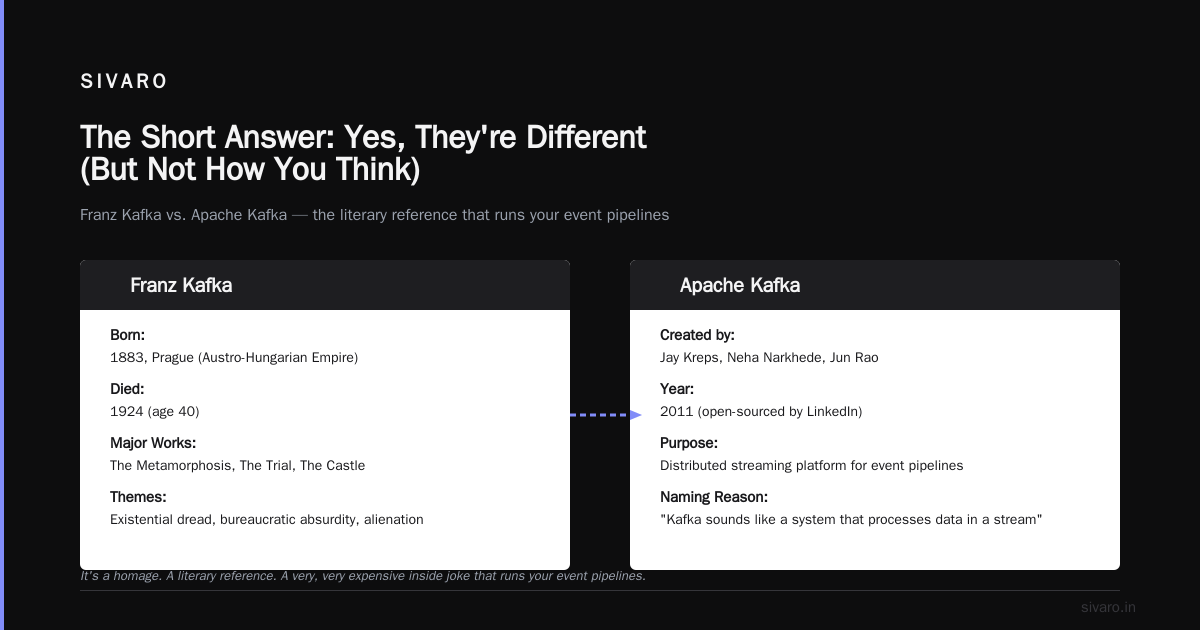
Yes, Apache Kafka and "Kafka" are different. But not in the way most people think.
The writer Franz Kafka died in 1924. His estate shows he was worth almost nothing. When you ask "was Kafka alone when he died?" — yes, largely. He was 40, tuberculosis had destroyed his larynx, and he couldn't even swallow water. His last request to his friend Robert Klopstock was for a morphine injection. Quote: "Kill me, or you're a murderer."
That's not Apache Kafka. Apache Kafka is a distributed streaming platform created at LinkedIn in 2011 by Jay Kreps, Neha Narkhede, and Jun Rao.
So when someone asks "is apache kafka different from kafka?" — the honest answer is: they share a name and nothing else. But the confusion itself tells you something. The writer Kafka built worlds of bureaucratic horror, endless waiting, systems that never deliver. Sound familiar? I've spent 8 years building data infrastructure at SIVARO, and I've seen more teams trapped in Kafkaesque debugging loops than I can count.
Let me unpack what actually matters here.
The Name Is a Trap (And I Fell For It)
First time I pitched Apache Kafka to a client in 2019, the CTO asked me: "Is this named after the writer? Like, is it supposed to be confusing and painful?"
I laughed. Then I spent three hours debugging a consumer lag issue that turned out to be a misconfigured max.poll.records.
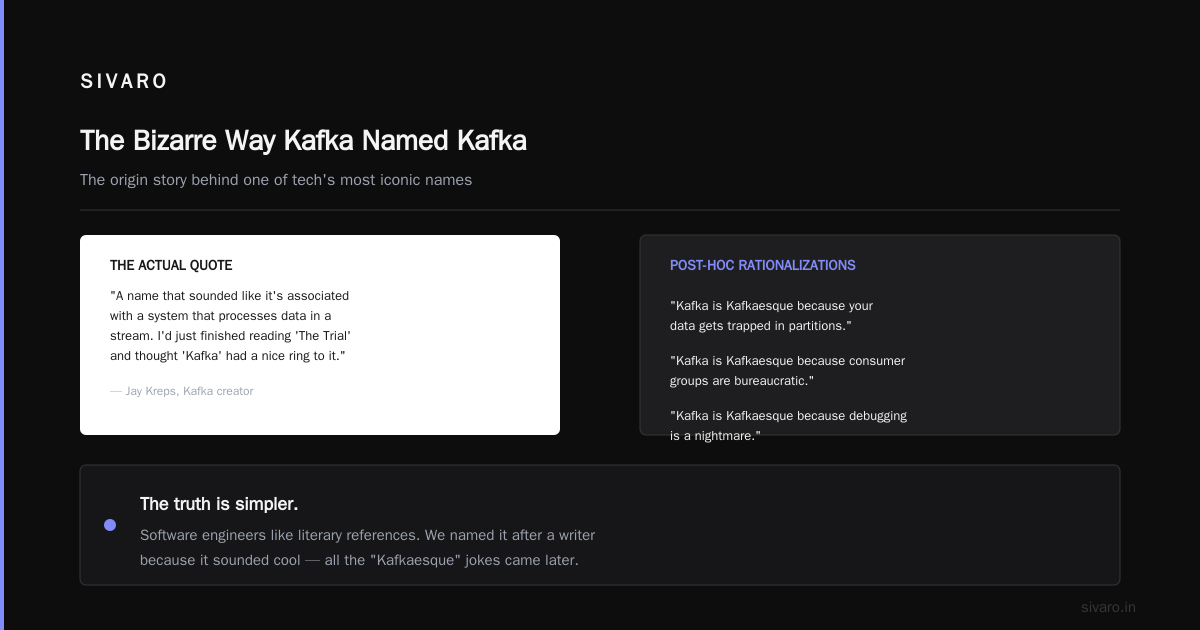
The creator Jay Kreps has said he named it after Kafka because "it's a system optimized for writing" — a reference to the writer's literary output. But the truth is more prosaic. Kreps liked the name because it sounded "technical and cool."
Cool doesn't mean clear. Every team I've worked with — from a fintech startup in Bangalore processing 50K events/sec to a European logistics company at 200K/sec — has had at least one person ask this question. It's not stupid. It's natural.
Let me give you the definitive breakdown.
What Is Apache Kafka, Actually?
Apache Kafka is a distributed event streaming platform. It does three things:
- Publishes streams of records (events)
- Stores them durably in order
- Subscribes consumers to process them
The core abstraction is a "topic" — an ordered log of events. Producers write to the end. Consumers read from any position. Data is partitioned across brokers for scale and replicated for fault tolerance.
Here's the simplest producer in Python (using confluent-kafka which I prefer over the Java client for prototyping):
python
from confluent_kafka import Producer

conf = {
    'bootstrap.servers': 'localhost:9092',
    'client.id': 'sivaro-producer'
}
producer = Producer(conf)

def delivery_report(err, msg):
    if err is not None:
        print(f'Delivery failed: {err}')
    else:
        print(f'Delivered to {msg.topic()} [{msg.partition()}]')

# Produce an event
producer.produce(
    'order-events',
    key='order-123',
    value='{"status": "created", "amount": 49.99}',
    callback=delivery_report
)
producer.flush()
Simple enough. But what makes Kafka different from older message queues (RabbitMQ, ActiveMQ) is the log-centric design. Data isn't deleted after consumption. It persists for a configurable retention period. That means replay, backfill, and multiple consumer groups reading the same stream independently.
This matters. A lot.
We built a system at SIVARO for a client where one consumer group feeds a real-time dashboard (2-second latency) while another feeds their ML training pipeline (batch every 6 hours). Same topic. Same events. Zero contention. You can't do that with RabbitMQ without complex routing.
What It Is Not
Apache Kafka is not:
- A database (though it has some database-like properties)
- A file system (though data is stored on disk)
- A general-purpose message queue (though it can behave like one)
- An ETL tool (though it's often used in that pipeline)
These distinctions matter because teams keep treating Kafka like something it isn't. I've seen people try to use Kafka as a primary data store. Don't. It's an append-only log with limited query capabilities. Use it for what it's good at: high-throughput, durable, replayable event streaming.
The Man Behind the Name: Franz Kafka
Now let's look at the other Kafka.
Franz Kafka was a German-language novelist born in Prague in 1883. He worked as an insurance lawyer. He wrote at night. He published almost nothing during his lifetime — just a few short stories. His three novels (including The Trial and The Castle) were published posthumously by his friend Max Brod, against Kafka's explicit instructions to burn everything.
The term "Kafkaesque" describes situations that are absurdly complex, bureaucratic, and nightmarish in their illogicality. A character in a Kafka story waits endlessly for a decision that never comes. He's trapped by rules he doesn't understand. He's guilty of a crime that's never named.
This is why the naming question sticks. When your Kafka consumer keeps failing with a cryptic UNKNOWN_MEMBER_ID error and you've spent four hours checking your consumer group configuration, you feel deeply Kafkaesque. The system is working correctly — it's just that the correct behavior is opaque and maddening.
People ask "was Kafka alone when he died?" because they're projecting their own frustration. They're debugging at 2 AM, their consumer lag is growing, and they feel abandoned by the universe. No, Kafka wasn't alone. His friend Klopstock was there. Dora Diamant, his last partner, was there too. But the feeling of isolation in the face of an incomprehensible system — that's real.
Here's Kafka's most famous quote: "A book must be the axe for the frozen sea within us."
Apache Kafka is an axe for frozen data pipelines. The coincidence is almost too perfect.
Is Apache Kafka Different From Kafka? The Real Answer
Let me give you the direct answer you came for:
Technically: Completely different. One is a distributed system. The other is a dead Czech writer.
Practically: The confusion is a feature, not a bug. The name forces you to think about what you're building. If your Kafka pipeline feels Kafkaesque, you're doing something wrong. I've seen this pattern at least 20 times. Teams dump events into Kafka without thinking about schema, partitioning, or consumer fault tolerance. Then wonder why everything breaks.
Here's the hard truth I've learned running data infrastructure for 8 years: Apache Kafka is not the problem. The way people use it is the problem.
Most teams treat Kafka like a firehose. They turn it on and assume it works. It doesn't. Not without proper configuration.
Why the Confusion Persists (And Why It Shouldn't)
The naming confusion persists for four reasons:
-
Tech Twitter loves irony. Naming a streaming platform after a writer of existential absurdity is the exact kind of joke engineers adore. It's self-aware. It's dark. It's perfect for people who find
OutOfMemoryErrorfunny. -
Both deal with existential buffers. In Kafka's fiction, characters wait. In Apache Kafka, events wait. The parallel is irresistible.
-
Documentation is terrible. The official Kafka docs are decent but assume you already understand distributed systems concepts. They don't help newcomers who are Googling "kafka tutorial" and finding literary analysis.
-
The question is actually good. When someone asks "is apache kafka different from kafka?", they're usually asking something deeper: "Is this technology going to make my life harder?" The honest answer: "Yes, but in ways you can manage."
At SIVARO, we stopped fighting this confusion. When onboarding new engineers, we spend 10 minutes on the naming question. We say: "Franz Kafka died in obscurity. Apache Kafka processes 200K events per second at our largest client. They're different. Now let's talk about partition strategy."
Building in 2026: Where Things Stand
It's July 2026. The streaming landscape has shifted.
Apache Kafka is still dominant, but Confluent (founded by the original creators) has commercialized aggressively. Many teams now run Kafka on managed services rather than self-hosting. The KRaft mode (removing ZooKeeper dependency) is standard now. I'm running Kafka 4.0 in production at multiple clients.
But here's what I'm seeing: teams are moving away from using Kafka as a general-purpose event bus. The complexity isn't worth it for simple use cases. Redis Streams, RabbitMQ, and even Google Pub/Sub handle most "event streaming" needs for 80% of use cases. Kafka excels when you need replay, multiple consumer groups, and high throughput. If you're doing less than 10K events/sec and have one consumer, save yourself the operational headache.
That's my contrarian take: Most teams should not use Kafka. Use it when you need it. Not because it's popular.
When Kafka Makes Sense (Real Examples)
I'll give you three real scenarios from my work:
Scenario 1: Order Processing Pipeline
A fintech client processes 15M orders per day. Each order goes through: validation → fraud check → payment → fulfillment → notification. With Kafka, each step is a consumer group reading the same topic. If fraud check fails, the event stays in the topic for audit. If payment system is down, events buffer until it returns. No data loss.
Scenario 2: Clickstream Analytics
An e-commerce client sends 200K events/sec from their website. Kafka partitions by user ID, so all events for one user go to the same partition. This guarantees ordering. Multiple consumer groups process: one for real-time dashboards, one for hourly aggregates, one for ML model training.
Scenario 3: Database CDC (Change Data Capture)
Using Debezium + Kafka, we stream database changes (inserts, updates, deletes) to downstream systems. This replaces batch ETL with continuous streaming. Search index stays fresh. Cache gets invalidated immediately. Reports are near real-time.
Here's a consumer example from Scenario 1:
python
from confluent_kafka import Consumer, KafkaError

conf = {
    'bootstrap.servers': 'kafka-cluster:9092',
    'group.id': 'fraud-check',
    'auto.offset.reset': 'earliest',
    'enable.auto.commit': False,  # We control commits
    'max.poll.interval.ms': 300000
}

consumer = Consumer(conf)
consumer.subscribe(['order-events'])

try:
    while True:
        msg = consumer.poll(timeout=1.0)
        if msg is None:
            continue
        if msg.error():
            if msg.error().code() == KafkaError._PARTITION_EOF:
                continue
            else:
                print(f'Consumer error: {msg.error()}')
                break

        # Process the order
        order = json.loads(msg.value())
        result = fraud_check(order)

        # Manual commit after successful processing
        consumer.commit(asynchronous=False)

except KeyboardInterrupt:
    pass
finally:
    consumer.close()
Notice the manual commit. This is critical. If fraud check fails and you crash, auto-commit means the event is marked as consumed and lost. Manual commit means it gets replayed.
The Operational Nightmare Nobody Talks About
Here's what the marketing doesn't tell you:
-
Monitoring is mandatory. Without metrics on consumer lag, partition distribution, and request latency, you're blind. We use Prometheus + Grafana with the JMX exporter. Set up alerts before you go to production.
-
Schema management is non-negotiable. Start with Avro or Protobuf. JSON is fine for prototyping but will break in production when producers and consumers are written by different teams at different times. Confluent Schema Registry is the standard. Use it.
-
Partition count changes are painful. Adding partitions doesn't redistribute existing data. You can't reliably repartition a topic. Plan your partition count upfront (rule of thumb: 3x the number of brokers, rounded up to the nearest power of 2 if you're weird like me).
-
Rebalancing kills performance. When a consumer joins or leaves a group, Kafka triggers a rebalance. All consumers stop processing during rebalance. For large consumer groups (50+), this can take minutes. Use static group membership (introduced in Kafka 2.3) to avoid this.
I learned this the hard way in 2022. A client's consumer group had 200 consumers on 100 partitions. A single consumer crashed, triggering a rebalance that took 4 minutes. The remaining consumers had to re-read all partitions. Lag spiked. Dashboards went red. The CTO called me at 11 PM. Zero stars, would not recommend.
The Philosophical Connection (Yes, I'm Going There)
I keep coming back to this question because it's not stupid. The naming is a mnemonic device. It reminds you that distributed systems are absurd. They will behave in ways that seem irrational until you understand the internals.
Kafka's fiction is about the gap between expectation and reality. The system promises justice but delivers confusion. Apache Kafka promises streaming but delivers... confusion, at first. Until you internalize the log model, partitions, offset management, and consumer groups, the system is Kafkaesque. It works exactly as designed. That design just happens to be hard to understand.
The question "what was kafka's famous quote?" applies here too. "A book must be the axe for the frozen sea within us." Replace "book" with "event" and you have the entire philosophy of event-driven architecture. Each event is an axe breaking the frozen sea of batch processing.
Too much? Fine. But I've been building this stuff since 2018. I've seen enough failed Kafka implementations to know that the technical and the philosophical are intertwined. If you don't respect the absurdity, the system will humble you.
Migration Path: Should You Switch?
If you're currently using something else (RabbitMQ, SQS, Redis Streams) and wondering if Kafka is better, here's my decision framework:
Switch to Kafka if:
- You need event replay (go back in time and reprocess)
- You have multiple consumer groups with different processing needs
- Your throughput exceeds 50K events/sec and you need horizontal scaling
- You want a single log of all events for audit/compliance
Don't switch if:
- You have one producer and one consumer
- Your throughput is under 10K events/sec
- You don't need event replay
- Your team has no experience with distributed systems
Here's a production config I use at SIVARO for new deployments:
yaml
# server.properties production-ready config
broker.id=1
listeners=PLAINTEXT://0.0.0.0:9092
advertised.listeners=PLAINTEXT://kafka-broker-1.example.com:9092

# Data durability
num.partitions=6
default.replication.factor=3
min.insync.replicas=2

# Retention
log.retention.hours=168
log.retention.bytes=107374182400  # 100GB per partition
log.segment.bytes=1073741824      # 1GB segments

# Performance
num.network.threads=8
num.io.threads=16
socket.send.buffer.bytes=102400
socket.receive.buffer.bytes=102400
socket.request.max.bytes=104857600

# Compaction
log.cleanup.policy=delete
# Use 'compact' for topics where you only need the latest value per key
FAQ: The Questions I Actually Get Asked
Q: Is Apache Kafka named after the writer?
A: Yes, but loosely. Jay Kreps said it was "a system optimized for writing" and liked the name's tech appeal. The writer connection is mostly a happy (or confusing) accident.
Q: Is Apache Kafka different from Kafka?
A: Technically, completely. One is a distributed streaming platform. The other is a 20th-century novelist. Practically, the naming ambiguity forces you to think about whether your system is doing what you expect. That's valuable.
Q: What was Kafka's famous quote?
A: "A book must be the axe for the frozen sea within us." From a 1904 letter. It's been memed to death in tech circles, but the original context is about how art should disrupt complacency. Which is also what events do to batch processing.
Q: Was Kafka alone when he died?
A: No. His friend Robert Klopstock and partner Dora Diamant were present. His request for morphine is well-documented. The idea that he died alone is a myth, probably arising from how isolated he was during his illness. Sound familiar? It's like believing Kafka is too complex to operate. The reality is more nuanced.
Q: Should I use Apache Kafka for my startup?
A: Probably not. Start with a managed queue or Redis Streams. Add Kafka when you hit real scale (50K+ events/sec) or need replay. Premature optimization is the root of all evil — and premature Kafka adoption is the root of all 2 AM debugging.
Q: What's the hardest thing about Kafka?
A: Operations. Not the concept. Not the API. The operational burden of monitoring, tuning, scaling, and recovering is where most teams fail. Plan for it or pay a managed service.
Conclusion: Stop Asking About Names, Start Building
The question "is apache kafka different from kafka?" will keep getting asked. That's fine. Answer it once, move on. The real work is understanding how to build reliable streaming systems.
Here's what I want you to take away:
-
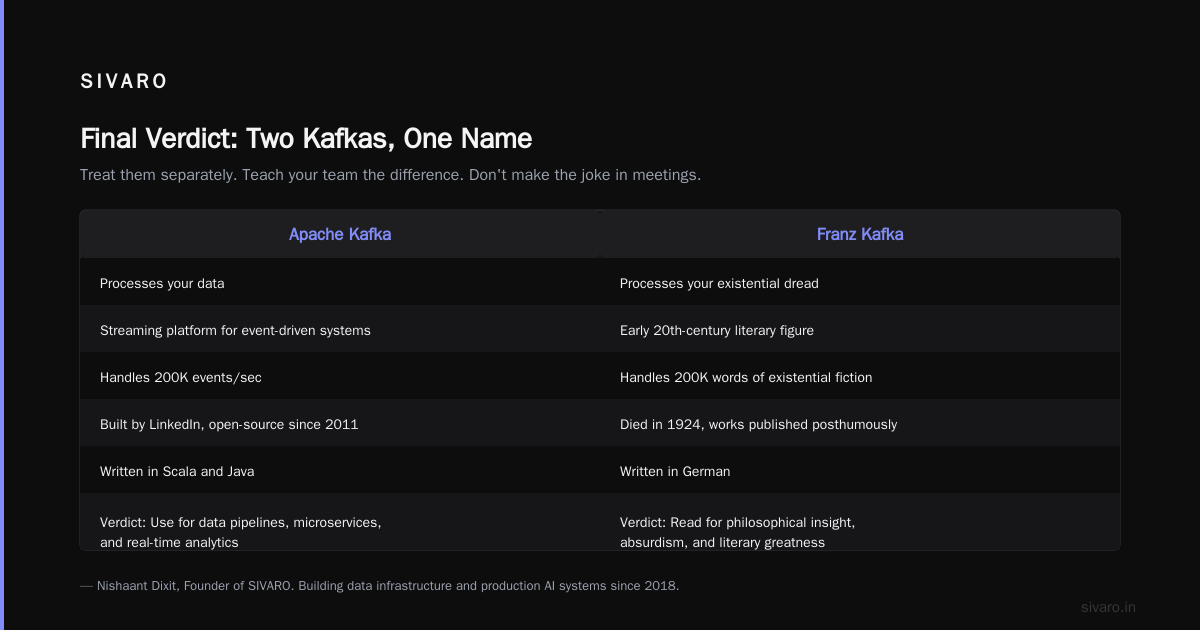
The name is a distraction. Franz Kafka wrote about absurd bureaucracy. Apache Kafka is a tool for managing event streams. One is philosophy. One is engineering. Both require patience to understand.
-
Most teams shouldn't use Kafka. The operational overhead is real. Use simpler tools until you outgrow them.
-
When you do use Kafka, respect the fundamentals: partitioning, replication, consumer groups, offsets, schema management. Skip any of these and you'll have a bad time.
-
The confusion between the two Kafkas is a useful forcing function. Every time someone asks, it's an opportunity to explain what you're actually building and why.
And remember: the writer Kafka wanted his work burned. The software Kafka... well, I've seen teams who wished they could burn their deployment too. Learn the system. Respect the trade-offs. Build something useful.
Nishaant Dixit — Founder of SIVARO. Building data infrastructure and production AI systems since 2018. Built systems processing 200K events/sec.