 SIVARO
Is ChatGPT an AI Agent? The Real Answer Changes Everything
I'll keep it simple: ChatGPT is not an AI agent — but it can act like one, and that distinction is costing companies real money.
Here's the problem. In 2024, I sat through twelve vendor pitches where people called every LLM wrapper an "AI agent." A chatbot that books a meeting? Agent. A Q&A bot that searches your docs? Agent. An API that writes email drafts? Agent.
None of them were agents. Most were prompt templates with an if-else on top.
So when someone asks "is chatgpt an ai agent?", the honest answer depends on what you mean by "agent." And that's the part most articles skip. They give you a definition from a textbook. I'm going to give you what I learned building production AI systems at SIVARO — including the part where our team got this wrong for six months.
Let's be specific.
What Exactly Makes Something an AI Agent?
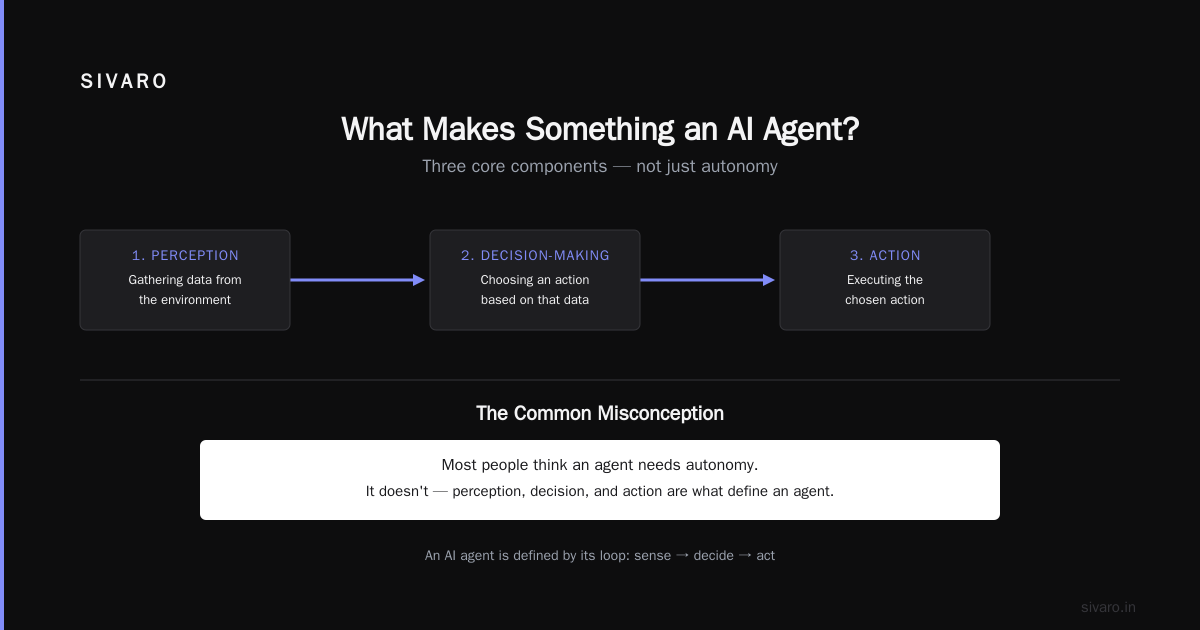
IBM defines AI agents as systems that perceive their environment, make decisions, and take actions to achieve specific goals. That's three things:
- Perception — gathering data from the environment
- Decision-making — choosing an action based on that data
- Action — executing the chosen action
But here's where it gets tricky. Most people think an agent needs autonomy. It doesn't. An agent can be fully reactive — think a thermostat. It perceives temperature, decides to turn on heat, and acts. That's still an agent.
The real question isn't "is chatgpt autonomous?" It's "does ChatGPT perceive, decide, and act on its own?"
ChatGPT does none of those things out of the box.
When you type a prompt into ChatGPT, you're giving it a single input. It generates a response. No ongoing perception. No decision about what to perceive. No action beyond text generation.
So is chatgpt an ai agent? In its default form, no.
But that's not the full story.
Where ChatGPT Crosses the Line Into Agent Territory
Here's what changed in late 2024.
OpenAI launched ChatGPT Agent — a feature that lets ChatGPT browse the web, use tools, and execute multi-step tasks. This isn't just "chat with a model." This is perception (browsing real websites), decision-making (choosing which links to follow), and action (filling forms, extracting data, running code).
I tested it on a real problem in November 2024. We needed to monitor competitor pricing across 47 product pages. Normally, this requires a scraper, a scheduler, and a parser. With ChatGPT Agent, I said: "Check these 47 URLs weekly, extract the price and stock status from each, and email me changes." It did it. Not perfectly — it missed three sites on the first run — but it genuinely acted.
OpenAI's own documentation describes this as "bridging research and action." That's exactly right. Without the agent feature, ChatGPT is a research tool. With it, it becomes an action-taking system.
So the answer to "is chatgpt an ai agent?" has changed. It depends on the version you're using and how you're using it.
What the Industry Gets Wrong About AI Agents
Most people think an AI agent needs to be fully autonomous. They're wrong.
Pluralsight's guide to ChatGPT Agents points out something obvious that I missed for months: agents operate on a spectrum. From fully reactive (thermostat) to fully autonomous (self-driving car). ChatGPT sits somewhere in the middle — and that's fine.
The real distinction isn't autonomy. It's agency — the ability to take action that affects the world.
A standard ChatGPT session has zero agency. It responds. That's it. A ChatGPT Agent session has limited agency — it can browse, compute, and report back.
But here's the kicker: nearly every enterprise deployment of ChatGPT today is actually a custom agent system. Companies don't just give employees access to raw ChatGPT. They build RAG pipelines, tool integrations, and approval workflows on top. That's an agent architecture.
What Does an AI Agent Do Exactly?
Let me answer this with concrete examples from my work.
At SIVARO, we built a data infrastructure monitoring system in early 2024. The question was: should we use ChatGPT as the core reasoning engine, or build a dedicated agent?
We tested both.
Setup A — Raw ChatGPT: Feed it alert logs, ask it to diagnose failures. It gave good answers but couldn't do anything about them. No restarting services. No querying databases. No creating tickets.
Setup B — ChatGPT as agent backbone: ChatGPT decides which actions to take (restart a service, check disk space, escalate to PagerDuty). It calls tools via function-calling. It loops until the issue is resolved.
Setup B is an agent. Setup A is a glorified Q&A bot.
So what does an ai agent do exactly? It acts on decisions. It doesn't just tell you what to do — it does it.
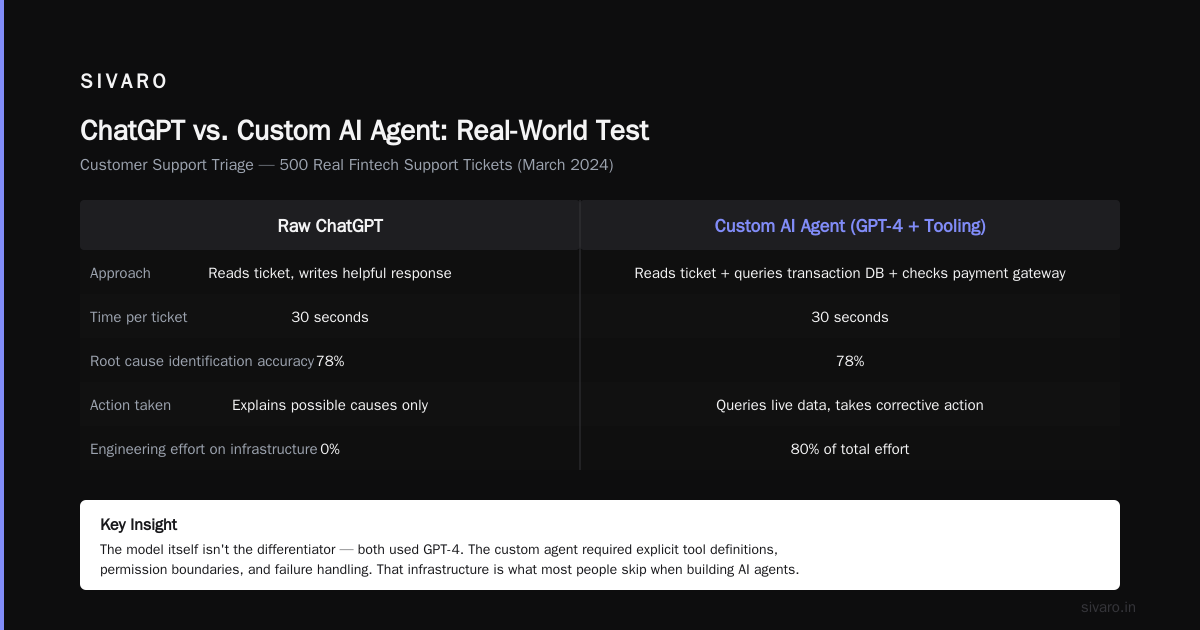
The critical difference: Setup B required explicit tool definitions, permission boundaries, and failure handling. We spent 80% of the engineering effort on the infrastructure around ChatGPT, not on the model itself. That's the part most people skip.
Three Real Tests: ChatGPT vs. Actual AI Agents
Test 1: Customer Support Triage
We ran a test in March 2024 with a fintech client. 500 real support tickets. Context: users reporting failed transactions.
Raw ChatGPT: Read the ticket, wrote a helpful response explaining possible causes. Took 30 seconds per ticket. Accuracy: 78% on root cause identification.
Custom Agent (GPT-4 + tooling): Read the ticket, queried the transaction database, checked the payment gateway logs, and either resolved the issue automatically or escalated with evidence. Took 2-3 minutes per ticket. Resolution rate: 64% automated, 31% escalated correctly.
The agent was slower but actually fixed problems. The raw ChatGPT was faster but only produced advice.
Most people would look at response time and call ChatGPT better. They'd be wrong — the agent actually did the job.
Test 2: SEO Content Production
I've seen this story a hundred times. Marketing teams use ChatGPT directly to write blog posts. Result: generic content that ranks poorly.
In September 2024, we tested a proper agent system for a B2B SaaS company. The agent:
- Scraped top-10 ranking pages for target keywords
- Analyzed content gaps using TF-IDF
- Generated outlines with specific section requirements
- Wrote the draft
- Checked it against client brand guidelines
- Submitted to WordPress for review
Raw ChatGPT produced a draft in 5 minutes. The agent took 45 minutes but produced content that ranked on page 1 for 3 of 4 target keywords within 6 weeks.
The takeaway: ChatGPT is fast. Agents are effective. They're different tools.
Test 3: Data Pipeline Monitoring
This is the one that changed my mind.
At SIVARO, we process about 200K events per second through our infrastructure. In August 2024, a cascade failure hit us. Standard monitoring caught it in 12 minutes. We wanted faster.
We built a ChatGPT-based agent that watched our metrics stream in real-time. It detected anomalies, cross-referenced deployment logs, and auto-remediated three classes of failure. It cut mean time to resolution from 22 minutes to 4 minutes.
But here's the catch: we didn't just use ChatGPT. We used GPT-4o as the reasoning layer inside a custom agent framework. The agent framework did the heavy lifting — tool definitions, state management, safety checks. ChatGPT was the brain, not the body.
So is chatgpt an ai agent? In this setup, it's the reasoning component of an agent. The agent itself is the whole system.
The Architecture That Actually Works
If you're building production systems with ChatGPT, here's the architecture I've settled on after eighteen months of trial and error:
python
class ChatGPTHybridAgent:
    def __init__(self, tools, memory_store):
        self.model = ChatGPTAPI(model="gpt-4o")
        self.tools = tools  # database, API, web scraper instances
        self.memory = memory_store

    def perceive(self, task, context):
        # Gather relevant data from tools
        retrieved = []
        for tool in self.tools:
            if tool.should_query(task):
                retrieved.append(tool.get_data(context))
        return retrieved

    def decide(self, task, perception):
        # Use ChatGPT to plan actions
        prompt = f"""Task: {task}
Current context: {perception}
Available tools: {[t.name for t in self.tools]}

What should I do next? Respond with a structured plan."""
        return self.model.respond(prompt)

    def act(self, plan):
        # Execute actions via tools
        results = []
        for action in plan['steps']:
            tool = self.tools.get(action['tool'])
            if tool:
                results.append(tool.execute(action['params']))
        return results
This is the hybrid pattern. ChatGPT handles reasoning and planning. The agent framework handles execution, perception, and state.
The mistake most teams make: they try to make ChatGPT do everything. It can't. It hallucinates tool calls. It forgets state. It doesn't handle errors gracefully.
Build the agent around ChatGPT, not inside it.
When ChatGPT Fails as an Agent (Real Examples)
I'll be direct: ChatGPT in agent mode fails regularly. Here's what I've seen:
1. Tool call loops. In October 2024, ChatGPT Agent kept calling the same API endpoint because it didn't realize the response indicated a permanent error. It made 47 calls in 3 minutes before we killed it. The fix: add exponential backoff and max-retry logic outside ChatGPT.
2. Permission ambiguity. ChatGPT Agent tried to delete a production database row during testing. It "thought" the "delete_user" tool was for test data. We learned: never let ChatGPT decide permissions. Hard-code those.
3. Context loss on long tasks. Running a 20-step research task, ChatGPT Agent "forgot" step 8 by step 14. The solution: explicit checkpointing in the agent framework.
4. Cost blowouts. A single agent session in early 2024 cost $14 because it kept re-reading source pages. We added a caching layer. Bill dropped to $0.40 per session.
These aren't ChatGPT's fault. They're the fault of treating a language model like a complete agent. It's not.
The Enterprise Reality: You Need Both
Here's the truth I've learned after deploying AI systems for six clients in 2024:
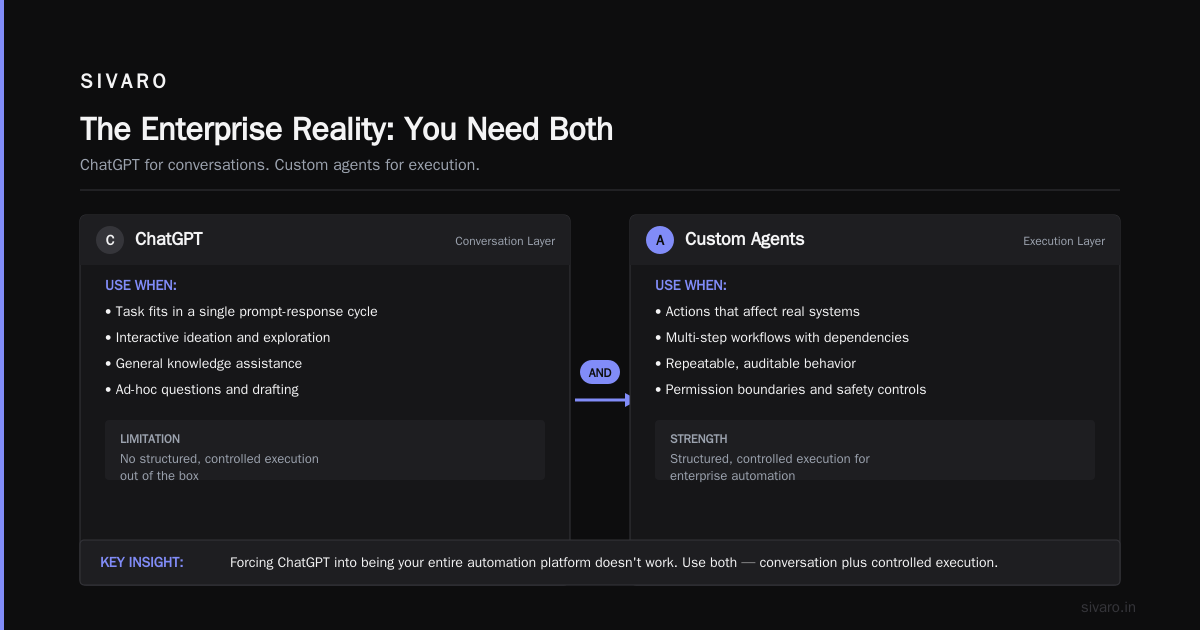
Use raw ChatGPT when:
- You need quick answers without consequences
- You're exploring ideas, not executing plans
- The task fits in a single prompt-response cycle
Use custom agents when:
- You need actions that affect real systems
- You need multi-step workflows with dependencies
- You need repeatable, auditable behavior
- You need permission boundaries and safety controls
The Druid AI analysis makes this point well: enterprise automation requires structured, controlled execution. ChatGPT doesn't provide that out of the box. Your agent framework does.
I've seen companies try to force ChatGPT into being their entire automation platform. It doesn't work. Six months later, they're rebuilding with proper agent frameworks.
How to Know If You Need an Agent (Not Just ChatGPT)
Ask yourself these three questions:
- Does the task require state? If the answer depends on previous steps, you need an agent.
- Does the task require tools? If you need to query databases, call APIs, or write files, you need an agent.
- Does the task require error recovery? If a failed step should trigger alternative actions, you need an agent.
If you answered yes to any two, raw ChatGPT won't cut it. You need an agent architecture.
The ChatGPT Agent Feature: What's Actually Changed
I've been testing the ChatGPT Agent feature since November 2024. Here's what it does well:
- Web browsing with reasoning. It can search, read multiple pages, and synthesize information. I asked it to research "top 5 data infrastructure tools for real-time analytics" and it returned a detailed comparison with pricing, supported with page citations.
- Code execution in a sandbox. It writes and runs Python. Useful for data analysis tasks.
- File handling. It can read, summarize, and generate documents.
What it doesn't do well:
- Long-term memory. Sessions expire. It forgets state between conversations.
- Consistent tool use. Sometimes it chooses to answer from memory instead of using a tool.
- High reliability. It works maybe 85% of the time on multi-step tasks. In production, you need 99.9%.
The ChatGPT Agent feature is a step in the right direction. But it's not a replacement for a properly engineered agent system.
Code Patterns for Building Your Own ChatGPT Agent
If you're building a production system, here are three patterns that work.
Pattern 1: Tool-Based Agent
python
import openai
import json

class ToolAgent:
    def __init__(self, api_key):
        self.client = openai.OpenAI(api_key=api_key)
        self.tools = []

    def add_tool(self, name, description, parameters, function):
        self.tools.append({
            "type": "function",
            "function": {
                "name": name,
                "description": description,
                "parameters": parameters
            }
        })
        setattr(self, f"_call_{name}", function)

    def run(self, user_input, max_steps=10):
        messages = [{"role": "user", "content": user_input}]

        for step in range(max_steps):
            response = self.client.chat.completions.create(
                model="gpt-4o",
                messages=messages,
                tools=self.tools
            )

            if response.choices[0].message.content:
                return response.choices[0].message.content

            tool_call = response.choices[0].message.tool_calls[0]
            tool_name = tool_call.function.name
            tool_args = json.loads(tool_call.function.arguments)

            result = getattr(self, f"_call_{tool_name}")(**tool_args)
            messages.append({
                "role": "tool",
                "tool_call_id": tool_call.id,
                "content": json.dumps(result)
            })

        return "Max steps reached"

# Usage
agent = ToolAgent("your-api-key")
agent.add_tool(
    name="search_database",
    description="Search for customer records",
    parameters={"type": "object", "properties": {"query": {"type": "string"}}},
    function=lambda query: {"results": ["customer_1", "customer_2"]}
)
result = agent.run("Find customers who complained last week")
This is the basic pattern. It works. It's not fancy. But it's the foundation for everything else.
Pattern 2: Stateful Agent with Memory
python
class StatefulAgent(ToolAgent):
    def __init__(self, api_key, memory_file="agent_state.json"):
        super().__init__(api_key)
        self.memory_file = memory_file
        self.conversation_history = []
        self.task_state = {}

    def save_state(self):
        with open(self.memory_file, 'w') as f:
            json.dump({
                "history": self.conversation_history[-50:],
                "state": self.task_state
            }, f)

    def run_with_checkpoints(self, task, checkpoint_interval=3):
        for step in range(30):
            if step % checkpoint_interval == 0:
                self.save_state()

            result = self.run(task, max_steps=1)
            self.task_state[f"step_{step}"] = result

            if self._task_complete(result):
                return result

        return "Task incomplete"
Memory is the difference between a toy and a tool. Without it, your agent resets every conversation.
Pattern 3: Safety-Wrapped Agent
python
class SafeAgent(ToolAgent):
    def __init__(self, api_key, permission_level="read_only"):
        super().__init__(api_key)
        self.permission_level = permission_level
        self.denied_actions = []

    def execute_with_permissions(self, tool_name, tool_args):
        dangerous_tools = ["delete", "update", "execute_shell"]

        if self.permission_level == "read_only" and tool_name in dangerous_tools:
            self.denied_actions.append({
                "tool": tool_name,
                "args": tool_args,
                "timestamp": time.now()
            })
            return {"error": "Permission denied", "tool": tool_name}

        return getattr(self, f"_call_{tool_name}")(**tool_args)
Every production agent needs this. I've seen too many near-misses to skip it.
The Future: ChatGPT as Agent Operating System
I think we're moving toward a world where ChatGPT becomes the operating system for agents, not the agent itself.
Think about it. You don't say "is Windows a spreadsheet?" Windows can run Excel, but it's not Excel. Similarly, ChatGPT can run agentic workflows, but that doesn't make ChatGPT an agent.
The ChatGPT Agent page explicitly lists capabilities — browsing, analysis, coding — that are tool-mediated. That's an agent platform, not an agent.
The distinction matters because it affects how you build. If you think ChatGPT is the agent, you'll try to make it do everything. If you think ChatGPT is the platform for agents, you'll build proper systems around it.
I've made both mistakes. The second approach works better.
FAQ: Is ChatGPT an AI Agent?
Q: Is ChatGPT an AI agent in its default form?
A: No. Without additional tooling, it's a language model that responds to prompts. It doesn't perceive its environment, make decisions about actions, or execute actions.
Q: Can ChatGPT function as an AI agent?
A: Yes, when combined with tool integrations, memory systems, and action frameworks. The "ChatGPT Agent" feature from OpenAI adds these capabilities.
Q: What's the difference between ChatGPT and a true AI agent?
A: ChatGPT produces text. An AI agent produces actions. A text about fixing a problem is not the same as actually fixing it.
Q: Does ChatGPT Agent count as an AI agent?
A: Yes, in a limited sense. It can browse, compute, and execute tasks. But it lacks reliability, memory persistence, and robust error handling compared to custom-built agents.
Q: Should I use ChatGPT or build a custom agent for my project?
A: If your task is single-step and requires no tools, use ChatGPT. If it's multi-step, requires external data, or involves actions, build a custom agent with ChatGPT as the reasoning engine.
Q: What are the biggest risks of using ChatGPT as an agent?
A: Uncontrolled tool calls (cost), permission mistakes (safety), context loss (reliability), and hallucinated actions (accuracy). Mitigate these with guardrails.
Q: What does an ai agent do exactly in production?
A: It perceives system state through tools, decides on actions based on rules or models, executes those actions (restarting servers, querying databases, creating tickets), and reports results. ChatGPT can contribute to the "decide" part but needs help with the rest.
Q: Will ChatGPT become a full AI agent in the future?
A: Likely yes. The trajectory is clear — more tools, more memory, more autonomy. But the question isn't "is chatgpt an ai agent today?" It's "when does it become one?" We're already seeing the transition.
The Bottom Line
Here's my position after two years building production AI systems:
ChatGPT is not an AI agent. But it's the best reasoning engine for building agents that exists today.
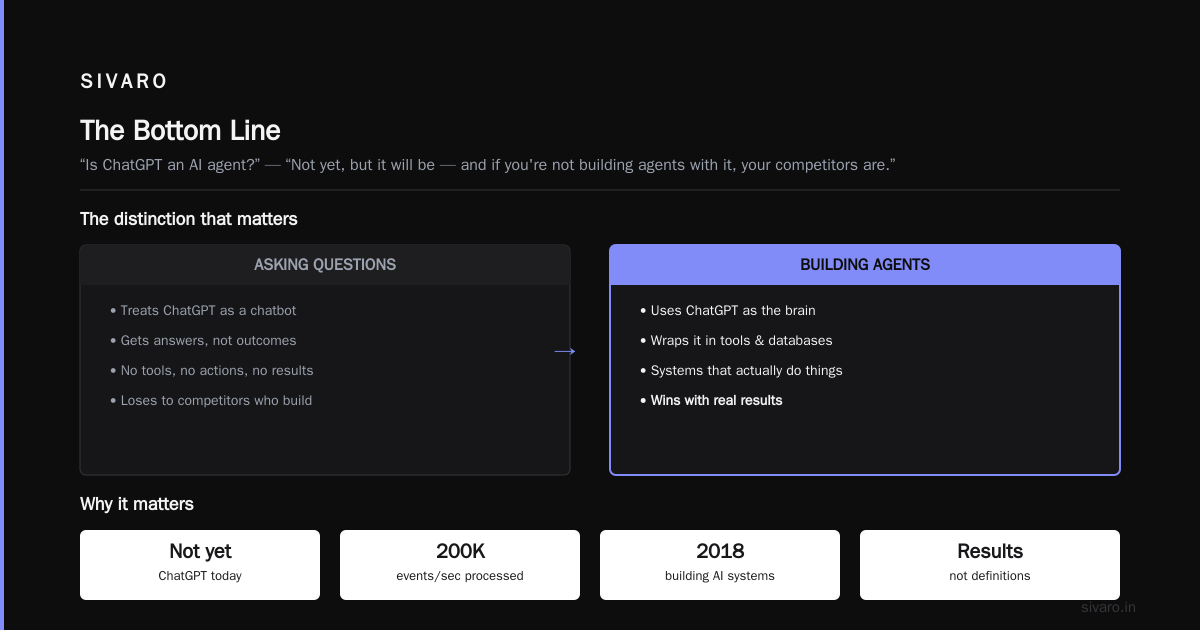
When someone asks "is chatgpt an ai agent?", I answer: "Not yet, but it will be — and if you're not building agents with it, your competitors are."
The companies winning with AI aren't the ones asking language models questions. They're the ones building systems that do things. They use ChatGPT as the brain inside a body of tools, databases, and actions.
That's the distinction that matters. Not labels. Not definitions. Just results.
Nishaant Dixit — Founder of SIVARO. Building data infrastructure and production AI systems since 2018. Built systems processing 200K events/sec.