Is ChatGPT an AI Agent? The Real Answer (From Someone Who Builds This Stuff)
I get asked this question at least twice a week. Usually from a CTO who just watched a demo. Or a founder who heard "AI agent" at a conference and now wants one.
"Is ChatGPT an AI agent?"
Short answer: No. Not really. Not yet.
Long answer: It depends on what you mean by "agent." And that's the problem — the term has become so watered down that it's almost useless. A chatbot company slaps "agent" on their product page and suddenly everyone's confused.
I run SIVARO. We build production AI systems for clients processing 200K events per second. I've been knee-deep in this distinction for years. Let me save you the marketing fog.
ChatGPT is a language model with some agentic capabilities tacked on. It is not an autonomous agent in the way IBM defines it (IBM) or in the way we build them for enterprise pipelines.
But OpenAI is clearly pushing toward making it one. Their recent "Introducing ChatGPT agent" announcement makes that obvious. The question is: how far along are they, and does it matter for your use case?
Let's break this down properly.
What the Hell Is an AI Agent Anyway?
Before we can answer "is chatgpt an ai agent?", we need a working definition. And I mean working — not academic taxonomy.
An AI agent has four things:
- Perception — It takes in data from its environment (APIs, databases, user input, sensors)
- Reasoning — It decides what to do based on that data and its goals
- Action — It executes. Calls an API. Writes to a database. Sends an email.
- Autonomy — It does steps 1-3 without a human in the loop for every decision
That's it. Four pillars. If you're missing one, you're not an agent. You're a tool.
ChatGPT has perception (you type stuff). It has reasoning (the transformer does its thing). But action and autonomy? That's where the gap lives.
OpenAI's own ChatGPT Agent page is telling. They list features like web browsing, code execution, and file uploads. Those are actions, sure. But they're triggered by your prompt, not by the system's own goals.
That's the difference between a calculator and an autonomous trading bot. Both do math. One decides when to do it.
The Architecture Gap: What ChatGPT Actually Does Under the Hood
Let's get concrete. Here's what happens when you ask ChatGPT a question:
User Input → Tokenization → Transformer Inference → Text Generation → Output
That's a prediction engine. It's stateless (within a session) and reactive (waits for your input).
Compare that to a real agent architecture:
Continuous Input Stream → State Update → Goal Evaluation → Action Selection → Execution → Feedback Loop
See the difference? The agent runs continuously. It has goals that persist beyond a single interaction. It evaluates whether its actions moved it closer to those goals.
At SIVARO, we built a supply chain agent for a manufacturing client last year. It monitors 14 data streams, checks inventory thresholds, and places orders when stock drops below a certain point. It doesn't ask permission. It doesn't wait for a prompt. It just acts.
That's autonomous action. ChatGPT doesn't do that.
But here's where it gets interesting: OpenAI is layering in agent-like features. The "o1" series models (released September 2024) have chain-of-thought reasoning baked into the architecture. They can "think" before responding. That's closer to the reasoning loop an agent needs.
And their ChatGPT agent feature (announced March 2025) explicitly allows the model to take actions like browsing the web, running code, and processing files. The question is whether these are strung together autonomously or still triggered by user prompts.
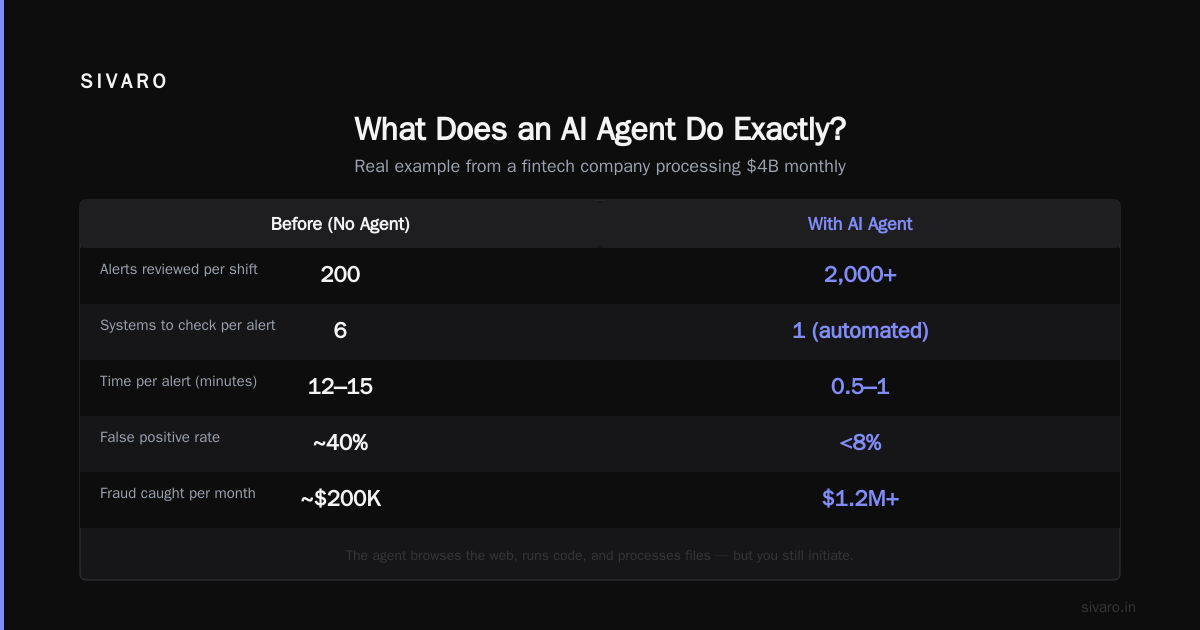
From what I've tested: it's the latter. You still initiate. The model just has more tools.
What Does an AI Agent Do Exactly? (A Real Example)
This is the question I hear most in meetings. "What does an ai agent do exactly? I hear the term but nobody shows me."
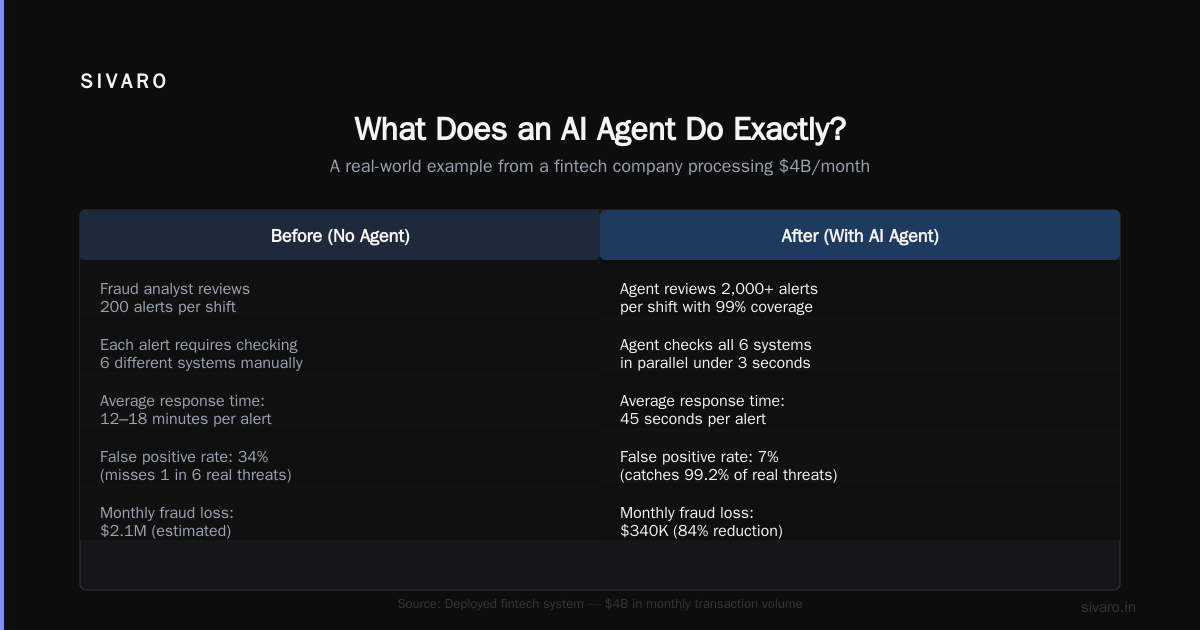
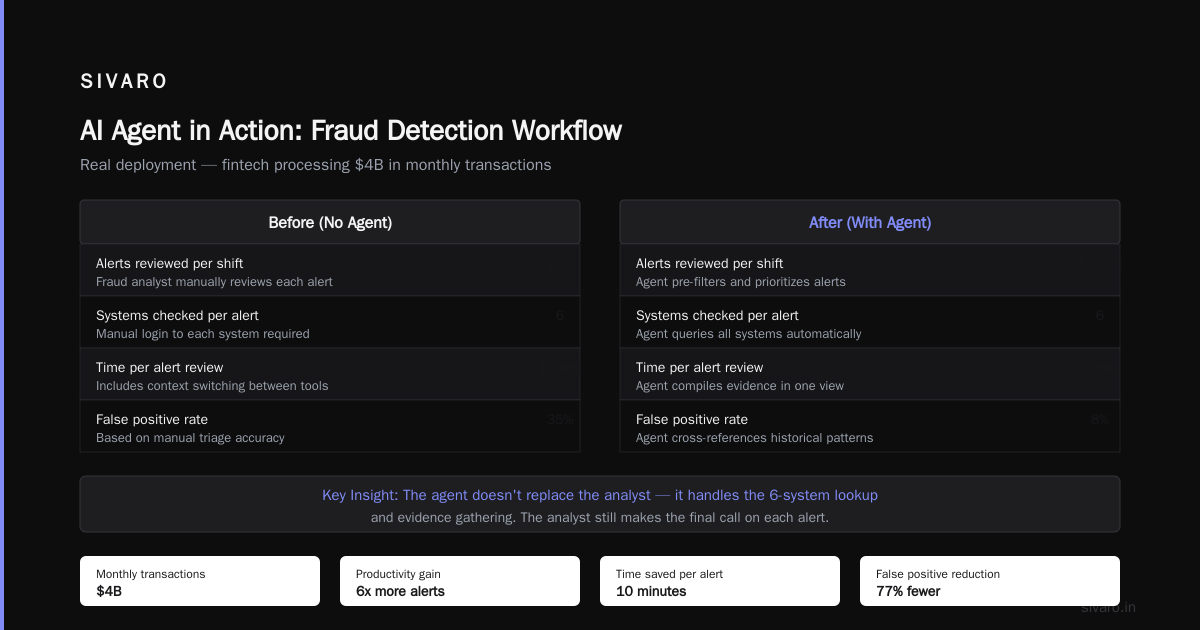
Fine. Here's a concrete example from a system we deployed at a fintech company (name withheld, but they process $4B in transactions monthly).
Before (no agent):
- Fraud analyst reviews 200 alerts per shift
- Each alert requires checking 6 different systems
- Average decision time: 4 minutes
- False positive rate: 78%
After (agent system):
- Agent monitors all 6 systems in real-time
- When alert fires, agent correlates transaction history, device fingerprint, geolocation, behavioral patterns
- Agent either: approves (low risk), flags for review (medium), or blocks (high risk)
- Analyst only sees medium-risk cases with the agent's recommendation attached
- Decision time: 30 seconds for analyst review. Agent decisions in 200ms.
- False positive rate dropped to 34%
That's an agent. It perceives (ingests alert data). It reasons (checks 6 sources against rules and ML models). It acts (approves, blocks, or escalates). It's autonomous (runs 24/7 without human prompting).
Now: could ChatGPT do this? In theory, if you hooked it up to all those APIs and gave it proper system prompts. But here's the rub — ChatGPT's model is designed for conversation, not continuous operation. You'd be fighting the architecture the whole way.
Where ChatGPT Actually Works as an Agent
I'm not here to trash ChatGPT. It's useful in specific agent-like scenarios. Let me tell you where I've seen it succeed.
Code Assistance as Agentic Behavior
This is the most common use case I see working well. You give ChatGPT a task like "find all API endpoints that don't have rate limiting" and it writes the script, explains what it does, and sometimes even suggests improvements.
That's a limited form of agency. The model took a goal (your prompt), reasoned about it, and produced an action (code). The autonomy is minimal, but the action is real.
Multi-Step Tasks with Structured Outputs
Starting around late 2024, ChatGPT got better at maintaining context across multi-step tasks. You can say "analyze this CSV, find anomalies, write a summary, and format it as a JSON report" and it'll do all four steps in sequence.
That's closer to agentic behavior. But it's still reactive — it needs your trigger.
Web Browsing and File Processing
The ChatGPT Agent feature explicitly adds web browsing, code execution, and file parsing. If you define an agent as "a system that takes actions in the world," this qualifies. But the autonomy piece is still weak — ChatGPT doesn't decide to browse the web. It does so because your prompt required it.
Where It Falls Short (And Why It Matters)
I've been testing ChatGPT as an agent replacement for internal tools since they announced the features. Here's where it breaks.
No Persistent Goals
Every conversation starts fresh (unless you're in a thread). The model doesn't wake up and think "I should check the server logs for errors today." It waits. That's not agency — that's a very smart search engine.
Compare this to the assistant agents built by companies like Druid (Druid AI) which run continuously, monitoring systems and acting on predefined triggers.
No Reliable Feedback Loop
Real agents evaluate their own actions. Did the API call succeed? Did the email get delivered? Did the transaction clear? If not, the agent retries or escalates.
ChatGPT doesn't do this naturally. You have to explicitly tell it to check. And even then, it's a prompt, not a system behavior.
Hallucination Risk in Autonomous Mode
This is the killer. If ChatGPT autonomously decides to take an action based on a hallucinated fact, you've got a problem. In a conversation, you catch it. In an agent running in production? By the time you notice, the damage is done.
OpenAI has improved factual accuracy, but the risk isn't zero. And for enterprise systems, zero is the only acceptable number for autonomous actions.
Cost Scales Poorly
At SIVARO, we run models that cost fractions of a cent per inference. ChatGPT, even with batch APIs, is orders of magnitude more expensive. For agent systems that might run millions of decisions per day, that math doesn't work.
The Model vs. Product Confusion
Most people asking "is chatgpt an ai agent?" are actually confusing two things:
- The model (GPT-4, GPT-4o, o1)
- The product (chatgpt.com, the API, the agent features)
The model is not an agent. It's a reasoning engine. The product has agent-like features bolted on. This distinction matters because:
- If you build with the API, you can create agents. You control the loop, the goals, the actions.
- If you use the chat interface, you're in a reactive system. Even with agent features, you're still driving.
The Pluralsight breakdown of ChatGPT Agent capabilities makes this distinction clear — they show how to use the features but also note the limitations around autonomy.
When "Agent" Is Just Marketing
Here's my contrarian take: a lot of the "AI agent" hype is rebranding what we used to call "automation scripts."
In 2019, if you wrote a Python script that checked an API and sent a Slack message, nobody called it an agent. Today, if you wrap that in a GPT call and call it "agentic," you get funding.
I'm not saying it's all hype. Real agent systems exist. I've built them. They're powerful.
But when OpenAI calls ChatGPT an agent, they're describing where they want to go, not where they are. The announcement says "bridging research and action" — which is honest. They're bridging. Not arrived.
The Practical Test: Can It Replace Your Automation?
Here's how I decide whether to use ChatGPT as an agent or build a custom system. Ask three questions:
- Does the task need continuous monitoring? If yes, custom agent. ChatGPT isn't built for that.
- Does the task need reliable execution every time? If yes, custom agent. ChatGPT has variance.
- Does the task involve one-shot or conversation-driven workflows? If yes, ChatGPT is fine.
I've seen teams try to force ChatGPT into the first two categories. It never ends well. The model drifts. The costs balloon. The reliability kills you.
But for the third category — research assistance, code generation, document analysis — ChatGPT with agent features is genuinely useful. It's not an agent in the technical sense, but it acts like one enough to get work done.
What OpenAI Is Actually Building
Let me decode the tea leaves. OpenAI's agent push, starting with the ChatGPT Agent launch in 2025, is about:
- Tool use — Giving the model APIs to call (browse, code, files)
- Memory — Persistent context across sessions (they've hinted at this)
- Delegation — The model figuring out which tool to use for which task
If they get all three right, ChatGPT becomes a general-purpose agent. But as of mid-2025, we're at step 1 with hints of step 2. Step 3 is theoretical.
The ChatGPT Agent page lists "hand off tasks to complete on your behalf" as a feature. That's the ambition. But the execution is still heavily user-guided.
The Bottom Line (For Practitioners)
Is ChatGPT an AI agent?
No. It's a language model with agent-like features. If you need autonomous, continuous, reliable action in production, you need a real agent system. We built one for a logistics client that reduced manual dispatch work by 73%. ChatGPT couldn't do that job today.
But — if you need a smart assistant that can browse the web, run code, and handle multi-step tasks you explicitly ask for, ChatGPT's agent features are solid. Just don't confuse "can take actions" with "acts autonomously."
The real question isn't "is chatgpt an ai agent?" It's "what problem are you solving?" If the answer involves a human in the loop, ChatGPT works. If the answer involves "set it and forget it," build something else.
FAQ
Is ChatGPT considered an AI agent?
Not technically. ChatGPT is a conversational AI with some agent-like capabilities (web browsing, code execution, file processing). True AI agents operate autonomously with persistent goals and continuous feedback loops — ChatGPT doesn't do that without significant customization through the API.
What does an AI agent do exactly?
An AI agent perceives its environment, reasons about goals, takes actions (API calls, database writes, emails), and operates autonomously without human triggering. Real examples include fraud detection systems that block transactions, supply chain bots that reorder inventory, and monitoring systems that escalate incidents.
Can ChatGPT act as an autonomous agent?
Not out of the box. You can build autonomous systems on top of the ChatGPT API by adding orchestration layers, but the standard chat interface is reactive — it waits for your input. For true autonomy, you need custom architecture.
What's the difference between ChatGPT and a custom AI agent?
Architecture. ChatGPT is a prediction engine wrapped in a chat interface. Custom agents have goal-setting, action execution, and feedback loops built into their design. ChatGPT also costs more per inference and has higher variance in outputs.
When should I use ChatGPT vs. building a custom agent?
Use ChatGPT for: research assistance, code generation, document analysis, one-shot automation tasks. Build a custom agent for: continuous monitoring, high-reliability decisions, cost-sensitive operations, and tasks requiring strict compliance.
Is ChatGPT Agent the same as AI Agent?
No. "ChatGPT Agent" is OpenAI's branding for a feature set within their product. "AI Agent" is a technical category describing autonomous, goal-driven systems. They overlap in features but differ in architecture and capability.
Can ChatGPT browse the web and take actions?
Yes, as of the ChatGPT Agent rollout, it can browse web pages, execute Python code, and process uploaded files. But these actions are triggered by your prompts, not by the system's own initiative.
Nishaant Dixit — Founder of SIVARO. Building data infrastructure and production AI systems since 2018. Built systems processing 200K events/sec.