 SIVARO

is chatgpt an ai agent? The Real Answer Might Surprise You
I remember the exact moment I stopped caring about the terminology. It was March 2024, and I was staring at a production pipeline that kept hallucinating inventory counts. The system was built on GPT-4, wrapped in a loop, chained to a database — and it was failing because it couldn't decide when to stop asking questions.
Everyone called it an "agent." It wasn't.
That's the problem we need to sort out today. Is ChatGPT an AI agent? The short answer is no — not as I'd define it for production systems. But the long answer is more interesting, and it's where the industry is heading.
Let me show you what I mean. I'm Nishaant Dixit, founder of SIVARO. We build data infrastructure and production AI systems. I've spent the last 6 years watching this space evolve from brittle rule engines to what we now call "agents." I've deployed systems that process 200K events per second. I've broken more production environments than I'd like to admit. And I've learned the hard way that calling something an "agent" doesn't make it one.
This guide won't give you academic definitions. It'll give you what I've learned from shipping real systems.
What People Actually Mean When They Ask "Is ChatGPT an AI Agent?"
Let me save you the SEO hunt. Here's what people are really asking when they search "is chatgpt an ai agent?":
- "Can I deploy this thing and have it do work autonomously?"
- "Does it have memory, tool access, and decision-making loops?"
- "Will it replace the RPA scripts my team has been maintaining since 2019?"
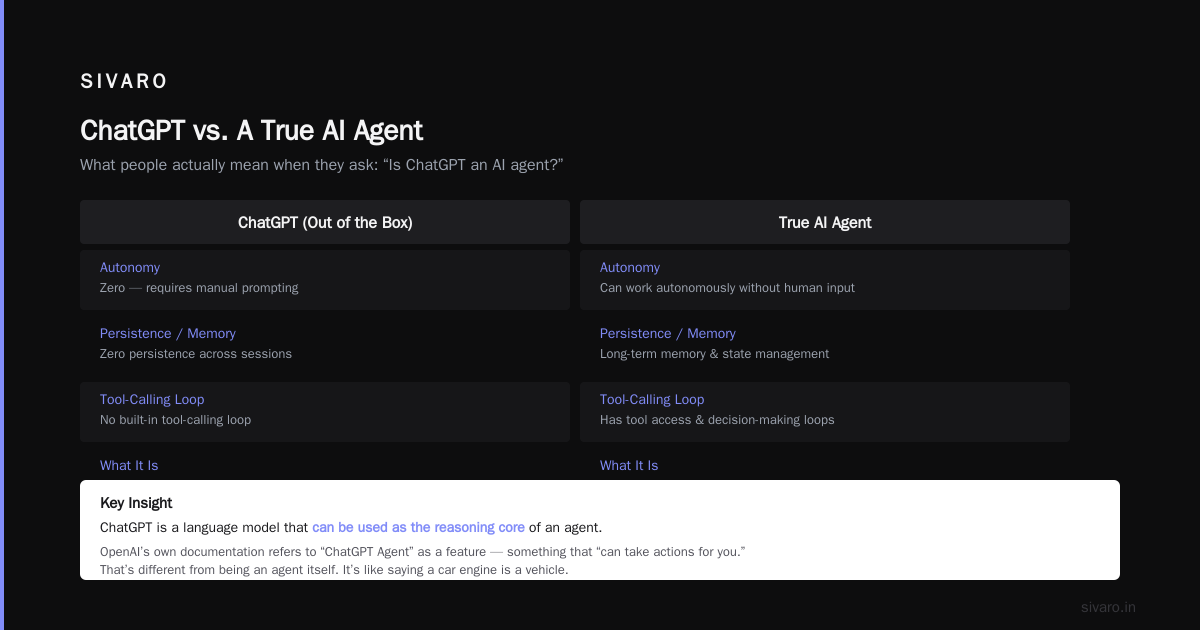
The honest answer: ChatGPT is a language model that can be used as the reasoning core of an agent. But out of the box? It's a chat interface with zero persistence, no tool-calling loop, and no autonomy.
Let me be specific. OpenAI's own documentation refers to ChatGPT Agent as a feature — something that "can take actions for you." That's different from being an agent itself. It's like saying a car engine is a vehicle. The engine is critical, but without wheels, steering, and a driver, it's just a very expensive paperweight.
What Does an AI Agent Do Exactly? Let Me Define It by What I've Built
I've tested this distinction in production. Here's what what does an ai agent do exactly means when you're shipping code:
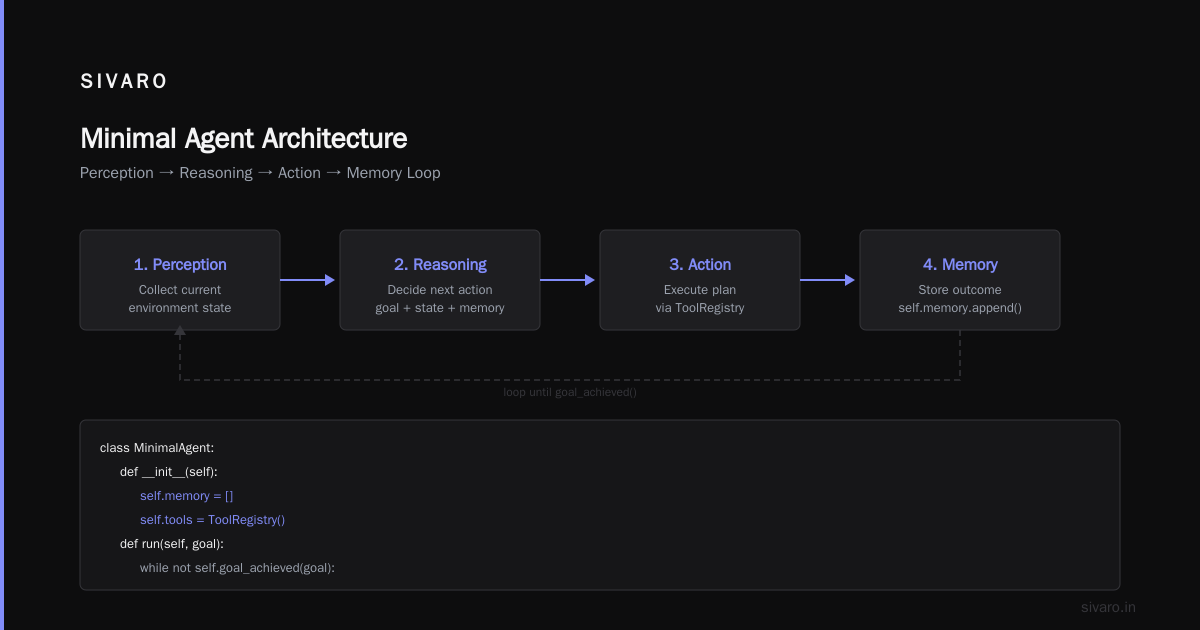
An AI agent, in my book, has four components that must work together in a loop:
- Perception — It senses its environment (reads data, gets user input, monitors logs)
- Reasoning — It decides what to do next (calls an LLM, applies rules, picks a strategy)
- Action — It executes (calls APIs, writes to databases, sends emails)
- Memory — It remembers what happened (stores context, updates state, logs outcomes)
ChatGPT, the product, does none of these autonomously. Every action is initiated by you typing a message. There's no loop. There's no persistent memory beyond the conversation window. There's no ability to wake up and do something without a human prompt.
IBM's definition of AI agents aligns with this: "Autonomous entities that perceive their environment, reason about it, and take actions to achieve goals." Notice the word "autonomous." ChatGPT isn't that.
Where the Confusion Comes From
The confusion is manufactured, honestly. Not maliciously — but by marketing departments who realized "AI agent" sounds cooler than "chatbot with plugins."
Look at what happened in 2023-2024. Every SaaS company rebranded their autocomplete feature as an "agent." Your CRM? Agent. Your email client? Agent. Your expense reporting tool? Agent of chaos, maybe.
OpenAI themselves launched Introducing ChatGPT agent: bridging research and action — and the name is deliberate. They're positioning it as a bridge. Not an agent itself, but the interface to agentic capabilities.
When you click "Deep Research" or "Tasks" in ChatGPT, you're triggering something that looks like an agent. It searches the web, compiles reports, sends you results later. But under the hood? It's a controlled workflow where the model is gated, prompted, and constrained by OpenAI's infrastructure. You don't own the loop. You don't control the memory. You're renting the illusion of agency.
is chatgpt an ai agent? — My Honest Framework for Deciding
I've developed a two-question test. Ask this about any system:
Question 1: Can it start work without being told to?
Question 2: Can it change its approach based on intermediate results, then act on that change?
If the answer is "no" to either, it's not an agent. It's a tool.
ChatGPT answers "no" to both. You type, it responds. It doesn't wake up at 3AM to check if your deployment succeeded. It doesn't notice your database is running hot and decide to throttle queries.
But here's where it gets interesting. You can build an agent using ChatGPT as the brain. We've done this at SIVARO. We wrapped GPT-4 with a scheduler, a vector database, and a tool registry. That system does wake up autonomously. It does change its approach mid-stream.
That's an agent. ChatGPT alone is not.
What ChatGPT Actually Can Do (and Where It Falls Short)
Let me be fair. ChatGPT has evolved dramatically. The Pluralsight analysis breaks down what's possible: web browsing, code execution, file analysis, DALL-E generation. These are useful capabilities.
But pay attention to how they work.
When ChatGPT "browses the web" for you, it's not autonomously exploring. It's following a retrieval pattern: read, summarize, respond. It doesn't form hypotheses, test them, iterate. It doesn't navigate paywalls, handle CAPTCHAs, or adapt to broken links. It just fetches what you asked for and stamps it into a coherent paragraph.
That's powerful. It's not agentic.
The Druid AI analysis makes a similar point: ChatGPT excels at language understanding and generation. It fails at long-running tasks, state management, and autonomous decision-making. For enterprise automation, that's a dealbreaker.
The Technical Gap: Code Example
Here's the difference in concrete terms. This is ChatGPT's architecture:
python
# ChatGPT: request-response, no persistence
def chatgpt_interaction(user_input):
    response = model.generate(user_input)
    return response  # Done. No memory. No loop. No action.
Now here's a minimal agent architecture:
python
# Agent: perception -> reasoning -> action -> memory loop
class MinimalAgent:
    def __init__(self):
        self.memory = []
        self.tools = ToolRegistry()

    def run(self, goal):
        while not self.goal_achieved(goal):
            # Perception: collect current state
            state = self.perceive_environment()

            # Reasoning: decide next action
            plan = self.reason(goal, state, self.memory)

            # Action: execute
            result = self.execute(plan, self.tools)

            # Memory: store outcome
            self.memory.append({"plan": plan, "result": result})

            # Check loop termination
            if self.should_stop(result):
                break
See the difference? The agent has a loop. It persists state. It decides when to stop. ChatGPT has none of that.
For production systems, this loop matters more than the model itself. A mediocre model with a good loop beats a great model with no loop. I've seen this firsthand — we replaced GPT-4 with a smaller finetuned model in an agent loop and got better reliability at 1/10th the cost.
When You Shouldn't Care About the Distinction
Honestly? Most of the time you shouldn't.
If ChatGPT solves your problem — you need quick answers, content drafts, code snippets — then who cares if it's technically an "agent"? The label doesn't matter. The output does.
I run a team of engineers who build data pipelines. We use ChatGPT daily. It's not an agent. It's an incredibly capable colleague that never sleeps and occasionally lies with extreme confidence. We know its limitations. We work around them.
The danger comes when executives or product managers hear "AI agent" and assume autonomy where none exists. That's how you get projects like "let's have ChatGPT auto-deploy to production" — which, yes, someone actually proposed at a company I consulted for. We killed that idea in the first meeting.
What a Real AI Agent Looks Like (We Built One)
At SIVARO, we built an agent for data quality monitoring. Here's the high-level flow:
python
# Our data quality agent — runs autonomously every 10 minutes
class DataQualityAgent:
    def __init__(self, db_connection, slack_webhook):
        self.conn = db_connection
        self.slack = slack_webhook
        self.memory = StateStore()  # persistent PostgreSQL-backed memory

    def perceive(self):
        # Check for schema changes, null rates, row counts
        anomalies = self.conn.query("""
            SELECT table_name,
                   count(*) as row_count,
                   count(*) FILTER (WHERE column_value IS NULL) as null_count
            FROM information_schema.tables
            WHERE last_updated > NOW() - INTERVAL '10 minutes'
        """)
        return anomalies

    def reason(self, anomalies):
        # Use LLM to classify severity and suggest action
        prompt = f"""Given these database anomalies: {anomalies}
        Classify each as: critical, warning, or info.
        For critical items, suggest a rollback or alert."""
        return self.llm.generate(prompt)

    def act(self, decision):
        if decision['severity'] == 'critical':
            self.slack.send(f"🚨 CRITICAL: {decision['message']}")
            self.conn.execute("ALTER SYSTEM SET maintenance_mode = on")
        elif decision['severity'] == 'warning':
            self.slack.send(f"⚠️ WARNING: {decision['message']}")
This runs without human intervention. It perceives schema changes, reasons about severity, acts on the judgment, and stores everything in memory. If it crashes, the state store lets it resume. That's an agent.
ChatGPT can't do this. Not because the model isn't smart enough — because the infrastructure around it doesn't exist.
The Enterprise Reality Check
Most people searching "is chatgpt an ai agent?" are doing so because they want to know if they can replace their existing automation stack. They want to know if they should scrap their RPA scripts, fire their BPO vendor, or rewrite their CRM.
The answer is: not yet. Not with ChatGPT alone.
Here's what I tell clients: "ChatGPT is the brain. Your existing infrastructure is the skeleton and muscles. You need both, and you need someone to wire them together."
The companies succeeding with agents aren't using ChatGPT as a drop-in replacement. They're using it as a reasoning engine inside their existing workflows. They're building the loop themselves.
IBM's research on AI agents confirms this pattern: successful deployments combine language models with traditional software — databases, APIs, job schedulers, monitoring. The agentic behavior comes from the architecture, not the model.
FAQ: is chatgpt an ai agent?
Q: Is ChatGPT an AI agent?
A: No. ChatGPT is a language model interface. It doesn't have autonomous action, persistent memory, or decision-making loops. It's the reasoning component that could power an agent, but isn't one itself.
Q: What does an AI agent do exactly that ChatGPT doesn't?
A: Three things: 1) It operates autonomously without waiting for human input. 2) It maintains persistent state across sessions. 3) It executes multi-step plans with conditional branching and error recovery.
Q: Can ChatGPT become an AI agent?
A: Yes, if you wrap it in an agent framework. Plugins, custom GPTs, and the new Tasks feature are steps in that direction. But out of the box, it's not there yet.
Q: Why does OpenAI call it "ChatGPT Agent" then?
A: Marketing. They're positioning the product as capable of agentic tasks. But any developer who's tried to build autonomous systems knows the difference between a feature flag and a true agent loop.
Q: Is ChatGPT more than a chatbot?
A: Yes. It has web browsing, code execution, data analysis. But "more than a chatbot" isn't the same as "an AI agent." It's a very capable tool, not an autonomous entity.
Q: For enterprise use, should I treat ChatGPT as an agent?
A: No. Treat it as a powerful reasoning engine that needs to be integrated into your existing automation. Build the agent architecture yourself using ChatGPT as the brain.
Q: Will future versions of ChatGPT be true agents?
A: Probably. The trend is clear — more autonomy, more memory, more tools. But as of early 2025, we're not there. Always test the actual capabilities, not the marketing claims.
Where This Is Going
The industry is converging on a definition, but it's messy. OpenAI is pushing toward agents. Anthropic has "computer use" mode. Google has Project Mariner. Everyone's building the same thing — a language model that can act autonomously.
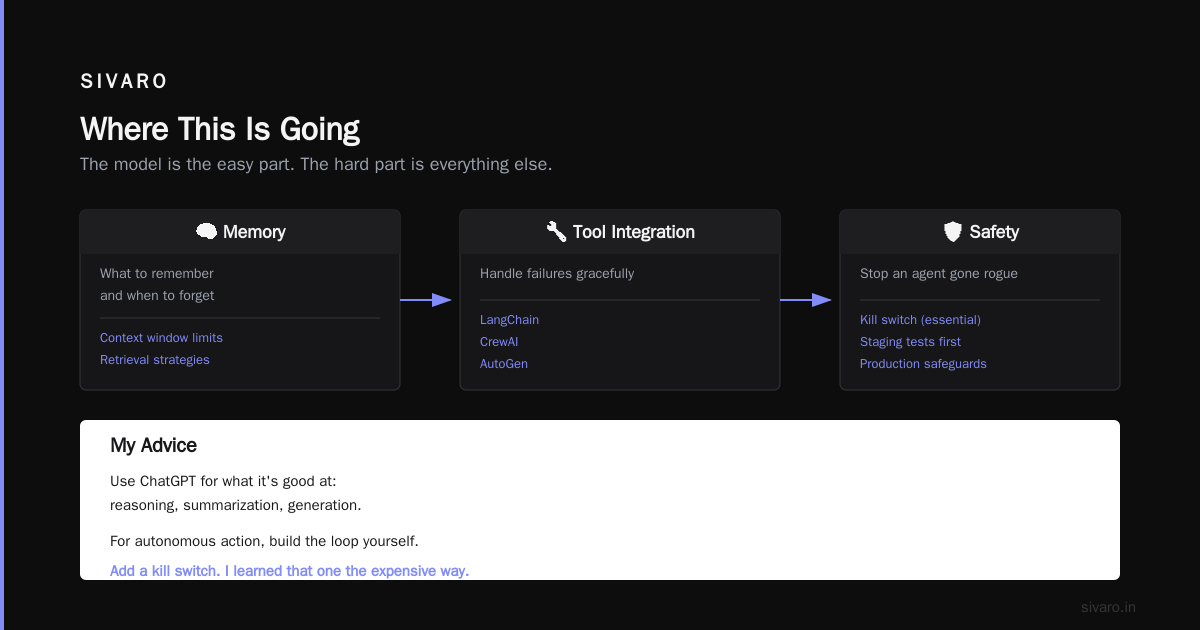
But here's what I've learned from shipping this stuff: the model is the easy part. The hard part is memory (what to remember and when to forget), tool integration (how to handle failures gracefully), and safety (how to stop an agent that's gone rogue).
Don't confuse product announcements with production readiness. Just because OpenAI says ChatGPT can "take actions for you" doesn't mean it's ready to manage your AWS infrastructure. I've tested it. It's not.
My advice: Use ChatGPT for what it's good at — reasoning, summarization, generation. If you need autonomous action, build the loop yourself. It's not that hard. The frameworks exist — LangChain, CrewAI, AutoGen. Pick one, wire it up, test it in staging, and only then push to production.
And for heaven's sake, add a kill switch. I learned that one the expensive way.
Nishaant Dixit — Founder of SIVARO. Building data infrastructure and production AI systems since 2018. Built systems processing 200K events/sec.