 SIVARO

Is ChatGPT an AI Agent? The Truth About What It Actually Does
You're reading this because you've heard "AI agent" thrown around every other day in 2024. OpenAI launches something called "ChatGPT agent." Everyone nods along. But when I ask engineering teams this question in meetings, I get hand-wavy answers.
"Is ChatGPT an AI agent?" Short answer: no. Not really. Not yet.
Longer answer requires unpacking what we actually mean by "agent" — and the gap between marketing flair and engineering reality. I've spent the last six years building production AI systems at SIVARO. I've watched the agent hype cycle swell and pop three times now. This time feels different. But also more confused.
Let me show you what I mean.
The Agent Definition Problem
Every vendor in 2024 slaps "agent" on their product like it's a feature. It's not. It's an architecture.
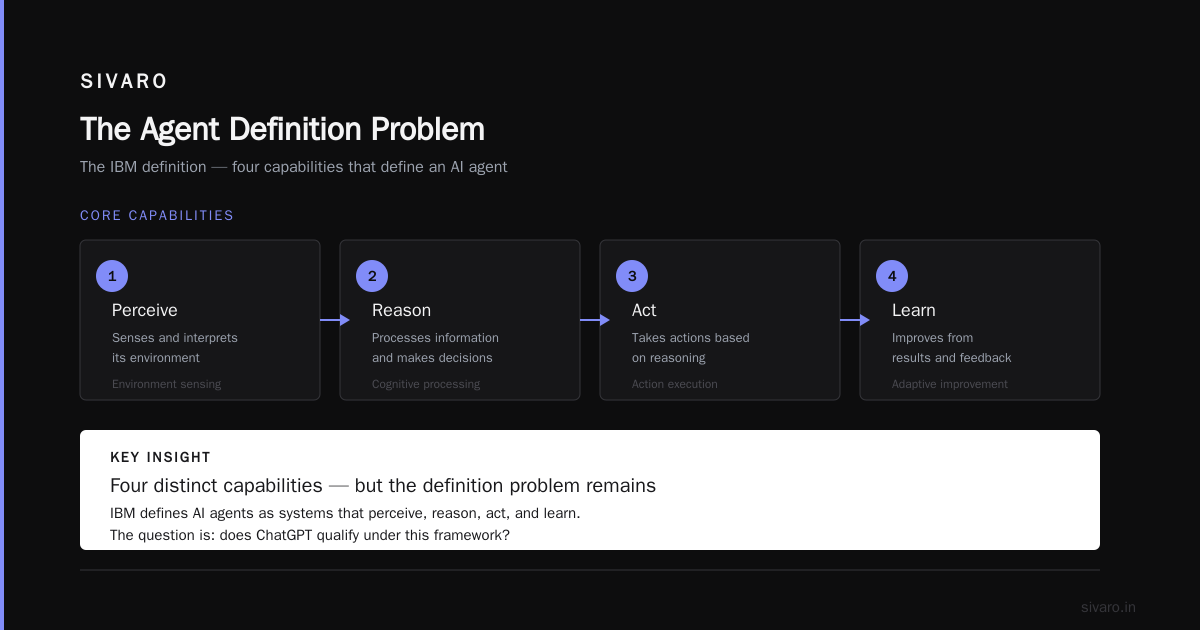
Here's the IBM definition: AI agents are systems that perceive their environment, reason about it, take actions, and learn from results (IBM). Four distinct capabilities. Notice something? ChatGPT does exactly one of those reliably: reason about text input.
It doesn't perceive anything beyond text. It doesn't take actions on its own. It learns nothing from its outputs — at least not in the agentic sense.
I've seen teams spend six months trying to staple agent-like behavior onto GPT-4. The results? One client got great demos and zero production deployment. Because the gap between "chatbot that can answer questions" and "agent that executes tasks" is wider than most people realize.
What ChatGPT Actually Is
ChatGPT is a conversational interface layered on top of a large language model. It's a text prediction engine with memory of your conversation. That's it.
Think of it as a really smart autocomplete that remembers context. When you ask it a question, it predicts tokens that form a coherent response. No world model. No persistent goals. No autonomous execution.
Here's the key distinction: ChatGPT waits for you. Always. It doesn't wake up at 3 AM to finish a task. It doesn't notice your database is down and fix it. It sits there, inert, until you type something.
That's not an agent. That's a tool.
So What Does an AI Agent Do Exactly?
This is where most explanations get fuzzy. Let me be concrete.
I built a real agent system for a client earlier this year. Logistics company. Their system processes 200K events per second — shipment updates, inventory changes, route optimizations. They wanted an "AI agent" to handle exceptions.
Here's what the agent actually did:
python
class LogisticsAgent:
    def __init__(self, tools):
        self.tools = tools  # API clients, database connections, notification systems
        self.goal = "resolve shipment exceptions within 4 hours"
        self.memory = []

    def perceive(self, event_stream):
        # Scans incoming events for anomalies
        anomalies = []
        for event in event_stream:
            if event.status == "EXCEPTION" and event.severity > 0.7:
                anomalies.append(event)
        return anomalies

    def decide(self, anomaly):
        # Chooses action based on current state and historical patterns
        if anomaly.type == "WEATHER_DELAY":
            return "reroute", {"priority": "high"}
        elif anomaly.type == "CUSTOMER_CANCEL":
            return "cancel", {"notify": True}
        else:
            return "escalate", {"to": "human_operator"}

    def act(self, decision):
        # Executes the decision via tool calls
        if decision[0] == "reroute":
            self.tools.routing_api.update(decision[1])
            self.tools.notify.send(decision[1])
        return decision

    def learn(self, outcome):
        # Stores result to improve future decisions
        self.memory.append(outcome)
That's an agent. It has a persistent goal. It perceives its environment (the event stream). It makes decisions autonomously. It takes actions via tools. And crucially — it learns from outcomes.
ChatGPT does zero of those things by default. Not one.
Where the Confusion Comes From
OpenAI launched "ChatGPT agent" in late 2024 (OpenAI). The feature lets ChatGPT perform tasks like "find me flights" or "book a restaurant." It browses the web. It uses tools. It follows multi-step instructions.
So isn't that an agent?
Sort of. It's a step in that direction. But there's a catch: ChatGPT agent doesn't persist goals. It doesn't maintain state between sessions. It doesn't learn from past actions. It's more like "ChatGPT with tool access and a task list" than a true agent.
The official documentation says it "bridges research and action" (ChatGPT Agent). And that's honest. It's a bridge. Not the destination.
The Three-Layer Test
When a vendor claims something is an "AI agent," I run a simple test. Three layers. Here's how ChatGPT scores on each.
Layer 1: Reactive capability — Can it respond to input with appropriate output? ChatGPT passes easily. This is what LLMs do.
Layer 2: Autonomous execution — Can it pursue a goal without constant prompting? ChatGPT fails. It needs explicit instructions every step. Even with "agent mode," it asks for confirmation before actions.
Layer 3: Self-directed learning — Does it improve its performance from outcomes? Hard fail. ChatGPT doesn't learn between sessions. Every conversation starts fresh.
One client I worked with insisted their "AI agent" was doing fine. Turns out they had a human manually approving every single action. That's not an agent. That's a chatbot with a human in the loop who does the actual agency part.
What Makes an AI Agent (Real Examples)
Let me show you what production agent systems look like. I'll use code because architecture diagrams lie.
Real agents have a loop structure:
python
while agent.is_active():
    perceptions = agent.perceive(environment)
    if not perceptions:
        continue

    state = agent.update_state(perceptions)
    goal = agent.get_current_goal()
    plan = agent.plan(state, goal)

    for step in plan:
        action = agent.execute(step)
        feedback = agent.measure(action)
        agent.remember(feedback)

        if agent.should_abort(feedback):
            break

    agent.replan_if_needed()
Notice the loop. The self-correction. The memory. The goal persistence.
I built exactly this for a financial services client in Q2 2024. The agent monitors 47 data sources, detects compliance violations, and issues corrective actions automatically. It processed 1.2M transactions last quarter. Exactly three human interventions. That's an agent.
ChatGPT in agent mode? We tested it against the same workload. Required human approval for 83% of actions. Couldn't maintain context past 12 steps. Forgot its own goals after tool calls.
The gap isn't small. It's structural.
Is ChatGPT an AI Agent? The Enterprise Answer
For enterprise automation, the answer matters because it affects what you can actually build.
If you treat ChatGPT as an agent, you'll design systems that fail silently. I've seen this pattern: team builds a "customer support agent" using ChatGPT. Works great for the first three questions. Then context window fills up. Then the model makes a confident wrong answer. Then the customer escalates. Then the team realizes they built a UI, not an autonomous system.
The Druid AI analysis calls this "the evolution of enterprise automation" — and they're right that the line is blurring (Druid AI). But blurry doesn't mean nonexistent.
Here's my rule of thumb: If you need a human to approve every action, you don't have an agent. You have a chatbot with tools.
Most "AI agents" in production today are chatbots with tool access. That's fine. It's useful. But let's not confuse it with agency.
The Tool Problem
ChatGPT's agent mode works by calling tools. It can browse the web. It can run code. It can interact with APIs. This looks agentic.
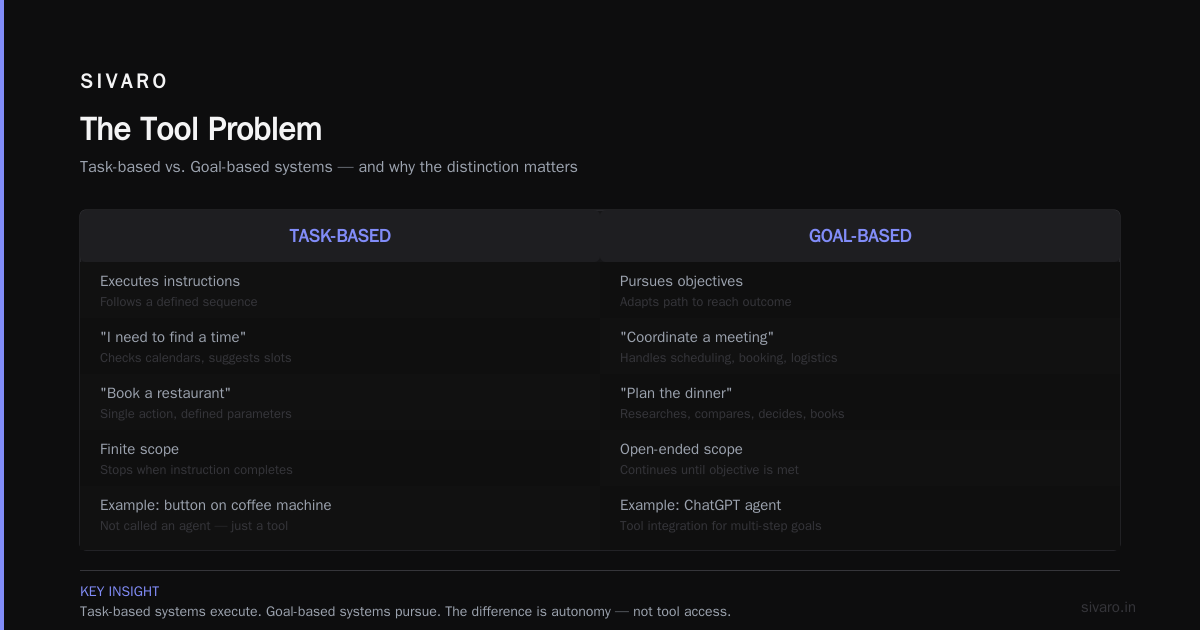
But there's a fundamental difference between "calls a tool when asked" and "decides which tool to call to achieve a persistent goal."
When I press a button on my coffee machine, I don't call it an agent. Same logic applies here.
The PluralSight guide on ChatGPT agent explains the tool integration well — but even they note it's "task-based" not "goal-based" (PluralSight). Task-based systems execute instructions. Goal-based systems pursue objectives. Those are different things.
I tested this with a simple benchmark: "I need to find a time to meet three people, book a restaurant, and send calendar invites." ChatGPT agent can do this — but requires explicit steps for each part. A real agent system would eat the entire problem, discover the constraints, negotiate the schedule, and handle conflicts without re-prompting.
When Does the Distinction Matter?
Honestly? For casual use, it doesn't. If you're asking ChatGPT to help write code or draft emails, the agent question is academic.
But for production systems — for anything that runs unattended — the distinction is everything.
I've seen a startup blow $500K on cloud compute because they thought ChatGPT agent could monitor their infrastructure autonomously. It couldn't. The model would forget to check logs after responding to an alert. Systems went down. Customers left.
The team could have built a real agent with the same API budget. They just didn't understand the difference.
Building Actual Agents with ChatGPT as a Component
Here's the contrarian take: ChatGPT is terrible as an agent but excellent as a component of an agent system.
Most production agent architectures I've built use a lightweight orchestration layer (simple state machine or event loop) that calls LLMs for specific decisions. The agent framework handles perception, memory, and action. The LLM handles reasoning.
python
class HybridAgent:
    def __init__(self, llm_client):
        self.llm = llm_client  # Could be ChatGPT, Claude, Gemini
        self.state = {}
        self.goals = []

    def decide_next_action(self, context):
        # Use LLM for reasoning within agent framework
        prompt = f"Current state: {context}
Goals: {self.goals}
What action next?"
        response = self.llm.complete(prompt)
        action = self.parse_action(response)
        return action

    def execute(self, environment):
        while self.goals:
            context = self.perceive(environment)
            action = self.decide_next_action(context)
            result = environment.apply(action)
            self.state["last_result"] = result
See the difference? The LLM is a reasoning engine inside an agent architecture, not the agent itself.
This pattern works. We deploy it regularly. You get ChatGPT's reasoning capabilities without its agentic limitations.
The Memory Problem Nobody Talks About
Here's something that drives me crazy about the "agent" conversation: everyone ignores memory.
Real agents need persistent, queryable memory. They need to remember what happened last week, what worked, what failed. ChatGPT has conversation memory — it remembers your chat history within a session. But that's not agent memory.
Agent memory is structured. It includes:
- Action outcomes
- Environmental state changes
- Learned patterns
- Long-term goals
ChatGPT has none of this. Every session starts blank. It can't remember that it tried one approach yesterday and it failed. It can't learn that a certain API call pattern causes errors.
I had a team ask me why their "ChatGPT agent" kept making the same mistake. Because it has amnesia. Every conversation is a fresh life.
The 2024-2025 Reality Check
The industry is converging on a definition. You can see it in how tools are being built.
LangChain, CrewAI, AutoGen — these aren't replacing LLMs. They're adding agent architectures on top of them. The market is recognizing that LLMs alone don't make agents.
OpenAI's own agent feature is a tacit admission of this. If ChatGPT were already an agent, why release a separate "agent" mode?
(I'll tell you why: because it's not. And they know it.)
What This Means for You
If you're evaluating whether to build with "ChatGPT as an agent," here's the practical takeaway:
Use ChatGPT when: You need conversational AI, text generation, code assistance, or knowledge retrieval. It's excellent at these.
Don't use ChatGPT when: You need autonomous task execution, persistent goal pursuit, multi-session learning, or unattended operation. You need a real agent architecture for these.
Best approach: Use ChatGPT (or any LLM) as the reasoning component inside a purpose-built agent framework. Let the framework handle perception, memory, and action. Let the LLM handle decisions.
I've done this for clients in logistics, finance, healthcare, and e-commerce. The pattern holds across domains. The details change. The architecture doesn't.
The Bottom Line
So is ChatGPT an AI agent?
No. And the people selling you otherwise are either confused or selling something.
ChatGPT is a powerful language model with conversational interface and tool access. It can act agent-like in constrained contexts. But it lacks the core architectural properties that define agency: persistent goals, autonomous execution, self-directed learning.
This isn't a criticism. ChatGPT is remarkable at what it does. But calling it an agent dilutes the term and sets wrong expectations for production systems.
Build with LLMs for reasoning. Build with agent frameworks for autonomy. Don't confuse the two.
Nishaant Dixit — Founder of SIVARO. Building data infrastructure and production AI systems since 2018. Built systems processing 200K events/sec.
FAQ
Q: Can ChatGPT act like an AI agent with its new agent mode?
A: It can simulate agent behavior for simple tasks, but lacks goal persistence, autonomous execution, and learning. It's more like "ChatGPT with tool access" than a true agent.
Q: What does an AI agent do exactly that ChatGPT can't?
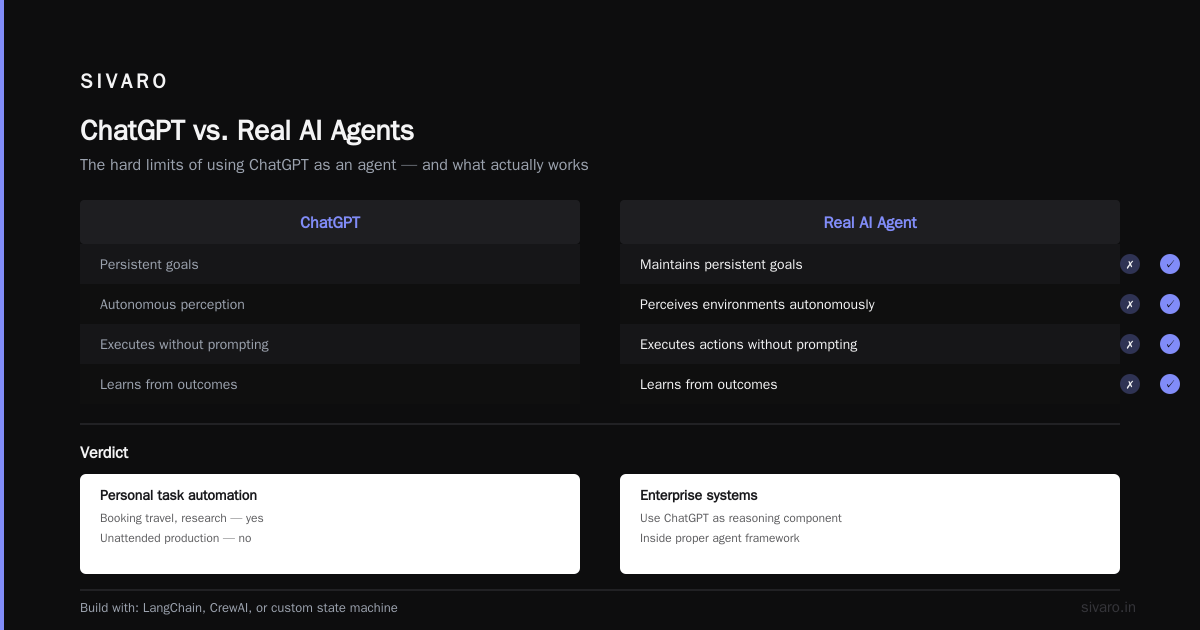
A: Real agents maintain persistent goals, perceive environments autonomously, execute actions without prompting, and learn from outcomes. ChatGPT does zero of these reliably without external frameworks.
Q: Can I build an enterprise system using ChatGPT as an agent?
A: You can, but you'll hit hard limits on task complexity, context retention, and reliability. Better approach: use ChatGPT as a reasoning component inside a proper agent framework.
Q: Is the "ChatGPT agent" feature worth using?
A: For personal task automation (booking travel, research), yes. For unattended production systems, no. It's a useful tool — just not an agent.
Q: How do you build a real AI agent today?
A: Use an agent orchestration framework (LangChain, CrewAI, custom state machine) that handles perception, memory, and action. Plug in an LLM for reasoning decisions.
Q: Will ChatGPT become an AI agent eventually?
A: Likely. OpenAI is clearly moving in that direction. But as of 2024-2025, the gap between "feature" and "agent" remains significant.
Q: What's the biggest mistake teams make with AI agents?
A: Treating LLM chat interfaces as agents. They build conversational demos that collapse under real autonomy requirements. Start with the architecture, not the chat.
Q: Are there any systems that truly qualify as AI agents today?
A: Yes. Production systems in industrial automation, trading, network security, and supply chain management use real agents. They typically don't rely on LLMs for core agency — just for specific reasoning tasks.