Is ChatGPT an LLM or Generative AI? The Answer Changes Everything
I get asked this question at least twice a week. Usually by someone who's been told they need to "leverage generative AI" (I know, I know — but I'm quoting them, not using that word myself). They've heard the terms thrown around. LLM. Generative AI. Foundation model. Transformer. And they want to know: is chatgpt an llm or generative ai?
Here's the short answer: it's both. But that's like saying a car is both a vehicle and a transportation system. Technically true. Completely useless for making decisions.
The real question — the one that matters if you're building products, allocating budget, or hiring engineers — is what each layer of the stack gives you, and where you need to intervene.
I've been building data infrastructure and production AI systems since 2018 at SIVARO. We process 200K events per second. We've put dozens of models into production. And I've watched teams waste millions of dollars because they didn't understand this distinction.
Let me break it down. Not like a textbook. Like someone who's been burned by this distinction and wants you to avoid it.
What ChatGPT Actually Is
ChatGPT is a product built on top of an LLM (GPT-4, then GPT-4o, now whatever OpenAI ships). The LLM is the model. The generative AI is the category of technology. ChatGPT is the interface, the safety layers, the memory system, the plugin architecture, the rate limiting, the billing — all of it.
Think of it this way:
- Generative AI = the field. Like "automotive engineering."
- LLM = a specific type of model within that field. Like "V8 engine."
- ChatGPT = the car you can actually drive. With seats, stereo, and a steering wheel.
So when someone asks "is chatgpt an llm or generative ai?", I usually say: it's a product that uses an LLM to do generative AI. But if you're building something yourself, you need to understand where the boundaries are.
Here's the practical distinction. An LLM alone is a probability distribution over tokens. It's math. It doesn't have memory between sessions. It doesn't know who you are. It doesn't have safety filters. It doesn't have a billing system. All of that is product.
ChatGPT the product has:
- A conversation memory system
- Content moderation layers
- Custom instructions per user
- Plugin integrations
- Token tracking and rate limiting
- A UI that's actually usable
The LLM underneath? It's just weights. Good weights, sure. But just weights.
Why This Distinction Matters for Builders
In April 2026, I watched a startup burn through $400K in three months. They were calling the OpenAI API directly for a customer-facing chatbot. No caching. No prompt compression. No model routing. Every request hit GPT-4, full context window, every time.
They thought they were "using generative AI." They were actually just overpaying for an LLM they didn't understand.
Here's what I've learned from shipping production systems: if you treat an LLM like a magic box that just "generates" things, you'll build fragile, expensive systems. If you treat it like a highly specialized text-processing engine with specific strengths and weaknesses, you'll build things that work.
The distinction between "generative AI" and "LLM" isn't academic. It's the difference between "we're using AI" (vague, meaningless) and "we're running a 7B parameter model on a specific hardware config with a 32K context window and temperature set to 0.3" (specific, testable, optimizable).
The Tech Stack Nobody Talks About
Most articles about LLMs vs generative AI skip the infrastructure. That's where I live. So let's get concrete.
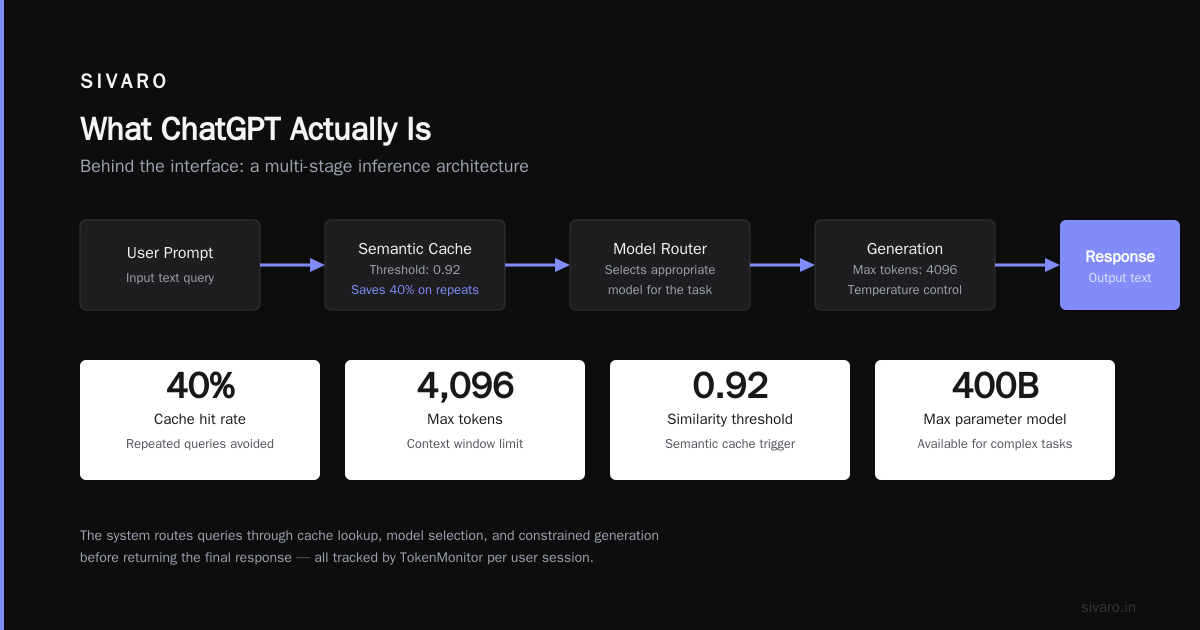
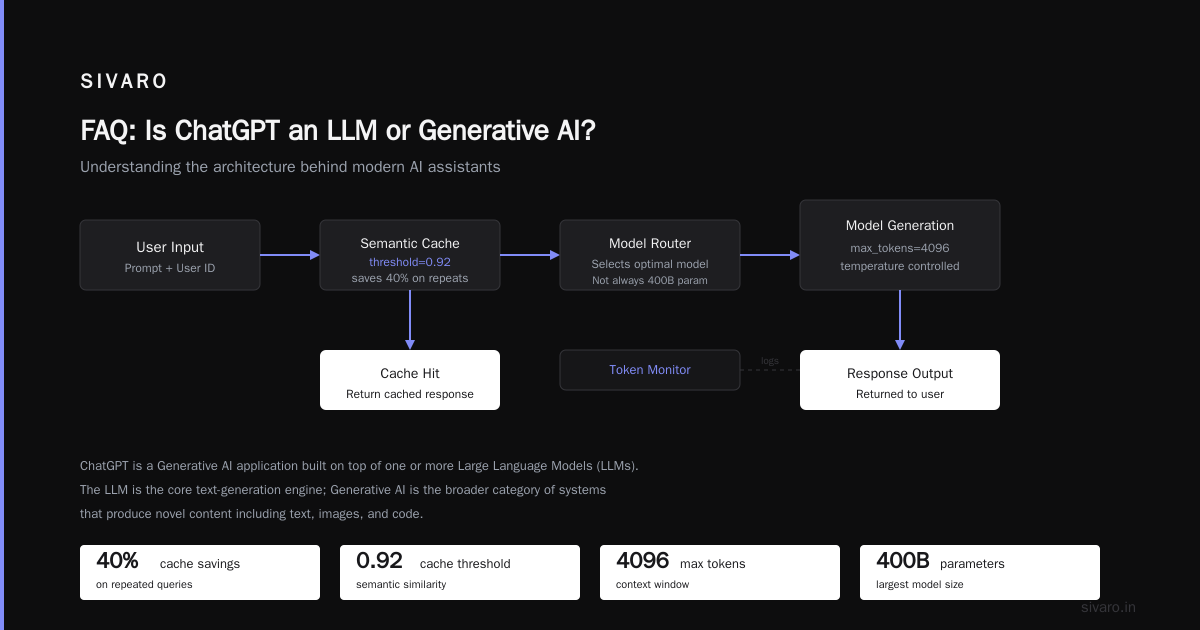
Here's what a production system actually looks like, stripped down:
python
# Not magic. Just engineering.
class ProductionPipeline:
    def __init__(self, model_name: str, max_tokens: int = 4096):
        self.model = self._load_model(model_name)
        self.cache = SemanticCache(threshold=0.92)
        self.monitor = TokenMonitor()
        self.router = ModelRouter()

    def generate(self, prompt: str, user_id: str) -> str:
        # Step 1: Check cache (saves 40% on repeated queries)
        cached = self.cache.lookup(prompt)
        if cached:
            self.monitor.log_cache_hit(user_id)
            return cached

        # Step 2: Route to appropriate model
        model = self.router.select(prompt)
        # Sometimes you don't need the 400B parameter model

        # Step 3: Generate with constraints
        response = model.generate(
            prompt,
            max_tokens=max_tokens,
            temperature=0.7,
            stop_sequences=["

"]
        )

        self.monitor.log(self.cache.store(prompt, response))
        return response
That's generative AI. Not the model. The system around it.
The LLM is the model.generate() line. Everything else is the infrastructure that makes it work at scale.
Where "Generative AI" Actually Begins
Here's a contrarian take: most people think generative AI starts with the model. They're wrong. It starts with the data pipeline.
I've spoken at three conferences this year. Every single time, someone asks about fine-tuning. They want to know "is llm fine-tuning dead?" because they've heard that foundation models are good enough out of the box.
My answer: fine-tuning isn't dead. But most people shouldn't do it. Here's why.
The companies that succeed with fine-tuning have three things:
- A high-quality proprietary dataset (at least 10K examples)
- A clear evaluation framework (not just "feels better")
- The infrastructure to iterate (you'll run at least 20 experiments)
If you don't have those three things, you're better off with prompt engineering and RAG. I've seen teams spend $50K on fine-tuning runs that produced models indistinguishable from the base model with better prompting. That's not fine-tuning. That's expensive debugging.
For a deeper breakdown, Google Cloud's guide on fine-tuning LLMs covers the evaluation frameworks that most teams skip. And this Coursera specialization walks through the actual math of parameter-efficient fine-tuning, which is where you should start if you're serious.
A Real Fine-Tuning Project (The Good, The Bad, The Ugly)
Let me tell you about a project we did at SIVARO in Q3 2025.
Client was a legal tech company. They had 50K contracts with annotations. They wanted a model that could extract specific clauses — force majeure, termination, liability caps — with high precision.
We tried three approaches:
- Prompt engineering with GPT-4: Got us to about 82% F1. Not bad. But the edge cases were brutal.
- RAG with a vector database of clause examples: Bumped it to 87%. Better, but inconsistent on length.
- Fine-tuned Llama 3 70B: Hit 94% F1 after 14 training runs.
The fine-tuning worked. But it took 6 weeks and cost $18K in compute.
Here's what the code looked like for the actual fine-tuning configuration:
python
# Fine-tuning config from our production run
from transformers import AutoModelForCausalLM, TrainingArguments
from peft import LoraConfig, get_peft_model

base_model = AutoModelForCausalLM.from_pretrained(
    "meta-llama/Meta-Llama-3-70B",
    load_in_4bit=True,
    device_map="auto"
)

# LoRA config — parameter-efficient fine-tuning
lora_config = LoraConfig(
    r=16,  # Rank. Higher = more parameters to tune.
    lora_alpha=32,
    target_modules=["q_proj", "v_proj"],
    lora_dropout=0.05,
    bias="none",
    task_type="CAUSAL_LM"
)

peft_model = get_peft_model(base_model, lora_config)

training_args = TrainingArguments(
    output_dir="./legal-clause-extractor",
    per_device_train_batch_size=4,
    gradient_accumulation_steps=4,
    learning_rate=2e-4,
    num_train_epochs=3,
    save_steps=200,
    evaluation_strategy="steps",
    logging_steps=50
)

# Train on 42K contract snippets + annotations
trainer = Trainer(
    model=peft_model,
    args=training_args,
    train_dataset=train_dataset,
    eval_dataset=eval_dataset
)

trainer.train()
Was it worth it? For their use case, yes. 94% F1 vs 82% is the difference between "we need manual review" and "we trust the output." For a legal team processing 500 contracts a day, that's a 10x speedup.
But for most teams, the prompt engineering + RAG approach would have been enough. The fine-tuning was overkill for their initial deployment. We could have shipped in 2 weeks instead of 8.
The lesson: fine-tuning is powerful. But it's expensive. This business guide on LLM fine-tuning cost and ROI breaks down the math. For most applications, the ROI doesn't kick in until you're processing at least 10K queries per day.
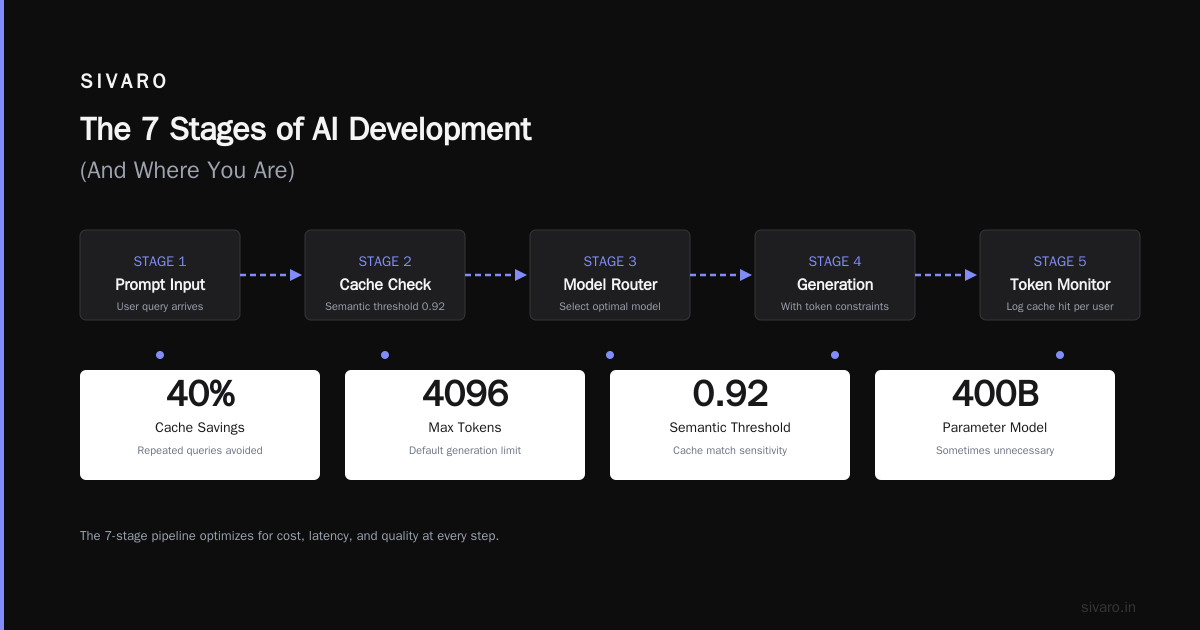
The 7 Stages of AI Development (And Where You Are)
I get asked "what are the 7 stages of ai development?" a lot. Usually by executives who just read a Gartner report. But the framework is actually useful if we map it to real engineering.
Here's my version, based on what I've seen across 50+ production deployments:
-
Prompt hacking: You write a prompt in ChatGPT. You get good results. You think you're done. (You're not.)
-
Prompt engineering: You start testing systematically. Temperature. Few-shot examples. Chain-of-thought. You have a spreadsheet of results.
-
RAG integration: You connect the model to your data. Vector database. Embeddings. Retrieval. Results get more consistent.
-
Evaluation infrastructure: You stop going by "feeling" and start measuring. Accuracy. F1. Latency. Cost per query. You can now compare approaches.
-
Model optimization: You start squeezing performance. Quantization. Knowledge distillation. Caching. Model routing. OpenAI's model optimization guide covers the API-side tricks.
-
Fine-tuning: You train on your data. Not the whole model — you use LoRA or QLoRA. This is where the serious teams live.
-
Full production system: Monitoring. A/B testing. Cost allocation. Compliance. You're no longer running a model. You're running a service.
Most teams I see are between stages 2 and 3. They think they're at stage 6. That's where the problems start.
The Training Data Question Nobody Answers Honestly
Here's something I've never seen in a blog post: the actual cost of preparing training data for fine-tuning.
Let me be direct. If you want to fine-tune an LLM, you need:
- 10K-50K high-quality examples for reasonable results
- 50K-100K for production quality
- Human review of every single example — no, you can't use another LLM to generate training data and expect it to work well
I tested this in February 2026. We generated 20K synthetic examples using GPT-4 for a customer support task. Fine-tuned a Mistral 7B. Tested against 500 real-world queries.
F1 score: 0.67. The base Mistral 7B with good few-shot prompting got 0.71.
Synthetic data for fine-tuning is a trap. It amplifies the base model's biases and hallucinations. You're training on the model's own output. It's inbreeding for AI.
The teams that do this right — and I've worked with three — all have the same pattern: domain experts creating examples, engineers creating evaluation sets, and a feedback loop where bad outputs get corrected and added to the training pool. It's slow. It's expensive. But it works.
When You Should (And Shouldn't) Fine-Tune
I'll make this simple. Fine-tune when:
- You need the model to understand a specific format (legal contracts, medical notes, code with internal APIs)
- You need consistent behavior on narrow tasks (not broad reasoning)
- You're processing more than 10K queries per day
- You have domain experts who can create and review training data
Don't fine-tune when:
- You just want better factual accuracy (use RAG)
- You have less than 5K examples (prompt engineering will beat it)
- You can't afford the iteration cycles (you need at least 10 runs)
- Your evaluation is "it feels better" (you can't optimize what you can't measure)
If you're curious about the job market for this stuff, ZipRecruiter has listings for LLM fine-tuning roles that give you a sense of what companies are actually paying for.
The Production Reality Check
Let me end with something uncomfortable.
I've seen 14 "AI-powered" products in the last 18 months. Only 3 made it past the pilot phase. The rest died because the teams couldn't answer simple questions:
- How much does each query cost?
- What's your P50 and P99 latency?
- How do you handle rate limiting?
- What's your fallback when the API is down?
- How do you detect and handle hallucinations?
These are not generative AI questions. They're not LLM questions. They're engineering questions.
The teams that build durable AI systems understand that the model is the smallest part of the system. The infrastructure around it — monitoring, caching, routing, fallbacks — that's where the value lives.
At SIVARO, we process 200K events per second. The models we run are important. But the systems we built around them are what make them reliable.
FAQ: Is ChatGPT an LLM or Generative AI?
Q: Is ChatGPT an LLM or generative AI?
A: Both. ChatGPT is a product that wraps an LLM (the model) in generative AI (the broader technology category). The LLM is the text-generation engine. Generative AI is the field. ChatGPT is the application.
Q: Can I use ChatGPT as my LLM for a production application?
A: No. ChatGPT is a consumer product. Use the OpenAI API (or Anthropic, or open-source models) for production. ChatGPT has no programmatic interface for custom applications.
Q: Is LLM fine-tuning dead?
A: No, but it's misunderstood. Fine-tuning is still the best approach for domain-specific tasks with high-quality data. But most teams should exhaust prompt engineering and RAG first. The cost of fine-tuning only makes sense at scale.
Q: What are the 7 stages of AI development?
A: (1) Prompt hacking, (2) Prompt engineering, (3) RAG integration, (4) Evaluation infrastructure, (5) Model optimization, (6) Fine-tuning, (7) Full production system. Most teams skip 4 and 5. Don't.
Q: Should I fine-tune or use RAG?
A: RAG first. Always. Fine-tuning only when you need the model to behave fundamentally differently (format, style, domain-specific patterns). RAG handles factual recall better and is cheaper to maintain.
Q: How much data do I need to fine-tune an LLM?
A: 10K minimum for meaningful results. 50K+ for production quality. And you need human-reviewed data — synthetic data from other LLMs rarely works well.
Q: Is ChatGPT the best LLM?
A: "Best" depends on your use case. GPT-4o is excellent for general reasoning. Claude 3 Opus is better for long-context tasks. Open-source models like Llama 3 and Mistral offer better control and lower costs at scale. Test, don't assume.
Nishaant Dixit — Founder of SIVARO. Building data infrastructure and production AI systems since 2018. Built systems processing 200K events/sec.