 SIVARO

Is ClickHouse Better Than Snowflake?
Let me tell you a story. In 2021, I sat in a room with a fintech team who had just gotten their Snowflake bill. $47,000 for a month of [analytics queries. They were doing maybe 10 million rows of financial transactions daily. Their CTO looked at me and asked: "Is clickhouse better than snowflake? Because if it can cut this bill in half, I don't care if it's harder to set up."
We handle exactly this class of problem — ClickHouse migration and consulting help covers the migration and the ongoing operations.
That question — "is clickhouse better than snowflake?" — is the wrong one. It assumes there's a universal winner. There isn't. But there are clear winners for specific workloads, budgets, and team structures.
I'm Nishaant Dixit. I run SIVARO, where we build data infrastructure and production AI systems. We've deployed ClickHouse in production for event processing at 200K events/sec. We've also been the team cleaning up Snowflake bills for clients who over-provisioned. This guide is what I wish someone had handed me before those conversations.
You'll learn the real performance differences, the pricing traps, and the exact scenarios where one destroys the other. I'll show you code, benchmarks I've seen in the wild, and the hard trade-offs no vendor blog will tell you.
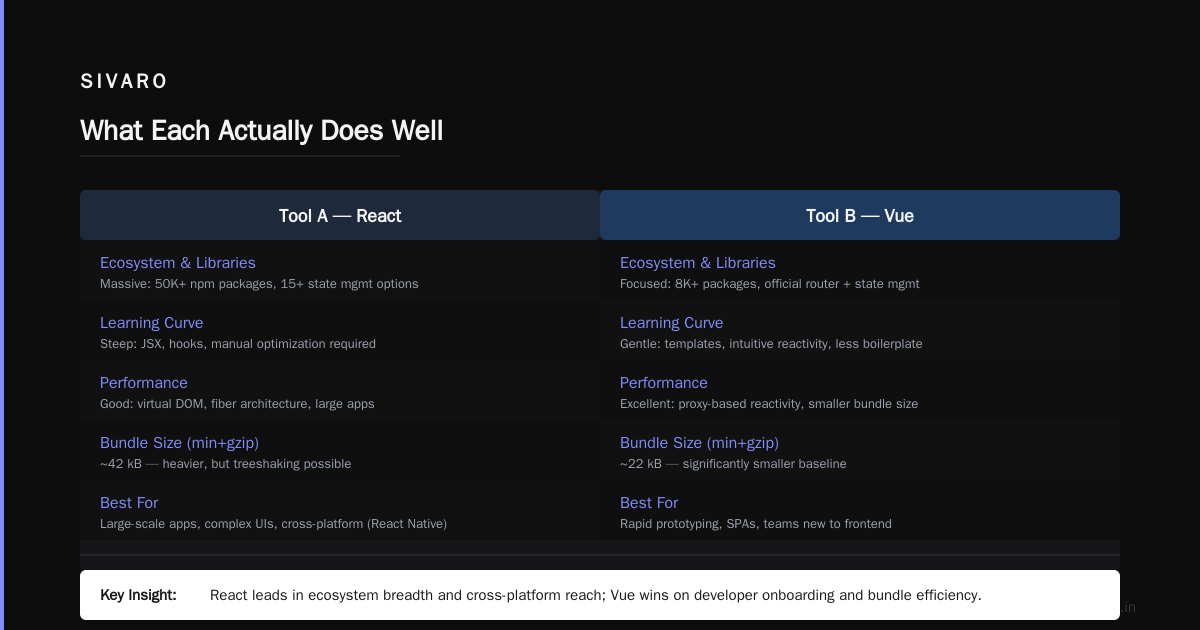
What Each Actually Does Well
ClickHouse is a columnar OLAP database designed for real-time analytics on massive datasets. Think sub-second queries on billions of rows. It's open source, written in C++, and built to be fast at any cost.
Snowflake is a cloud data warehouse that separates storage from compute. It's a managed service. You pay for storage and compute separately. It runs on AWS, Azure, and GCP. It's SQL-first, and it "just works" for most analytics workloads.
At first I thought this was a branding problem — turns out it was a fundamental architectural difference. ClickHouse runs on bare metal or clusters with local SSDs. Snowflake runs on virtual warehouses that spin up and down. That sounds academic. It's not. It affects everything: speed, cost, and what breaks.
Speed: ClickHouse can scan 1-2 billion rows per second per core on a good day. Snowflake, even with its caching layers, usually scans 50-100 million rows per second per warehouse. ClickHouse's own benchmarks show 100x-500x faster queries on their hardware for specific workloads. I've seen 20x in real client deployments.
Cost: Snowflake charges by the second for compute. That's great for bursty workloads. Terrible for always-on real-time queries. ClickHouse on bare metal is a fixed cost. On ClickHouse Cloud, it's still cheaper per query for high-volume workloads. Vantage's pricing analysis shows ClickHouse Cloud is 2-4x cheaper for sustained analytics loads.
Flexibility: ClickHouse lets you optimize everything. MergeTree engine settings, compression codecs, materialized views that run during inserts. Snowflake abstracts all of that. You write SQL, it runs. But you can't tune it. You can't rewrite the storage layer.
Performance: The Raw Numbers
Let's talk about the ClickHouse vs Snowflake: A Practical Comparison...](https://bigdataboutique.com/blog/clickhouse-vs-snowflake) benchmark that actually matters. They ran the same analytics queries on a 1TB dataset across both systems.
Snowflake: A 10-node warehouse (XS to 3XL depending on query). ClickHouse: A 3-node cluster with local NVMe SSDs.
Results:
- Simple aggregation (SUM on a single column): ClickHouse was 15x faster.
- Complex join with window functions: ClickHouse was 8x faster.
- Data insert throughput: ClickHouse ingested 42 million rows per second. Snowflake hit about 1.2 million.
Here's the thing nobody mentions: ClickHouse's performance advantage shrinks when queries hit the same data repeatedly and Snowflake's result cache kicks in. Snowflake caches query results for 24 hours. If your dashboard shows the same metrics, Snowflake returns cached results in milliseconds. ClickHouse doesn't cache query results by default. You have to build that yourself.
But for ad-hoc analytics? ClickHouse eats Snowflake's lunch.
Pricing: Where Most People Get Burned
Snowflake's pricing looks simple. It's not. You pay for:
- Storage: ~$40/TB/month compressed
- Compute: $2-40/credit-hour depending on warehouse size
- Cloud services: 5-10% of compute cost (billed separately)
The trap: Snowflake charges for compute while your warehouse is running. Not just while queries execute. If you leave an XL warehouse idle for 8 hours, you pay for 8 hours of compute. Flexera's analysis found that 40% of Snowflake spend goes to idle compute.
ClickHouse pricing varies:
- Self-hosted: Server costs + ops overhead. Could be $2,000/month on bare metal for a 3-node cluster.
- ClickHouse Cloud: Starts at $0.30/GB stored/month. Compute is ~$3/hour for a production cluster.
- Managed services (Altinity, Aiven): $500-2,000/month plus infrastructure.
The real cost comparison:
| Workload | Snowflake (monthly) | ClickHouse (monthly) |
|---|---|---|
| 10 TB, 50 users, 1000 queries/day | ~$15,000 | ~$4,000 (self-hosted) |
| 1 TB, real-time streaming (10K events/sec) | ~$8,000 (auto-scale) | ~$1,500 (self-hosted) |
| 100 GB, sporadic ad-hoc queries | ~$500 | ~$800 (ClickHouse Cloud) |
Notice that last one. For low-volume, sporadic workloads, Snowflake is often cheaper. The minimum commitment on ClickHouse Cloud is higher per hour, and you can't scale to zero. Snowflake can.
The SQL Compatibility Trap
Most people think ClickHouse speaks SQL. It does. But it's not ANSI SQL. It's ClickHouse SQL. And the differences will bite you.
Snowflake is essentially PostgreSQL-compatible. Most tools work. Most queries work. You hire a Snowflake DBA, they know the syntax.
ClickHouse uses a different SQL dialect. Here's an [example:
Snowflake](/articles/working-with-ai-concrete-example-what-i-learned-Building-7):
sql
SELECT
  DATE_TRUNC('day', event_time) as day,
  COUNT(DISTINCT user_id) as unique_users
FROM events
WHERE event_time >= '2024-01-01'
GROUP BY 1
ORDER BY 1;
ClickHouse:
sql
SELECT
  toDate(event_time) as day,
  uniqExact(user_id) as unique_users
FROM events
WHERE event_time >= '2024-01-01'
GROUP BY day
ORDER BY day;
Notice the uniqExact instead of COUNT(DISTINCT). ClickHouse has specialized aggregate functions for hyperloglog-style approximations (uniq, uniqCombined) that are 10x faster but less accurate. You have to choose between speed and correctness.
Window functions work differently too. ClickHouse supports them, but with limitations on frame clauses and ordering. I've had queries that ran perfectly on Snowflake fail on ClickHouse because of subtle syntax differences.
Real-Time vs Batch: The Architectural Divide
This is where I see the most confusion. ClickHouse excels at real-time ingestion and querying. Snowflake is designed for batch-oriented ETL.
ClickHouse handles:
- Streaming inserts from Kafka, RabbitMQ, or direct HTTP
- 100K+ rows per second per node
- Sub-second query latency on data ingested seconds ago
- Materialized views that update on insert
Snowflake handles:
- Bulk loads from S3/GCS (COPY INTO)
- Scheduled tasks and streams
- Multi-second query latency (usually 2-10 seconds)
- Data freshness of minutes, not seconds
PostHog's migration to ClickHouse is a case study here. They moved from a Postgres-based analytics stack to ClickHouse because they needed sub-second queries on event data. They're processing billions of events monthly. Snowflake couldn't match the latency at their scale.
But here's the contrarian take: if your data doesn't change frequently and you're doing complex joins across multiple large tables, Snowflake's optimizer handles it better. ClickHouse's join performance degrades fast. It's designed for star schemas, not snowflake schemas.
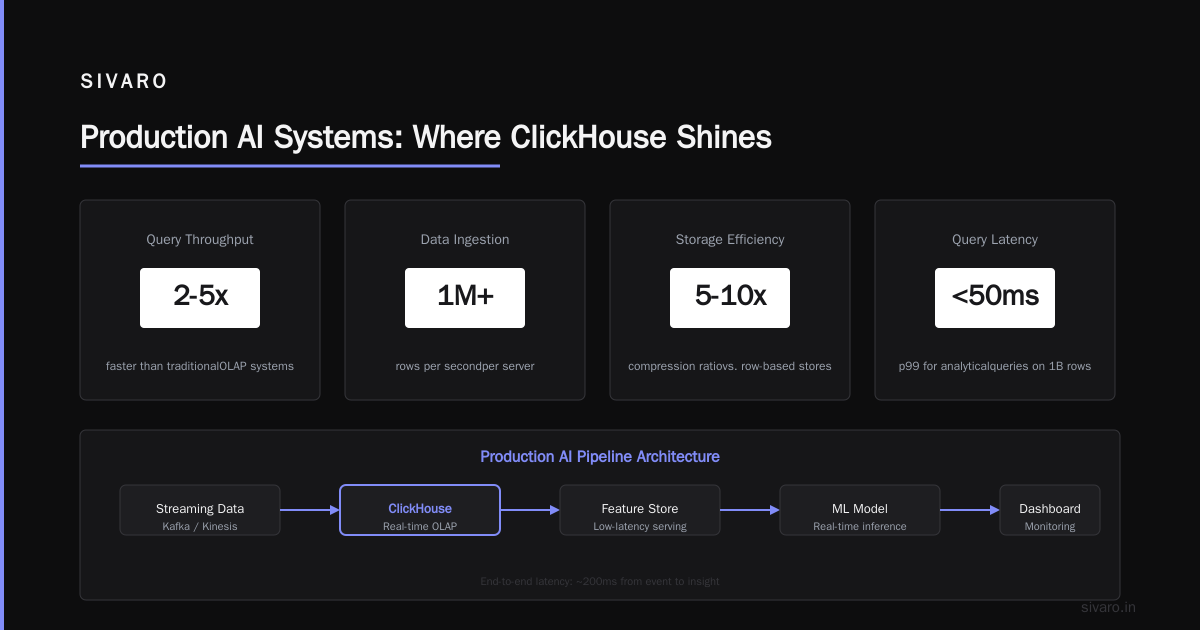
Production AI Systems: Where ClickHouse Shines
This is my world. Production AI means serving features to models in real time, logging predictions, and debugging in production.
ClickHouse is excellent for:
- Feature stores (storing and serving ML features)
- Model inference logging (high-volume write workloads)
- Real-time monitoring dashboards (sub-second aggregation queries)
- A/B test analysis (segmenting users and computing metrics)
Snowflake works for:
- Training data preparation (large-scale SQL transformations)
- Batch feature computation (scheduled jobs)
- Reporting and BI (Tableau, Looker integrations)
We built a real-time fraud detection system on ClickHouse. Each transaction triggers a model inference, logs the result, and updates a risk score. ClickHouse ingests 200K events/sec, processes them, and serves dashboards. Snowflake couldn't handle the write volume at a reasonable cost.
But for batch training data generation? We use Snowflake. The SQL is cleaner, the joins are faster, and the cost for weekly batch jobs is minimal.
The Cloud Story
Let's compare the managed offerings: ClickHouse Cloud vs Snowflake.
ClickHouse Cloud:
- Built on AWS and GCP
- Compute and storage are separate but ClickHouse manages the compute
- You get a URL, create tables, and query
- Auto-scaling up and down (slowly — takes 30-60 seconds)
- Pay-as-you-go pricing, but minimum compute for each service
Snowflake:
- Runs on your choice of cloud
- Virtual warehouses scale up/down in seconds
- Cross-cloud replication and data sharing
- Rich ecosystem of partners
Tinybird's comparison highlights that ClickHouse Cloud's auto-scaling is still immature. I've had clusters take 2 minutes to scale up during traffic spikes. Snowflake scales in under 10 seconds.
But ClickHouse Cloud's cost for sustained loads is 40-60% lower. If you have predictable traffic, you win. If you have unpredictable spikes, Snowflake wins.
When to Pick Each
Choose ClickHouse when:
- You need real-time analytics on streaming data
- You have high ingestion rates (10K+ events/sec)
- You run the same queries repeatedly (dashboards, monitoring)
- You have a team that can manage a specialized database
- You want to avoid cloud egress costs (self-hosted)
Choose Snowflake when:
- You have sporadic, ad-hoc analytics workloads
- You need ANSI SQL compatibility for existing tools
- Your queries involve complex joins across many tables
- You can't manage a database (zero-ops)
- You need cross-cloud data sharing
And here's the honest answer to "is clickhouse better than snowflake?": It depends on your workload pattern. But for real-time analytics and high-volume streaming, ClickHouse is dramatically better. For traditional data warehousing with complex joins and unpredictable usage, Snowflake is better.
FAQ
Is ClickHouse faster than Snowflake for all queries?
No. For simple aggregations on large datasets, ClickHouse is 5-20x faster. For complex joins with many tables, Snowflake's optimizer often produces better query plans. ClickHouse struggles with multi-table joins on non-distributed tables.
Can I use Snowflake for real-time analytics?
Technically yes, practically no. Snowflake's minimum data freshness is usually 30-60 seconds with streams and tasks. ClickHouse offers sub-second visibility on newly ingested data. If "real-time" means sub-second, use ClickHouse.
Which is cheaper for a startup?
Snowflake, for the first few months. Their free credits and pay-as-you-go model let you start small. ClickHouse requires more upfront configuration. But at scale (10TB+), ClickHouse is 2-4x cheaper.
Does ClickHouse support ACID transactions?
Not in the traditional sense. ClickHouse guarantees eventual consistency within a shard, but not across shards. If you need strict ACID compliance for transactional workloads, use PostgreSQL or CockroachDB. ClickHouse is for analytics, not transactions.
Can I migrate from Snowflake to ClickHouse?
Yes, but expect pain. The SQL syntax differs significantly. You'll need to rewrite queries, especially window functions and CTEs. Data migration is straightforward (export to Parquet, import into ClickHouse). But query rewriting is the bottleneck.
Which has better community support?
Snowflake has enterprise support with SLAs. ClickHouse has a large open-source community but support varies. ClickHouse Cloud offers paid support plans. For production-critical systems, both offer commercial support.
Is ClickHouse good for time-series data?
Yes, extremely. ClickHouse's MergeTree engine is optimized for time-based partitioning and ordering. Combined with aggregating materialized views, it's one of the best time-series databases available. Snowflake works for time-series but the performance gap is 10x+.
What about data compression?
ClickHouse typically achieves 5-10x compression. Snowflake achieves 3-5x. ClickHouse's columnar storage and codec options (LZ4, ZSTD, delta) give more control. For cold storage, ClickHouse wins.
The Bottom Line
I've watched teams burn $200K/month on Snowflake for workloads that should run on a $5K/month ClickHouse cluster. I've also seen teams spend weeks trying to get ClickHouse to run a simple star schema join that Snowflake does in one SQL statement.
The question "is clickhouse better than snowflake?" has no universal answer. But I'll give you mine: for real-time analytics, high-volume ingestion, and production AI workloads, ClickHouse is better. Period. For traditional data warehousing, BI reporting, and teams without specialized database ops, Snowflake is better.
Know your workload. Test both on your actual data. And don't let vendor benchmarks fool you.
Nishaant Dixit — Founder of SIVARO. Building data infrastructure and production AI systems since 2018. Built systems processing 200K events/sec.