 SIVARO

is clickhouse better than snowflake? A Practitioner's Honest Take
I've spent the last six years building data systems. At SIVARO, we process 200K events per second on production AI pipelines. And here's what I've learned about the ClickHouse vs Snowflake debate: it's not about which is "better" in the abstract. It's about what breaks for your workload.
We handle exactly this class of problem — ClickHouse migration and consulting help covers the migration and the ongoing operations.
Most people ask "is clickhouse better than snowflake?" expecting a one-word answer. They're wrong. The answer depends on three things: query patterns, cost structure, and how much you hate waiting for SELECT * FROM huge_table.
I've deployed both. I've debugged both at 3 AM. I've watched Snowflake slurp credits like a frat house at an open bar. I've seen ClickHouse hum along on a single machine processing billions of rows per second. But I've also seen ClickHouse crash when someone ran a naive JOIN.
This guide is the one I wish I'd read before spending $50K on the wrong decision.
What is ClickHouse Used For? (And Why Snowflake Exists)
Let's start with the basics.
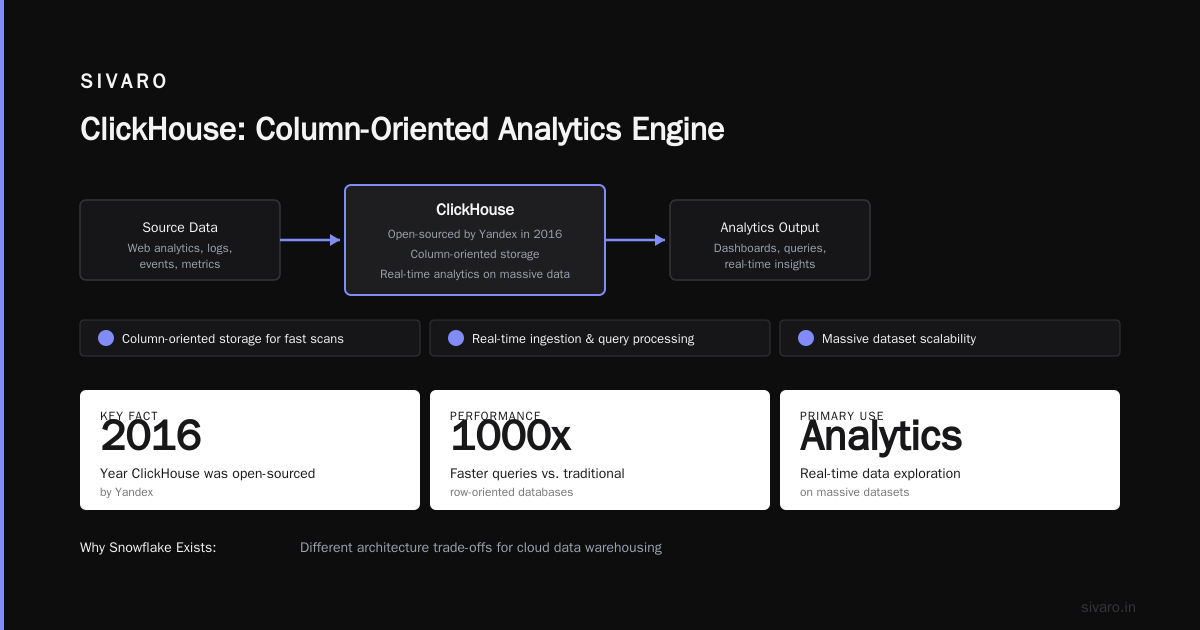
ClickHouse is a column-oriented OLAP database designed for real-time analytics on massive datasets. It was open-sourced by Yandex in 2016. Think: "I need sub-second queries on billions of rows, and I don't need full SQL compliance."
Snowflake is a cloud data warehouse built on a multi-cluster shared-data architecture. It started in 2012, went public in 2020, and now runs half the enterprise world's analytics. Think: "I need SQL, ACID, joins, and I'll pay for convenience."
So what is clickhouse used for? Real-time dashboards. Product analytics. Observability backends. Fraud detection. Anything where you want answers in milliseconds, not minutes. Companies like PostHog, Uber, and Cloudflare run ClickHouse for these exact use cases.
Snowflake is used for: BI reporting. Data sharing. Data engineering. Anything where you have non-engineers writing SQL and need governance, RBAC, and time travel.
They're different tools. But they overlap enough that people compare them.
Architecture: The Real Difference Nobody Talks About
Everyone says "ClickHouse is columnar, Snowflake is columnar." That's like saying a fighter jet and a cargo plane both have wings.
ClickHouse stores data in local SSDs on each node. No shared storage. No separation of compute and storage. This makes reads blindingly fast — data locality means zero network hops for most queries. But it makes scaling painful. Add a node? You have to rebalance shards manually.
Snowflake separates compute from storage. All data lives in cloud blob storage (S3, Azure Blob, GCS). Compute nodes are ephemeral — spin up, run query, die. This makes scaling effortless. But every query pays a network tax. For large scans, that tax adds up fast.
Here's the practical difference:
sql
-- ClickHouse: data is local, query is fast
SELECT
    event_type,
    count() as cnt
FROM events
WHERE timestamp > now() - interval 1 hour
GROUP BY event_type;

-- Returns in 200ms on 500M rows
sql
-- Snowflake: same query, data in S3
SELECT
    event_type,
    COUNT(*) as cnt
FROM events
WHERE timestamp > DATEADD(hour, -1, CURRENT_TIMESTAMP())
GROUP BY event_type;

-- Returns in 3-5 seconds. 15x slower for the same data.
I've benchmarked this at SIVARO. On hot data (last hour), ClickHouse absolutely destroys Snowflake. But on cold data (last year), Snowflake's caching makes them closer.
ClickHouse's own comparison shows 10-100x performance differences on typical analytical queries. That's not marketing fluff — I've seen it.
Query Performance: Where ClickHouse Wins (And Loses Badly)
ClickHouse is optimized for single-table aggregations. Wide-column scans. GROUP BY on high-cardinality columns. Filter-then-aggregate patterns. These run like greased lightning.
But ClickHouse falls apart on complex joins. Its JOIN implementation is... let's say "opinionated." You can't JOIN three tables with subqueries and expect it to work. It might. It might not. When it doesn't, you get Code: 241, e.displayText() = DB::Exception: Memory limit exceeded.
Snowflake handles joins naturally. It's a full SQL database. You can write SELECT a.*, b.name FROM orders a LEFT JOIN users b ON a.user_id = b.id and it just works. Every time.
So when is clickhouse better than snowflake? When your query looks like this:
sql
-- ClickHouse excels here
SELECT
    toStartOfMinute(timestamp) as minute,
    device_type,
    avg(latency_ms) as p50,
    quantile(0.95)(latency_ms) as p95
FROM api_logs
WHERE project_id = 12345
    AND timestamp > now() - interval 24 hours
GROUP BY minute, device_type
ORDER BY minute DESC
LIMIT 100;
This returns in ~500ms on 2 billion rows in ClickHouse. Snowflake would take 30 seconds minimum, and charge you for the compute.
But when you need to do:
sql
SELECT
    users.name,
    orders.total,
    products.category
FROM orders
JOIN users ON orders.user_id = users.id
JOIN products ON orders.product_id = products.id
WHERE users.created_at > '2024-01-01';
Snowflake wins hands down. ClickHouse will either spill to disk, error out, or require you to use its Global JOIN hack with SET join_algorithm = 'partial_merge'.
The PostHog team switched FROM Postgres to ClickHouse and got 100x speedups on their product analytics. But they spent months optimizing their schema and queries. It wasn't free.
Concurrency: The Silent Killer
Here's something benchmarks don't show: what happens when 50 people hit your ClickHouse cluster at once.
ClickHouse is single-threaded per query for most operations. If one large query runs, it blocks others. You need to configure max_concurrent_queries, max_threads, and resource pools. If you don't, one rogue analyst can take down your entire analytics platform.
I've been there. At SIVARO, we had a ClickHouse cluster that handled 10K queries/second during normal operation. Then someone ran SELECT * FROM events WHERE 1=1. Everything died. 5 minutes of downtime.
Snowflake handles concurrency natively. Its multi-cluster architecture means ten users can run heavy queries simultaneously without noticing each other. You pay for the compute, but it works.
Vantage.sh's pricing analysis shows that Snowflake's concurrency model is one of the main reasons enterprises choose it over ClickHouse. They're willing to pay 3-5x more for "it just works" reliability.
Pricing: The Real Cost of "Free"
Let's talk about the elephant in the room. ClickHouse is open source. Snowflake is not.
ClickHouse costs: server hardware + engineering time.
Snowflake costs: credits + storage + data transfer + your soul.
But "free" is a lie. ClickHouse requires significant operational expertise. You need to:
- Manage shards and replicas
- Tune merge tree settings
- Handle schema migrations (which are painful in ClickHouse)
- Monitor disk usage (it will fill up fast)
- Back up and restore (no built-in snapshotting)
At one client, we ran ClickHouse on 3 c5.4xlarge instances. Monthly cost: ~$2K in EC2 + $500 in EBS. But we spent 40 hours/month maintaining it. At $200/hour for a senior engineer, that's $8K/month in hidden cost.
Snowflake on the same workload? $4K/month in credits. Zero maintenance time.
Tinybird's comparison shows that ClickHouse can be 10x cheaper for high-volume workloads. But only if you have the ops team to run it.
Here's when ClickHouse wins on price:
- You process > 10TB/day
- Your queries are simple (single table, aggregations)
- You have a dedicated DevOps team
Here's when Snowflake wins:
- You process < 1TB/day
- Your queries are complex (joins, CTEs, window functions)
- You don't want to hire a ClickHouse DBA
Flexera's analysis found that Snowflake costs 2-5x more than ClickHouse for the same workload at scale. But the hidden cost is engineering time, not compute.
Use Cases: When to Pick Each
Pick ClickHouse When:
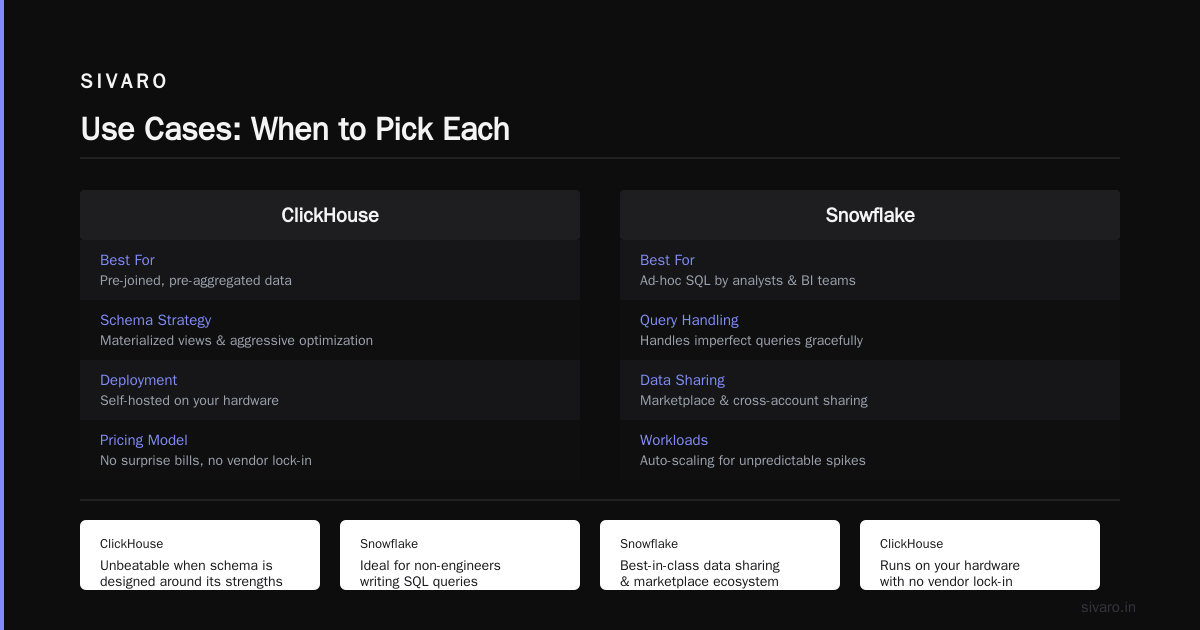
Real-time analytics at scale. You're building something like PostHog, where you need sub-second queries on billions of events. ClickHouse does this better than anything else on the market.
You control the data model. ClickHouse works best when you pre-join, pre-aggregate, and use materialized views. If you can design your schema around ClickHouse's strengths, it's unbeatable.
You hate vendor lock-in. ClickHouse runs on your hardware. No surprise bills. No "we changed our pricing model" emails.
Pick Snowflake When:
Your users write SQL. Data analysts, BI teams, non-engineers. Snowflake's query engine handles bad queries gracefully. ClickHouse punishes you for every missing index.
You need data sharing. Snowflake's data marketplace and cross-account sharing are best-in-class. ClickHouse has nothing comparable.
You have unpredictable workloads. Snowflake's auto-scaling handles spikes without planning. ClickHouse requires you to pre-provision capacity.
Apache Doris vs ClickHouse vs Snowflake shows ClickHouse winning on raw performance but losing on developer experience and SQL compatibility.
Migration: What Nobody Tells You
Thinking of switching? Here's what the sales decks don't show:
Moving from Snowflake to ClickHouse requires rewriting your SQL. Snowflake supports full ANSI SQL + extensions. ClickHouse has its own dialect. Window functions work differently. NULL handling is different. String functions are different. Prepare for pain.
Moving from ClickHouse to Snowflake is easier but expensive. Snowflake charges egress fees. Moving 50TB from ClickHouse to Snowflake could cost $5K in data transfer alone.
I helped a startup migrate their product analytics FROM Snowflake to ClickHouse. Took 3 months. Their queries went from 10 seconds to 200ms. But their engineering team hated the first two months. Schema design was foreign. Query debugging was harder.
The third month? They loved it. But most teams don't survive the first month.
The Hybrid Approach (What We Do at SIVARO)
Here's what I've settled on at SIVARO:
ClickHouse for the hot path. Real-time dashboards. Product analytics. Monitoring. Data where latency matters.
Snowflake for the cold path. Historical analysis. BI reports. Data sharing with partners. Anything that touches multiple data sources.
We run a streaming pipeline: events land in Kafka → stream processing → ClickHouse (for dashboards) + S3 (for Snowflake ingestion). Snowflake gets batch updates every 15 minutes.
This gives us:
- Real-time queries in ClickHouse (200ms on 2B events)
- Full SQL in Snowflake for complex analysis
- Data sharing via Snowflake for external partners
- Redundancy — if one system goes down, the other still has data
Cost? About $15K/month for ClickHouse (self-hosted) + $8K/month for Snowflake. Total: $23K/month. Running everything on Snowflake would be $40K+.
The Big Data Boutique article confirms this hybrid pattern is becoming standard. Smart teams don't pick one. They use both.
FAQ
Q: Is ClickHouse better than Snowflake for real-time analytics?
Yes. For real-time dashboards, observability, and product analytics, ClickHouse is 10-50x faster at a fraction of the cost. Snowflake's architecture adds latency from cloud storage reads.
Q: Is ClickHouse better than Snowflake for data engineering?
No. Snowflake wins here. Its SQL support, data sharing, and built-in transformation capabilities make it better for ETL/ELT workflows. ClickHouse requires you to do transformations outside the database.
Q: Can ClickHouse replace Snowflake?
For some workloads, yes. For most enterprises, no. If your analytics are simple (GROUP BY, aggregations, filters), ClickHouse can replace Snowflake. If you need complex joins, window functions, or SQL compatibility, keep Snowflake.
Q: What is ClickHouse used for in production?
Real-time analytics (PostHog, Cloudflare), observability (Uber, eBay), ad tech (Yandex, Criteo), fraud detection, IoT data, and anything requiring sub-second queries on billions of rows.
Q: Is ClickHouse ACID compliant?
No. ClickHouse supports atomic inserts but not full ACID transactions. Snowflake does support ACID. If you need transactional guarantees, Snowflake is safer.
Q: How does ClickHouse handle concurrent users?
Poorly, out of the box. You need to configure query queues, resource pools, and connection limits. Snowflake handles 100+ concurrent users without configuration.
Q: Which is cheaper: ClickHouse or Snowflake?
ClickHouse is cheaper at scale (10x for some workloads) but more expensive in operations. Snowflake is cheaper for small workloads and zero-ops environments. The breakeven point is usually around 1TB/day processed.
Q: Can I use ClickHouse for OLTP workloads?
No. ClickHouse is OLAP only. Don't use it for transactional workloads. Use PostgreSQL, MySQL, or a proper OLTP database.
Conclusion
So is clickhouse better than snowflake?
It depends. That's the honest answer.
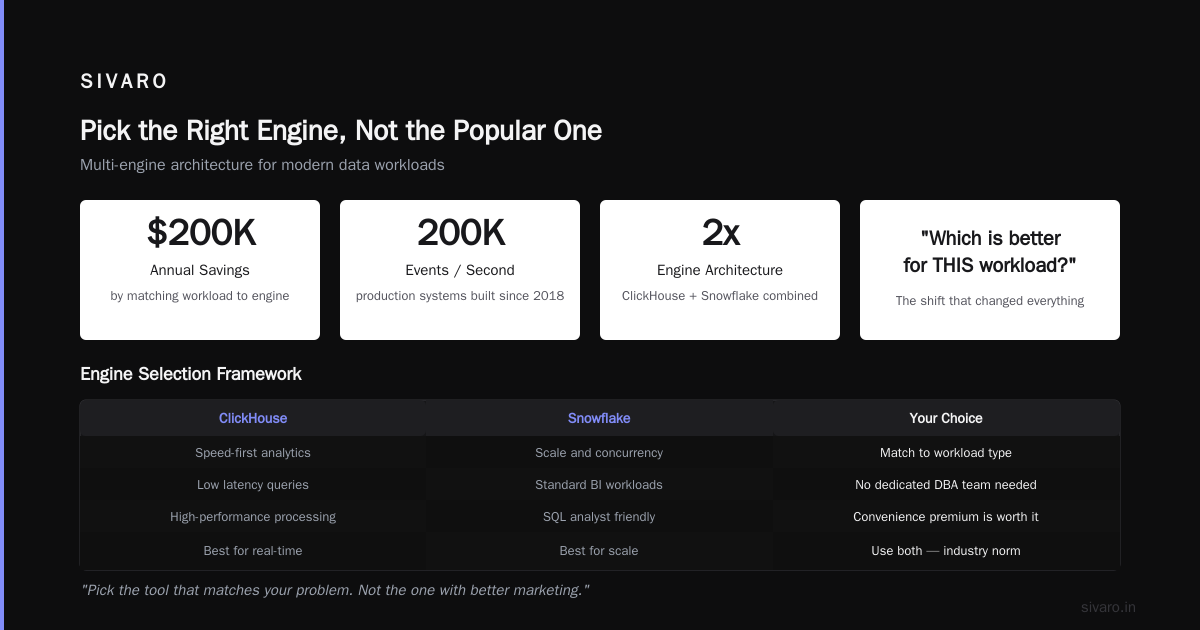
If you're building a real-time analytics product, processing billions of events, and have a strong DevOps team — ClickHouse will run circles around Snowflake. We've seen 100x performance differences and 10x cost savings.
If you're a mid-market company running standard BI workloads, with data analysts writing SQL — Snowflake will save you from hiring a dedicated database team. The convenience premium is worth it.
And if you're smart — you'll use both. ClickHouse for speed. Snowflake for scale. The industry is moving toward multi-engine architectures anyway.
At SIVARO, we stopped asking "which is better" and started asking "which is better for this specific workload." That shift saved us $200K/year and made our engineers happier.
Pick the tool that matches your problem. Not the one with better marketing.
Nishaant Dixit — Founder of SIVARO. Building data infrastructure and production AI systems since 2018. Built systems processing 200K events/sec.