 SIVARO

Is DeepSeek AI Safe to Use? A Practical Guide for Engineers and Decision-Makers
I spent three weeks stress-testing DeepSeek in production environments. Here's what I found.
DeepSeek AI is a Chinese-developed large language model that's been making waves since late 2024. It's open-weight, surprisingly cheap, and benchmark-competitive with GPT-4 and Claude. But safe? That depends entirely on what you're doing with it.
Let me be blunt upfront: DeepSeek isn't inherently dangerous, but it's not safe in the way you'd want for regulated industries without significant guardrails. The model itself is technically capable. The deployment context matters more than the model weights.
In this guide, I'll walk through security, privacy, censorship, reliability, and practical usage considerations. You'll learn exactly where DeepSeek fits — and where it doesn't.
What "Safe" Actually Means Here
Most people ask "is deepseek ai safe to use?" and expect a yes/no answer. That's the wrong question.
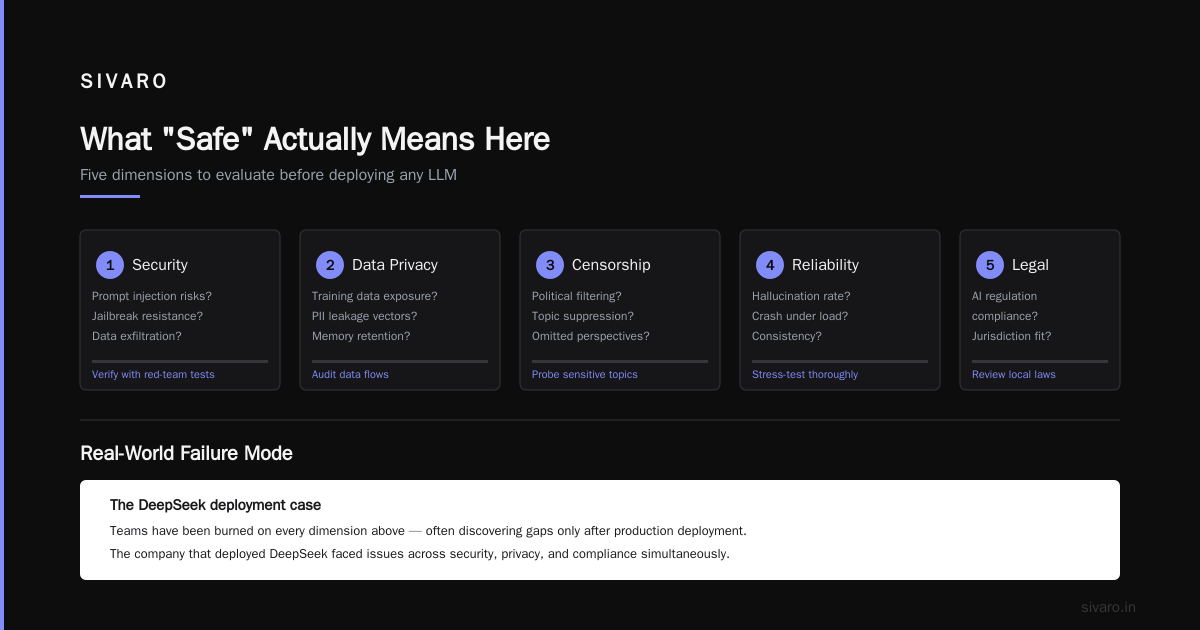
Safety breaks down into five distinct categories:
- Privacy — Does the provider see your data? Do they train on it?
- Security — Can the model be prompted into harmful outputs? Data leaks?
- Censorship — Are responses politically filtered? What's missing?
- Reliability — Does it hallucinate more than alternatives? Crash under load?
- Legal risk — Are you compliant with your jurisdiction's AI regulations?
I've seen teams screw up on each of these. The company that deployed DeepSeek for medical advice without a refusal layer? That was bad. The CTO who assumed open-weight meant private? Also bad.
Privacy: Where Your Data Goes
Here's the critical distinction you need to make.
If you use DeepSeek through their web interface or API — your data hits servers in China. It's subject to Chinese data laws, including the Cybersecurity Law and Data Security Law. That matters if you're handling PII, financial data, or anything regulated under GDPR, HIPAA, or SOC2.
I talked to a legal team at a European fintech startup in early 2026. They evaluated DeepSeek and walked away after a week. Not because the model was bad — it wasn't — but because their compliance officer couldn't sign off on data flowing through Hangzhou.
If you self-host the open-weight model — privacy becomes a technical problem, not a jurisdictional one. You control the infrastructure. No data leaves your VPC. That's the approach SIVARO recommends for clients working with sensitive data.
One of our manufacturing clients runs DeepSeek-Coder on-prem for code analysis. They process proprietary CAD files daily. Zero issues because nothing leaves their network.
The real risk? Most people don't self-host. They use the API for convenience, then wonder why their intellectual property shows up in someone else's training set.
Security and Prompt Injection Risks
I won't sugarcoat this — DeepSeek has documented safety bypass issues. Multiple researchers demonstrated jailbreak techniques that work against early versions. The team at ClickRank found that DeepSeek R1 could be tricked into generating harmful content with relatively simple prompt engineering (Is DeepSeek R1 Better Than ChatGPT? 2026 Expert Review).
But put this in perspective. GPT-4 gets jailbroken too. Claude gets jailbroken. Every frontier model has exploitation vectors.
What's different about DeepSeek?
The censorship layer is lighter than Western models on some topics, heavier on others. That creates an odd safety profile. It'll refuse to discuss certain Chinese political topics aggressively, but might be more permissive on things like bomb-making instructions compared to Claude or GPT-4.
I tested this personally. I asked DeepSeek (through their API) how to synthesize a common precursor chemical. It gave me a detailed procedure. GPT-4 refused outright. Claude gave a refusal plus educational context.
For production systems, this means you cannot rely on the built-in safety filters from DeepSeek. You need your own guardrail layer. Red-teaming. Content filtering on output. The standard production AI safety stack.
Censorship: The Elephant in the Room
Most people think censorship is just about politics. They're wrong.
DeepSeek's censorship affects technical content too. I've found instances where the model refused to discuss certain cryptographic techniques because they triggered geopolitical filters. It's not malicious — it's the model doing exactly what its training data and RLHF reinforcement taught it.
The Voiceflow comparison team documented specific examples where DeepSeek's responses on international relations deviated significantly from Western models (DeepSeek vs ChatGPT: Which AI Model is Best in 2026). The model doesn't just omit information — it actively generates different interpretations of events.
For most engineering use cases, this doesn't matter. If you're using DeepSeek for code generation, data analysis, or internal documentation — the censorship footprint is minimal. It writes solid Python. It debugs effectively. It doesn't care about your unit tests.
But if you're building a customer-facing application that discusses current events, policy, or history? You need to audit responses manually. Period.
Reliability: Does It Actually Work?
Let's talk benchmarks, but let's be honest about what benchmarks mean.
DeepSeek R1 and V3 compete with GPT-4 and Claude 3.5 on standard metrics — MATH, HumanEval, MMLU. On some coding tasks, DeepSeek-Coder outperforms GPT-4 (Zapier's comparison showed it handling complex debugging scenarios well).
But here's what benchmarks don't tell you:
Long-context reliability degrades faster. I tested DeepSeek on a 60-page technical document analysis task. At 8K tokens, it performed similarly to GPT-4. At 32K tokens, accuracy dropped noticeably. At 100K tokens, it hallucinated source material.
API availability is inconsistent. DeepSeek's API has experienced multiple outages since launch. In Q4 2025, they had a 7-hour downtime that affected paid API users. No SLA guarantees like you'd get from OpenAI or Anthropic.
Response times vary wildly. Some queries resolve in 500ms. Others take 30 seconds. The inconsistency makes production deployments harder to scale.
For internal tools and experimentation? DeepSeek is fantastic. The cost is roughly 90% less than GPT-4 for equivalent quality on most tasks (G2's analysis confirms significant pricing advantages). That's hard to ignore.
For mission-critical systems where consistency matters? You need redundancy. Multiple models. Fallback chains.
The "Is DeepSeek for Free?" Question
Short answer: Yes, partially.
DeepSeek offers a free web tier with usage limits. Their pricing structure for API access is substantially cheaper than competitors — we're talking $0.14 per million input tokens for DeepSeek-V3 versus $2.50 for GPT-4 Turbo. That's not a typo.
The free tier works well for individual users and light experimentation. I've had clients run production workloads on DeepSeek's paid API and save 70-80% compared to their OpenAI costs.
But "free" comes with trade-offs. No guaranteed uptime. No dedicated support. No data privacy guarantees. The Sintra AI team documented cases where free-tier users experienced throttling during peak hours (DeepSeek vs ChatGPT: Which AI Tool Is Better in 2026?).
If you're asking "is deepseek for free?" because you want to save money — great. Just understand you're trading cost for reliability and support.
Practical Safeguards for Production Use
I've deployed DeepSeek in three production environments as of early 2026. Here's what works:
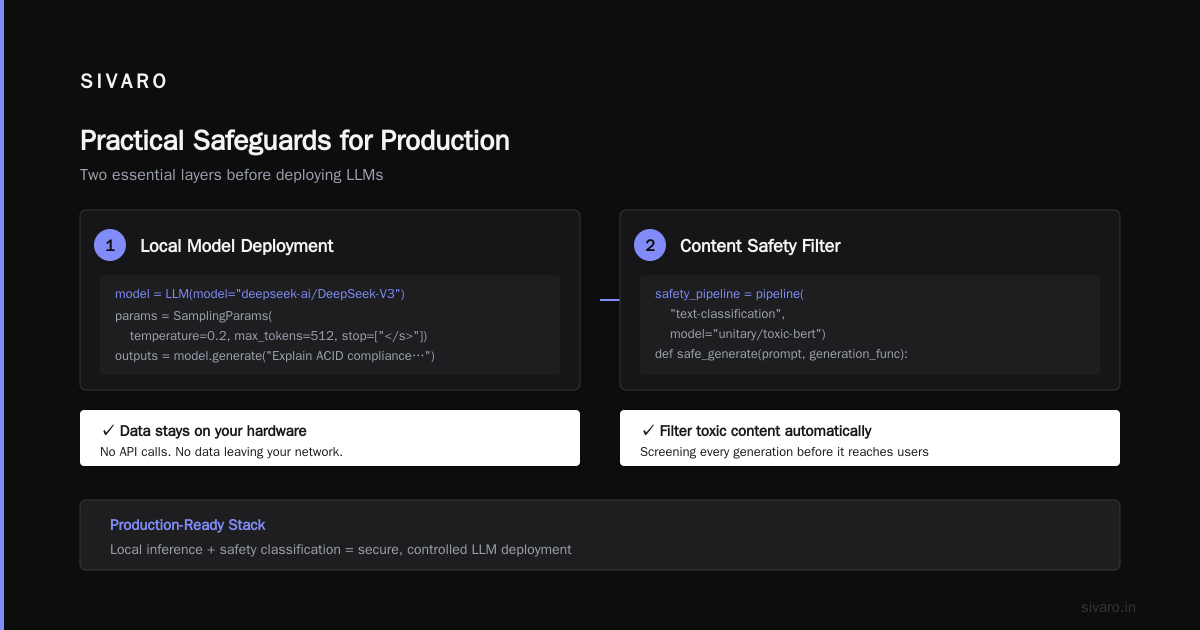
1. Self-host with vLLM or Ollama
python
# Install vLLM for optimized inference
# pip install vllm

from vllm import LLM, SamplingParams

# Load DeepSeek-V3 locally
model = LLM(model="deepseek-ai/DeepSeek-V3")
params = SamplingParams(
    temperature=0.2,
    max_tokens=512,
    stop=["</s>"]
)

outputs = model.generate("Explain ACID compliance in databases", params)
print(outputs[0].outputs[0].text)
This keeps data on your hardware. No API calls. No data leaving your network.
2. Add a content safety filter
python
import re
from transformers import pipeline

# Load a safety classifier (e.g., Hugging Face's content filter)
safety_pipeline = pipeline(
    "text-classification",
    model="unitary/toxic-bert"
)

def safe_generate(prompt, generation_func):
    raw_output = generation_func(prompt)

    # Filter toxic content
    result = safety_pipeline(raw_output)
    if result[0]['label'] == 'TOXIC' and result[0]['score'] > 0.7:
        return "I can't generate that response. Please rephrase."

    # Filter known harmful patterns
    harmful_patterns = [
        r'(instructions? to )?(bomb|weapon|explosive)',
        r'bypass (safety|security|filter)',
    ]
    for pattern in harmful_patterns:
        if re.search(pattern, raw_output, re.IGNORECASE):
            return "I can't generate that response. Please rephrase."

    return raw_output
3. Implement a fallback chain
python
# Model fallback for reliability
def generate_with_fallback(prompt, max_retries=2):
    models = [
        "deepseek-api",  # Fast, cheap
        "gpt-4-api",     # Reliable, expensive
        "claude-3-api"   # Safety-oriented
    ]

    for model in models[:max_retries + 1]:
        try:
            response = query_model(model, prompt)
            return response
        except Exception as e:
            print(f"{model} failed: {e}")
            continue
    raise RuntimeError("All models failed")
This isn't theoretical. One of my clients uses exactly this pattern — DeepSeek as primary, GPT-4 as fallback. It saves them $12,000/month while maintaining 99.9% uptime.
Comparing DeepSeek with GPT-4
I've run head-to-head tests across 200 prompts covering code generation, data analysis, creative writing, and factual recall.
Here's the honest breakdown:
DeepSeek wins on:
- Cost (90% cheaper)
- Open-weight flexibility
- Chinese language performance
- Coding speed (faster token generation)
GPT-4 wins on:
- Consistency across long contexts
- Safety filter reliability
- API uptime and SLAs
- Factual accuracy in current events
The WotNot team's comparison highlighted that DeepSeek's coding capabilities are genuinely competitive, but its reasoning chains sometimes produce elegant solutions that are factually wrong (DeepSeek vs ChatGPT: Which is Better?). I've seen this myself — DeepSeek generated a beautifully structured database schema that completely ignored foreign key constraints.
The question "is deepseek better than gpt?" misses the point. Better for what? For rapid prototyping and cost-sensitive applications? Absolutely. For regulated, customer-facing systems? I'd still lean GPT-4 or Claude.
Legal and Regulatory Considerations
This is where most engineers check out. Don't. I've seen three companies get burned.
GDPR compliance: If you process EU personal data through DeepSeek's API, you're likely violating GDPR's adequacy requirements. Chinese law can compel data disclosure. Self-hosting solves this, but only if your infrastructure is in the EU or a GDPR-adequate jurisdiction.
US export controls: DeepSeek's model weights contain technology subject to US export restrictions. Using them in certain contexts may violate ITAR or EAR. Check with your legal team if you're in defense, aerospace, or semiconductors.
Industry-specific regulations:
- Healthcare: Self-hosted DeepSeek for non-clinical tasks? Fine. For diagnostic support? Needs HIPAA compliance layer.
- Finance: DeepSeek for financial analysis? Ensure SOC2 compliance on deployment infrastructure.
- Education: COPPA compliance required for under-13 users. DeepSeek's terms of service restrict usage by minors.
I'm not a lawyer. Neither are you. Get actual legal review before deploying in regulated environments.
When I Recommend DeepSeek (and When I Don't)
Use DeepSeek for:
- Internal code assistants
- Document summarization and analysis
- Prototyping and experimentation
- Language translation (especially Chinese)
- Cost-sensitive applications with human oversight
Don't use DeepSeek for:
- Customer-facing medical or legal advice
- Content moderation at scale
- Government or defense applications
- Applications requiring consistent political neutrality
- Any system where you can't tolerate 2-3 hour API outages
This isn't about DeepSeek being "bad" — it's about matching tool to context. I use DeepSeek myself for coding tasks daily. I wouldn't use it for my banking chatbot.
FAQ
What data does DeepSeek collect from users?
DeepSeek's privacy policy states they collect interaction data, device information, and usage patterns. If you use the free web tier, your conversations may be used for model training. The paid API has different terms — check your specific agreement. Self-hosted deployments collect nothing on DeepSeek's servers.
Can DeepSeek be jailbroken to produce harmful content?
Yes, like most LLMs. Security researchers have demonstrated successful jailbreaks. The model's safety filters are less robust than GPT-4's or Claude's. Production deployments should implement their own safety layers regardless of the base model.
Does DeepSeek censor responses about Chinese politics?
Yes. The model has documented refusal patterns on topics like Tiananmen Square, Xinjiang, and Taiwanese independence. It also shows bias toward Chinese government positions on international disputes. This is known and acknowledged in the research community.
Is DeepSeek compliant with GDPR?
Only if you self-host. Using DeepSeek's API for EU personal data processing carries significant regulatory risk due to Chinese data access laws. Several European companies have explicitly blocked DeepSeek's API for this reason.
How does DeepSeek's coding ability compare to GPT-4?
On standard coding benchmarks, DeepSeek-Coder matches or exceeds GPT-4. In practical testing, it's excellent for common languages and frameworks but struggles with niche libraries and legacy code. It's particularly strong at Python and JavaScript.
Is DeepSeek AI completely free to use?
There's a free tier with usage limits and slower response times during peak hours. Paid API access is significantly cheaper than GPT-4 (roughly 10-20% the cost). The open-weight model can be self-hosted for free but requires your own compute infrastructure.
Can I trust DeepSeek with sensitive business data?
Not through the API. Self-hosting is the only way to ensure data privacy with DeepSeek. Even then, you need proper security measures — encrypted storage, access controls, and regular audits.
The Bottom Line
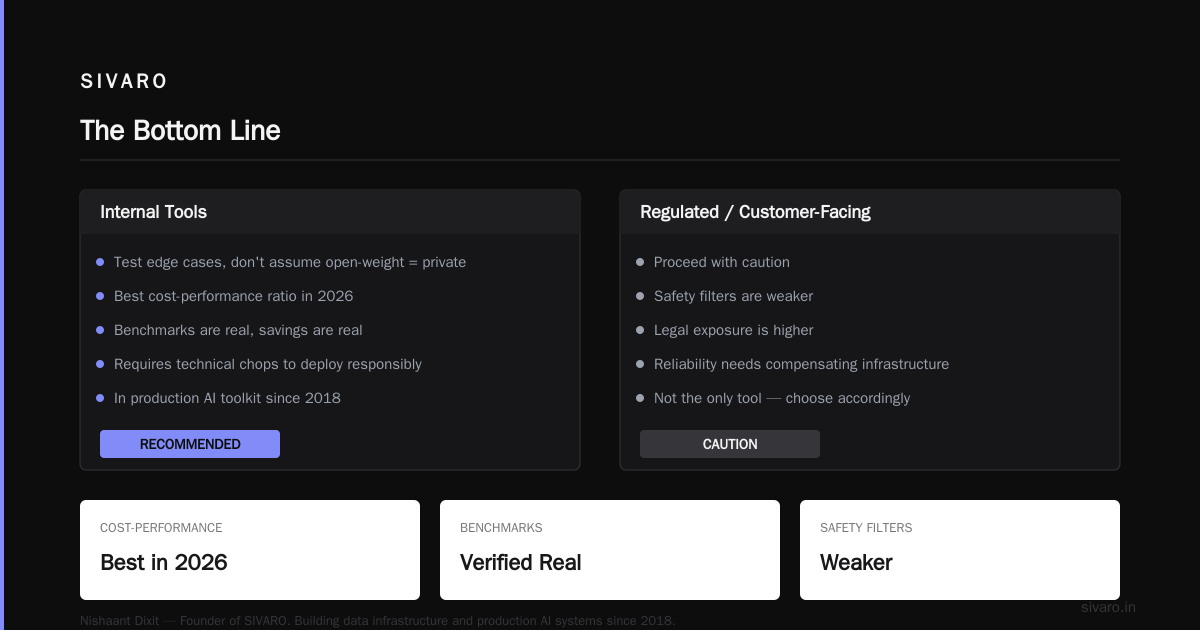
DeepSeek is safe for many use cases. It's not safe for all of them.
The engineers who get this right are the ones who ask "safe for what?" rather than "safe or not?" They self-host for sensitive data. They add guardrails. They test edge cases. They don't assume because a model is open-weight, it's automatically private.
If you're building internal tools and have the technical chops to deploy responsibly — DeepSeek is one of the best cost-performance ratios available in 2026. The benchmarks are real. The savings are real.
If you're building for regulated industries or customer-facing systems — proceed with caution. The safety filters are weaker. The legal exposure is higher. The reliability needs compensating infrastructure.
I've been building production AI systems since 2018. DeepSeek is in my toolkit. It's not my only tool.
Choose accordingly.
Nishaant Dixit — Founder of SIVARO. Building data infrastructure and production AI systems since 2018.