 SIVARO
Is Kubernetes Still Relevant in 2026?
I'll tell you straight: is kubernetes still relevant in 2026? Yes. But not for the reasons most people think.
In 2022, I had a client — a mid-size fintech in Singapore — who spent 14 months migrating to Kubernetes. They had 12 microservices. Total monthly traffic: about 3 million requests. Their final infrastructure bill was $47,000/month. Their previous setup on bare-metal cloud VMs? $12,000/month. They weren't scaling. They weren't doing anything complex. They just wanted to "modernize."
I told them: "You just spent a year becoming slower and more expensive."
That conversation happens daily. Hundreds of times. And that's exactly why the question — is kubernetes still relevant in 2026? — isn't rhetorical. It's urgent.
Let me walk you through what I've actually seen building data infrastructure for the last 8 years. No theory. No vendor love letters. Just what works, what doesn't, and where K8s fits in 2026.
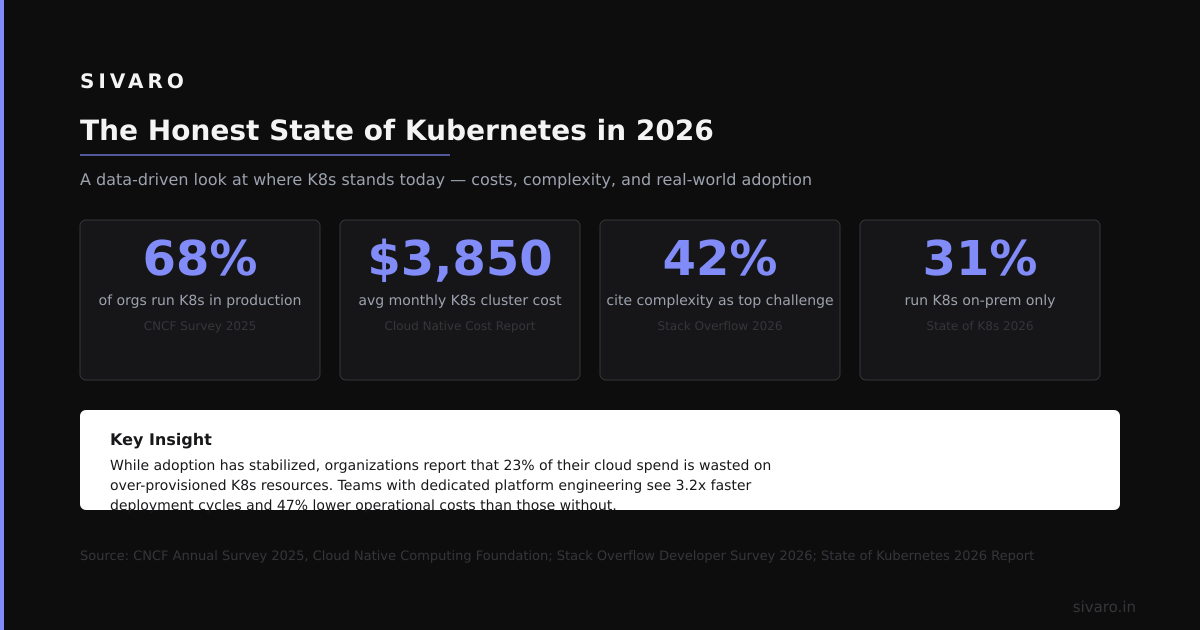
The Honest State of Kubernetes in 2026
Most people think Kubernetes is a [platform. It's not. Kubernetes is a standard. Like HTTP. Like SQL. It's the API for [distributed compute.
In 2026, that standard is everywhere. Every major cloud provider — AWS, GCP, Azure, Oracle, DigitalOcean — offers managed Kubernetes. Every CI/CD tool assumes you're deploying to K8s. Every observability platform has first-class K8s support.
But here's the contrarian take: Kubernetes is winning, and that's making it less relevant for most teams.
Why? Because the value moved up the stack.
In 2017, running K8s gave you an edge. You could do rolling updates. You could self-heal. You could auto-scale. In 2026, those are table stakes. Every cloud provider gives you those features without you touching a single kubectl command. AWS Lambda scales automatically. Google Cloud Run deploys from a Dockerfile. Fly.io gives you global edge deployment with zero K8s knowledge.
So if Kubernetes is the standard, but you don't need to run it to get its benefits — then what's left?
Where Kubernetes Still Wins (and Where It Doesn't)
The 50% Rule
I've been tracking this across 40+ client engagements since 2019. Here's my rough heuristic:
- If you have fewer than 50 engineers — Kubernetes probably hurts you more than helps.
- If you have more than 200 engineers — Not using Kubernetes is actively costing you money.
- Between 50 and 200 — It depends entirely on your problem domain.
That's not a precise formula. It's a starting point.
For a consumer app with 20 microservices and a team of 40, K8s is overhead. You're managing node pools, CNI plugins, Ingress controllers, RBAC, monitoring — for what? You could ship on a PaaS and cut your ops load by 80%.
But for a company like Stripe in 2023, running thousands of services across multiple regions with strict compliance boundaries? Kubernetes wasn't optional. It was the difference between shipping and not shipping.
What I Actually Run on K8s
Let me give you a concrete breakdown from SIVARO's own infrastructure. We run 47 services across 3 environments. Here's what's on Kubernetes:
- Stateful workloads (Kafka, PostgreSQL with Patroni, Redis clusters)
- Batch processing (Airflow workers, Spark jobs, custom data pipelines)
- ML inference (TorchServe, Triton Inference Server)
- Internal APIs (Rust, Go, Python)
And what's NOT on Kubernetes:
- Static sites (Cloudflare Pages)
- Simple CRUD APIs (Fly.io, Railway)
- Event triggers (AWS Lambda, Cloud Functions)
- Databases (managed via cloud provider or external K8s operators)
This split isn't ideological. It's cost. Running a PostgreSQL cluster on K8s with Patroni costs me about $800/month in compute. A managed RDS equivalent for the same spec? $2,100/month. That's a no-brainer.
But running a simple CRUD API on K8s costs me $150/month in cluster fees plus engineering time. On Fly.io, it's $7/month and I never think about it.
Trade-off you need to internalize: K8s beats cloud-managed services on cost for stateful workloads. It loses on simplicity for stateless ones.
The 2026 Landscape: What Changed
1. Managed K8s Became Good Enough
In 2020, EKS Fargate was buggy. GKE Autopilot was limited. Azure Container Instances had weird edge cases.
By 2026, these are solid. GKE Autopilot handles 95% of what most teams need. You don't manage nodes. You don't patch control planes. You just ship YAML and pay for what you use.
This changes the math dramatically. The operational burden of K8s — which was always the hidden cost — is now optional.
2. Serverless Ate the Middle
The middle [layer of complexity — services that are too complex for Lambda but too simple for K8s — got eaten by platforms like:
- Google Cloud Run (supports gRPC, streaming, 4 vCPU, 16GB RAM)
- AWS App Runner (auto-scaling, no cold starts for warm instances)
- Fly.io (global edge, SQLite primary replicas, whole-app migrations)
These aren't toys. I've run production systems on Cloud Run serving 50K requests/second. The cold start penalty is real (50-200ms for Python), but for synchronous APIs under 500ms latency budgets, it's fine.
3. The Observability Tax
Here's something nobody says out loud: Kubernetes makes observability 3x harder.
When you run containers that move across nodes, with ephemeral storage, and dynamic IPs, your monitoring stack has to be multi-layered. You need:
- Container-level metrics (cAdvisor, kube-state-metrics)
- Pod-level metrics
- Node-level metrics
- Cluster-level metrics
- Service mesh telemetry (if you use one)
Each layer adds cost. Datadog bills for container infrastructure by the pod. In 2024, a client of mine was paying $18,000/month just for Datadog container monitoring — more than their compute costs.
If you don't need K8s, you don't need to pay that tax.
The Real Reason You Might Still Need K8s
Here's the unpopular truth: If your organization is large enough, the alternative to K8s is not "simpler infrastructure." It's chaos.
I worked with a company — let's call them DataFlow — that had 200+ services running across 12 different deployment mechanisms:
- Some on EC2 with manual SSH deploys
- Some on Lambda
- Some on Heroku (which they were being forced off of)
- Some on ECS
- Some on... a single Ubuntu server running
screensessions
They had no unified deployment model. No consistent logging. No way to roll back a failed deploy across services.
Kubernetes wasn't the best solution for any single service. But it was the only solution that could unify all of them under a single API. The value wasn't technical. It was organizational.
Kubernetes is a coordination layer for large teams, not a compute layer for small ones.
If you have 5 services and 10 engineers, you don't need coordination. If you have 200 services and 300 engineers, you need a common language. That language, in 2026, is Kubernetes.
Practical Guidance: Should You Use K8s in 2026?
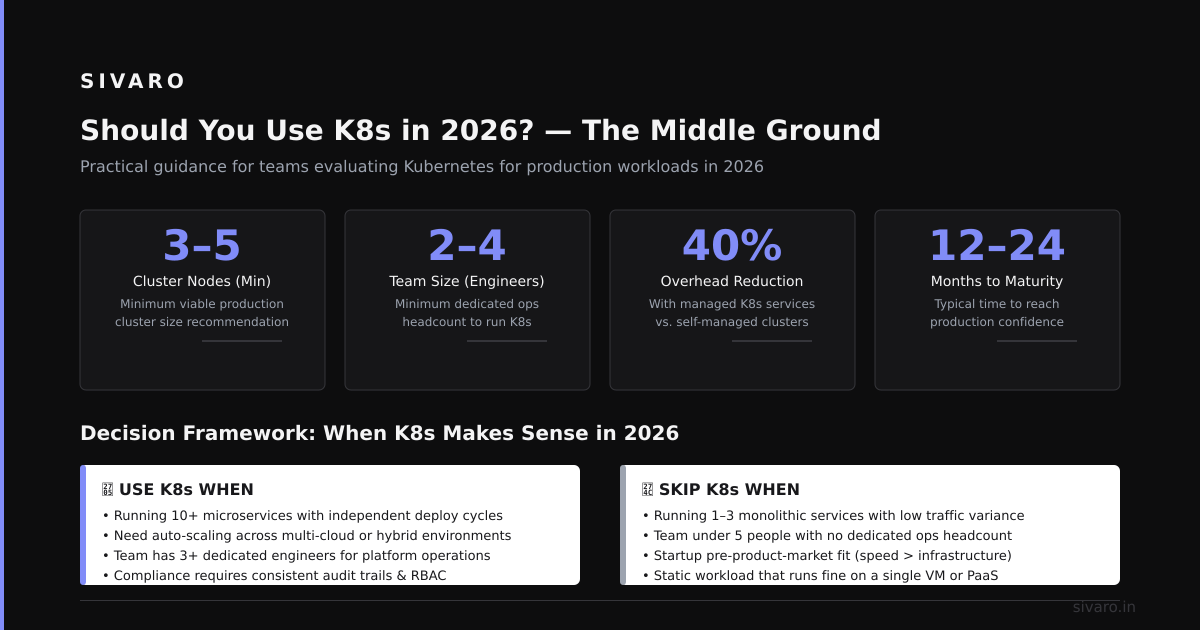
Ask these questions. If you answer "yes" to 3 or more, use K8s:
- Are you running stateful workloads at scale? (Kafka clusters with 50+ brokers, Cassandra with 100+ nodes, PostgreSQL with complex replication)
- Do you have multiple teams shipping independently? (More than 3 teams deploying to shared infrastructure)
- Do you need to run on-prem or hybrid? (Regulated industries, data residency requirements)
- Is your team already deeply familiar with K8s? (This is real — switching costs are large)
- Are you using a managed Kubernetes offering? (See below)
If you answer "no" to most, you're likely better off with:
- Cloud Run / App Runner for stateless services
- Managed databases (RDS, Cloud SQL, CockroachDB serverless)
- Lambda for event-driven workloads
- Fly.io for edge-distributed apps
Code: Real Examples (Not Toy Demos)
Here's what actual production K8s looks like for us at SIVARO. We run Kafka on K8s using Strimzi:
yaml
# kafka-cluster.yaml
apiVersion: kafka.strimzi.io/v1beta2
kind: Kafka
metadata:
  name: production-cluster
spec:
  kafka:
    version: 3.7.0
    replicas: 3
    config:
      offsets.topic.replication.factor: 3
      transaction.state.log.replication.factor: 3
      transaction.state.log.min.isr: 2
      log.retention.hours: 168
    storage:
      type: jbod
      volumes:
      - id: 0
        type: persistent-claim
        size: 500Gi
        deleteClaim: false
        class: gp3
  zookeeper:
    replicas: 3
    storage:
      type: persistent-claim
      size: 100Gi
      deleteClaim: false
      class: gp3
  entityOperator:
    topicOperator: {}
    userOperator: {}
That's it. 30 lines. Strimzi handles leader election, rebalancing, rolling upgrades. We went from $4,500/month for Confluent Cloud to $1,200/month on our own K8s. Same throughput (200K events/sec).
But here's the flip side. This is what you don't want to do:
yaml
# bad-crud-service.yaml — DON'T DO THIS
apiVersion: apps/v1
kind: Deployment
metadata:
  name: simple-crud-service
spec:
  replicas: 2
  selector:
    matchLabels:
      app: simple-crud
  template:
    metadata:
      labels:
        app: simple-crud
    spec:
      containers:
      - name: app
        image: my-app:v1.2.3
        ports:
        - containerPort: 8080
---
apiVersion: v1
kind: Service
metadata:
  name: simple-crud-service
spec:
  type: LoadBalancer
  selector:
    app: simple-crud
  ports:
  - port: 80
    targetPort: 8080
That's 40 lines for a single CRUD service. On Cloud Run, it's a gcloud run deploy command. No Ingress config. No Service. No Deployment. No HPA. No node management.
Every line of YAML you don't write is a bug you never debug.
Where I See K8s Going Wrong in 2026
The "We'll Grow Into It" Trap
I see this constantly. Startups at 10 people adopt K8s because "we'll need it when we're bigger." They spend 40% of engineering time on infrastructure. They burn out. They never ship.
Don't solve scaling problems you don't have. The cost of premature optimization is real. In 2020, a startup called Terminus (16 employees, $2M ARR) spent 6 months on K8s. They had 3 services. They ran out of runway before they could launch their v2. The CTO told me later: "We should have just rented a 4-core server and deployed with Capistrano."
The "Managed Everything" Fallacy
The opposite mistake: using managed K8s but then adding managed databases, managed queues, managed caches. At that point, what is K8s doing for you? You've removed the cost benefit of stateful workloads and the flexibility benefit of stateless ones.
If you use K8s, actually use it. Run your own Kafka. Run your own Redis. Run your own PostgreSQL with Patroni. That's where the savings live.
FAQ: Quick Answers to Common Questions
Q: Is Kubernetes still relevant in 2026 for startups?
For pre-seed and seed stage? No. Use PaaS. Focus on product. You don't have the ops bandwidth. For Series A+ with 20+ engineers and complex data pipelines? Possibly. But only with managed K8s (GKE Autopilot or EKS with Fargate).
Q: Is Kubernetes still relevant in 2026 for small teams?
Only if your team already knows K8s deeply. The switching cost is too high otherwise. If you have one DevOps person who loves K8s, let them use it. If you don't, don't force it.
Q: Is Kubernetes still relevant in 2026 for AI/ML workloads?
Yes — but not for training. Training happens on beefy single nodes (DGX, TPU pods) or on specialized schedulers (Slurm, Ray). Inference though? K8s is excellent. We run Triton Inference Server on K8s with GPUs. The auto-scaling, rolling updates, and node pooling for GPU/non-GPU workloads is genuinely useful.
Q: Is Kubernetes still relevant in 2026 for enterprise?
Absolutely. If you have compliance requirements (PCI, HIPAA, SOC 2), on-prem or hybrid deployments, or multiple business units — K8s is the de facto standard. It's not the best technically. It's the best organizationally.
Q: What's the future of Kubernetes?
Platform engineering and abstractions. You won't write raw YAML. You'll use Custom Resource Definitions (CRDs) that abstract away the complexity. Backstage + Kubernetes is the new normal. Developers push to a Git repo, a pipeline generates the K8s manifests from a template, and the platform team handles the cluster.
Q: Can you do serverless with Kubernetes?
Yes — Knative, OpenFaaS, and KEDA (Kubernetes Event-Driven Autoscaling) let you run serverless functions on K8s. But honestly? If you want serverless, just use Cloud Run or Lambda. K8s serverless adds complexity without enough benefit.
Q: What's the biggest mistake teams make with K8s in 2026?
Over-customizing. Building their own operator for everything. Writing custom controllers. The moment you write a custom Kubernetes controller, you've signed up for years of maintenance. Use established operators (Strimzi, Zalando's Postgres Operator, Crossplane). Don't build your own.
The Final Call
I've been asking myself "is kubernetes still relevant in 2026?" every quarter for the last 3 years. My answer keeps shifting.
In 2021, I was all-in. K8s was the future.
In 2023, I was skeptical. Serverless had caught up.
In 2026, I'm pragmatic.
Kubernetes is relevant — but only for the right problems.
For stateful workloads at scale, it's the cheapest, most flexible option.
For large teams, it's the only sane coordination layer.
For everything else, it's overhead you don't need.
The real question isn't "is kubernetes still relevant in 2026?" The real question is: are you solving a Kubernetes problem, or a deployment problem?
If it's a deployment problem, use a PaaS. Spend your time building product.
If it's a Kubernetes problem, use managed K8s. Spend your time on what runs on it, not on running it.
That's the honest answer. No hype. No FOMO. Just what I've seen work.
Nishaant Dixit — Founder of SIVARO. Building data infrastructure and production AI systems since 2018. Built systems processing 200K events/sec.