
Is Microsoft 365 and Azure the Same? A Practitioner's Guide to Microsoft's Twin Giants
I can't tell you how many times I've sat across from a founder or CTO who asked me this exact question. Usually after their third espresso. Usually after someone in their org pitched a "cloud migration" that somehow merged their Office licensing with their Kubernetes cluster costs on the same invoice.
No. They are not the same. But the confusion isn't stupid.
Microsoft 365 and Azure share a parent company, a login portal, and a billing relationship that gets more tangled every quarter. But they serve fundamentally different jobs. One is your office. The other is your factory floor.
Let me walk you through what I've learned running SIVARO, building data infrastructure that touches both products daily. I'll give you the honest distinction, the overlap zone where things get muddy, and the practical decision framework I use with clients.
The Elevator Answer
Microsoft 365 is a productivity suite. It's Outlook, Word, Excel, Teams, SharePoint, and that license you pay per user per month so your marketing team can edit the same deck without emailing 14 versions.
Azure is a cloud computing platform. It's virtual machines, databases, AI services, Kubernetes, and the infrastructure that runs a good chunk of the internet's backend. You pay for what you consume — compute hours, storage GB, API calls.
One is a subscription for software. The other is infrastructure you build on top of.
But if it were that simple, nobody would ask the question.
Why Everyone Gets This Wrong
Microsoft's branding doesn't help.
Both products show up in the Azure portal. Both use the same Microsoft account. Both have "365" in some Azure product names (Azure 365? No. But Azure AD is now Entra ID. And Microsoft 365 uses Azure AD. See what I mean?).
I've seen companies with 50 employees pay for Azure credits they never used because someone clicked "enable" during Teams setup. I've seen engineering teams provision Azure resources under their M365 tenant and then wonder why their DevOps guy can't spin up a VM.
At first I thought this was a branding problem — turns out it was pricing.
The Core Distinction: What Each Product Actually Does
Microsoft 365: The Productivity Layer
Microsoft 365 is what happens when Office 365 met Windows 10 licensing and had a baby with enterprise mobility management. It covers:
- Office applications: Word, Excel, PowerPoint, Outlook
- Communication: Teams, Exchange Online, Yammer (still exists, apparently)
- Storage: OneDrive, SharePoint Online
- Security: Microsoft Defender for Office 365, Entra ID (formerly Azure AD)
- Device management: Intune, Autopilot
You pay per user. Monthly or annual. A typical plan runs $12–$57/user/month depending on features.
Azure: The Infrastructure Layer
Azure is Microsoft's answer to AWS and Google Cloud. It covers:
- Compute: Virtual machines, containers, serverless functions
- Storage: Blob storage, disks, data lakes
- Databases: SQL Database, Cosmos DB, PostgreSQL
- AI/ML: Azure OpenAI Service, Cognitive Services, Machine Learning
- Networking: Virtual networks, load balancers, VPN gateways
- DevOps: Azure DevOps, GitHub Actions integration
You pay as you go. Per hour, per GB, per API call. A single VM can run you $50/month. A production AI inference cluster can run $50,000/month.
The Overlap Zone: Where Things Get Confusing
Here's where the question "is microsoft 365 and azure the same?" actually becomes interesting. Because there's a gray zone where both products touch the same problem.
Identity: The Biggest Offender
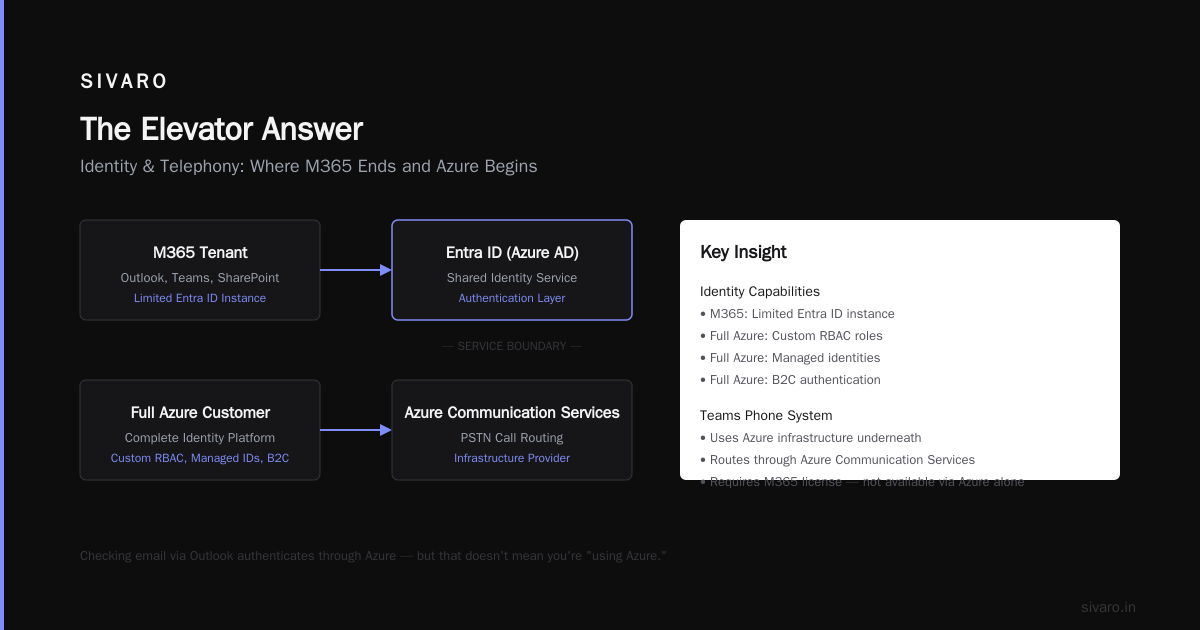
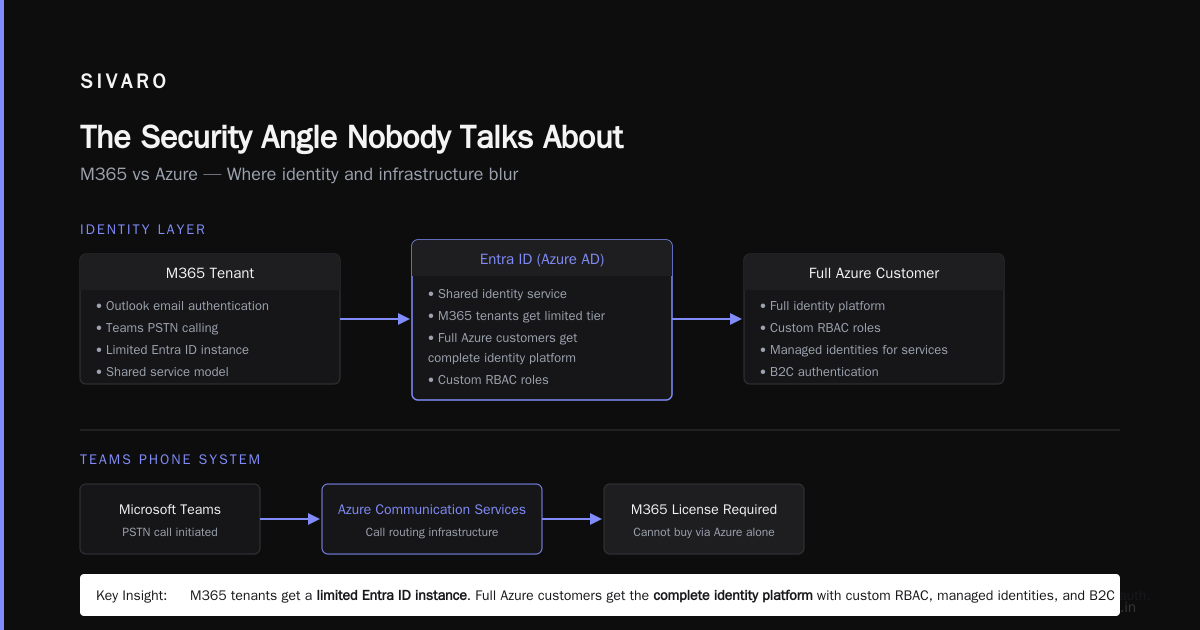
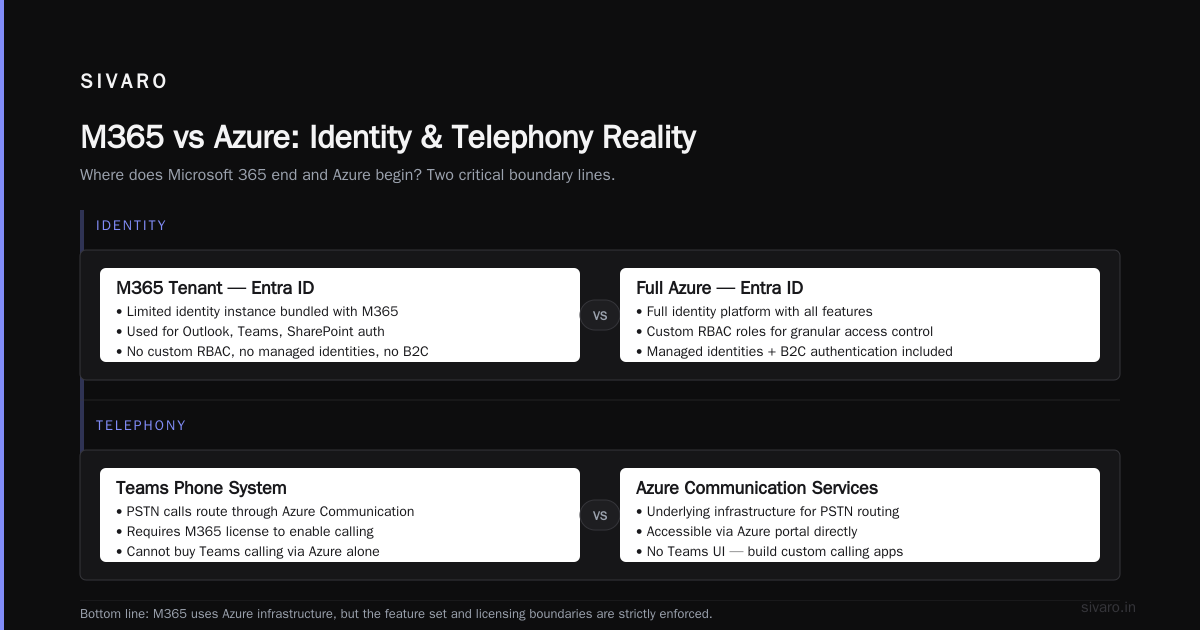
Microsoft 365 uses Azure Active Directory (now Entra ID) for authentication. So when you log into Outlook, you're technically authenticating through an Azure service. This leads people to think they're "using Azure" when they're just checking email.
The reality: Entra ID is a shared service. But M365 tenants get a limited Entra ID instance. Full Azure customers get the full identity platform. The difference matters when you need custom RBAC roles, managed identities for services, or B2C authentication.
Teams Phone System
Microsoft Teams calling uses Azure infrastructure underneath. When you make a PSTN call, it routes through Azure Communication Services. But you can't buy Teams calling through Azure alone — you need the M365 license.
I had a client try to build a call center on pure Azure because they thought "it's all the same platform." They spent three weeks fighting licensing before calling me.
SharePoint vs. Azure Blob Storage
Both offer file storage. Both integrate with Microsoft's ecosystem. But they're built for different jobs:
- SharePoint: Document collaboration, version history, metadata, search, compliance
- Azure Blob: High-throughput storage for applications, data lakes, backups, media
If you're storing engineering build artifacts, use Blob. If you're storing legal contracts that need approval workflows, use SharePoint. Mixing them up causes real pain.
The Pricing Trap: Why Your Azure Bill Explodes
Here's the contrarian take that costs companies real money.
Most people think Microsoft 365 is the expensive one because it's a predictable per-user fee. Azure looks cheap because you only pay for what you use.
They're wrong.
I've seen a mid-size company (about 200 employees) run up a $47,000 Azure bill in one month because someone left a GPU VM running over a long weekend. That same company's entire M365 bill was $8,400/month.
Azure's consumption model scales differently. And it scales without warning.
The trick isn't choosing one over the other. It's understanding that these are fundamentally different economic models:
- M365: Fixed cost, scales with headcount
- Azure: Variable cost, scales with usage
You optimize them differently. You budget for them differently. You shouldn't even put them on the same dashboard.
When You Actually Need Both
Most organizations need both. Here's the pattern I see working well:
Use Microsoft 365 for:
- Internal communication
- Document management
- Email and calendaring
- Device management
- Identity (as your source of truth)
Use Azure for:
- Application hosting
- Data pipelines
- AI workloads
- Database services
- Anything that needs to scale independently of headcount
The integration point is identity. Once you set up Entra ID sync properly, your M365 users can authenticate against Azure services without a second login. That's where the "same platform" story actually delivers value.
How This Compares to Other Cloud Providers
People who ask "is microsoft 365 and azure the same?" often also ask is gcp the same as google cloud? That one's easier: yes, Google Cloud Platform is Google Cloud. But Workspace (Gmail, Docs, Drive) is separate — similar to the M365/Azure split.
And who is aws' biggest competitor? In pure infrastructure, it's still AWS vs Azure vs GCP. But if you count the office productivity angle, Microsoft has a moat AWS can't touch. Nobody builds a $10M data pipeline because they like PowerPoint. But plenty of companies choose Azure because they're already on M365 and the single sign-on is easier.
The Security Angle Nobody Talks About
Most security discussions focus on M365 vs Azure separately. That's a mistake.
The July 2026 research on AirDrop and Quick Share vulnerabilities (Over 5 Billion iPhones And Android Devices Are Vulnerable, Systematic Vulnerability Research in the Apple AirDrop) shows something relevant: proximity-based transfer protocols have systemic flaws that affect billions of devices. The same principle applies to Microsoft's ecosystem.
When you've got M365 data syncing to SharePoint, SharePoint syncing to OneDrive on Azure storage, and Azure AD authenticating everyone — you've created a trust chain. A vulnerability in one link compromises everything.
Multiple vulnerabilities were found in Apple AirDrop and Android Quick Share (Multiple Vulnerabilities Found in Apple AirDrop and) precisely because the protocols weren't designed with unified security models. Microsoft faces the same risk when M365 and Azure share authentication tokens but enforce policies differently.
The fix: don't assume consistent security across both platforms. Audit M365 and Azure security separately. Then audit the integration points.
Real Example: SIVARO's Setup
Since I keep talking abstractly, let me show you what we actually run at SIVARO.
yaml
# Our infrastructure decision matrix
services:
  - name: "Internal Email & Docs"
    platform: "Microsoft 365 Business Premium"
    cost_model: "Per user ($23/user/month)"
    notes: "Non-negotiable for compliance"

  - name: "CI/CD Pipeline"
    platform: "Azure DevOps + GitHub"
    cost_model: "Per pipeline minute"
    notes: "M365 integration with Entra ID"

  - name: "Production AI Inference"
    platform: "Azure Kubernetes Service"
    cost_model: "Per vCPU hour"
    notes: "GPU nodes scale to zero at night"

  - name: "Customer Data Lake"
    platform: "Azure Data Lake Storage Gen2"
    cost_model: "Per TB stored + per GB read"
    notes: "Separate subscription from M365"
Notice the last line: separate subscription. This is crucial. If you put M365 and Azure resources in the same subscription, your M365 admins accidentally get Azure permissions. We've seen this cause data leaks.
Practical Decision Framework
When a client asks me "is microsoft 365 and azure the same?", I walk them through this:
Question 1: What are you building?
- If you're writing documents, scheduling meetings, managing users → M365
- If you're writing code, running databases, deploying models → Azure
Question 2: Who pays the bill?
- M365: Usually the COO or CFO
- Azure: Usually the CTO or VP Engineering
Question 3: What's the scaling unit?
- M365: Scales per employee added
- Azure: Scales per request processed
Question 4: Do you need integration?
- Yes: Use Entra ID as the bridge
- No: Keep them completely separate
The Billing Nightmare (and How to Fix It)
Here's a piece of code I wrote for a client to tag their Azure resources clearly:
python
#!/usr/bin/env python3
"""
Azure cost tagging script for M365 vs Infrastructure separation.
Run weekly to catch mis-tagged resources.
"""

import subprocess
import json

def get_untagged_resources():
    cmd = [
        "az", "resource", "list",
        "--query", "[?tags.environment == null || tags.cost_center == null]",
        "--output", "json"
    ]
    result = subprocess.run(cmd, capture_output=True, text=True)
    resources = json.loads(result.stdout)
    return resources

def generate_separate_billing_reports():
    """
    Generate two reports: one for M365-adjacent costs,
    one for pure infrastructure costs.
    """
    # Azure consumption
    consumption = {
        "m365_adjacent": ["Entra ID P1/P2", "Azure Communication Services"],
        "infrastructure": ["Virtual Machines", "Kubernetes", "Storage"]
    }
    return consumption

if __name__ == "__main__":
    untagged = get_untagged_resources()
    if untagged:
        print(f"Found {len(untagged)} untagged resources. Apply tags now.")
    else:
        print("Clean. All resources tagged.")
Without this tagging, your M365 and Azure costs look identical on the invoice. You can't tell if that $12K spike is from someone running heavy Teams meetings or a runaway data pipeline.
The Future: Convergence or Divergence?
Microsoft keeps pushing these products closer together. Copilot for Microsoft 365 now uses Azure OpenAI under the hood. Azure DevOps integrates with Teams. SharePoint uses Azure Search.
But they're not merging. The economics are too different.
What I expect by 2027:
- More AI features that span both products (Copilot everywhere)
- Better billing unification (one dashboard, two cost models)
- Tighter security integration (unified threat detection)
- Still separate compute and productivity layers
The question "is microsoft 365 and azure the same?" will persist because Microsoft wants the confusion. It helps them sell more Azure by making M365 customers feel like they're "already in the ecosystem."
FAQ
Q: Can I use Microsoft 365 without Azure?
Yes. Millions of companies do. You get Entra ID included, but you don't need to provision any Azure services.
Q: Can I use Azure without Microsoft 365?
Yes. Many Azure customers use Gmail or on-prem Exchange for email. You lose some integration but gain flexibility.
Q: Does buying M365 give me free Azure credits?
No. Some plans include a small amount of Azure AD features, but not compute credits. You pay separately for both.
Q: Do M365 and Azure use the same login?
Same Microsoft account, same Entra ID tenant. But permissions are separate — M365 admin doesn't mean Azure admin.
Q: Which is better for startups?
Start with M365 for internal tools. Add Azure when you need to build infrastructure. Don't start with both.
Q: How do I audit if my M365 and Azure are properly separated?
Check your Azure subscription's RBAC assignments. Make sure M365 admins don't have Owner or Contributor roles in Azure.
Q: Is GCP the same as Google Cloud?
Yes. GCP = Google Cloud Platform. But Google Workspace is separate — similar to M365 vs Azure.
Q: Who is AWS' biggest competitor?
Azure, by revenue. GCP is growing but still behind. The gap is smaller in AI workloads thanks to OpenAI's Azure exclusivity.
Bottom Line
Is Microsoft 365 and Azure the same? No. They're siblings with different jobs, different bills, and different owners in most organizations.
But treating them as completely separate is also wrong. The identity integration, the security overlap, and the growing AI features mean you need to understand both to use either well.
Here's my rule: if someone in your company is editing a document, you're in M365 territory. If someone is deploying code, you're in Azure territory. If both are happening, you need someone who understands the boundary line.
At SIVARO, we draw that line clearly. And we sleep better at night.
Nishaant Dixit — Founder of SIVARO. Building data infrastructure and production AI systems since 2018. Built systems processing 200K events/sec.