 SIVARO
Is Platform Engineer the Same as DevOps?
I remember the exact moment I stopped caring about the title.
- I'm at a conference in Bangalore. A guy walks up to me, says he's a "Platform Engineer." I ask what that means. He tells me he builds internal tools for developers. I ask if that's DevOps. He gets defensive.
"No. DevOps is dead."
I laughed. But I also started watching the job boards. And here's what I found: the question "is platform engineer the same as devops?" isn't a trivial semantic debate. It's a signal that something broke in how we build [software.
Let me be direct about what I've seen operating SIVARO since 2018, working with teams processing 200K events/sec, building data infrastructure and [production AI systems. The answer isn't clean. But the practical distinction matters more than most people [think.
You need](/articles/what-is-an-example-of-a2a-the-practical-guide-you-need) to understand this because the wrong title on a hire will cost you months of friction. I've watched it happen.
What DevOps Actually Was (And Why It Cracked)
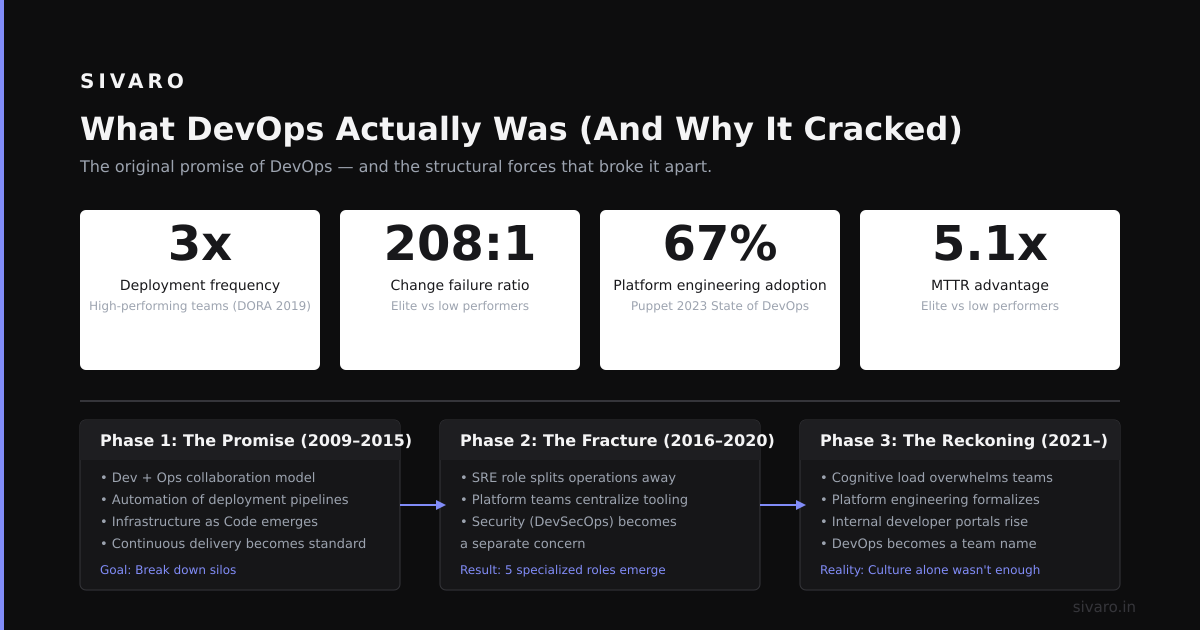
Most people think DevOps is "developers doing operations." That's wrong.
DevOps, when it emerged around 2009-2010, was a cultural movement. It said: the divide between Dev and Ops is stupid. They share the same goal—shipping reliable software—so they should share the same practices. Automate deployments. Monitor production. Use the same [tools.
Patrick](/articles/tokenmaxxing-the-optimization-trick-that-doubles-llm) Debois, John Willis, Andrew Clay Shafer—they weren't proposing a role. They were proposing a philosophy.
But philosophy doesn't fill a req.
Companies in 2014-2017 started hiring "DevOps Engineers." What they meant was: "Someone who can manage our CI/CD pipeline, write Terraform, and fix production issues at 3 AM." That's not a philosophy. That's a job.
And that job became unsustainable.
Because here's the dirty secret: when you hire one DevOps engineer for a team of 15 developers, that person becomes a bottleneck. They own all the "infrastructure stuff." Developers push code over the wall. The DevOps person deploys it. The DevOps person gets paged when it breaks.
That's not DevOps. That's just Ops with a cooler title.
By 2018-2019, burnout was rampant. The DevOps Engineer role had become "the person who is responsible for everything no one else wants to touch." I saw this at multiple client engagements. One team had a single DevOps engineer managing Kubernetes clusters for 40 microservices across 3 environments. He quit. The system didn't survive him.
This is where Platform Engineering emerged.
What Platform Engineering Actually Is
Platform Engineering is the answer to "DevOps failed to scale as a role."
You take the tools, practices, and automation that DevOps should have delivered, and you productize them. You build a platform—an internal developer platform (IDP)—that developers can self-serve on. They don't need to deep-dive Kubernetes configs. They don't need to manually set up CI/CD. The platform handles the boilerplate.
Platform Engineers build the factory. DevOps Engineers used to build each product by hand.
Here's a concrete example from our work at SIVARO.
We had a client—let's call them FinCo—with 8 microservices teams. Each team had their own deployment pipeline. Each team had slightly different Terraform modules. Each team handled secrets differently. The "DevOps Engineer" (one guy) was rebuilding the same patterns 8 times.
We suggested a platform approach. We built:
- A standardized CI/CD pipeline template (one config, parameterized)
- A service catalog with predefined deployment patterns
- Self-service provisioning via a CLI tool
- Centralized monitoring and alerting with team-specific dashboards
The result? The single DevOps engineer became a platform engineer. He stopped doing each team's work. He built the tools so each team could do their own work. The friction dropped by 60% inside two months.
That's the difference. Not the tools. The output.
A DevOps Engineer directly manages infrastructure and deployment pipelines. A Platform Engineer builds the system that allows developers to manage their own infrastructure and deployment pipelines.
Where the Titles Blur (And Why It Matters)
You can't escape the confusion. Look at any job board today. You'll see:
- "Senior DevOps Engineer — must have experience building internal developer platforms"
- "Platform Engineer — will manage Kubernetes, Terraform, CI/CD"
- "DevOps Platform Engineer" (this one makes me laugh — they're admitting they don't know)
The reality is that many companies use the titles interchangeably. And sometimes they mean the same thing. But if you're hiring or choosing a career path, the distinction matters in three concrete ways:
1. Scope of Responsibility
| Dimension | DevOps Engineer | Platform Engineer |
|---|---|---|
| Primary output | Managed infrastructure and deployment pipelines | A product that developers consume |
| Who they serve | The organization's infrastructure | The developers themselves (as internal customers) |
| Success metric | Uptime, deployment frequency, MTTR | Developer productivity, adoption rate of platform |
| Day-to-day | Fixing production issues, writing configs | Building abstractions, designing APIs, gathering feedback |
2. The Cognitive Load Shift
A DevOps Engineer carries the cognitive load of all infrastructure decisions. A Platform Engineer offloads cognitive load from developers onto themselves and then into code.
This is subtle but critical.
When I'm building a platform, I'm constantly asking: "What decisions do I need to abstract away so a developer doesn't have to make them?" Sometimes that means providing sane defaults. Sometimes it means enforcing guardrails. Sometimes it means saying no.
At SIVARO, we built a deployment platform for a client in early 2023. The developers wanted full access to Kubernetes namespaces. We said no. We gave them a deploy CLI command that handled everything—build, push, deploy, rollback. They didn't need to touch YAML. They didn't need to understand Ingress controllers.
One developer complained. I asked him: "Do you want to debug why your pod can't resolve DNS at 2 AM, or do you want to ship features?" He chose features.
Platform Engineering is about making hard choices on behalf of developers. DevOps was about giving developers the tools to make those choices themselves. The tension between those two philosophies is why the question "is platform engineer the same as devops?" still sparks debates.
3. Required Skills Overlap (But Differ)
Both roles require:
- Container orchestration (Kubernetes, Docker)
- Infrastructure as Code (Terraform, Pulumi, CloudFormation)
- CI/CD tooling (GitHub Actions, GitLab CI, Jenkins)
- Observability (Prometheus, Grafana, Datadog)
- Scripting (Python, Go, Bash)
But Platform Engineering adds:
- Product management skills (you're building a product for internal users)
- API design (your platform exposes an API, not just CLI commands)
- Developer experience (DX) thinking (every config knob is a failure of abstraction)
- UI/CLI design (if your platform has a user interface, you need to think about it)
A DevOps Engineer might write a Terraform module for a specific service. A Platform Engineer writes the Terraform generator that creates modules for all services.
The Legacy Trap: When "Platform" Is Just New Labeling
I need to be blunt here.
Most companies that hire "Platform Engineers" are just renaming their DevOps role.
They haven't changed the work. They haven't built an internal developer platform. They haven't shifted the responsibility model. They just changed the job title because "Platform Engineer" sounds more modern and commands a higher salary.
I've seen this at three different organizations in the last two years. One was a Series B startup in 2022. They hired a "Lead Platform Engineer." Within a month, she realized she was just the old DevOps person with a new title—still manually managing deployments for 15 services, still the sole point of failure. She quit after 6 months.
Don't do this. It's dishonest, and it fails.
If you're building an organization, ask yourself: Are you creating leverage, or are you creating a bottleneck?
A genuine platform role creates leverage. One person builds a system that 50 developers consume. That's 50x leverage. A fake platform role is just a DevOps role with better branding. One person directly manages infrastructure for 50 developers. That's 1x leverage with more meetings.
When You Need DevOps vs. When You Need Platform
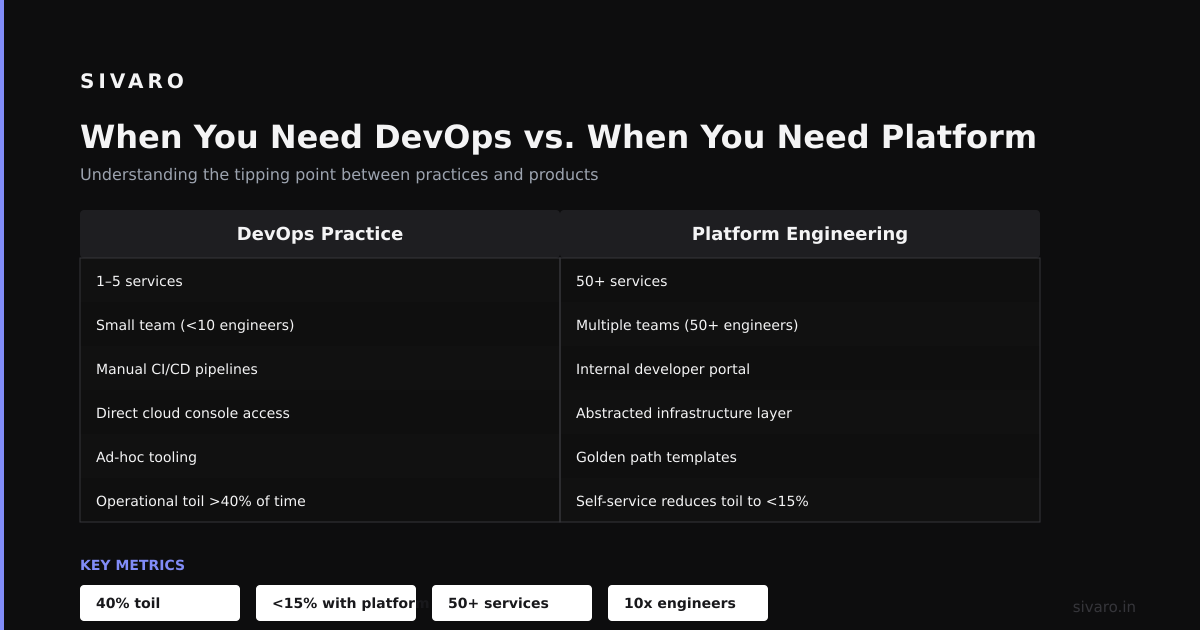
This is the practical part.
You need DevOps when:
- Your team is small (<15 engineers). You don't have scale to justify a platform.
- Your infrastructure is simple. A single deployment pipeline works.
- You're still exploring tech choices. A platform would lock you in prematurely.
- You don't have the budget for two roles (platform engineer + platform software engineer).
Real talk: At SIVARO, for our internal projects with teams under 10, I don't push for a separate platform role. We have one person who handles infrastructure, and we keep it simple. Kubernetes managed by a single Helm chart. CI/CD in a single GitHub Actions workflow. It's not elegant. It works.
You need Platform when:
- Your team is growing (>25 engineers). The DevOps person becomes a bottleneck.
- You have multiple product teams with different needs.
- You're seeing "deployment drift" — each team's setup is slightly different.
- Your DevOps person is asking for more headcount just to keep up.
I saw the inflection point clearly at a company called BuildTech in 2022. They had 12 engineers, one DevOps guy, things worked. Then they hired 20 more engineers in 6 months. The DevOps guy went from managing 4 services to 22 services in 90 days. He burned out. They tried to hire another DevOps person. Found nobody qualified. Finally, they restructured around a platform team — 2 engineers building abstractions, the rest of the engineering org using those abstractions.
That's when it clicked for me. Platform engineering isn't a replacement for DevOps. It's what DevOps becomes when it hits scale.
Code Example: The Shift in Practice
Let me show you the difference with code. Here's a typical DevOps terraform snippet for setting up an ECS service:
hcl
resource "aws_ecs_service" "my_service" {
  name            = "my-service-production"
  cluster         = aws_ecs_cluster.main.id
  task_definition = aws_ecs_task_definition.my_task.arn
  desired_count   = 3

  network_configuration {
    subnets         = ["subnet-xxx", "subnet-yyy"]
    security_groups = [aws_security_group.my_sg.id]
  }
}
That's direct. It manages one specific service. Good for a DevOps role on a small team.
Now here's the platform engineering approach — a module that generates that config based on metadata:
hcl
# platform/templates/service/main.tf
variable "service_name" { type = string }
variable "environment" { type = string }

resource "aws_ecs_service" "this" {
  name            = "${var.service_name}-${var.environment}"
  cluster         = var.cluster_arn
  task_definition = aws_ecs_task_definition.this.arn
  desired_count   = var.environment == "production" ? 3 : 1

  network_configuration {
    subnets         = var.environment == "production" ? var.private_subnets : var.public_subnets
    security_groups = [aws_security_group.default.id]
  }
}
The platform engineer builds the template once. Then a developer deploys a service with:
bash
platform deploy my-service --env production
The platform handles the rest. The developer never sees the Terraform. Never edits a YAML file. Never thinks about subnets.
That abstraction is the entire point.
What I've Learned Building Data Systems at Scale
We process 200K events/sec on some pipelines. That level of scale forced us to stop pretending.
You can't have a single DevOps person managing infrastructure for that kind of traffic. It's impossible. Every decision—partitioning, replication, retry logic, dead-letter queues—has implications that ripple through the system.
What works for us at SIVARO is a "thin platform" philosophy:
- We abstract the common patterns (deployment, secrets, logging, metrics)
- We expose escape hatches for teams that need custom configurations
- We treat the platform as a product with SLAs, not a project with deadlines
Does that mean we don't need DevOps skills? No. Our platform engineers need deeper DevOps knowledge, not less. They need to understand the underlying systems to build good abstractions. But they don't do the day-to-day operations work—they build the system that does.
The best platform engineers I know were former DevOps engineers who got tired of doing the same thing 20 times.
FAQ
Is platform engineer the same as devops?
No. They're related but different. DevOps is a philosophy and role that directly manages infrastructure and deployment pipelines. Platform engineering builds internal products (platforms) that developers use to self-serve infrastructure and deployment. If your "platform engineer" is still manually managing each team's deployment, you're just using the wrong title.
Can one person do both DevOps and platform engineering?
Yes, at small scales. Under 15 engineers, you can have one senior person wearing both hats. But as the organization grows, these roles diverge because the platform role requires product thinking and abstraction design that doesn't leave room for daily operations firefighting.
Do I need to be a developer to be a platform engineer?
Yes, more than you need to be for DevOps. Platform engineering requires building software—APIs, CLIs, UIs—that other developers consume. You need to think about code quality, testing, versioning, and deprecation. A pure ops background won't prepare you for this.
Is platform engineering killing DevOps?
No. Platform engineering is the natural evolution of DevOps at scale. DevOps gave us the practices. Platform engineering productizes them. The philosophy survives; the role transforms.
What tools do platform engineers use?
Same core tools as DevOps plus: Backstage (for service catalogs), Crossplane (for control plane abstractions), Dagger (for CI/CD as code), and internal CLI tools (often built with Go or Python). The key isn't the tool—it's that the platform engineer builds tools, they don't just use them.
Should I hire a platform engineer or a DevOps engineer?
Depends on your stage. Under 20 engineers? Hire a strong DevOps engineer who can grow into platform thinking. Over 30 engineers? You need a platform engineer who can build abstractions. Between 20-30 is a grey zone—I'd hire for attitude over title, someone who can tell you why they prefer one approach over the other.
What's the biggest mistake companies make with platform engineering?
They build a platform before they understand the problem. I've seen teams spend 6 months building an elaborate internal developer platform that nobody uses because they didn't talk to developers first. Start by being a DevOps engineer. Listen. Automate the painful parts. Then productize those automations. Don't build the golden castle.
The Real Answer
So is platform engineer the same as devops?
No. But it's what DevOps grows up to become.
DevOps was the rebellion against silos. Platform engineering is the institution that rebellion created. The best version of both is when you have people who can do the work of DevOps but think like platform engineers—building systems that multiply impact rather than directly delivering it.
At SIVARO, we don't waste time arguing about titles. We ask: "Are you reducing friction for developers? Are you creating leverage? Are you building something that outlasts you?"
If the answer is yes, I don't care what you call yourself.
Nishaant Dixit — Founder of SIVARO. Building data infrastructure and production AI systems since 2018. Built systems processing 200K events/sec.