 SIVARO

Is Platform Engineer the Same as DevOps? A Practitioner's Guide
You're building a product. You need a cloud infrastructure team. The job postings say "Platform Engineer" and "DevOps Engineer" — sometimes for the same role. Sometimes for different ones. You're not alone in asking: is platform engineer the same as devops?
Let me save you the confusion: No. They're not the same. But the line is blurry enough that most companies treat them interchangeably. That's a mistake — one I've seen cost teams six months of rework.
I run SIVARO, a product engineering shop. We build data infrastructure and production AI systems. We've hired for both roles. We've watched teams fail because they hired a DevOps engineer expecting a platform engineer — and vice versa.
This guide is my honest take on the distinction. Not the LinkedIn hot-take version. The real one.
The Short Answer (Spoiler Alert)
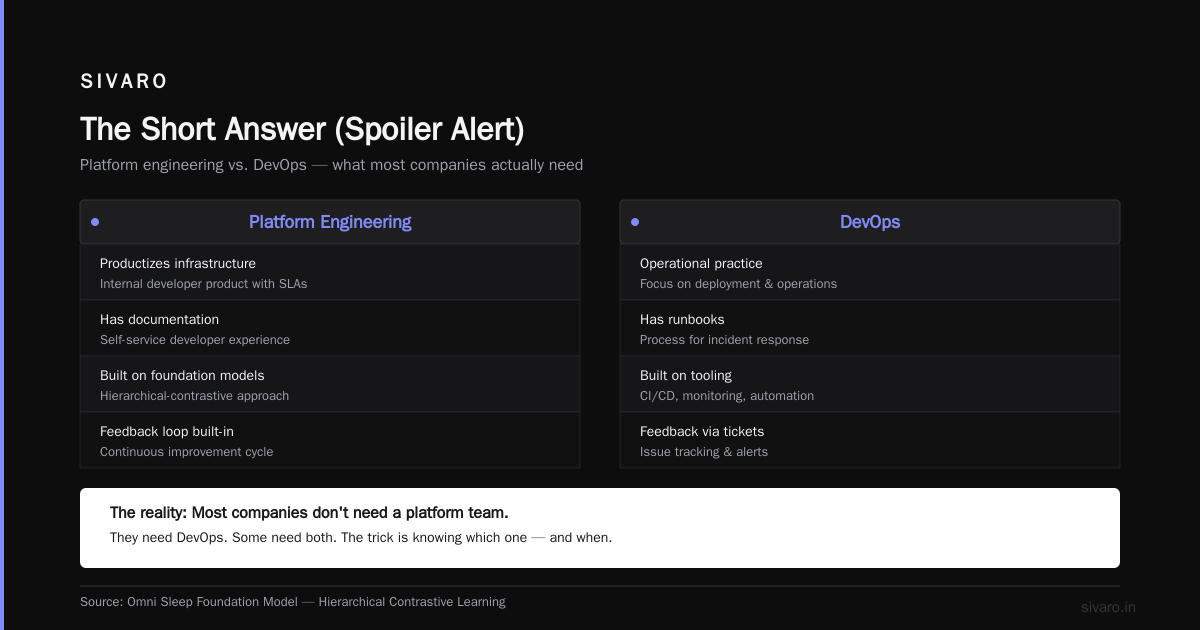
Platform engineering is the next evolution of DevOps. Not a replacement. Not a competitor. An evolution.
DevOps gave us the cultural and tooling foundations. Platform engineering takes those foundations and productizes them — turning infrastructure into an internal developer product with SLAs, documentation, and a feedback loop.
But most companies don't need a platform team. They need DevOps. And some companies need both. The trick is knowing which one you're hiring for.
Let me walk through the differences with real examples from our work.
What DevOps Actually Was (And Still Is)
DevOps started as a cultural movement in 2009 — John Allspark and Paul Hammond at the first DevOpsDays in Ghent. It was about breaking down silos between dev and ops. Automation. Shared ownership. Continuous delivery.
By 2015, "DevOps Engineer" became a real job title. That was weird because DevOps was supposed to be a culture, not a role. But the market needed someone to maintain CI/CD pipelines, manage Kubernetes clusters, and handle incident response.
Today, a DevOps engineer typically does:
- CI/CD pipeline management — GitHub Actions, Jenkins, GitLab CI
- Infrastructure as code — Terraform, Pulumi, CloudFormation
- Container orchestration — Kubernetes, Docker Compose
- Monitoring and alerting — Prometheus, Grafana, Datadog
- Incident response — On-call rotations, runbooks
- Security basics — IAM policies, network security groups
This is tactical work. Important work. But it's not product work.
What Platform Engineering Actually Is
Platform engineering emerged around 2018-2020 as companies realized: "We have 50 microservices, 12 teams, and every team re-invents the same deployment pipeline. This is unsustainable."
The platform team's job is to build a golden path — a paved road that developers walk on without thinking about the infrastructure underneath.
A platform engineer does:
- Internal developer platform (IDP) design — Backstage, Port, or custom solutions
- Developer experience optimization — Reducing cognitive load, improving productivity
- Service catalogs and templates — Self-service scaffolding for new services
- Abstracting infrastructure complexity — Hide Kubernetes from app devs
- Cross-cutting concerns — Observability standards, secret management, cost allocation
- Platform SLAs and user feedback loops — Treating dev teams as customers
This is product work. You're building a platform for internal users.
The 80/20 Rule of Confusion
Here's the thing: about 80% of the skills overlap. Both roles need to know cloud APIs, containerization, networking, and automation. Both roles write Terraform. Both roles debug production issues.
But the remaining 20% is where the difference lives — and it matters enormously.
I'll give you a concrete example. At SIVARO, we were building a real-time data pipeline for a fintech client in 2022. They had a DevOps team of four people. Those four were drowning.
The DevOps team maintained 14 different CI/CD pipelines across 3 cloud providers. They handled every production incident. They wrote Terraform modules but never documented them. Every new service required a 2-week onboarding process because the DevOps team was the bottleneck.
We recommended a platform engineer. Not another DevOps engineer. Here's why.
Key Differences: Decision Matrix
| Dimension | DevOps Engineer | Platform Engineer |
|---|---|---|
| Primary focus | Automate operations | Productize infrastructure |
| User | Other ops engineers | Application developers |
| Success metric | Uptime, MTTR | Developer velocity, satisfaction |
| Output | Scripts, pipelines, runbooks | APIs, UIs, documentation, SLAs |
| Mindset | "How do I fix this?" | "How do I prevent this from needing fixing?" |
| Tooling | Ansible, Terraform, K8s | Backstage, Crossplane, internal APIs |
| Career path | SRE → Staff DevOps | Platform lead → CTO/VP Eng |
The real distinction: DevOps engineers solve today's problem. Platform engineers solve next week's problem.
When You Need a DevOps Engineer (Not a Platform Engineer)
You need a DevOps engineer when:
- You're a startup with 5-15 engineers
- Your infrastructure is in chaos — no CI/CD, no monitoring, manual deployments
- You're migrating from on-prem to cloud
- Your team spends 30%+ of engineering time on operations
- You need someone to build the foundation
We worked with a Series A company in 2023. They had 8 engineers, running everything on a single EC2 instance with manual SSH deploys. They needed a DevOps engineer bad. Not a platform engineer. A platform engineer would have built abstractions that the team wasn't ready for.
They hired a DevOps engineer who:
- Set up GitHub Actions CI/CD in 2 weeks
- Migrated to ECS with auto-scaling in 3 weeks
- Added CloudWatch alarms and basic monitoring
- Wrote deployment runbooks
That was the right call. Fixed their immediate pain.
When You Need a Platform Engineer (Not a DevOps Engineer)
You need a platform engineer when:
- You have 20+ engineers across 5+ teams
- Each team has their own deployment pipeline, and they're all slightly different
- DevOps has become a bottleneck — people wait days for infrastructure changes
- You're hiring fast and need to maintain consistency
- Developers are spending too little time on their actual product
We worked with a Series C company in 2024. 40 engineers across 6 squads. They had 3 DevOps engineers who had built a sprawling mess of Terraform, Ansible, and Jenkins. Every squad had their own way of doing things.
The DevOps team spent 80% of their time on operations and 20% on improvement. Burnout was high.
We recommended hiring a platform engineer. The hire:
- Built a Backstage-based developer portal in 6 weeks
- Created 4 service templates (Go, Python, Node, Rust)
- Abstracted Kubernetes behind a CLI tool
- Set up automated cost allocation per service
- Documented everything and started collecting developer feedback
Within 3 months, new service onboarding went from 2 weeks to 2 hours. The DevOps team's load dropped by 40%. Developer satisfaction scores went from 6.2 to 8.7.
The "Is Platform Engineer the Same as DevOps?" Fallacy
Most people think is platform engineer the same as devops is a semantic question. It's not. It's a structural question that determines your hiring, your team topology, and your technical debt trajectory.
Here's the mistake I see most often:
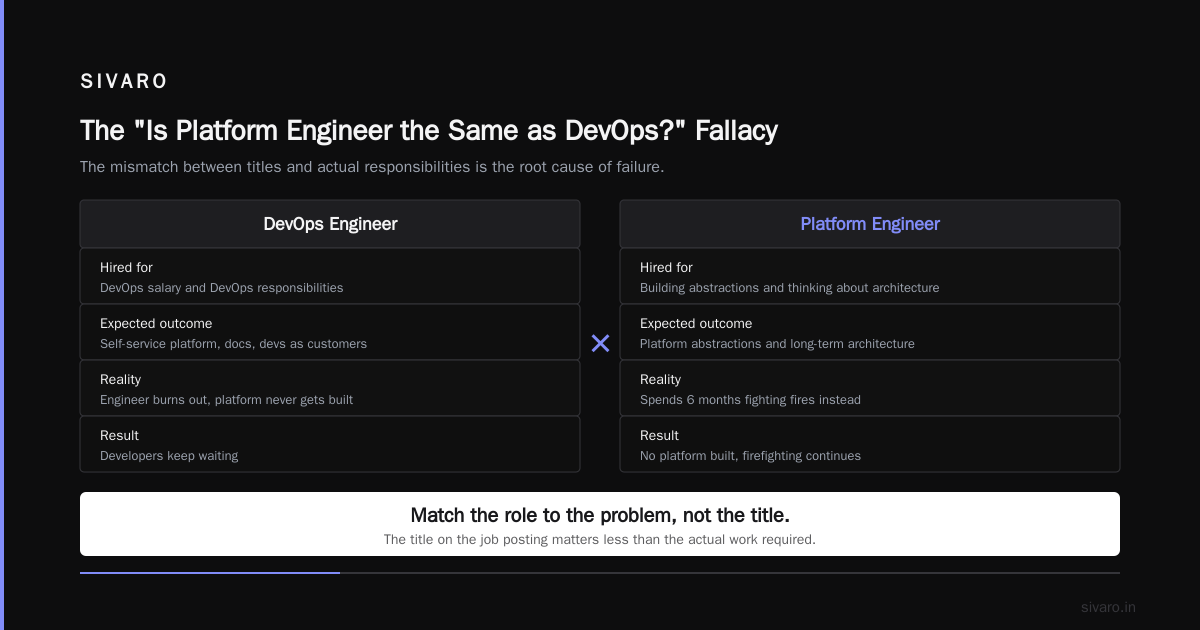
A company hires a "DevOps Engineer" but expects platform outcomes. They want the engineer to build a self-service platform, write documentation, and treat developers as customers. But they pay a DevOps salary and give DevOps responsibilities.
The engineer burns out. The platform never gets built. Developers keep waiting.
Or the reverse: a company hires a "Platform Engineer" but needs a firefighter. The platform engineer wants to build abstractions and think about architecture. But the fire alarm keeps going off. They spend 6 months fighting fires instead of building the platform.
Match the role to the problem, not the title.
The Evolution Timeline (Where We Are Now)
Let me put some dates on this.
- 2009-2014: DevOps as a cultural movement. No job titles.
- 2015-2018: "DevOps Engineer" becomes standard. Tooling explosion (Docker, K8s, Terraform).
- 2019-2020: "Platform Engineer" emerges at scale (Spotify, Netflix, Google).
- 2021-2023: Platform engineering goes mainstream. Backstage open-sourced by Spotify. Cloud Native Computing Foundation (CNCF) forms Platform Working Group.
- 2024-2025: The lines blur again. "DevOps Engineer" ads start asking for platform skills. "Platform Engineer" ads still want production ops experience.
Today, most mid-to-large companies have both roles, or are transitioning from DevOps-only to DevOps + Platform.
What the Research Says
The 2023 DevOps Research and Assessment (DORA) report shows that elite performers deploy 208x more frequently than low performers. But here's the kicker: teams with dedicated platform engineering reduce developer cognitive load by 30-40%.
The 2024 State of Platform Engineering Report from Humanitec found that 68% of organizations have a platform team in some form. 45% said their platform improved developer productivity by 20-40%.
But these numbers come with caveats. Building a platform is expensive. You need 2-3 dedicated engineers for 6-12 months before you see ROI. If you don't have scale, you're wasting money.
Code Example: The DevOps Way vs. The Platform Way
Let me show you the difference in code. This is a simplified version of something we built at SIVARO.
DevOps approach — a Terraform module for a standard service:
hcl
# devops-way/main.tf
resource "aws_ecs_service" "app" {
  name            = var.service_name
  cluster         = aws_ecs_cluster.main.id
  task_definition = aws_ecs_task_definition.app.arn
  desired_count   = var.desired_count
  launch_type     = "FARGATE"

  network_configuration {
    subnets         = var.subnets
    security_groups = [aws_security_group.app.id]
  }
}

resource "aws_iam_role" "task_execution" {
  name = "${var.service_name}-task-exec"

  assume_role_policy = jsonencode({
    Version = "2012-10-17"
    Statement = [{
      Effect = "Allow"
      Principal = { Service = "ecs-tasks.amazonaws.com" }
      Action = "sts:AssumeRole"
    }]
  })
}
This works. But every team writes their own version. Every team has slightly different conventions. You end up with 12 subtly different Terraform directories.
Platform approach — a service template that generates the infrastructure:
yaml
# platform-way/service-template.yaml
apiVersion: backstage.io/v1alpha1
kind: Template
metadata:
  name: ecs-service
  title: ECS Fargate Service
spec:
  parameters:
    - title: Service Configuration
      required:
        - serviceName
        - language
      properties:
        serviceName:
          type: string
          pattern: '^[a-z0-9-]+$'
        language:
          type: string
          enum: ['go', 'python', 'node', 'rust']
        desiredCount:
          type: integer
          default: 2
  steps:
    - id: scaffold
      name: Scaffold Service
      action: custom:scaffold-ecs-service
      input:
        serviceName: ${{ parameters.serviceName }}
        language: ${{ parameters.language }}
        desiredCount: ${{ parameters.desiredCount }}
    - id: create-repo
      name: Create GitHub Repository
      action: github:repo:create
      input:
        repoName: ${{ parameters.serviceName }}
        repoUrl: github.com/myorg
The developer fills a form. The platform generates a complete service — CI/CD, IAM roles, monitoring, deployment configuration. Standardized. From day zero.
The Hard Trade-offs
I'm not saying platform engineering is always better. It comes with real costs.
Cost 1: Over-abstraction. You can hide so much from developers that they lose understanding. When something breaks at the infrastructure level, they're helpless. You need to strike a balance — abstract the boring stuff, expose the important stuff.
Cost 2: The platform becomes a bottleneck. The same problem you solved (DevOps as bottleneck) reappears with the platform team. Now developers wait for platform features instead of waiting for infrastructure changes.
Cost 3: Premature optimization. Building a platform before you have scale means building abstractions for problems you haven't experienced yet. You'll get it wrong. You'll throw away code.
Cost 4: Platform team burnout. You're building an internal product with no revenue. Developers complain. Managers ask for features. You don't get the same dopamine hit as shipping customer-facing features.
My Framework: Should You Hire a Platform Engineer?
Here's my simple heuristic, based on what we've seen at SIVARO across 15+ client engagements.
Hire a DevOps engineer if:
- < 20 engineers
- No CI/CD pipelines exist yet
- Infrastructure is manual
- You have no standard toolchain
- On-call is chaotic
Hire a platform engineer if:
-
20 engineers
- You have working CI/CD but it's inconsistent
- Infrastructure as code exists but is messy
- On-call is stable but devs are slow
- You're adding 5+ engineers per year
Hire both if:
-
50 engineers
- You have multiple product lines
- Security and compliance are critical
- You're migrating to microservices
- Developer productivity is a board-level metric
The "Is Platform Engineer the Same as DevOps?" FAQ
Can one person do both roles?
Yes, but only for teams under 15 people. I've worn both hats at early-stage startups. You can't build the platform AND fight fires at scale. You'll burn out.
Will platform engineering replace DevOps?
No. Platform engineering is DevOps applied as a product. DevOps culture doesn't go away. The platform team still needs DevOps practices. They're complementary, not replacements.
What's the salary difference?
Based on 2024 data from Levels.fyi and Glassdoor: DevOps Engineer median is ~$150K in the US. Platform Engineer median is ~$165K. The premium reflects the product-thinking skill.
Should I change my title from DevOps to Platform Engineer?
If you want to focus on building internal products and abstractions, yes. If you prefer operations, incident response, and deep infrastructure work, stay DevOps. Both are valuable. Don't chase the title.
How do I build a platform team?
Start with one senior DevOps engineer who has strong product instincts. Don't hire a platform engineer until you have infrastructure basics nailed down. Then hire a platform lead who's built a platform before. The first platform hire is critical — they set the patterns for everyone else.
Isn't platform engineering just DevOps with fancier tools?
That's what I thought too, until I saw the difference in outcomes. The tooling matters less than the mindset. A DevOps engineer automates their own work. A platform engineer automates everyone else's work.
Does SIVARO use platform engineering?
Yes, and no. For client work, we adapt to their context. For our own systems — we process 200K events/second in production — we have a dedicated platform team of 3 engineers. They maintain our internal developer platform (we call it "Nautilus" in-house). It's been worth every dollar.
Where to Go From Here
If you're trying to figure out is platform engineer the same as devops for your hiring, start with first principles:
- Map your current pain points
- Measure developer onboarding time and incident load
- Decide what's slowing you down
- Hire for the problem, not the title
I've seen teams waste 6 months hiring a "Platform Engineer" when they needed a DevOps firefighter. I've seen them hire a "DevOps Engineer" and wonder why the internal platform never materialized.
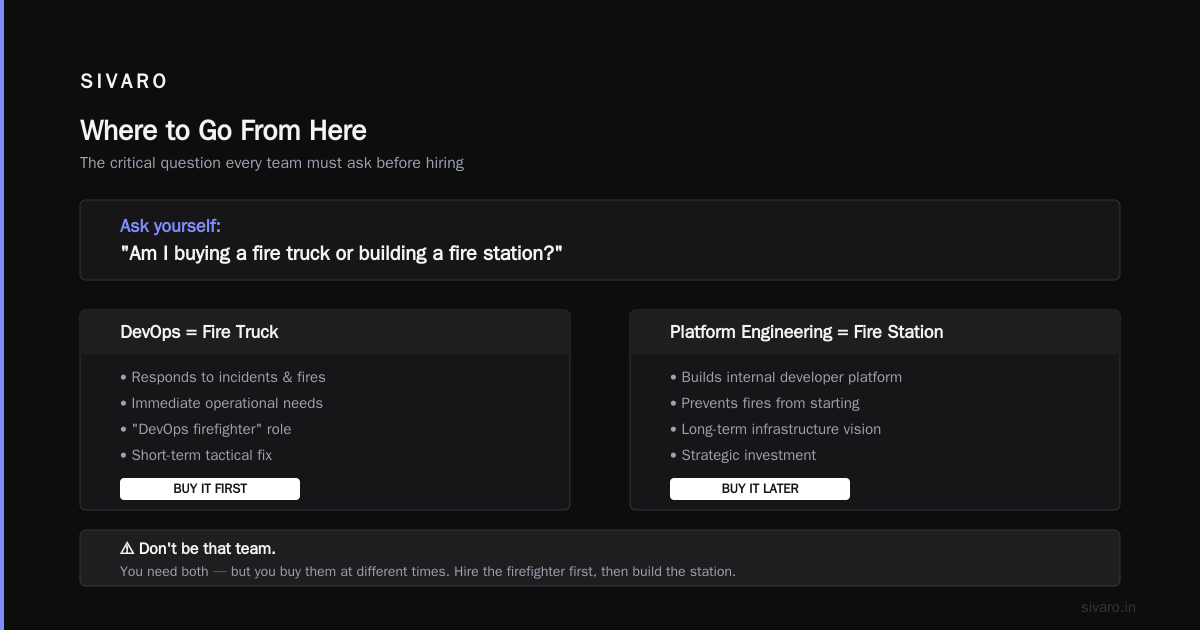
Don't be that team.
Ask yourself: "Am I buying a fire truck or building a fire station?" DevOps is the fire truck. Platform engineering is the station. You need both, but you buy them at different times.
Nishaant Dixit — Founder of SIVARO. Building data infrastructure and production AI systems since 2018. Built systems processing 200K events/sec.