 SIVARO

How Is A2A Different From MCP? A Practitioner’s Guide to Two Protocols That Don't Do the Same Thing
You’re building something with agents. You hit the wall where two agents need to talk—but they speak different dialects of “I need X, here’s Y.” That’s when you start looking at protocols. And you immediately run into two: MCP and A2A.
Everyone asks the same question: how is a2a different from mcp?
I’ll save you the 30 tabs of confusion. They aren’t competitors. They aren’t even in the same layer of the stack. One is a file format for tool definitions. The other is a runtime contract between agents. Confusing the two is like asking how a JSON schema differs from gRPC. Both matter, but for totally different jobs.
I run a team that deploys production AI systems. We’ve built agents that trade, scrape, route, and re-rank. We also maintain a data infrastructure that processes 200K events per second. We hit this MCP-vs-A2A wall in early 2025. This is the write-up I wish I had then.
First, What’s MCP? (Model Context Protocol)
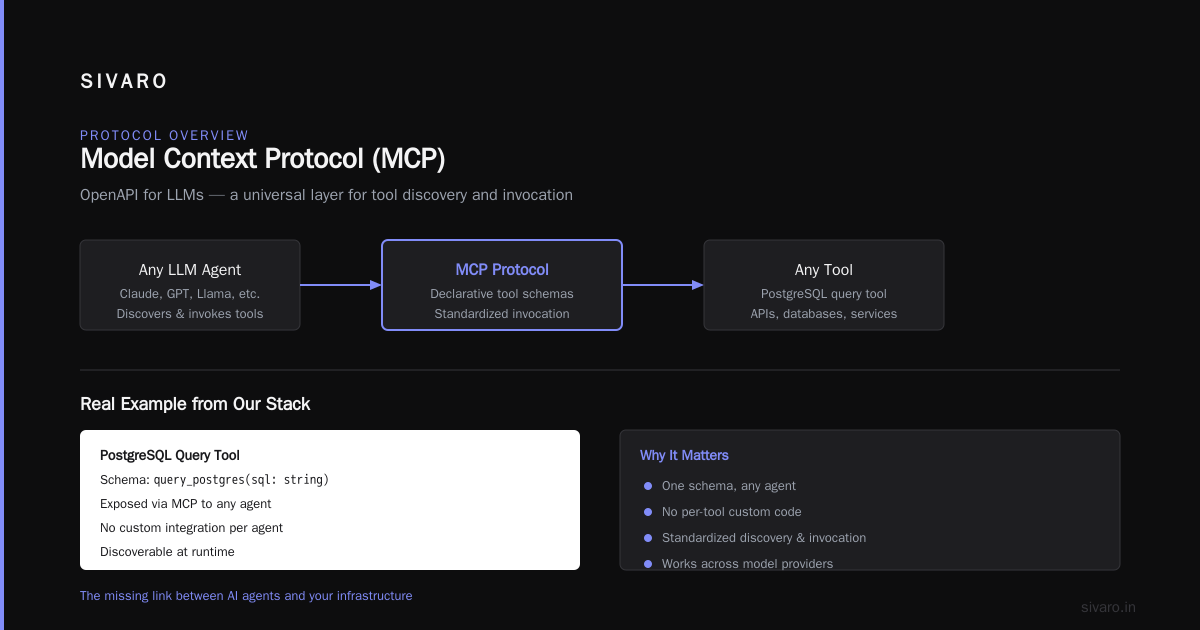
MCP is Anthropic’s open protocol for describing tools. It standardizes how you tell an LLM: “Here’s a function. Here’s what it does. Here are its inputs and outputs. Here’s how you call it.”
Think of it as OpenAPI for LLMs. A way to declare tool schemas so any agent (not just Claude) can discover and invoke them.
Real example from our stack:
We have a tool that queries our PostgreSQL warehouse for user engagement metrics. Here’s the MCP definition:
json
{
  "name": "get_user_engagement",
  "description": "Returns DAU, MAU, retention by cohort for a given date range",
  "inputSchema": {
    "type": "object",
    "properties": {
      "start_date": {"type": "string", "format": "date"},
      "end_date": {"type": "string", "format": "date"},
      "cohort_type": {"type": "string", "enum": ["daily", "weekly", "monthly"]}
    },
    "required": ["start_date", "end_date"]
  }
}
That’s it. MCP doesn’t say how that function gets called, who hosts it, how auth works, or what happens if the request takes 30 seconds. It just says “here is a contract for a single atomic operation.”
Anthropic released MCP in November 2024. It’s already adopted by LangChain, LlamaIndex, and most major agent frameworks. It’s a static schema language. Not a runtime.
Second, What’s A2A? (Agent-to-Agent Protocol)
A2A is Google’s proposal (announced April 2025) for agent-to-agent communication. It defines how two independently running agents discover each other, negotiate tasks, share state, and hand off control.
A2A isn’t about tool schemas. It’s about inter-agent orchestration:
- How Agent A asks Agent B to “find me three vendors who can ship by Friday”
- How Agent B can respond with partial results, ask for clarification, or delegate subtasks to Agent C
- How both agents manage long-running operations (minutes, not milliseconds)
Here’s a sketch of an A2A message:
json
{
  "protocol": "a2a/v1",
  "sender": "agent://purchasing-system-v2",
  "receiver": "agent://vendor-database-prod",
  "task": {
    "id": "task-a1b2c3",
    "type": "query",
    "input": {
      "action": "search_vendors",
      "criteria": {
        "category": "electronics",
        "min_rating": 4.2,
        "ship_by": "2025-05-15"
      }
    },
    "state": "pending",
    "artifacts": []
  }
}
Notice: no function signature. No input schema. A2A cares about task lifecycle: pending → working → partial_response → completed → failed. It defines how agents signal “I’m still alive” or “I need more info.”
So How Is A2A Different From MCP? Let Me Count the Ways
Here’s the short version. Then I’ll walk through each dimension with real scars.
| Dimension | MCP | A2A |
|---|---|---|
| Purpose | Describe a tool’s interface | Manage a conversation between agents |
| Scope | Single atomic operation | Multi-step, long-running tasks |
| State | Stateless (call-and-response) | Stateful (tasks can pause, resume, fork) |
| Discovery | Static schema file | Dynamic agent registry + capability negotiation |
| Auth | Not defined (out of scope) | Defines auth token exchange |
| Error handling | HTTP status codes + error body | Rich task statuses, partial failures, retry policies |
| Streaming | Not natively supported | Supports artifact streaming, chunked responses |
| State storage | Doesn’t care | Defines how to persist task state across restarts |
At first I thought these were competing protocols. Turned out they’re complementary. You use MCP to define what tools an agent has. You use A2A to define how agents talk to each other.
Where MCP Falls Apart (and A2A picks up)
We tried to use MCP as an agent-to-agent protocol. Bad idea.
Problem 1: No concept of a task.
MCP says: “Call this function, get a response.” But what if the function takes 3 minutes? What if it returns partial results? What if the agent needs to interrupt and say “wait, actually filter by region first”?
MCP has no state machine for that. You’d hack it by returning a session ID and polling. We did that. It was ugly.
Problem 2: No lifecycle.
Real agents crash. Networks drop. A2A defines what happens when an agent restarts mid-task: the agent can query “what’s my outstanding task status?” from a shared state store. MCP can’t do that—it doesn’t even know what a “task” is.
Problem 3: No capability negotiation.
MCP assumes you already know what tools an agent exposes. That works for internal systems. But when you have 50 agents in production, each with different capabilities (some can do SQL, some can do RAG, some can do HTTP calls, some are banned from certain data), you need a way for agents to say “I can handle X but not Y, and here’s what I require.”
A2A has a capability card—a manifest an agent publishes that declares its skills, constraints, and trust requirements. Here’s a minimal example:
json
{
  "agent_id": "data-query-agent-v3",
  "capabilities": [
    {"type": "query", "source": "postgres", "scope": "read-only"},
    {"type": "query", "source": "bigquery", "scope": "read-only"}
  ],
  "limitations": [
    {"type": "rate_limit", "max_requests_per_minute": 100},
    {"type": "data_restriction", "deny_tables": ["pii_customers"]}
  ],
  "auth_required": "bearer_token"
}
MCP can’t express this. It’s a schema, not a profile.
A2A’s Killer Feature: Task State Machine (And Why MCP Can’t Do It)
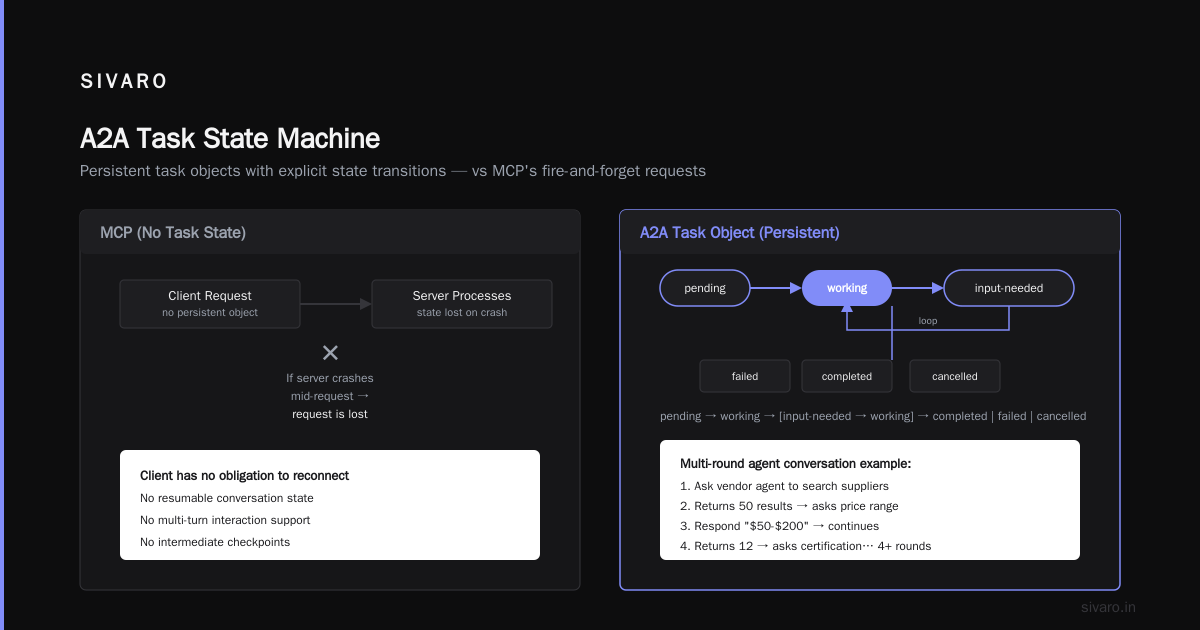
This is the deepest difference. I’ll show you with code.
In MCP, your entire interaction is:
Client -> Server: "call tool X with params Y"
Server -> Client: "result Z or error E"
That’s it. The server has no memory. The client has no obligation to reconnect. If the server crashes mid-request, the request is lost.
In A2A, every interaction creates a task object that persists. The task has a state:
pending -> working -> [input-needed | working] -> completed | failed | cancelled
This matters when you’re building a purchasing agent that needs to:
- Ask vendor agent to search for suppliers
- Vendor agent returns 50 results, asks “narrow by price range?”
- Purchasing agent responds “$50-$200”
- Vendor agent continues, returns 12 results, asks “do you need certification?”
- ... continue for 4 more rounds
That’s a single task with multiple interactions. A2A models this natively:
python
# Pseudocode for A2A task lifecycle
task = a2a_client.create_task(
    target_agent="vendor-db-prod",
    input={"action": "search", "criteria": {"category": "electronics"}}
)

while task.state not in ["completed", "failed", "cancelled"]:
    if task.state == "input-needed":
        # Agent is asking for clarification
        user_input = prompt_user(task.last_message)
        task = a2a_client.send_input(task.id, user_input)
    elif task.state == "working":
        # Agent is still processing
        time.sleep(2)
        task = a2a_client.poll_status(task.id)
    elif task.state == "partial":
        # Agent returned intermediate results
        process_partial(task.artifacts)
        task = a2a_client.continue_task(task.id)

process_final(task.artifacts)
MCP doesn’t have a loop. It has a function call. The difference is fundamental.
Real-World Test: We Built an Agent Mesh With Both
In March 2025, we built a prototype multi-agent system for a client in logistics. The system had:
- A RAG agent that queries internal docs
- A pricing agent that calculates shipping costs
- A scheduling agent that books warehouse slots
- A customer agent that handles user requests
We used MCP to define each agent’s tool schemas. The RAG agent exposed search_docs(category, query). The pricing agent exposed calculate_rate(origin, dest, weight).
We used A2A to wire the agents together. The customer agent received a user request, created an A2A task for the scheduling agent, which then sub-created a task for the pricing agent. The scheduler paused mid-task to ask the user “which warehouse do you prefer?”—then resumed.
The result? MCP handled the atomic tool descriptions cleanly. A2A handled the dynamic, long-running orchestration. Neither could replace the other.
Where People Get Confused (And Why That’s Dangerous)
The biggest trap I see: teams think they need to pick one.
MCP-only approach: You end up writing everything as a single “do everything” tool because MCP can’t handle multi-step negotiation. That’s what we saw at a startup in January 2025—they had a “master agent” that called 40 MCP tools in sequence. It was fragile. Any mid-task clarification broke the chain.
A2A-only approach: You end up over-engineering simple function calls. Every “get current time” becomes a task with lifecycle management. At SIVARO, we tried this for a simple data retrieval. The overhead was 800ms per task just for state management. For things that return in 5ms, MCP is better.
The right play: Use MCP for tool definitions—the static contracts that describe what a function does. Use A2A for agent conversations—the dynamic negotiation of what needs to happen, across multiple steps, with possible human interrupts.
FAQ: The Questions I Get Every Week
Q: Can MCP support streaming responses?
Technically, no. MCP defines a request-response pattern. Some implementations hack SSE (Server-Sent Events) on top, but that’s not part of the spec. A2A natively supports artifact streaming—you can send partial results as they arrive.
Q: How is A2A different from MCP in terms of security?
MCP doesn’t define auth at all. You’re expected to wrap it in HTTPS + your own auth. A2A defines a token field in the capability card, supports OAuth 2.0 flows, and allows agents to specify required trust levels. We’ve seen teams combine both: MCP for internal tools (no auth, behind a VPN), A2A for cross-agent auth.
Q: Do I need both protocols?
If you have more than 3 agents that talk to each other in non-trivial ways? Yes. If you’re building a single agent that calls a few APIs? Stick with MCP. A2A has overhead.
Q: Can I run A2A without MCP?
Yes. But you’ll have to define your own tool description format inside A2A messages. Most teams I talk to use MCP for that because it’s already standard.
Q: How is a2a different from mcp in terms of latency?
MCP is designed for sub-second function calls. A2A is designed for tasks that can take minutes or hours. If you need a function call to return in 50ms, use MCP. If you need to say “find me all suppliers in the EU” and wait 5 minutes for a database scan plus human review, use A2A.
Q: Is A2A production-ready?
Google released the spec in April 2025. We’ve seen reference implementations from LangChain and AutoGen. Our production system uses it for task orchestration, but we had to build our own state store (we used Redis Streams). The protocol is solid. The ecosystem is young.
Q: Will MCP and A2A merge?
I doubt it. They solve different things. MCP is a schema language. A2A is a runtime protocol. You might see MCP definitions embedded inside A2A capability cards—that’s already happening in the community.
A Final Thought on the How Is A2A Different From MCP Question
The confusion is understandable. Both are about agents. Both look like JSON. Both came from big AI companies in late 2024/early 2025. But think about it like this:
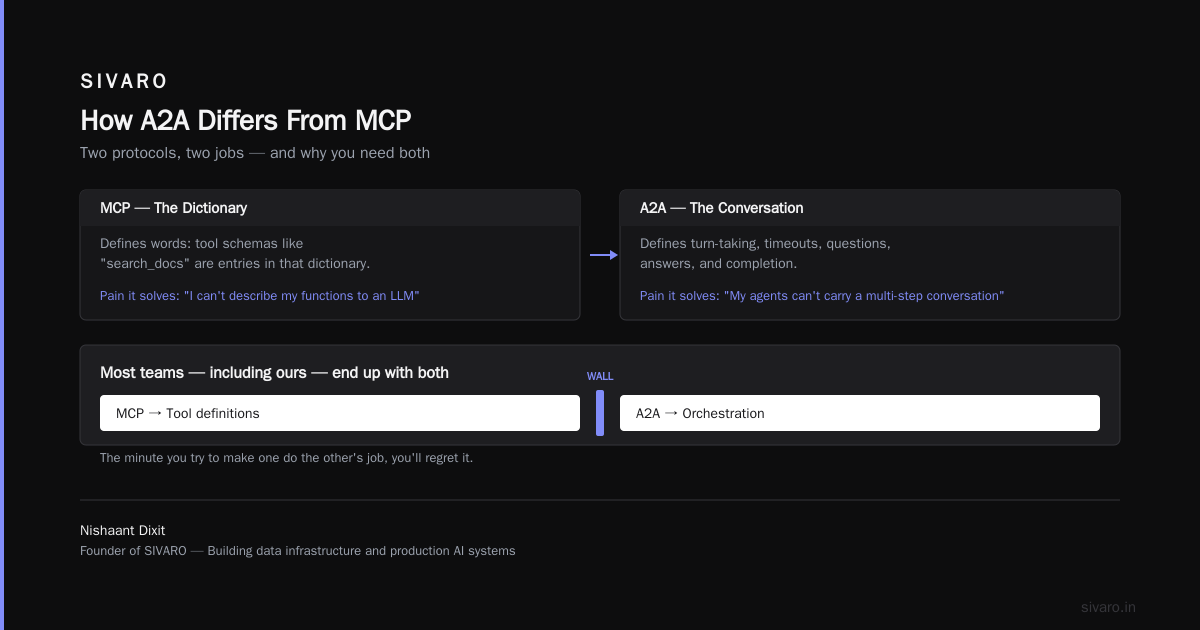
MCP is a dictionary. It defines words. A tool schema for “search_docs” is a word in that dictionary.
A2A is a conversation. It defines turn-taking, timeouts, questions, answers, and completion.
When someone asks “how is a2a different from mcp?” they’re usually trying to understand which one solves their immediate pain. If your pain is “I can’t describe my functions to an LLM,” start with MCP. If your pain is “my agents can’t carry a multi-step conversation,” start with A2A.
Most teams, including ours, end up with both. MCP for the tool definitions. A2A for the orchestration. And a clear wall between them—because the minute you try to make one do the other’s job, you’ll regret it.
Nishaant Dixit — Founder of SIVARO. Building data infrastructure and production AI systems since 2018. Built systems processing 200K events/sec.