 SIVARO
SOC2 AI Readiness Assessment: 5 Red Flags That Will Fail Your Type II Audit
Six months post-close on a Series A. The customer procurement team from a Fortune 500 just flagged your SOC 2 Type II report. Exceptions. Contract rescinded. I've watched this happen three times in the last year.
The problem isn't that these companies lacked controls. It's that their readiness assessment missed the specific patterns that kill Type II audits. When you're building AI systems that process customer data, the stakes multiply.
Here's the raw truth: A SOC 2 readiness assessment is your pre-audit diagnostic. It tests whether your controls will survive the 6-12 month observation period that defines a Type II audit. Most founders treat it like a checklist. That's how you get burned.
I'll walk you through the five red flags auditors flag consistently—and exactly what to do before your Type II audit starts.
What Is a SOC2 Readiness Assessment for AI Systems?
A readiness assessment is a systematic evaluation of your controls against the Trust Services Criteria (TSC) before your actual audit begins. For AI companies, this gets complicated fast.
According to TrustCloud's guide, a readiness assessment should cover "security, availability, processing integrity, confidentiality, and privacy" across your entire infrastructure. Here's the catch: AI systems introduce dynamic, model-driven behaviors that traditional compliance frameworks weren't designed for. You have to go deeper.
Your readiness assessment needs to catch:
- Gaps in training data access controls
- Model behavior monitoring (or lack thereof)
- Logging for automated decisions
- Third-party risks from foundation model APIs
- Data retention and deletion for training pipelines
Most companies skip these AI-specific controls. Then their Type II audit reveals them as exceptions. A thorough readiness assessment would have flagged these early.
Red Flag #1: Your Access Controls Are Based on Trust, Not Verification
"We only allow senior engineers to modify production models." I've heard this from four different CTOs in the last six months. Every single one failed their first Type II audit.
Access control is the single most common finding in failed SOC 2 audits. The AICPA expects you to demonstrate continuous enforcement, not policy documentation.
Here's what auditors want to see:
python
# What most AI companies have (incomplete):
class AccessControl:
def __init__(self):
self.roles = ["admin", "engineer", "viewer"]

def can_access_model(self, user, model):
# Relies on human judgment
return user.role in ["admin", "engineer"]

# What passes SOC 2 Type II (actually works):
from datetime import datetime, timedelta

class SOC2CompliantAccessControl:
def __init__(self):
self.access_log = []
self.least_privilege_enforced = True
self.review_period = timedelta(days=90)

def grant_temp_access(self, user, resource, reason, duration_hours):
if not reason or not duration_hours:
raise ValueError("SOC 2 requires justification")
expiry = datetime.now() + timedelta(hours=duration_hours)
entry = {
"user": user.id,
"resource": resource.id,
"expiry": expiry,
"reason": reason,
"granted_by": user.manager
}
self.access_log.append(entry)
# Auto-revoke on expiry
self._schedule_revocation(resource, expiry)
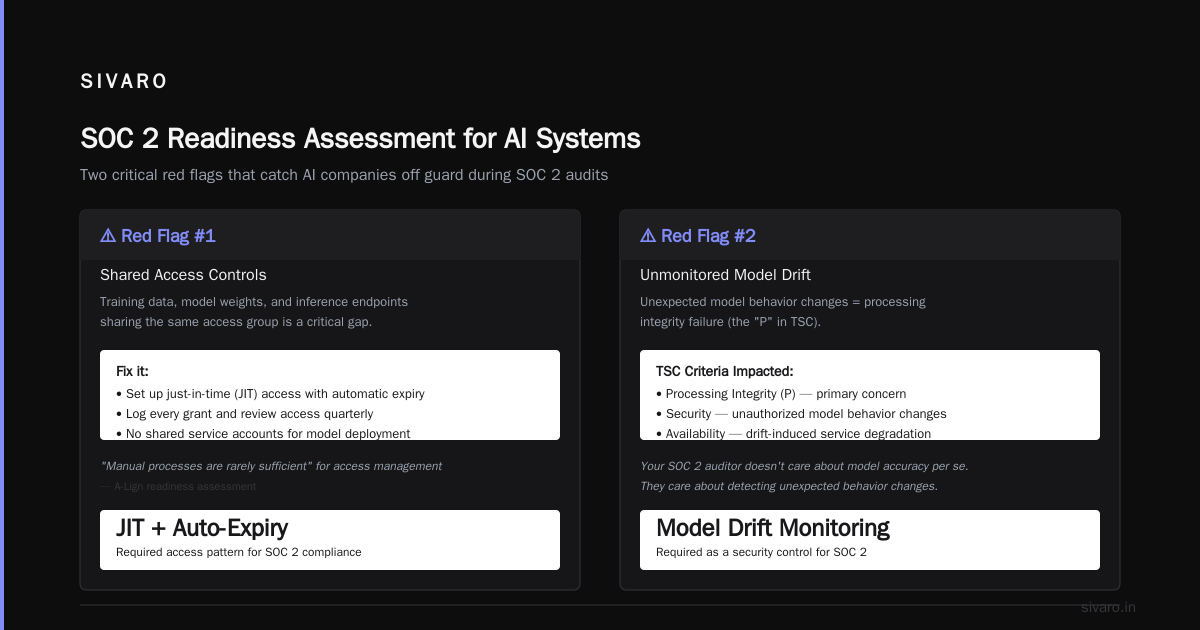
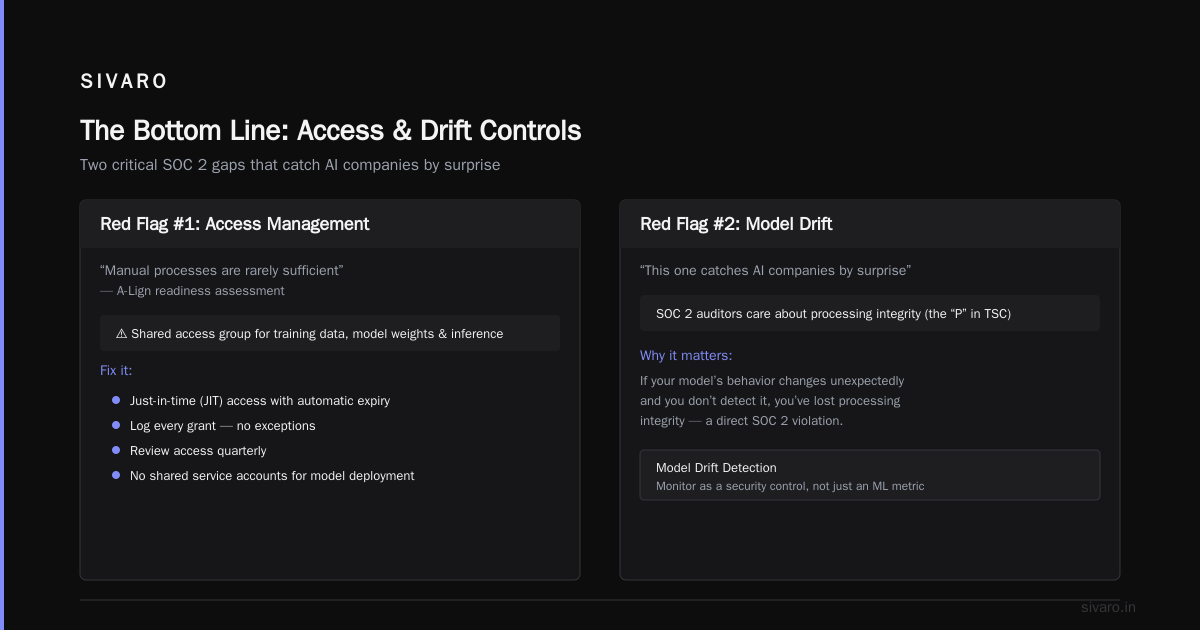
The A-Lign readiness assessment explicitly calls out that "manual processes are rarely sufficient" for access management. If your AI system's training data, model weights, and inference endpoints share the same access group, you have a problem.
Fix it: Set up just-in-time (JIT) access with automatic expiry. Log every grant. Review access quarterly. No shared service accounts for model deployment.
Red Flag #2: You Don't Monitor Model Drift as a Security Control
This one catches AI companies by surprise.
Your SOC 2 auditor doesn't care about model accuracy per se. They do care about processing integrity—the "P" in the TSC. If your model's behavior changes unexpectedly and you don't detect it, you've lost processing integrity.
Hyperproof's guide to Type II preparation emphasizes that "controls must be tested over a period of time to demonstrate their operating effectiveness." For AI systems, model drift is a control failure waiting to happen.
python
# Dangerous: No drift detection
class ProductionInference:
def predict(self, input_data):
return self.model.predict(input_data)

# Compliant: Drift monitoring as a control
from scipy.stats import ks_2samp
import numpy as np

class MonitoredInference:
def __init__(self, baseline_distribution, alert_threshold=0.05):
self.baseline = baseline_distribution
self.alert_threshold = alert_threshold
self.recent_predictions = []

def predict(self, input_data):
output = self.model.predict(input_data)
self.recent_predictions.append(output)

# Every 1000 predictions, check drift
if len(self.recent_predictions) >= 1000:
drift_detected = self._check_drift()
if drift_detected:
# This is your audit trail
self._alert_security(f"Model drift detected at {datetime.now()}")
self._disable_model_version()
self.recent_predictions = []
return output

def _check_drift(self):
stat, p_value = ks_2samp(self.baseline, self.recent_predictions)
return p_value < self.alert_threshold
The SOC 2 controls list for 2026 maps processing integrity to specific evidence requirements. If you can't show you're monitoring for unexpected changes in system behavior, your Type II will show exceptions.
Fix it: Set up baseline drift detection. Log all alerts. Document your response procedure. Treat model drift as a processing integrity incident.
Red Flag #3: Your Third-Party AI Providers Are Black Boxes
"We use OpenAI's API for summarization. That's their problem, not ours."
No. No. No.
If your AI system depends on third-party models, you're responsible for their controls too. The SOC 2 requirements for 2026 clarify that "vendors that process, store, or transmit your data" must have their own SOC 2 reports.
Here's the specific failure pattern I see: Companies sign up for AI SaaS products, connect them to internal data, and never review the vendor's SOC 2 report. When the auditor asks for vendor due diligence, they find nothing.
The checklist you need:
markdown
## Third-Party AI Vendor Due Diligence
- [ ] SOC 2 Type II report obtained (no older than 12 months)
- [ ] Report covers relevant TSCs (especially confidentiality and privacy)
- [ ] Data processing agreement signed
- [ ] Subprocessors disclosed (e.g., does your AI vendor use Anthropic?)
- [ ] Data deletion timeline confirmed
- [ ] Breach notification process documented
- [ ] Compliance with your data residency requirements
The Reddit thread from cybersecurity professionals on SOC 2 red flags highlights that "lack of vendor management" is a top finding. It's worse for AI because:
- Foundation model APIs change without notice
- Training data sources shift continuously
- You can't easily audit a black-box model's behavior
Fix it: Create a vendor risk tier specifically for AI providers. Require SOC 2 Type II before any data sharing. Automate quarterly report review. If a vendor won't provide their report, that's a deal-breaker for enterprise sales.
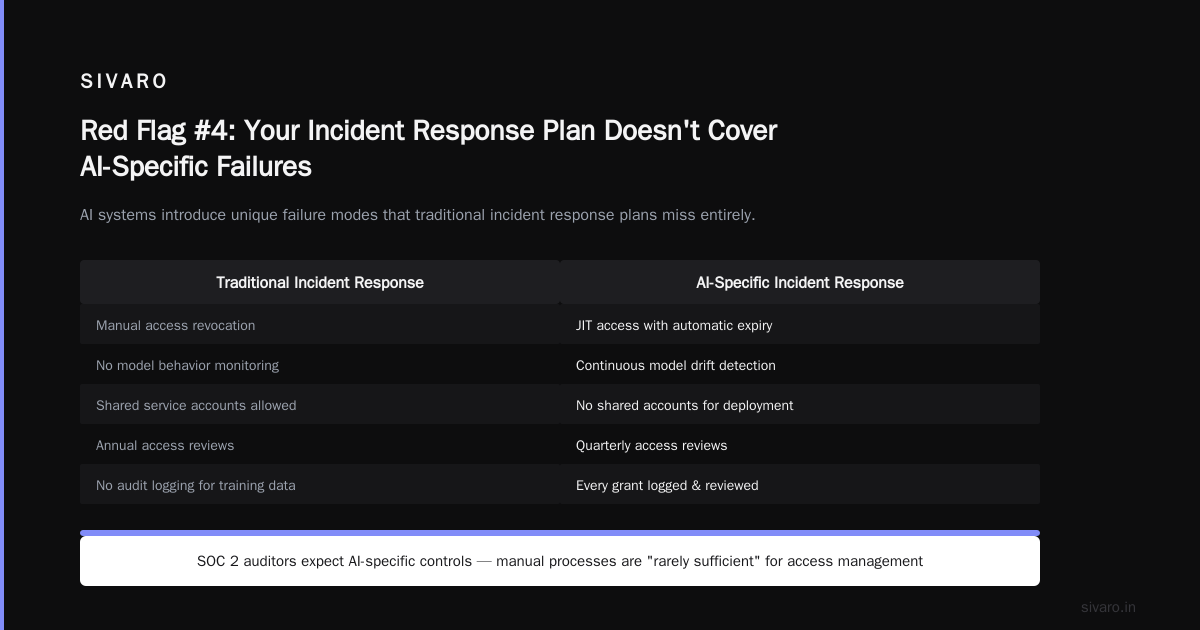
Red Flag #4: Your Incident Response Plan Doesn't Cover AI-Specific Failures
"We have an incident response plan for security breaches."
Great. Now tell me: What happens when your recommendation model starts serving inappropriate content to enterprise customers? What's the playbook for a training data leak where customer PII was accidentally included in the training set?
Most AI companies I work with have security incident response plans written before their AI system existed. Those plans don't cover:
- Model jailbreak attempts
- Training data poisoning
- Prompt injection attacks
- Unauthorized model extraction
- Data leakage through model memorization
The CompliancePoint guide to effective SOC 2 readiness assessments notes that "incident response testing" is a control that frequently fails during Type II audits because companies don't actually practice it.
What a SOC 2-compatible AI incident response looks like:
python
# Incident classification for AI systems
class AIPlaybook:
SEVERITY_MAP = {
"prompt_injection": {
"severity": "high",
"response": ["block_input_pattern", "update_filter", "audit_logs"],
"notification": ["CISO", "ML team lead", "legal"],
"sla_hours": 2
},
"data_leakage_via_memorization": {
"severity": "critical",
"response": ["take_model_offline", "apply_filter", "notify_privacy"],
"notification": ["CEO", "CISO", "legal", "board"],
"sla_hours": 1
},
"model_drift_anomaly": {
"severity": "medium",
"response": ["restore_previous_version", "root_cause_analysis"],
"notification": ["ML team lead"],
"sla_hours": 8
}
}

def respond_to_incident(self, incident_type, details):
playbook = self.SEVERITY_MAP.get(incident_type)
if not playbook:
raise ValueError(f"Unknown incident type: {incident_type}")
# Log everything — this is your audit evidence
self._create_incident_ticket(
incident_type, details, playbook["severity"]
)
self._notify_stakeholders(playbook["notification"])
self._execute_response(playbook["response"])
UpGuard's advice for unprepared companies is blunt: "If you're scrambling during an audit, you're doing it wrong." The time to test AI-specific incident response is during your readiness assessment, not after your Type II period has started.
Fix it: Run a tabletop exercise for an AI-specific incident every quarter. Document the results. Update your playbook based on findings. If you can't show the auditor three consecutive quarters of tested AI incident response, expect an exception.
Red Flag #5: Your Data Management Doesn't Account for Training Lifecycle
Here's where AI companies fail hardest.
Your SOC 2 auditor will ask: "Show me the controls that govern training data from collection to deletion." If you've ever trained a model on customer data without explicit consent documentation, or if you can't demonstrate exactly which data went into which model version, you're going to have a bad audit.
The Assurance Dimensions readiness assessment guide emphasizes "data lifecycle management" as a critical control area. For AI systems, this means:
- Training data provenance: Every training dataset must have documented source, consent, and classification
- Model versioning: Every deployed model must map back to its training data
- Retention and deletion: Customer data used for fine-tuning must be deletable on request
- Shadow inference: Customer data used for live inference that gets stored for future training
The specific pattern that fails audits: Companies use customer data for model improvement without it being covered in their privacy policy or terms of service. The auditor finds training data that includes customer information with no documented consent. Exception written.
Fix it: Set up a data lineage system:
markdown
## Training Data Lineage Template (must exist for each model version)
- Dataset Name: customer_support_conversations_v3
- Source System: Zendesk API (sanitized)
- Consent Basis: Section 4.2 of Terms of Service
- Classification: PII (requires anonymization)
- Anonymization Method: Named entity removal + differential privacy (epsilon=1.0)
- Training Model: fine_tuned_llama_v2.1
- Retention Policy: Delete 90 days after model deprecation
- Deletion Mechanism: S3 lifecycle policy + database purge
- Last Compliance Review: 2025-11-15 (passed)
The Drata beginner's guide to SOC 2 Type II notes that "evidence collection" is the hardest part for first-time auditors. With AI systems, you need evidence not just of what you did, but of what you didn't do—affirmative proof that customer data was excluded from training when required.
How to Run Your SOC2 Readiness Assessment
You've seen the red flags. Here's the practical playbook.
Month 1: Scoping and baseline
- Identify which TSCs apply to your AI system (security is mandatory; availability depends on uptime SLAs; processing integrity requires model monitoring)
- Inventory all AI-related data flows: training data ingestion, model training, inference, feedback loops
- Map controls to the SOC 2 controls list
Month 2-3: Control set upation
- Fix access controls (JIT, least privilege, auto-expiry)
- Set up drift monitoring and logging
- Complete vendor due diligence on all AI providers
- Write AI-specific incident response playbooks
- Document training data lineage and consent workflows
Month 4: Gap assessment
- Run a mock audit with your compliance team or a third party
- Focus on evidence collection—can you prove each control operated continuously?
- The TrustCloud readiness assessment recommends "identifying gaps between your current state and the target state"
Month 5: Remediation
- Address all findings from the gap assessment
- Run tabletop exercises for AI-specific incidents
- Document your evidence collection for the Type II period
Month 6: Type II audit begins
- Your controls are in place and tested
- You can survive the 6-12 month observation period
- You've eliminated the five red flags
FAQ
Q: How long does a SOC2 readiness assessment take?
A: For most AI startups, 4-6 weeks if you have dedicated resources. Longer if you're building controls from scratch. The Assurance Dimensions guide suggests 2-3 months for first-time assessments.
Q: Can I use automated tools?
A: Yes, but be careful. Automation for access control, logging, and vendor management works great. Model-specific controls like drift monitoring require custom work by your ML team. Don't try to fit your AI system into a generic compliance tool—it won't catch the important gaps.
Q: Do I need SOC 2 Type II before my first enterprise customer?
A: Yes, if they're in regulated industries or process sensitive data. Some startups get away with SOC 2 Type I and a readiness assessment, but Type II is becoming table stakes for larger deals. Hyperproof's guide notes that Type II demonstrates "operating effectiveness"—that's what enterprise buyers want.
Q: What if my AI provider doesn't have SOC 2 Type II?
A: Then you're carrying their risk. You can perform a compensating control assessment, but most auditors will flag this. Consider switching providers or building a bridge that prevents the provider from accessing raw data. This is the number one finding I see in AI company audits.
Q: How much does a failed SOC 2 Type II audit cost?
A: Beyond the $10K-$50K audit fee, the real cost is delayed enterprise deals. One failed audit can push your sales cycle by 6-9 months. I've seen companies lose $500K+ deals because their Type II showed exceptions. The readiness assessment is cheap insurance.
Q: Can I fix red flags during the Type II observation period?
A: Technically, but the exceptions will still appear in your report for the period before the fix. Auditors want to see controls operating consistently for the entire observation window. Fix red flags before Type II starts. The UpGuard resource warns against "starting an audit before your controls are ready."
Q: Should I hire a specialist for SOC2 readiness?
A: If your revenue depends on enterprise deals, yes. Generalist SOC 2 consultants miss AI-specific risks. Find someone who understands both model architectures and trust services criteria. The cost ($15K-$30K for a thorough readiness assessment) pays for itself in avoided audit exceptions.
The Bottom Line
SOC 2 Type II audits are failing AI companies at alarming rates. Not because AI is inherently insecure, but because the standard readiness assessment playbook doesn't account for how AI systems actually work.
The five red flags a readiness assessment will uncover:
- Access controls based on trust, not verification
- Missing model drift monitoring as a security control
- Third-party AI providers treated as black boxes
- Incident response plans that ignore AI-specific failures
- Training data management without lineage and consent
Each of these is fixable. But you have to start before your Type II observation period begins. The Sprinto guide to SOC 2 requirements has it right: "Compliance is not a one-time project; it's an ongoing program."
For AI companies, that program starts with a readiness assessment built for the way your systems actually work—not for a compliance checklist written before foundation models existed.
Run the readiness assessment. Find the red flags. Fix them. Then start your Type II audit.
Your next enterprise deal depends on it.
Nishaant Dixit — Founder of SIVARO. Building data infrastructure and production AI systems since 2018. Built systems processing 200K events/sec.