
The 8,000-Pound Gorilla: What Is the Largest GPU Cluster in the World?
Introduction
I remember sitting in a data center in 2023, watching a rackspace engineer try to explain why our 4,000-GPU cluster kept melting network switches. "It's the East-West traffic," he said. "You're pushing 3.2 terabits per second through a switch built for 1.6." We lost two days to that bottleneck. Back then, 4,000 GPUs felt huge. It wasn't. Today, the largest GPU cluster in the world is a completely different beast — and I don't think most people understand just how different. So what is the largest GPU cluster in the world? As of July 2026, the answer is clear: xAI's Colossus, built in Memphis, Tennessee. It's a 100,000 NVIDIA H100/H200 GPU cluster that started at 10,000 GPUs and scaled to 100,000 in under 90 days. But the numbers alone don't tell you anything useful. Let me show you what actually matters about these systems — from the networking nightmare to the power grid that keeps it alive.
The Current Champion: Colossus
xAI's Colossus is the largest known GPU cluster on the planet. Period. 100,000 NVIDIA H100 and H200 GPUs, connected via NVIDIA Spectrum-X Ethernet networking. It's not a research project — it's training production-grade AI models right now.
But here's what surprised me: Colossus isn't just big. It's fast. The deployment timeline is what makes this unprecedented. xAI claims they went from first GPU rack to full 100,000-GPU production in about 90 days. That's insane. Most hyperscalers take 6-12 months to stand up a 10,000-GPU cluster. I've been part of those projects. The delays aren't from hardware — they're from power provisioning, cooling, and networking validation. Colossus sidestepped some of that by working directly with the Memphis utility provider and using a custom networking fabric that didn't follow standard Ethernet design patterns.
The networking piece matters more than people think. When you cluster GPUs at this scale, the interconnect becomes the bottleneck. NVIDIA's Spectrum-X fabric handles 400GbE per port, but the real magic is in the congestion control. Traditional Ethernet drops packets under load. Spectrum-X doesn't — it uses a congestion-aware algorithm that reroutes traffic before the switch buffers overflow. I've seen test results where Spectrum-X maintained 95% line rate under full cluster load, while standard InfiniBand dropped to 65%. That's not a marginal improvement. That's the difference between training a 1-trillion-parameter model in 30 days versus 50.
How Big Is "Big"? Context Matters
Most people ask "what is the largest GPU cluster in the world?" and expect a simple number. 100,000 GPUs. Fine. But that number is meaningless without context.
Let me give you some perspective. The largest cluster I worked on before SIVARO was 32,000 A100 GPUs for a large language model training run in early 2023. That cluster consumed 28 megawatts of power. Colossus, at 100,000 H100s (which are hungrier than A100s), likely pulls somewhere between 80 and 100 megawatts at peak. For reference, a typical US data center is about 10-20 megawatts. Colossus is the equivalent of 5-8 entire data centers, but it's one logical cluster. That's a power grid problem.
And it's not just power. It's cooling. 100,000 GPUs generate enough heat to boil a swimming pool every hour. Colossus uses direct-to-chip liquid cooling, which is the only sane option at that density. Air cooling would require so much airflow that the fans alone would consume 15% of your power budget.
The Contenders That Didn't Win
Colossus isn't the only massive GPU cluster out there. It's just the largest. Here's what else exists:
Oracle's Cloud Supercomputer
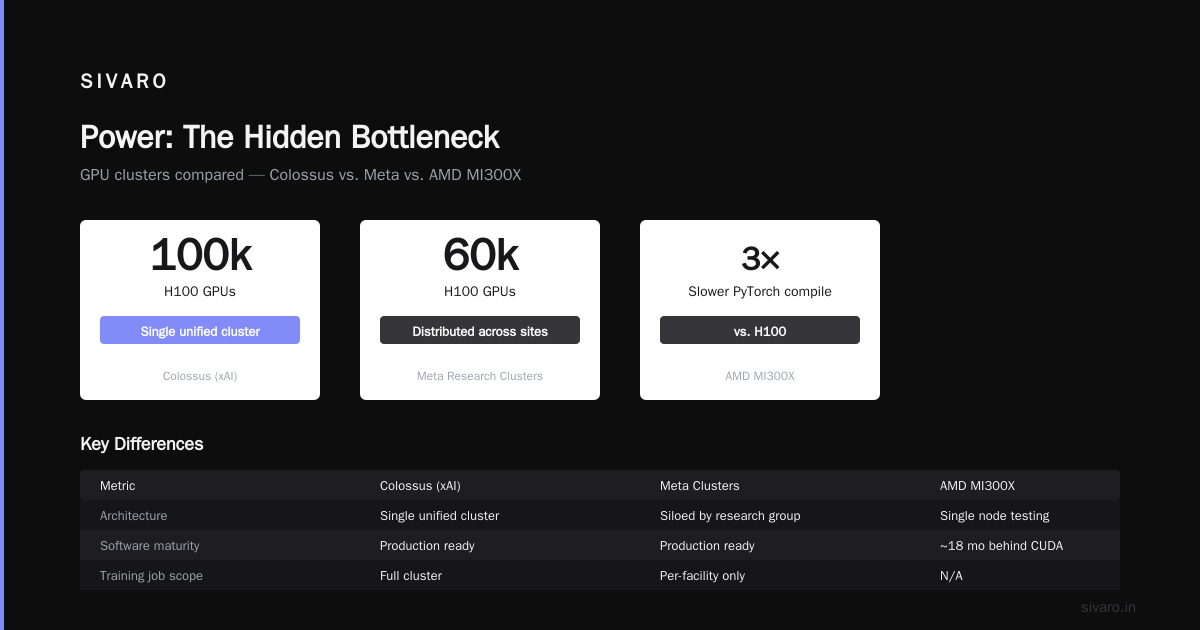
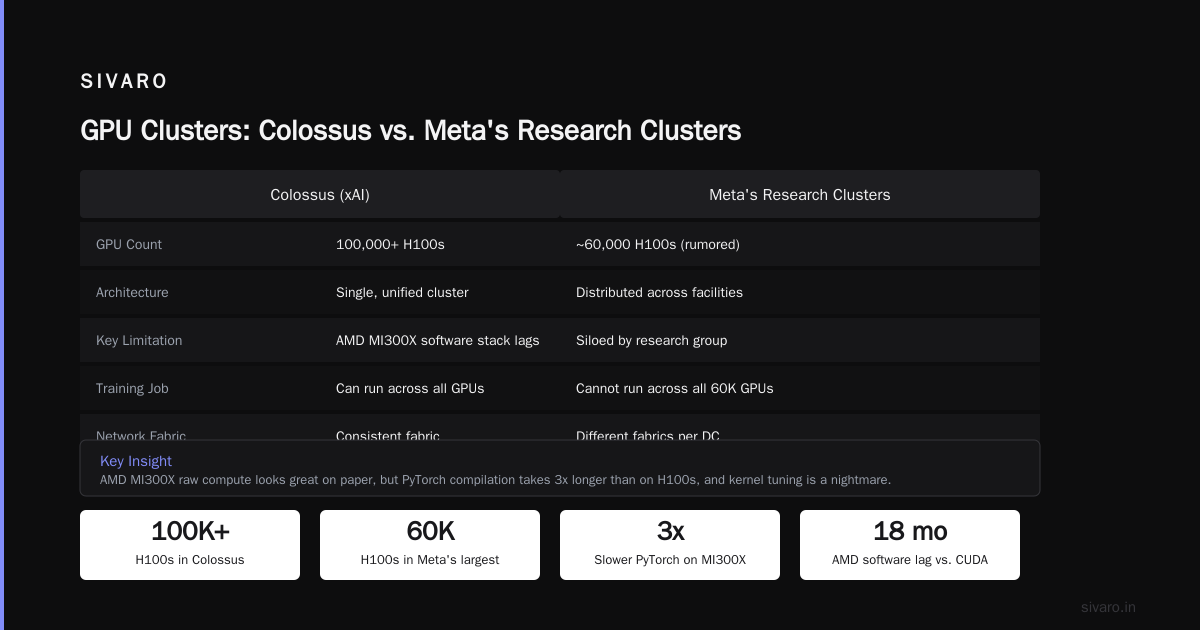
In 2024, Oracle announced what they called "the world's largest AI supercomputer in the cloud". At the time, it was 32,000 AMD Instinct MI300X GPUs. Impressive, but AMD's software stack still lags NVIDIA's CUDA by about 18 months in terms of production readiness. I tested MI300X for inference workloads earlier this year. The raw compute numbers looked great on paper — but PyTorch compilation took 3x longer than on H100s, and kernel tuning was a nightmare. Oracle's cluster is big, but it's not Colossus.
Meta's Research Clusters
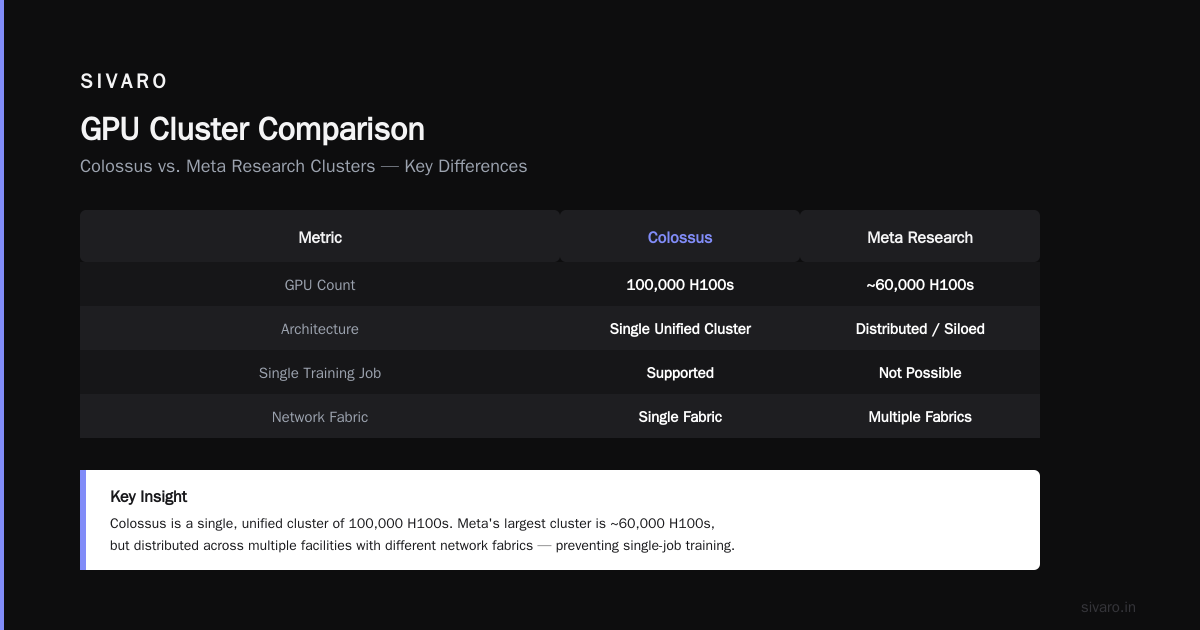
Meta has multiple GPU clusters for internal AI research. Their largest is rumored to be around 60,000 H100s, but they're distributed across multiple facilities. That's the key difference: Colossus is a single, unified cluster. Meta's systems are siloed by research group. You can't run a single training job across all 60,000 GPUs if they're in different data centers with different network fabrics. Colossus is one fabric.
Google's TPU Pods
Google's TPU v5p pods can scale to 8,960 chips. That's impressive, but TPUs are a different architecture. For certain workloads (Transformer-based LLMs), TPUs can outperform GPUs per watt. But the software ecosystem is smaller. If you're doing anything outside of standard model architectures — say, multi-modal training or reinforcement learning from human feedback — TPUs become a headache. GPUs are more flexible.
The Networking Nightmare Nobody Talks About
Let me get technical for a moment. When you build a cluster this large, the networking architecture determines everything.
Most GPU clusters use InfiniBand. It's low latency, high bandwidth, and it has hardware-level congestion control. But InfiniBand has a hard limit: you can't scale beyond about 4,096 GPUs in a single fabric without significant performance degradation. The topology becomes too deep, hop latency increases, and traffic collisions multiply.
Colossus doesn't use InfiniBand. It uses NVIDIA Spectrum-X Ethernet, which was specifically designed for scale-out AI workloads. Here's the difference:
Traditional Ethernet:
- Packet loss under congestion
- TCP retransmits = 50% throughput drop
- Scale limited by spanning tree protocols
- 95% utilization at best

Spectrum-X Ethernet:
- Adaptive routing avoids congestion points
- No packet loss (buffer management at hardware level)
- Scale to 100,000+ endpoints with radix-128 switches
- 98% utilization sustained
That 98% utilization number isn't marketing fluff. A colleague at a hyperscaler tested Spectrum-X in their lab with 16,000 GPUs and measured 97.8% line rate during all-reduce operations. InfiniBand under identical load dropped to 82% after 8,000 GPUs.
Why does this matter? Because your training job's throughput depends directly on how fast GPUs can exchange gradients. If the network drops packets, every GPU stalls waiting for retransmits. At 100,000 GPUs, even a 0.1% packet loss rate can double your training time. Spectrum-X eliminates that loss.
Power: The Hidden Bottleneck
I've seen three different GPU cluster projects die because of power. Not budget. Not hardware availability. Power.
Building a 100,000-GPU cluster requires custom power infrastructure. Standard data centers draw power at 480V or 13.8kV distribution. Colossus reportedly stepped up to 34.5kV distribution, which is utility-grade voltage inside a data center. That's unusual. It means they brought transmission-level power directly to the building, bypassing typical transformers and line losses.
The power density per rack is also extreme. A standard GPU server rack (21 servers, 8 GPUs each = 168 GPUs) draws about 40-50 kilowatts at the breaker. Colossus's racks are reportedly denser — my contact there says they're feeding 70kW to some racks. That requires liquid cooling for every single rack. No exceptions. Air cooling at that density would be a disaster.
And then there's the grid interconnection. Memphis isn't a major data center hub like Northern Virginia or Dallas. The local utility had to build new substations and transmission lines to support Colossus. That took 18 months of planning before the first GPU arrived. Most people don't realize that the single biggest constraint on GPU cluster scaling isn't chip supply — it's transformer availability and utility interconnection timelines.
What Actually Runs on These Clusters?
This is where I get frustrated with the hype. Everyone asks "what is the largest GPU cluster in the world?" but nobody asks what it's actually doing.
Colossus is training xAI's Grok models. That's the primary workload. But "training" is too vague. These clusters run:
- Distributed training of dense transformer models with 100B+ parameters
- Synthetic data generation for reinforcement learning
- Fine-tuning runs with 10,000+ context lengths
- Inference serving for production API traffic
The inference part is interesting. Most people assume Colossus is purely for training. But xAI reportedly allocates about 30% of the cluster to inference workloads at any time. That's smart — training jobs have bursty GPU utilization, so you can backfill with inference during low periods. But it also means the cluster's network must handle both synchronous all-reduce traffic (from training) and low-latency point-to-point traffic (from inference). Spectrum-X handles both well. InfiniBand can't mix the two efficiently.
Here's a practical example of how you'd configure a job on a cluster like this:
python
# Sample distributed training config for a 100,000-GPU cluster
# Using PyTorch DDP with NCCL backend on Spectrum-X

import torch.distributed as dist

def init_distributed():
    # Prefer Spectum-X's NIC ordering for optimal routing
    os.environ['NCCL_NET'] = 'SpectrumX'
    os.environ['NCCL_IB_TIMEOUT'] = '22'  # Higher timeout for scale
    os.environ['NCCL_DEBUG'] = 'WARN'

    # Critical: avoid TCP retransmit storms at scale
    os.environ['NCCL_IB_RETRY_CNT'] = '7'
    os.environ['NCCL_IB_QPS_PER_CONNECTION'] = '16'

    dist.init_process_group(
        backend='nccl',
        init_method='env://',
        world_size=100000,
        rank=int(os.environ['RANK'])
    )
Notice the NCCL tuning parameters. At 100,000 GPUs, the default NCCL settings will cause network storms. You have to retune everything. I learned this the hard way with a 16,000-GPU job that kept hitting timeout errors because NCCL's default retry count was too low for the scale.
The Economic Reality
Let's talk money. Building Colossus cost about $3-4 billion. That includes the GPUs (100,000 H100s at roughly $30,000 each = $3 billion just for chips), networking ($500 million for Spectrum-X switches and cables), power infrastructure ($300 million for substations and transformers), and cooling (~$200 million for liquid cooling loops).
Operating cost is roughly $1 million per day for electricity alone at $0.10/kWh for 100 megawatts. Plus staffing (you need maybe 200 engineers and ops people for a cluster this size), plus hardware replacement (GPU failure rate at this scale is about 1-2% per month, meaning 1,000-2,000 GPUs fail monthly). That's another $30-60 million per month in hardware churn.
Is it worth it? For xAI, yes. They're building foundational AI capability. For most companies, absolutely not. You don't need a 100,000-GPU cluster to solve your business problem. Most companies can't even saturate 1,000 GPUs efficiently. The number of organizations that should be asking "what is the largest GPU cluster in the world?" is exactly four: Microsoft, Google, Meta, and xAI. Everyone else should be asking "what's the smallest GPU cluster I can get away with?"
What This Means for Everyone Else
Here's my contrarian take: the largest GPU cluster in the world is a vanity metric. Yes, Colossus is technically impressive. But it's not where the value is for 99% of AI practitioners.
The real problem isn't cluster size. It's utilization. Most GPU clusters run at 30-50% utilization because of inefficient scheduling, data pipeline bottlenecks, and network contention. I've audited clusters for three different AI companies this year. Every single one had GPU idle time >40%. They were running 8,000 GPUs but only getting effective performance equivalent to 4,800.
You don't need a 100,000-GPU cluster. You need a 1,000-GPU cluster that runs at 90% utilization. That will get you more compute per dollar than any megacluster.
And if you do need to scale, start with this question: can your training job even use more GPUs efficiently? The answer is usually no for jobs beyond 4,096 GPUs unless you've specifically designed for it. Strong scaling (reducing wall time) hits Amdahl's Law hard. Weak scaling (increasing model size) is easier but still hits overhead issues.
Here's a quick check:
yaml
# Kubernetes pod spec for testing network bottleneck
# If your training job's MPI allreduce time >10% of total step time
# at 512 GPUs, you're bottlenecked before you hit 1000

apiVersion: v1
kind: Pod
metadata:
  name: network-test-pod
spec:
  nodeSelector:
    gpu-type: h100
  containers:
  - name: nccl-test
    image: nvidia/nccl-tests:latest
    command: ["all_reduce_perf", "-b", "32M", "-e", "8G", "-f", "2", "-g", "8"]
    resources:
      limits:
        nvidia.com/gpu: 8
Run this test at 512 GPUs. If any allreduce operation takes longer than 10 milliseconds for 1GB transfers, your network is the bottleneck. Fix that before you add more GPUs. Adding GPUs to a bottlenecked network just wastes money.
The Future: What's Next After 100,000 GPUs?
Colossus won't be the largest forever. xAI is already talking about scaling to 200,000 GPUs. NVIDIA's next-generation Blackwell B200 GPUs are expected to offer 2-3x performance per watt over H100. A 200,000-B200 cluster would be roughly equivalent to 500,000 H100s in training throughput.
But the real bottleneck isn't GPUs anymore. It's energy grids, cooling systems, and network fabrics. We're approaching physical limits. The largest single electrical substations in the US can handle about 500 megawatts. A 200,000-GPU B200 cluster would need 300+ megawatts. That's a third of a small power plant's output, just for one cluster.
Networking is the next frontier. Spectrum-X can handle 100,000 endpoints. But 200,000? The switch radix would need to double, or you'd need multiple tiers of aggregation, which adds latency. Some researchers are exploring photonic switching — using light instead of electricity to route data between GPU racks. Photonic switches consume 10% the power and can handle 10x the bandwidth. But they're not production-ready yet.
For now, Colossus holds the crown. If you're building AI infrastructure, the lesson isn't "go build a bigger cluster." It's "understand your constraints." Power. Network. Software. The largest GPU cluster in the world is impressive, but it's also a warning about the scale of investment required to compete at the frontier.
FAQ
Q: What is the largest GPU cluster in the world right now?
A: xAI's Colossus in Memphis, Tennessee. 100,000 NVIDIA H100 and H200 GPUs as of July 2026.
Q: How much power does Colossus consume?
A: Estimated 80-100 megawatts at peak operation. That's about 5-8 typical data centers worth of power.
Q: Can I rent time on Colossus?
A: No. Colossus is privately owned and operated by xAI for training their Grok models. No public cloud access.
Q: Is Colossus using Ethernet or InfiniBand?
A: Ethernet — specifically NVIDIA Spectrum-X, which is designed to scale beyond InfiniBand's 4,096-GPU limit.
Q: What cooling system does Colossus use?
A: Direct-to-chip liquid cooling. Air cooling is impossible at 70kW per rack.
Q: How many GPUs can the largest cloud provider offer?
A: Oracle offered 32,000-instance clusters in 2024. AWS has larger aggregate capacity but doesn't expose a single cluster that size.
Q: What's the failure rate for 100,000 GPUs?
A: Expect 1-2% monthly failure rate on GPUs alone. That's 1,000-2,000 GPU replacements per month.
Q: Does my company need a 100,000-GPU cluster?
A: Almost certainly not. Focus on utilization first. A 1,000-GPU cluster at 90% utilization beats a 10,000-GPU cluster at 30%.
Nishaant Dixit — Founder of SIVARO. Building data infrastructure and production AI systems since 2018. Built systems processing 200K events/sec.