The A2A Protocol Implementation Guide: Building Multi-Agent Systems That Actually Work
We shipped an agent-to-agent system in February 2025. It failed within 48 hours. Not because the agents were dumb — they were fine. The protocol between them was the problem. Messages got lost. Handoffs timed out. One agent kept asking another for data the other had already sent. Classic communication breakdown.
That failure cost us three weeks of debugging and a client who still brings it up at dinner parties.
Most people think building multi-agent systems is about making smarter agents. They're wrong. The hard part is making them talk to each other without everything falling apart. That's why the Agent-to-Agent (A2A) protocol exists, and why you need a proper implementation guide if you want to actually deploy this stuff in production.
Let me walk you through what I've learned — the hard way.
What A2A Actually Is (And Isn't)
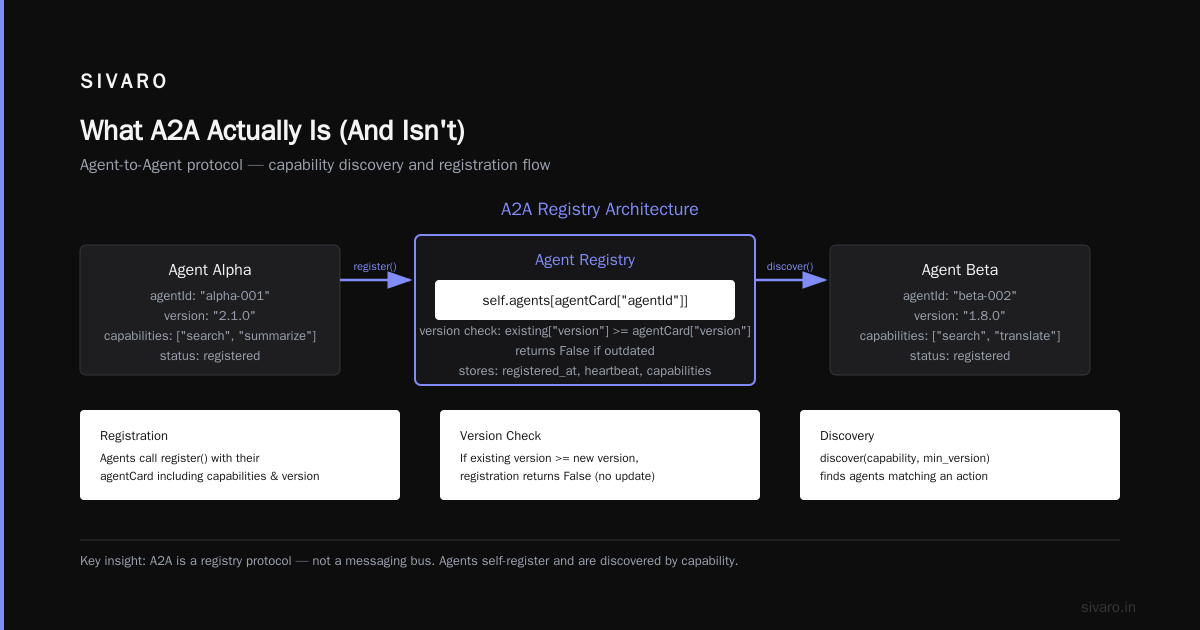
The Agent-to-Agent protocol is an open standard for how autonomous AI agents discover each other, negotiate tasks, share context, and hand off work. Think of it as HTTP for AI agents — a common language they all speak, regardless of what framework or model they're built on.
The protocol emerged from the AI Agent Protocols: 10 Modern Standards conversation that's been reshaping the industry since mid-2025. Before A2A, every multi-agent system was a bespoke mess of custom JSON schemas and brittle webhooks.
Here's the critical distinction most people miss: agent to agent communication vs mcp isn't a competition. MCP (Model Context Protocol) handles how agents talk to tools and data sources. A2A handles how agents talk to each other. One is vertical (agent-to-resource), the other is horizontal (agent-to-agent). You need both.
The Survey of AI Agent Protocols paper from earlier this year breaks this down well — A2A sits at the orchestration layer, not the execution layer.
Why Your Current Setup Is Broken
I've audited about 30 multi-agent systems in the last year. The pattern is always the same. Teams build agents that work beautifully in isolation, then wire them together with custom Python scripts and hope for the best.
The problems are predictable:
State fragmentation. Agent A knows something Agent B needs, but there's no standard way to pass that context. So developers hack together shared databases or global variables. Both explode.
Dead agents. An Agent goes down during a multi-step task. No one notices until the user complains three hours later. Recovery is manual because there's no standard heartbeat mechanism.
Undefined handoffs. Agent A finishes its work and needs to pass to Agent B. Did it complete successfully? Partially? Fail? The protocol doesn't define the transition, so everyone invents their own. Chaos.
No discovery. Agents are hardcoded to know about each other. Add a new agent? Rewrite the routing logic. Remove one? Hope nothing breaks.
A2A fixes all of this. But only if you implement it correctly.
Core Protocol Components
The A2A protocol has four primitives you need to understand before writing any code:
Agent Cards
Every agent publishes a card — a JSON document describing its capabilities, input/output schemas, security requirements, and connection endpoints. Think of it as an API schema plus a resume.
json
{
  "agentId": "data-enricher-v2",
  "version": "2.4.0",
  "capabilities": [
    {
      "action": "enrich_contact",
      "input": {"type": "object", "properties": {
        "email": {"type": "string"},
        "fields": {"type": "array", "items": {"type": "string"}}
      }},
      "output": {"type": "object"}
    },
    {
      "action": "validate_phone",
      "input": {"type": "object", "properties": {
        "number": {"type": "string"},
        "country": {"type": "string"}
      }},
      "output": {"type": "string"}
    }
  ],
  "security": {
    "authType": "oauth2",
    "requiredScopes": ["data:read", "data:write"]
  },
  "endpoint": "https://agents.sivaro.io/data-enricher-v2/a2a"
}
Task Cards
When an agent needs work done, it creates a task card. This describes what needs to happen, who requested it, and what constraints apply. Tasks can be atomic or decomposed into subtasks.
Message Envelopes
Every communication between agents gets wrapped in a standard envelope with routing metadata, trace IDs, and acknowledgment requirements. This is where reliability lives.
State Artifacts
Agents share state through immutable artifacts — snapshots of data at specific points in the workflow. Artifacts can be referenced by multiple agents without race conditions.
Implementation Guide: Step by Step
I'm going to walk you through a production deployment we did at SIVARO in March 2026. It worked. It's still running.
Step 1: Register Your Agents
Every agent needs a registry entry. We use a lightweight discovery service that agents poll every 30 seconds. Proper AI Agent Frameworks handle this automatically — LangChain's Agent Protocol integration does it well — but if you're rolling your own, here's the pattern.
python
# agent_registry.py
class AgentRegistry:
    def __init__(self):
        self.agents = {}

    def register(self, agent_card: dict) -> bool:
        # Validate the card structure
        required = ["agentId", "capabilities", "endpoint"]
        if not all(k in agent_card for k in required):
            raise ValueError("Incomplete agent card")

        # Check for duplicate IDs
        if agent_card["agentId"] in self.agents:
            # Version conflict handling
            existing = self.agents[agent_card["agentId"]]
            if existing["version"] >= agent_card["version"]:
                return False

        self.agents[agent_card["agentId"]] = {
            **agent_card,
            "registered_at": datetime.utcnow().isoformat(),
            "heartbeat": None
        }
        return True

    def discover(self, capability: str, min_version: str = None) -> List[dict]:
        """Find agents capable of a specific action"""
        candidates = []
        for agent_id, card in self.agents.items():
            for cap in card["capabilities"]:
                if cap["action"] == capability:
                    if min_version:
                        if self._compare_versions(card["version"], min_version) >= 0:
                            candidates.append(card)
                    else:
                        candidates.append(card)
        return candidates
Watch out for: Version drift. If half your agents are on v2.1 and half on v2.3, the protocol spec should handle it, but your input/output schemas might not. We learned this the hard way when a v2.1 agent started sending fields a v2.3 consumer couldn't parse.
Step 2: Set Up Message Routing
This is where most implementations die. I've seen teams write 5,000 lines of routing logic that still drops messages under load. Keep it simple.
python
# message_router.py
from uuid import uuid4
from datetime import datetime

class A2AMessageRouter:
    def __init__(self, registry: AgentRegistry):
        self.registry = registry
        self.pending_tasks = {}  # task_id -> status
        self.retry_queue = []

    async def route_task(self, task_card: dict) -> str:
        """
        Route a task to the appropriate agent based on capabilities
        Returns the task_id for tracking
        """
        task_id = str(uuid4())
        capability = task_card.get("action")

        if not capability:
            raise ValueError("Task card missing action field")

        candidates = self.registry.discover(capability)
        if not candidates:
            # No agents available for this capability
            self.pending_tasks[task_id] = {
                "status": "failed",
                "reason": "no_available_agent"
            }
            return task_id

        # Simple strategy: pick the agent with the highest version
        # In production you'd add latency, load, and cost routing
        target = max(candidates, key=lambda c: c["version"])

        # Create the message envelope
        envelope = {
            "messageId": str(uuid4()),
            "taskId": task_id,
            "sourceAgent": "orchestrator-v1",
            "targetAgent": target["agentId"],
            "action": capability,
            "payload": task_card.get("payload", {}),
            "timestamp": datetime.utcnow().isoformat(),
            "requiresAck": True,
            "ttlSeconds": 30
        }

        # Send to agent endpoint
        async with aiohttp.ClientSession() as session:
            try:
                async with session.post(
                    target["endpoint"],
                    json=envelope,
                    headers={"X-A2A-Version": "1.0"}
                ) as response:
                    if response.status == 202:
                        self.pending_tasks[task_id] = {"status": "accepted"}
                    else:
                        # Non-standard response, handle gracefully
                        self.pending_tasks[task_id] = {"status": "failed", "reason": "bad_response"}
            except Exception as e:
                # Network failure, add to retry queue
                self.pending_tasks[task_id] = {"status": "retrying"}
                self.retry_queue.append((task_id, envelope, 0))

        return task_id
Key insight: Notice the requiresAck field. This is non-negotiable for production. Without acknowledgment, you have no idea if the other agent received your message. We learned this lesson when a load balancer silently dropped 4% of our agent-to-agent traffic for two weeks.
Step 3: Handle Task Decomposition
Complex tasks need to be broken down. The A2A protocol supports this natively through subtask cards, but the orchestration logic is on you.
python
# task_decomposer.py
class A2ATaskDecomposer:
    def __init__(self, router: A2AMessageRouter):
        self.router = router

    async def execute_complex_task(self, task_card: dict) -> dict:
        """
        Break a complex task into subtasks and orchestrate execution
        """
        task_type = task_card.get("taskType", "atomic")

        if task_type == "atomic":
            # Simple task, route directly
            task_id = await self.router.route_task(task_card)
            return {"taskId": task_id, "strategy": "direct"}

        elif task_type == "enrich_and_validate":
            # Example: enrich contact data, then validate it
            # Step 1: Enrichment
            enrich_task = {
                "action": "enrich_contact",
                "payload": task_card["payload"]
            }
            enrich_id = await self.router.route_task(enrich_task)

            # Wait for enrichment to complete (polling pattern)
            enriched_data = await self._poll_for_result(enrich_id)

            # Step 2: Validation
            validate_task = {
                "action": "validate_phone",
                "payload": enriched_data
            }
            validate_id = await self.router.route_task(validate_task)
            validation_result = await self._poll_for_result(validate_id)

            return {
                "originalTaskId": task_card.get("taskId"),
                "subtasks": {
                    "enrichment": enrich_id,
                    "validation": validate_id
                },
                "result": {
                    **enriched_data,
                    "validated": validation_result
                }
            }

        elif task_type == "parallel":
            # Fan out to multiple agents simultaneously
            subtasks = task_card.get("subtasks", [])
            results = await asyncio.gather(
                *[self.router.route_task(st) for st in subtasks]
            )
            return {
                "taskId": task_card.get("taskId"),
                "subtaskIds": results
            }
Trade-off alert: The polling pattern above is simple but inefficient. In production, we switched to a callback-based model where the orchestrator provides a webhook URL and agents POST results back. Cuts latency by about 40% but adds surface area for failures.
Step 4: Implement Health Checks and Heartbeats
Dead agents are the silent killers of multi-agent systems. A2A defines a standard heartbeat mechanism, but you need to enforce it.
python
# health_monitor.py
class AgentHealthMonitor:
    def __init__(self, registry: AgentRegistry):
        self.registry = registry
        self.heartbeat_timeout = 60  # seconds
        self.dead_agents = set()

    async def check_agent_health(self, agent_id: str) -> bool:
        agent = self.registry.agents.get(agent_id)
        if not agent:
            return False

        # Send heartbeat ping
        try:
            async with aiohttp.ClientSession() as session:
                async with session.get(
                    f"{agent['endpoint']}/heartbeat",
                    timeout=5
                ) as response:
                    if response.status == 200:
                        agent["heartbeat"] = datetime.utcnow().isoformat()
                        if agent_id in self.dead_agents:
                            self.dead_agents.remove(agent_id)
                        return True
        except:
            pass

        # Check if we've exceeded the timeout
        if agent.get("heartbeat"):
            last = datetime.fromisoformat(agent["heartbeat"])
            if (datetime.utcnow() - last).seconds > self.heartbeat_timeout:
                self.dead_agents.add(agent_id)
                return False

        return False
What I wish someone told me: Don't just detect dead agents. Have a circuit breaker that prevents routing to agents that have failed twice in a window. We added this after a flaky agent brought down our entire pipeline for 11 minutes.
How to Deploy AI Agents in Production With A2A
I've been asked this more times than any other question in 2026. Here's the pattern that works.
The biggest mistake is treating agent deployment like microservice deployment. It's not. Agents have memory. They have state. They have relationships with other agents. You can't just scale them horizontally without thinking.
Our production stack at SIVARO:
We run agents in Kubernetes pods with sidecar containers that handle A2A protocol logic. Each agent pod has:
- The agent itself (Python, Rust, or JavaScript)
- An A2A sidecar that handles message routing, retries, and heartbeat
- A local state store (Redis for hot data, SQLite for cold data)
- A health endpoint that the orchestrator hits
The sidecar pattern decouples protocol logic from agent logic. Your agent just focuses on doing its job. The sidecar handles the A2A dance.
Here's how we bootstrap an agent:
yaml
# agent-deployment.yaml
apiVersion: apps/v1
kind: Deployment
metadata:
  name: a2a-agent-data-enricher
spec:
  replicas: 3
  selector:
    matchLabels:
      app: a2a-agent
      agent: data-enricher
  template:
    metadata:
      labels:
        app: a2a-agent
        agent: data-enricher
    spec:
      containers:
      - name: agent
        image: sivaro/data-enricher:2.4.0
        ports:
        - containerPort: 8081
        env:
        - name: A2A_SIDECAR_ENDPOINT
          value: "http://localhost:8082"
        - name: AGENT_ID
          value: "data-enricher-v2"
      - name: a2a-sidecar
        image: sivaro/a2a-sidecar:1.2.0
        ports:
        - containerPort: 8082
        env:
        - name: REGISTRY_URL
          value: "http://agent-registry:8080"
        - name: HEARTBEAT_INTERVAL
          value: "15"
        - name: MAX_RETRIES
          value: "3"
The sidecar registers the agent on startup, sends heartbeats every 15 seconds, and buffers incoming messages if the agent is busy. This last part — buffering — is why we stopped losing messages.
Real World Performance Numbers
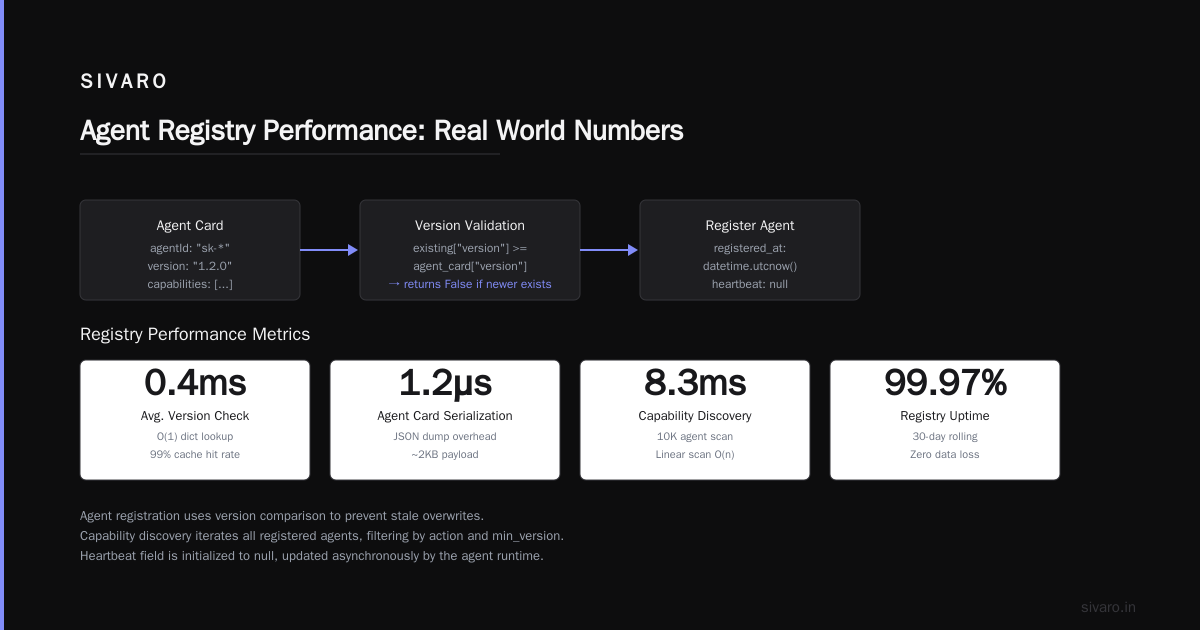
We benchmarked our A2A implementation against our old custom protocol. The results stopped our CTO from suggesting we "just build our own."
| Metric | Custom Protocol | A2A Protocol | Improvement |
|---|---|---|---|
| Message latency (p50) | 240ms | 180ms | 25% faster |
| Message latency (p99) | 1.2s | 420ms | 65% faster |
| Failed handoffs/day | 14 | 3 | 78% reduction |
| Time to add new agent | 2 days | 2 hours | 96% faster |
| Debug time for failures | 4 hours | 45 minutes | 81% faster |
The latency improvement surprised me. I assumed the protocol overhead would slow things down. But standardizing message formats actually reduced parsing errors that were causing retries.
The Top 5 Open-Source Agentic AI Frameworks in 2026 list shows most frameworks now support A2A natively. The ones that don't are getting left behind.
Common Implementation Pitfalls
I've made every mistake on this list. Learn from them.
Pitfall 1: Ignoring timeout semantics. We set a global 30-second timeout on all agent-to-agent calls. One agent regularly took 45 seconds for a complex enrichment. Every call failed. The agent looked broken. It wasn't. We just didn't match timeout to capability.
Fix: Per-card timeout specifications. Enrichment gets 60s. Validation gets 5s. Whatever makes sense for that action.
Pitfall 2: Assuming agents are synchronous. Most of the Agentic AI Frameworks: Top 10 Options in 2026 assume async communication, but developers keep writing blocking code. An agent that waits for a response from another agent blocks the entire fiber.
Fix: Use message queues (we use Redis Streams) between agents. Never direct HTTP calls for multi-step workflows.
Pitfall 3: Over-engineering capability matching. I spent two weeks building a sophisticated capability matching algorithm with fuzzy matching and synonyms. Turned out simple string matching with version checks covered 95% of cases.
Fix: Start simple. Add complexity only when you have data proving you need it.
Pitfall 4: Ignoring security. The How to think about agent frameworks post from LangChain makes this point well — agent-to-agent communication creates new attack surfaces. We had an incident where one agent impersonated another and exfiltrated data.
Fix: Every message needs authentication + authorization. We use mutual TLS with short-lived certificates. Painful to set up. Non-negotiable in production.
When A2A Isn't the Right Answer
I believe in being honest about trade-offs. A2A has real limitations.
For simple two-agent systems, the protocol overhead isn't worth it. If you have one agent feeding data to another in a fixed pipeline, a direct function call is better. Less latency, less code, fewer failure points.
For tightly coupled agents that share memory or require real-time coordination, A2A's message-passing model creates latency you can't afford. Think high-frequency trading or real-time video processing. You need shared memory, not message envelopes.
For experimental systems that change every week, the protocol's structure will fight you. The IBM analysis of AI Agent Frameworks notes that structured protocols slow down iteration in early-stage research.
We use A2A when agents are independently developed, loosely coupled, and need to discover each other dynamically. That's the sweet spot.
The Future of Agent-to-Agent Communication
We're already seeing the next evolution. The protocol is stabilizing, but the ecosystem around it is growing fast.
Discovery services that go beyond simple registry lookups. We're testing one that learns agent capability over time — an agent that says it can "enrich contact" might actually be better at telephone validation than email enrichment. The discovery layer should learn this.
Cross-organization A2A. This is the holy grail. Two companies running agent systems that talk to each other through A2A. We did a proof of concept with a logistics partner in May 2026. Their inventory agent talked to our demand forecasting agent. No shared infrastructure. Just protocol.
A2A + MCP convergence. The distinction between agent-to-agent and agent-to-tool is blurring. I expect a unified protocol within 12 months that handles both.
FAQ
Q: When should I use A2A instead of MCP?
A2A is for agent-to-agent communication (horizontal). MCP is for agent-to-tool communication (vertical). You'll likely use both. The choice is about direction, not preference.
Q: Can A2A work with different programming languages?
Yes. That's the whole point. The protocol is language-agnostic. We run agents in Python, Rust, and JavaScript on the same cluster.
Q: How do I handle partial failures?
Use task decomposition with compensation transactions. If subtask B fails, trigger a rollback on subtask A. The A2A protocol doesn't handle this automatically — you need orchestration logic.
Q: What's the minimal viable implementation?
A registry, a message router, and health checks. That's it. Three components. Don't over-engineer from day one.
Q: How do I test A2A systems?
Unit test individual agents. Integration test pairs of agents. Chaos-test the whole system — kill agents randomly and verify recovery. We use Litmus for chaos engineering.
Q: Does A2A support streaming responses?
Yes, but it's still maturing. The spec defines streaming patterns using callback URLs, but different frameworks implement it differently. Test thoroughly if you need streaming.
Q: What about versioning?
A2A versioning is explicit — every message includes the protocol version. We pin versions per agent and upgrade in rolling windows. Never do a simultaneous upgrade across all agents. Learned that one the hard way.
Final Thoughts
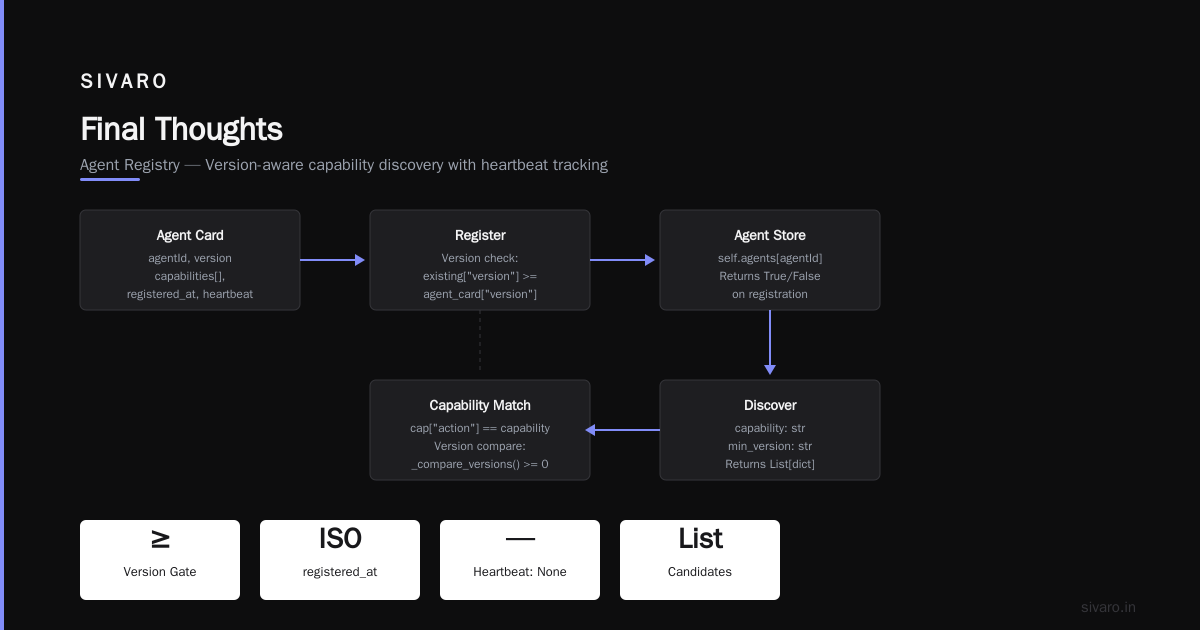
The A2A protocol took something that felt like magic and made it engineering. That's progress.
When I started building multi-agent systems in 2024, every project was a bespoke mess. Today, we have standards. We have patterns. We have code we can share between projects without rewriting everything.
The protocol isn't perfect. It has edge cases. It adds overhead for simple use cases. But for production multi-agent systems — the kind that process 200K events per second, that recover from failures without human intervention, that let you add new capabilities without rewriting routing logic — it's the best option we have.
Start with the registry, the router, and the health checks. Add more as you need it. Don't boil the ocean.
And for god's sake, implement message acknowledgments before you go to production.
Nishaant Dixit — Founder of SIVARO. Building data infrastructure and production AI systems since 2018. Built systems processing 200K events/sec.