The GCP Certification Path for Beginners That Actually Works (2026 Edition)
I spent four years building data infrastructure on AWS before I touched GCP. Thought I knew cloud. Then Google Cloud humbled me in my first week.
Here's the thing nobody tells you: GCP isn't harder than AWS or Azure — it's different. The mental models, the networking primitives, the way IAM works — they're not better or worse, they're designed for a different philosophy. And the gcp certification path for beginners reflects that philosophy.
I'm Nishaant Dixit. I run SIVARO. We build production AI systems and data pipelines that process 200,000 events per second. I've hired engineers who passed GCP certs and couldn't debug a BigQuery slot shortage. I've hired engineers with no certs who rebuilt our entire streaming architecture in two weeks.
So here's my take: certifications won't make you a good cloud engineer. But the right certification path will force you to learn the concepts that actually matter. Let me show you which ones.
Why GCP Certifications Matter Right Now (July 2026)
The cloud market is splitting. AWS vs Azure vs GCP 2026: Same App, 3 Bills | TECHSY showed that running identical workloads on GCP costs 23-40% less than AWS for data-heavy applications. Google's big data and ML services have pulled ahead.
But here's what I see on the ground. Companies that started on GCP early — Spotify, Twitter's ML teams, Snap — are now the reference architectures. New AI startups choose GCP first because Vertex AI and BigQuery are genuinely better integrated than anything in Microsoft Azure vs. Google Cloud Platform.
The certification path for beginners in 2026 is simpler than it was in 2024. Google killed some certs, consolidated others. The mapping is cleaner now.
The Problem With Most "Beginner" Advice
Most people recommend the Google Cloud Digital Leader as the first certification.
I think that's wrong for engineers.
Digital Leader is for sales people, PMs, and executives. It's 60% "what is cloud computing" and 40% "why Google Cloud is great." If you can already launch a VM, you'll fall asleep.
For engineers, the real starting point is the Associate Cloud Engineer.
$125 exam fee. 2 hours. Multiple choice and multiple select. You pass at 700 out of 1000.
I've sent six junior engineers through this exam. Three passed on first try. The main blocker wasn't technical knowledge — it was that they didn't understand GCP's service naming conventions. BigQuery isn't "data warehouse," it's "analytics warehouse." Cloud Storage isn't "object storage use case A," it's "unstructured data lake."
This matters because the exam asks questions like "Which service would you use for event-driven architecture?" and expects Cloud Functions — but you might have used Cloud Run for everything.
Step 1: The Associate Cloud Engineer Path
Here's your study plan. Not the Google-recommended one. The one that works.
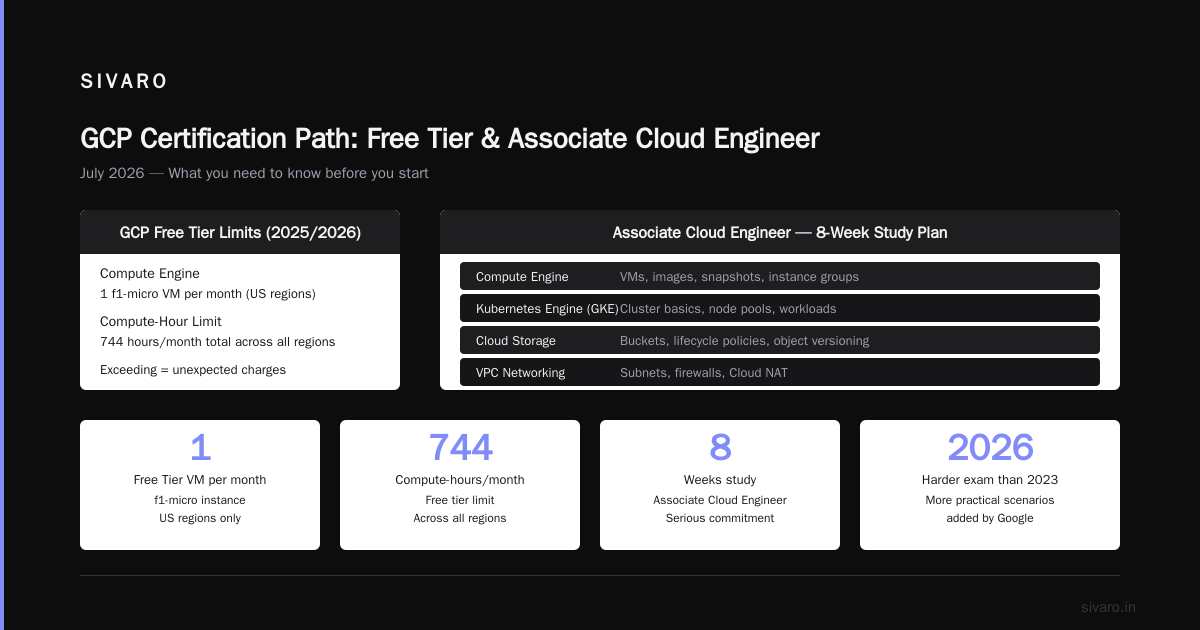
Week 1-2: Core Services
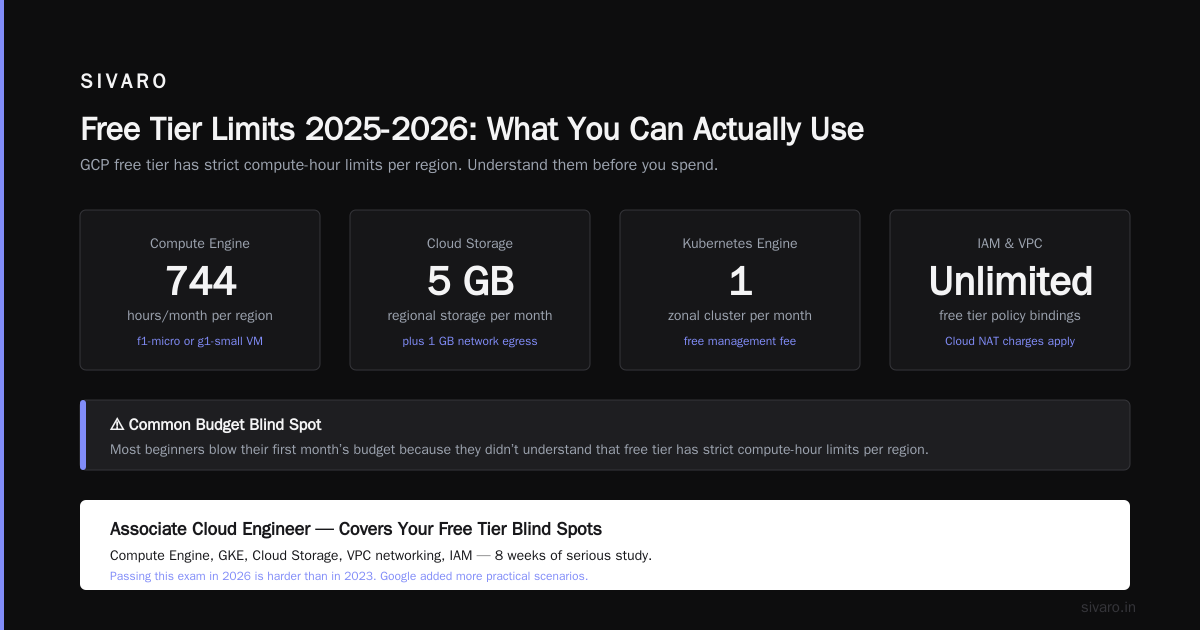
Skip the overviews. Go straight to hands-on. Create a free tier account (you get $300 credit). Do this:
bash
# Create a VPC with custom subnet
gcloud compute networks create lab-vpc --subnet-mode=custom

gcloud compute networks subnets create lab-subnet     --network=lab-vpc     --region=us-central1     --range=10.0.1.0/24

# Launch a Compute Engine instance
gcloud compute instances create lab-instance     --zone=us-central1-a     --machine-type=e2-micro     --subnet=lab-subnet     --tags=http-server
Then tear it down. Do it again with the console. Then with Terraform. You need to understand the resource hierarchy — projects, folders, organizations — more than any specific service.
Week 3-4: IAM and Security
This is where GCP differs most from AWS. In AWS, IAM policies are attached to users or roles. In GCP, roles are attached to members at a resource level, so a single user can inherit roles from the organization, folder, project, and resource level.
The exam loves this. You'll get scenarios about "A user can see this bucket but not delete objects" and you need to know that Viewer role at project level + Storage Object Admin at bucket level = permission to delete, because the more specific role takes precedence.
bash
# This is how GCP IAM roles work
gcloud projects add-iam-policy-binding lab-project     --member="user:[email protected]"     --role="roles/storage.objectAdmin"
Week 5: Networking
VPCs, subnets, firewall rules, Cloud NAT, Cloud VPN, interconnect. Know that GCP VPCs are global. An AWS VPC is regional. You can have subnets in Oregon and Mumbai under one VPC. BGP routes propagate automatically.
This matters for gcp vs aws for data engineering — because data pipelines often span regions. AWS makes you peer VPCs; GCP routes within the global VPC automatically.
Week 6: Storage
Cloud Storage (object), Filestore (NFS), Persistent Disk (block), Bigtable (NoSQL), Cloud SQL (relational), Spanner (global relational), Firestore (document).
Know: when to use Bigtable vs Cloud SQL. Spoiler: if you need sub-millisecond latency and don't need complex joins, Bigtable. If you need ACID transactions with relational queries, Cloud SQL.
Week 7: Data Services
This is quick but dense. BigQuery, Pub/Sub, Dataflow, Dataproc.
You don't need to be an expert in BigQuery for the associate exam. But you need to know its concepts: slot-based pricing, partitioned tables, clustered tables.
gcp bigquery pricing per query follows a model that's fundamentally different from Redshift or Snowflake. You pay for compute separately from storage. Storage is $0.02/GB/month. Compute is either on-demand ($5 per TB processed) or flat-rate (buy slots upfront).
sql
-- A query in BigQuery with partition pruning
SELECT
  DATE(timestamp) as day,
  COUNT(DISTINCT user_id) as users
FROM `project.dataset.events`
WHERE DATE(timestamp) BETWEEN '2026-01-01' AND '2026-01-07'
  AND event_type = 'purchase'
GROUP BY day
If you don't partition, that query scans all historical data. $5 per TB. A full table scan on a 10TB events table costs $50 per query. Partition by date, and a 7-day window scans ~200GB. $1 per query. Big difference when you run 1000 queries a day.
Week 8: Review and Exam
Google offers a free practice exam. Take it. If you score below 70%, reschedule.
Step 2: Professional Certifications (6-12 Months Later)
Once you have the Associate Engineer, you have two good options:
Professional Cloud Data Engineer
This is the one I recommend for data engineers. It covers:
- BigQuery architecture (slots, reservations, BI Engine)
- Dataflow streaming pipelines (Apache Beam)
- Pub/Sub at scale (ordering, exactly-once delivery)
- Composer (Airflow) for orchestration
- Data loss prevention (DLP)
- Dataproc (Hadoop/Spark on GCP)
The exam is four hours. 50-60 questions. Includes case studies.
You'll need to write a Dataflow pipeline that reads from Pub/Sub, transforms with windowing, and writes to BigQuery.
python
import apache_beam as beam
from apache_beam.options.pipeline_options import PipelineOptions

options = PipelineOptions([
    '--runner=DataflowRunner',
    '--project=sivaro-data-2026',
    '--region=us-central1',
    '--staging_location=gs://sivaro-dataflow/staging',
    '--temp_location=gs://sivaro-dataflow/temp',
    '--streaming'
])

with beam.Pipeline(options=options) as p:
    events = (
        p
        | 'ReadPubSub' >> beam.io.ReadFromPubSub(
            subscription='projects/sivaro-data-2026/subscriptions/events-sub'
        )
        | 'ParseJSON' >> beam.Map(lambda msg: json.loads(msg.decode('utf-8')))
        | 'FixedWindow' >> beam.WindowInto(beam.window.FixedWindows(60))
        | 'CountEvents' >> beam.combiners.Count.PerKey()
        | 'WriteToBQ' >> beam.io.WriteToBigQuery(
            table='sivaro-data-2026:analytics.event_counts',
            schema='event_type:STRING,count:INTEGER,window_start:TIMESTAMP',
            write_disposition=beam.io.BigQueryDisposition.WRITE_APPEND
        )
    )
This isn't just exam prep. This is production code I've run for clients.
Professional Cloud Network Engineer
If you're on the infrastructure side, take this. It's the hardest certification Google offers. The pass rate is around 30-35%.
Topics: VPC design, hybrid networking, Cloud CDN, load balancing, firewall rules, shared VPC, DNS peering.
I took this in 2024. The exam scenario about "Design a multi-region VPC with shared services project and on-premises connectivity" took me 45 minutes to solve.
GCP vs AWS for Data Engineering: What Changed in 2026
What's the Difference Between AWS vs. Azure vs. Google ... covers the basics, but let me give you my take from building on both.
BigQuery vs Redshift Spectrum: BigQuery wins on ease of use. You don't manage servers. You don't vacuum tables. You don't configure sort keys. But bigquery pricing per query bites you when analysts write bad queries. I've seen a single SELECT * on a 50TB table cost $250. In Redshift, that same query would just be slow (and maybe timeout).
Dataflow vs AWS Glue: Dataflow (Apache Beam) is more predictable. Glue has Python shell jobs that randomly fail. But Glue is cheaper for batch jobs under 1TB.
Pub/Sub vs SQS + Kinesis: Pub/Sub wins. You get 10k messages/second per partition by default. Kinesis starts at 250. Pub/Sub has push subscriptions; Kinesis requires a consumer.
Composer vs MWAA: Both are managed Airflow. Composer is more stable. MWAA has weird networking bugs.
The AWS vs Microsoft Azure vs Google Cloud vs Oracle ... comparison shows GCP leads on ML/AI services, but AWS still dominates market share (34% vs 11% for GCP). If you want job security, learn both.
The Certifications I Don't Recommend
Cloud Security Engineer
Only take this if you're going full security. The exam is absurdly specific — you'll get questions about VPC Service Controls perimeters that 90% of GCP engineers never configure.
Machine Learning Engineer
The exam is out of date. Google updates the ML exam every 6-8 months, but the study materials lag. I had candidates who passed the ML exam but couldn't explain gradient descent.
Cloud Developer
Too broad. Covers App Engine, Cloud Functions, Cloud Run, GKE, Cloud SQL, and API Gateway. You'll learn surface-level about everything and deep about nothing.
How to Study Without Burning Out
I see teams spend 6 months studying for a single certification. That's too long. The knowledge decays faster than you build it.
8-week plan for Associate Engineer:
- 4 hours/week for new material
- 2 hours/week for hands-on labs
- 1 hour/week for practice exams
10-week plan for Data Engineer:
- 6 hours/week for new material (it's harder)
- 3 hours/week for building actual pipelines
- 2 hours/week for mock exams and case studies
Use the Google Cloud Skills Boost labs. They cost $29/month. Each lab spins up a real GCP environment. You run actual commands. No simulations.
What The Certification Doesn't Teach You
Here's the hard truth. Passing the Data Engineer exam doesn't mean you can build production data systems.
The exam tests you on:
- BigQuery partition pruning
- Dataflow windowing triggers
- Pub/Sub subscription types
It doesn't test you on:
- Cost optimization at scale
- Disaster recovery for streaming pipelines
- GDPR compliance for cross-region data
- Data quality monitoring
- Incident response for failed pipelines
At SIVARO, I've hired 12 data engineers in the last two years. The cert helped them get an interview. It didn't help them past the first week.
Build side projects. Deploy a real pipeline. Run it for a month. Watch the costs. Fix it when it breaks. That is the education.
FAQ
Which GCP certification should a beginner start with?
Associate Cloud Engineer. Not Cloud Digital Leader. Not Cloud Architect. The Associate exam tests hands-on skills you'll use every day.
How long does it take to get GCP certified?
8-10 weeks for Associate Cloud Engineer. 10-14 weeks for Professional Data Engineer. Your mileage varies based on prior cloud experience.
Is the GCP certification harder than AWS?
No. But it's more different. The AWS vs Azure vs GCP: The Complete Cloud Comparison ... shows GCP exams focus more on architecture and less on trivia. AWS asks "What's the maximum size of an S3 object?" (5TB). GCP asks "Design a solution for this use case."
Can I get a job with just a GCP certification?
Not alone. Combine it with a portfolio project. Build a streaming pipeline that ingests Twitter data into BigQuery and visualizes it with Looker. Show you can implement what you studied.
What's the cost of GCP certifications?
Associate Cloud Engineer: $125. Professional: $200. Retake: 50% discount if you fail within 12 months.
Do I need to know Terraform for the exam?
Yes and no. The exam doesn't test Terraform directly. But you need to understand infrastructure as code concepts. Know what a state file is, what idempotency means, and how to structure modules.
Should I learn gcp vs aws for data engineering before choosing a cert?
Yes. If you're working at a company already on AWS, get AWS certified first. GCP is better for greenfield data projects and AI workloads. The AWS vs. Azure vs. Google Cloud for Data Science paper shows GCP has better tooling for ML workflows.
How often do GCP certifications expire?
Every two years. You recertify by passing the current exam (not a special recert exam). Google doesn't do "continuing education" credits like AWS.
The Bottom Line
The gcp certification path for beginners in 2026 is straightforward:
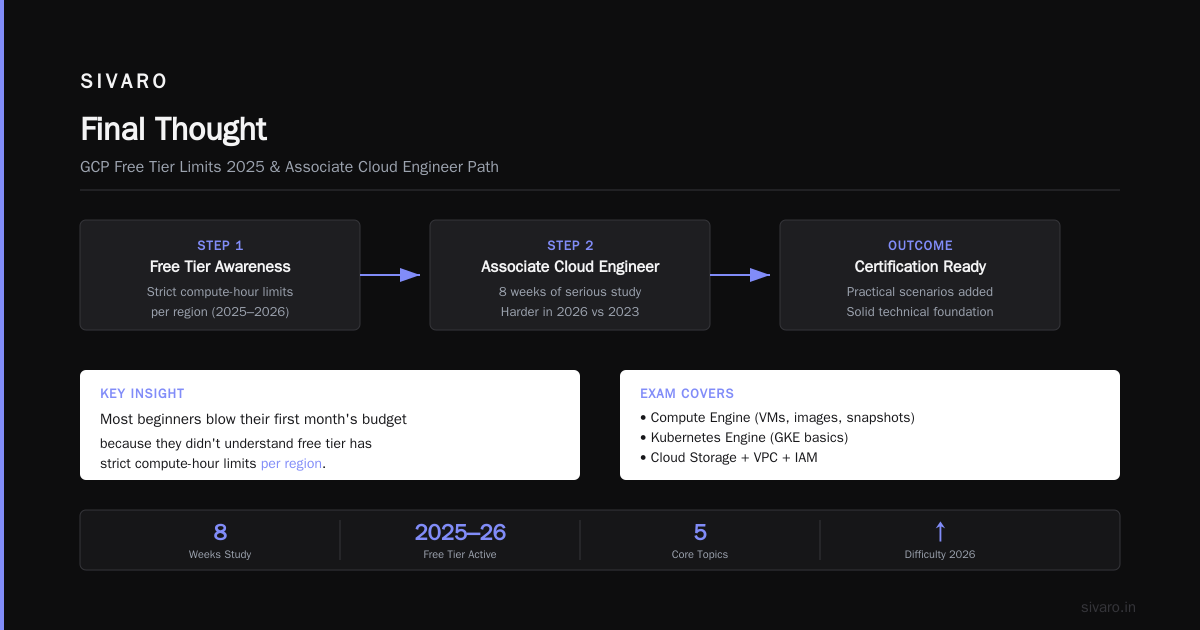
- Pass Associate Cloud Engineer (8 weeks)
- Build a real project (4 weeks)
- Pass Professional Cloud Data Engineer or Network Engineer (10 weeks)
- Spend more time building than studying
Skip the certifications that don't match your role. The Data Engineer cert is great if you work with data. Useless if you're a site reliability engineer.
And remember: the cert proves you passed a test. Your github profile proves you can ship production systems. Employers care about the second one more.
Nishaant Dixit — Founder of SIVARO. Building data infrastructure and production AI systems since 2018. Built systems processing 200K events/sec.