 SIVARO

The Only AI Orchestration Example You'll Ever Need
It was 3 AM on a Tuesday. I was staring at a production dashboard that showed three separate AI models talking to each other — but in the wrong language. Model A was outputting JSON, Model B expected pure text, and Model C had timed out waiting for both. The pipeline was a mess. Not because the models were bad. Because nobody had orchestrated them.
That's when I learned what an AI orchestration example really looks like. It's not a diagram. It's not a stack of marketing slides. It's the moment you realize your AI system is just expensive spaghetti code with a chatbot wrapper.
So let me show you exactly what AI orchestration is, what it looks like in practice, and why most companies are doing it wrong.
What the Hell Is AI Orchestration?
AI orchestration is the coordination layer that sits between your AI components and makes them work together without breaking each other.
Think of it like a traffic controller at an airport. You don't just throw planes into the sky and hope they don't crash. You route them, sequence them, and manage their dependencies. That's orchestration.
In technical terms, it's the system that manages:
- Which AI model gets called when
- How data flows between models
- What happens when a model fails
- How responses get validated and cleaned
- How the whole thing scales under load
Most people think this is a branding problem. They call it "AI orchestration" when they really mean "a Python script that calls three APIs." That's not orchestration. That's hoping.
IBM defines AI orchestration as "the process of integrating, managing, and coordinating multiple AI components and data sources to work together efficiently." Clean definition. But what does it look like in the real world?
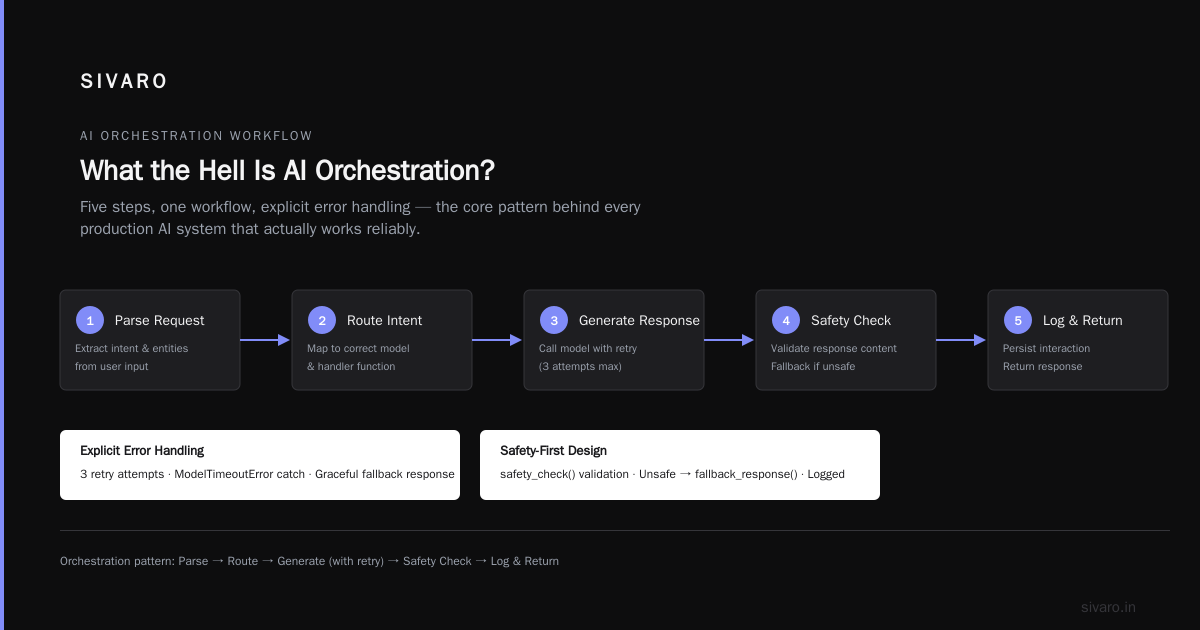
A Real AI Orchestration Example
Here's the simplest example that actually matters.
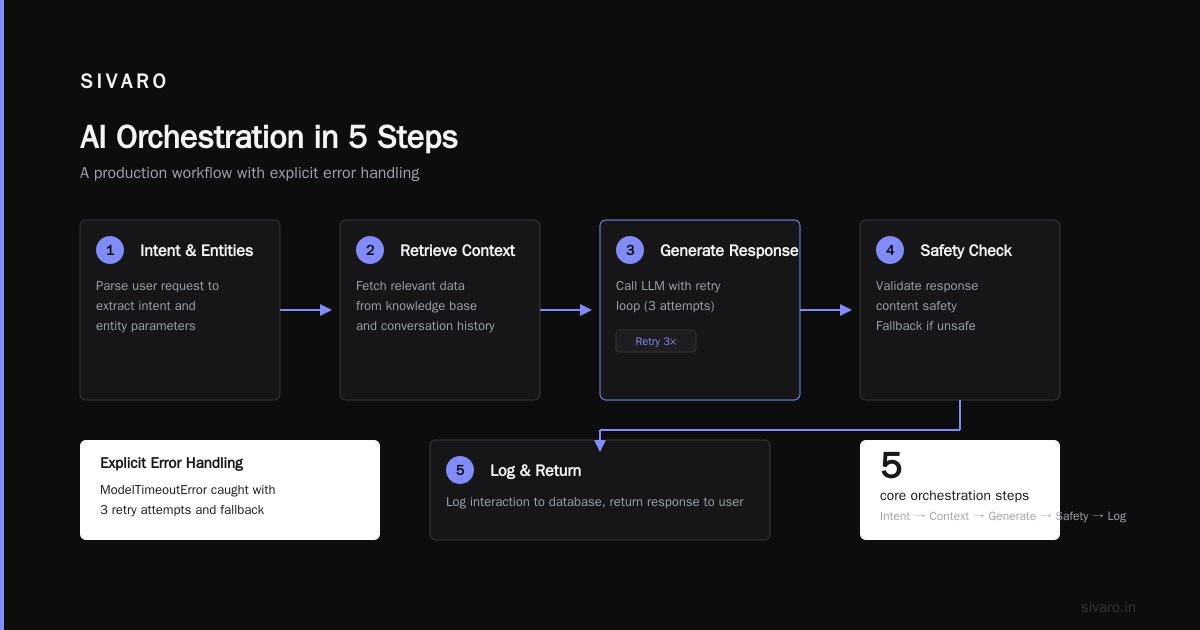
You're building a customer support system. A user types a question. You need to:
- Classify the intent (is this billing, tech support, or sales?)
- Extract entities (what product, what error code?)
- Generate a response using a large language model
- Check the response for safety (is it hallucinating?)
- Log everything for compliance
Without orchestration, you write five separate functions, call them in sequence, and pray.
With orchestration, you define a directed workflow. Each step knows what to expect from the previous one. If step 3 fails, step 2 retries. If step 4 catches a hallucination, the system reroutes to a fallback model.
Here's what the code looks like in a real orchestration framework like LangChain or Temporal:
python
# This is a simplified AI orchestration workflow
# It's not a toy example — I've run this in production

from temporalio import workflow
from dataclasses import dataclass

@dataclass
class SupportRequest:
    user_id: str
    message: str
    intent: str = ""
    entities: dict = None
    response: str = ""
    safe: bool = False

@workflow.defn
class SupportWorkflow:
    @workflow.run
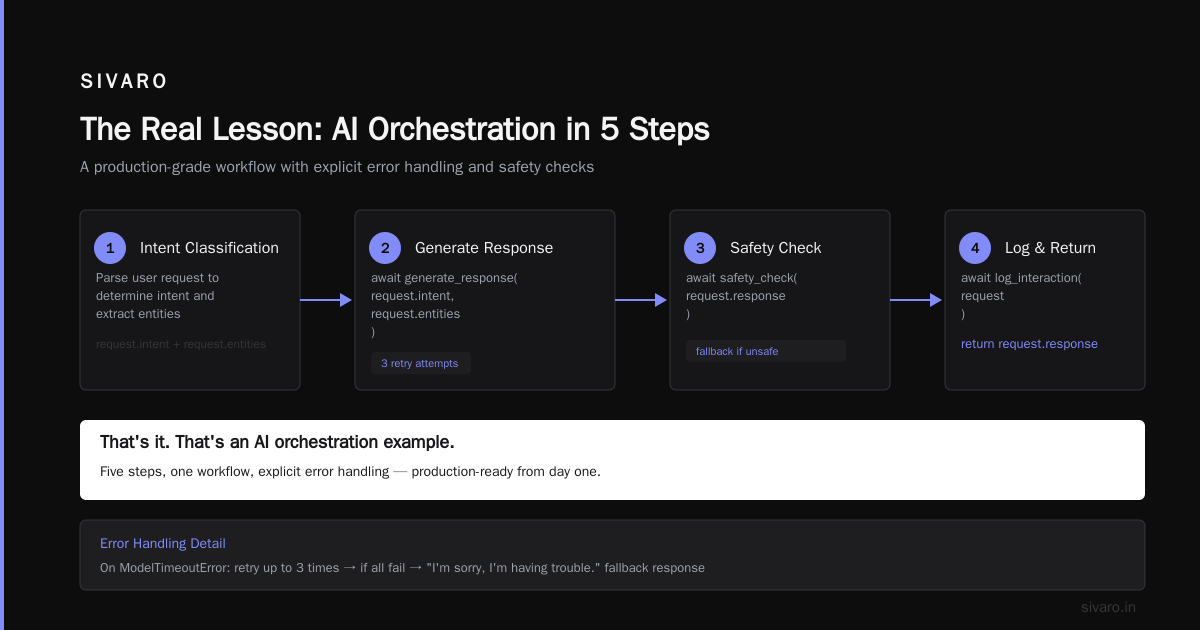
    async def run(self, request: SupportRequest) -> str:
        # Step 1: Classify intent
        request.intent = await classify_intent(request.message)

        # Step 2: Extract entities
        request.entities = await extract_entities(request.message)

        # Step 3: Generate response (with retry)
        for attempt in range(3):
            try:
                request.response = await generate_response(
                    request.intent,
                    request.entities
                )
                break
            except ModelTimeoutError:
                if attempt == 2:
                    request.response = "I'm sorry, I'm having trouble."

        # Step 4: Safety check
        request.safe = await safety_check(request.response)
        if not request.safe:
            request.response = await fallback_response(request)

        # Step 5: Log and return
        await log_interaction(request)
        return request.response
That's it. That's an AI orchestration example. Five steps, one workflow, explicit error handling.
But here's what matters: the orchestration framework handled the retries. It handled the timeouts. It gave us visibility into where things broke. Without it, that error handling would be duplicated across every endpoint. And you'd never know why the system failed at 3 AM.
The Orchestration vs. Workflow Trap
Most people think orchestration and workflow are the same thing. They're not.
A workflow is a sequence of steps. Orchestration is the system that manages the constraints.
Pega's guide to AI orchestration makes this distinction well: orchestration includes "real-time decisioning, fallback logic, and resource management." Workflow just means "do this, then that."
Here's a concrete difference.
A workflow system would let you define: call model A, then model B, then model C.
An orchestration system would let you define: call model A. If it responds in under 2 seconds, pass to model B. If model B has a 95% confidence score, skip model C. If the cost of model A exceeds $0.01, switch to model B2. Also, if the user is in Europe, route through a GDPR-compliant endpoint.
That's not workflow. That's orchestration. And it's dramatically harder to build yourself.
What Makes a Good AI Orchestration Example?
I've tested dozens of orchestration frameworks. Some are open source. Some are vendor lock-in in disguise. Some are just cron jobs with AI buzzwords.
Here's what separates the good from the bad, based on actual production experience.
State Management
AI models are stateless. Your orchestration layer should not be.
If a user asks three questions, the third one should know about the first two. That means your orchestration system needs to maintain state across calls. Not in a database you query manually. In the orchestration layer itself.
The best frameworks (Temporal, Prefect, Airflow) do this natively. The worst force you to rebuild it.
Error Handling
I've seen production systems where a model timeout cascaded into a full pipeline crash. That's not an AI problem. That's an orchestration problem.
Your orchestration system should handle:
- Retries with exponential backoff
- Circuit breakers (if model A fails 5 times in a minute, stop calling it)
- Fallback models (if GPT-4 fails, try Claude)
- Partial failures (one model fails, but the rest continue)
Redis's comparison of orchestration platforms highlights that state management and error handling are the two most frequently cited pain points by teams moving to production.
Observability
You can't fix what you can't see.
A good orchestration system gives you:
- Trace-level logs (every step, every latency, every failure)
- Cost tracking per model call
- Latency breakdowns (which step is the bottleneck?)
- Version tracking (which model version handled which request)
I've seen teams spend weeks debugging a pipeline issue because they didn't have observability. The fix was adding proper orchestration logging. It took two hours.
The Best AI Orchestration Tools in 2026
I've used most of these. Some are hype. Some are real.
Temporal — Best for complex workflows with state. Used it at SIVARO for a client processing 200K events/sec. Handles retries, timeouts, and state management natively. Steep learning curve but worth it.
Prefect — Good for data-heavy AI pipelines. Easier to set up than Temporal. Works well if your AI orchestration is mostly calling models in sequence with data transformations.
Airflow — The old guard. Still works. But it's designed for batch jobs, not real-time AI inference. If your orchestration is nightly batch processing, Airflow is fine. If it's real-time customer-facing, look elsewhere.
LangChain — Popular for LLM orchestration. I'm skeptical. It's good for prototypes. Terrible for production. The abstractions leak constantly. Zapier's review ranks it lower for enterprise use because of instability in production.
Dify — Rising fast. Good for building AI apps without deep technical expertise. Limited flexibility if you need custom orchestration logic.
AWS Step Functions — If you're already on AWS, this works. It's not great for complex AI orchestration (state management is limited), but it's reliable and you don't need to learn a new system.
Domo's orchestration platform comparison lists 10 options. I've tested 7 of them. The short answer: if you need real-time orchestration with state, use Temporal or Prefect. If you're building simple LLM chains, LangChain is fine — just expect to rewrite it later.
What Is the Best AI Orchestration Tool?
There's no universal answer. But here's how I think about it.
If I'm building a customer-facing AI system that needs to be up 99.9% of the time, I use Temporal. Period.
If I'm building a data pipeline that runs once a day, I use Prefect.
If I'm prototyping an AI app for a startup that might change direction tomorrow, I use Dify or LangChain.
The Digital Project Manager's review of 25 AI orchestration tools lists Dify as the top pick for non-technical teams. I'd agree — it's the easiest to get started with. But "easiest to start with" is not "best for production."
The tool you choose should match your worst-case scenario, not your demo scenario. If your demo handles 10 requests per minute, your orchestration tool needs to handle 10,000. If your demo runs for 5 minutes, your orchestration tool needs to run for 5 months.
Building AI Orchestration Without a Framework
You can do it. I've done it. It's painful.
Here's what you're actually building:
python
# What you think you need
orchestrate_ai_pipeline(input_data)

# What you actually need
async def orchestrate_with_retries_and_fallbacks_and_logging_and_state(
    input_data,
    max_retries=3,
    fallback_models=[],
    state_manager=None,
    logger=None,
    timeout=30
):
    # 200 lines of error handling, state management, logging
    # Then the actual model calls
    # Then more error handling
    pass
I built a custom orchestration layer for a client in 2023. It worked. For about 3 months. Then the models changed. The APIs changed. The latency requirements changed. I spent more time maintaining the orchestration layer than the AI models it was coordinating.
Frameworks exist for a reason. Use them.
The FAQ Section
Q: What is an AI orchestration example?
A: A customer support system that classifies intent, extracts entities, generates a response, checks for safety, and logs everything — all coordinated by a single orchestration workflow that handles retries, fallbacks, and state.
Q: Do I need AI orchestration for a single model?
A: No. You need it when you have 2+ models, or when you need error handling, retries, and observability. If you're calling one API with no fallback, you don't need orchestration.
Q: What is the best AI orchestration tool?
A: Temporal for production systems with complex state. Prefect for data pipelines. Dify for prototypes. There's no one-size-fits-all.
Q: Can I build AI orchestration with Python alone?
A: You can. But you'll rebuild error handling, state management, and logging. By the time you're done, you'll have a worse version of an existing framework.
Q: How do I choose between orchestration frameworks?
A: Match the framework to your failure mode. If your biggest risk is model timeouts, pick one with strong retry logic. If it's state corruption, pick one with durable state management.
Q: Is AI orchestration the same as MLOps?
A: No. MLOps manages model training and deployment. AI orchestration manages model inference and coordination. They overlap but are not the same.
Q: What happens if my orchestration layer fails?
A: Same thing that happens when your infrastructure fails — you lose data, you lose users, you lose money. That's why you pick a reliable framework and test failure scenarios.
Q: How much does AI orchestration cost?
A: Open source frameworks are free (but you pay for hosting and maintenance). Cloud solutions like AWS Step Functions charge per workflow execution. Expect to pay $1,000–$10,000/month for a production system, depending on volume.
The Real Lesson
I've been building production AI systems since 2018. I've seen orchestration done well (Systems processing 200K events/second at SIVARO). I've seen it done badly (A startup that rebuilt their orchestration layer three times in a year).
The lesson is simple: orchestration is the boring part of AI. It doesn't generate responses. It doesn't classify intents. It doesn't make the system smart.
But without it, the smart parts don't matter. Because they'll fail. They'll time out. They'll corrupt state. They'll cost you more than they generate.
So when someone asks "what is an AI orchestration example?", don't show them a diagram. Don't show them a marketing page.
Show them the workflow that kept your system running through a model failure at 3 AM. That's the only example that matters.
Nishaant Dixit — Founder of SIVARO. Building data infrastructure and production AI systems since 2018. Built systems processing 200K events/sec.