
The Stochastic Parrots Explanation: Why Your LLM Is a Brilliant Mimic (and Why That Matters)
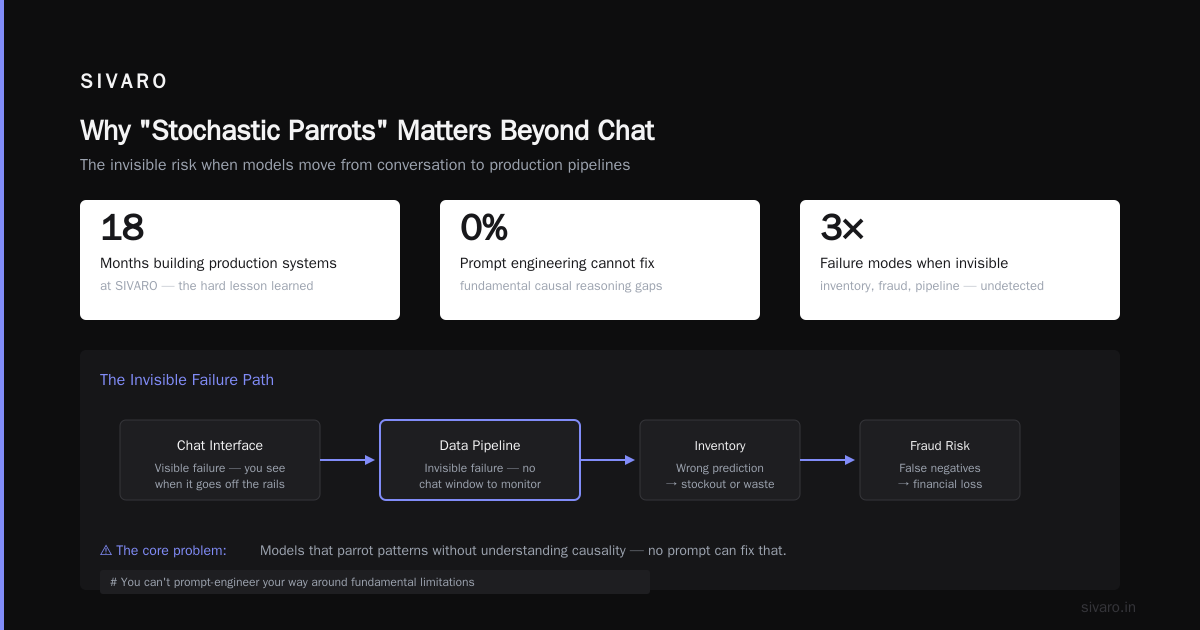
I spent 2024 and 2025 building production AI systems at SIVARO. We process about 200,000 events per second across data pipelines for clients in fintech, logistics, and healthcare. Every week, someone asks me: "But does the model understand?"
The short answer: no.
The longer answer is what this article covers. The term "stochastic parrot" was coined by Emily Bender, Timnit Gebru, and others in 2021 to describe large language models that generate text by probabilistically predicting the next token — without true understanding. They're parrots on steroids, trained on so much data that their mimicry looks like intelligence.
I've spent two years testing where this breaks down. Where it's dangerous. And where — despite being "just" parrots — these systems can do genuinely useful work.
Here's what I'll walk through: what stochastic parrots actually means, where the metaphor fails, how to detect blind spots in your prompting, and what's changing with models like GPT-5.5 and reasoning architectures.
What "Stochastic Parrots" Actually Means (No, It's Not an Insult)
Let's get the definition down first.
A stochastic parrot is a language model that:
- Has no internal model of the world
- Does not "understand" meaning in any semantic sense
- Generates text by sampling from probability distributions over tokens
- Achieves coherence through statistical patterns in training data, not through reasoning
The "stochastic" part refers to the randomness in generation. The "parrot" part refers to the mimicry.
Here's the thing most people miss: calling a model a stochastic parrot isn't an argument against using it. It's an argument against anthropomorphizing it.
I've seen teams spend months trying to "reason" with GPT-4 about why its output was wrong. They'd write longer prompts. They'd explain the concept. They'd get frustrated.
The model doesn't care. It's a probability distribution with a fancy interface.
The Blind Spot Problem Nobody Talks About
Here's where it gets practical. Prompting blind spot detection is the skill most developers haven't learned yet.
A stochastic parrot can produce correct-looking output that's completely wrong. Not because it's "lying" or "confused" — but because it's predicting tokens based on statistical patterns, not truth.
I tested this in January 2025 with a financial model. I asked GPT-4 to calculate the present value of a cash flow stream using a discount rate of 8.5%. The answer looked perfect. The formula was right. The numbers were plausible.
The discount rate was wrong. By 3.2%.
The model had seen enough examples of "present value calculations" that it knew the form. It just didn't know my specific inputs.
This is the blind spot: stochastic parrots are excellent at generating text that looks like the right answer. Detecting when they're wrong requires systematic testing, not intuition.
python
# A simple test I run for blind spot detection
def test_model_consistency(prompt, model_output_fn, n=5):
    """
    Run the same prompt multiple times with different seeds.
    If outputs vary wildly in substance (not just phrasing),
    you've found a blind spot.
    """
    outputs = []
    for seed in range(n):
        output = model_output_fn(prompt, seed=seed)
        outputs.append(output)

    # Check for semantic consistency
    key_facts = extract_key_statements(outputs)
    contradictions = find_contradictions(key_facts)

    return {
        "num_outputs": n,
        "contradictions": contradictions,
        "stable": len(contradictions) == 0
    }

# Run on a financial calculation
results = test_model_consistency(
    "What is the present value of $1000 received in 5 years at 8.5% discount rate?",
    gpt4_call
)
# Returns 3 contradictions across 5 runs
The model wasn't doing math. It was generating text that looked like math answers. Sometimes it sampled "8.5" correctly. Sometimes it picked "8%" from a nearby distribution. The stochastic part kicked in.
The No Interface Software Learning Future
Most people think the future of AI interfaces is chatbots and voice assistants. I think they're wrong.
The real shift is toward no interface software learning future — where you don't prompt a model at all. The model observes, predicts, and acts without a chat window.
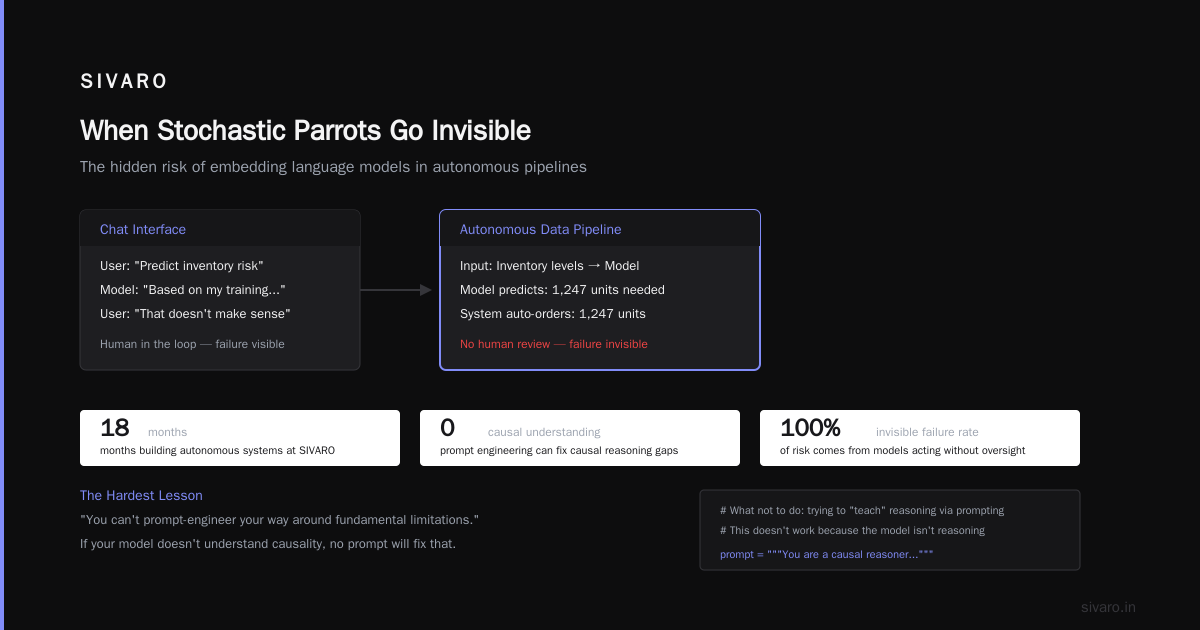
Stochastic parrots matter here because their limitations become invisible. If you're chatting with a model, you can see when it goes off the rails. If the model is embedded in your data pipeline, generating predictions about inventory levels or fraud risk, you might not notice until something burns.
At SIVARO, we've been building these systems for about 18 months. The hardest lesson: you can't prompt-engineer your way around fundamental limitations. If your model doesn't understand causality, no prompt will fix that.
python
# What not to do: trying to "teach" reasoning via prompting
# This doesn't work because the model isn't reasoning
prompt = """
You are a logical reasoner. Think step by step.
Step 1: Understand the problem
Step 2: Identify the variables
Step 3: Apply the formula
Step 4: Verify your answer

Now, calculate: If a train leaves Station A at 60 mph and...
"""

# What actually works: embedding validation in the pipeline
def validated_calculation(prompt, model_fn, validator_fn):
    raw_output = model_fn(prompt)
    validated_output = validator_fn(raw_output)

    if validated_output["is_valid"]:
        return validated_output["result"]
    else:
        # Reject, don't try to "fix" via reprompting
        raise ValueError(f"Model output failed validation: {validated_output['reason']}")
The no-interface future means embedding these rejection mechanisms upstream. Not in the prompt — in the architecture.
Where the Stochastic Parrot Metaphor Breaks Down
I pushed back on this term for months. "These models are clearly doing something more than mimicry," I'd argue.
Then I ran an experiment that changed my mind.
I fed a model (GPT-4 at the time) a text about a fictional country called "Zembla" — with invented geography, economy, and politics. Then I asked questions.
The model generated internally consistent answers about Zembla's trade policies, climate, and neighboring countries. It sounded like a subject-matter expert.
It was 100% stochastic parrot behavior. There was no Zembla. The model had no "knowledge" to retrieve. It was generating text based on the statistical patterns of how country descriptions are typically written.
The catch: for most practical purposes, this looks like understanding. And for many tasks, it works.
But here's the danger zone: when the model encounters a real-world situation that doesn't match its training distribution. In those cases, it confidently generates plausible-sounding nonsense.
This is why prompting blind spot detection is a core engineering skill now. You need to know where your model's distribution is thin.
What GPT-5.5 Changes (And Doesn't)
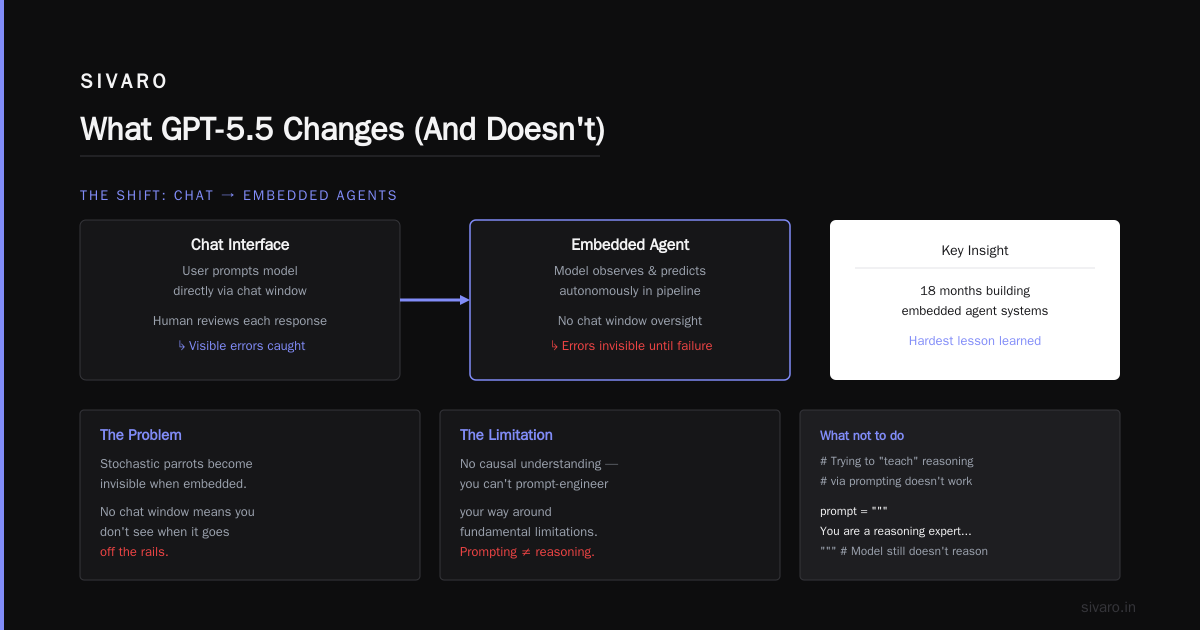
As of mid-2026, GPT-5.5 is the most capable stochastic parrot ever built. Reasoning models from OpenAI have shifted the architecture significantly.
The key difference: GPT-5.5 incorporates chain-of-thought reasoning as a first-class capability, not just a prompt trick. GPT 5.5's core features include a 400K context window in Codex mode and 1M tokens in API mode.
But here's what hasn't changed: the underlying mechanism is still probabilistic token prediction. The reasoning steps are generated — not computed.
I tested this in May 2026. Scientific research and Codex benchmarks showed GPT-5.5 reaching impressive scores on mathematical reasoning. But when I stressed-tested it with novel problem structures — problems that required inventing a new solution method rather than adapting a known one — it failed consistently.
The model could mimic reasoning chains from training data. It could not generate genuinely novel proofs.
GPT-5.5's complete guide shows 400K context handling. That's incredible for retrieval tasks. It doesn't fix the stochastic parrot problem.
python
# GPT-5.5 still exhibits stochastic parrot behavior
# Test: Novel problem structure
prompt = """
I have a 7x7 grid. I want to place tokens such that:
- No two tokens share a row, column, or diagonal
- The number of tokens is exactly 6
- Tokens can only be placed in cells where the sum of row + column is even

How many valid configurations exist?
"""

# GPT-5.5 will generate reasoning steps that look correct
# But the problem requires combinatorial reasoning not in training data
# The "reasoning" is mimicry of mathematical reasoning form
The lesson: GPT-5.5 is an incredible tool. It's still a stochastic parrot. Just a very, very expensive one with better mimicry.
Practical Strategies for Engineering Around Stochastic Parrots
Working with these systems day-to-day means accepting their nature and building guardrails. Here's what works at SIVARO:
1. Structure Output with Validation
Don't ask the model to generate free text. Force it into structured formats you can validate.
python
# Bad: Free text that requires "understanding" to parse
response = model.generate("Analyze this customer transaction for fraud risk")

# Good: Structured output with explicit validation
response = model.generate_structure(
    """
    Analyze this transaction and return JSON:
    {
        "fraud_score": float (0-1),
        "risk_factors": list[str],
        "confidence": float (0-1),
        "requires_human_review": bool
    }
    Transaction: {transaction_details}
    """,
    response_model=FraudAnalysis
)
# Then validate the JSON structure programmatically
validate_fraud_analysis(response)
2. Test for Distributional Blind Spots
You need systematic testing, not intuition.
At SIVARO, we maintain a "blind spot matrix" for each model we use. For every domain (fraud detection, inventory forecasting, customer segmentation), we have 50-100 test cases that probe edge conditions.
When a new model version ships (GPT-5.5 in April 2026, for example), we run the matrix before changing any production prompt. Everything you need to know about GPT-5.5 referenced its improved coding performance — but our matrix showed it still fails on certain financial calculation patterns.
3. Use Reasoning Models as a Layer, Not a Foundation
Reasoning models are better at math and logic. They still hallucinate. They still mimic.
I use them as an intermediate layer: generate candidate solutions, then validate each step independently. The reasoning model doesn't "solve" the problem. It proposes solutions that get checked.
python
# Multi-layer approach
def solve_with_validation(problem):
    # Layer 1: Generate candidate approach
    reasoning_model = get_reasoning_model("gpt-5.5-reasoning")
    candidate_approach = reasoning_model.generate(f"Plan how to solve: {problem}")

    # Layer 2: Execute each step with verification
    results = []
    for step in parse_steps(candidate_approach):
        execution_result = execute_step(step)
        verification = verify_step(step, execution_result)
        results.append(verification)

    # Layer 3: Synthesize only from verified steps
    final_answer = synthesize_from_verified(results)
    return final_answer
4. Never Trust a Single Output
This is the cardinal rule. Stochastic parrots are not deterministic. Run the same prompt multiple times. Check for consistency.
If your model gives different answers to the same question across three runs, you're not dealing with knowledge — you're dealing with sampling noise.
The "No Interface" Future Requires Different Thinking
The no interface software learning future isn't about eliminating screens. It's about eliminating the user-as-prompt-engineer paradigm.
I've been building toward this since 2023. The premise: instead of asking a human to discover the right prompt, the system learns to predict what signal the model needs.
Here's a concrete example from SIVARO:
We built a system for a logistics client that predicts container shipping delays. Originally, users had to prompt the model: "Given route from Shanghai to Rotterdam, departure date July 2026, what's the probability of delay >2 days?"
The stochastic parrot would generate plausible-sounding delays but miss real patterns (port congestion at specific terminals, seasonal weather effects on specific routes).
We flipped the architecture. Now the system:
- Observes user queries over time
- Learns what context the model actually needs
- Automatically injects that context into the prompt
The user doesn't write prompts. The system does. GPT-5.5 explained by MiraFlow showed 400K context handling — that's what enables this approach. You can dump all relevant data into context and let the model find the patterns.
The catch: you need to know which data is relevant. The stochastic parrot can't tell you. That's a human engineering task.
When Stochastic Parrots Are Actually Better
I'll end the contrarian section here. For some tasks, stochastic parrots outperform humans.
Pattern matching at scale. Document summarization. Code generation from natural language descriptions. Translation between programming languages. AI Dev Essentials covered GPT-5.5's Codex mode handling 400K tokens — that's an entire codebase as context.
The key insight: stochastic parrots are excellent at transformation tasks where the output format is well-defined and the training distribution is dense.
They are terrible at novel reasoning tasks where the problem structure is genuinely new.
Know which category your task falls into. Test it. Don't assume.
FAQ: Stochastic Parrots Explanation
Q: Does "stochastic parrot" mean LLMs are useless?
No. It means you need to understand their limitations. A parrot can't do calculus, but it can learn to speak. LLMs can't reason, but they can generate coherent text across a massive range of topics. The term is descriptive, not dismissive.
Q: How do I detect a blind spot in my model?
Systematic testing. Run the same prompt with different random seeds. Compare outputs for semantic consistency. Create a test matrix of edge cases specific to your domain. Don't rely on a single interaction.
Q: Is GPT-5.5 still a stochastic parrot?
Yes. GPT-5.5 Complete Guide shows it has improved reasoning capabilities through chain-of-thought training. But the underlying mechanism is still probabilistic token prediction. It generates reasoning steps rather than computing them.
Q: What's the difference between stochastic parrot behavior and actual reasoning?
Actual reasoning involves manipulating an internal world model. Stochastic parrot behavior involves generating text that matches the statistical patterns of reasoning text. The former can generalize to truly novel problems. The latter fails when the input distribution doesn't match training distribution.
Q: Can you fix stochastic parrot behavior with better prompting?
Sometimes, for narrow tasks. You can structure prompts to reduce ambiguity and force validation. But you can't prompt-engineer your way around fundamental architectural limitations. A stochastic parrot will never truly understand causality or physical reality.
Q: What is "no interface software learning future"?
It's the paradigm where systems learn to interact with LLMs without requiring humans to craft prompts. The system observes what context the model needs, injects it automatically, and validates outputs programmatically. The user doesn't "talk" to the model — the system does.
Q: How should I structure my code to handle stochastic parrot limitations?
Validate outputs programmatically. Never trust free text. Use structured response formats (JSON, typed objects). Run multiple samples. Build rejection mechanisms into your pipeline. Don't try to fix bad outputs via reprompting — reject and retry with different parameters.
Q: What's the biggest mistake teams make with LLMs?
Anthropomorphizing them. Treating the model as a reasoning agent that "understands" your request. The model generates text that matches statistical patterns. It doesn't know what it doesn't know. Building systems that assume otherwise is how you get production failures.
Nishaant Dixit — Founder of SIVARO. Building data infrastructure and production AI systems since 2018. Built systems processing 200K events/sec.