 SIVARO
Third Party AI Vendor Risk Assessment: Hugging Face, OpenAI & SOC2 Coverage Checklist
You're evaluating an AI vendor. Maybe it's a model hosted on Hugging Face. Maybe it's an OpenAI API integration. And now your compliance team wants a SOC2 report.
Here's the problem: Most vendor risk assessment frameworks were built for SaaS, not AI. They don't account for model drift, data leakage through inference, or supply chain risks that span three layers deep into open-source dependencies. I've spent the last year building production AI systems at SIVARO, and this gap is costing companies real money and real security incidents.
Let me show you exactly how to build a checklist that covers Hugging Face, OpenAI, SOC2 compliance, and the stuff nobody talks about.
Why Standard Vendor Assessments Fail for AI
First, let's be honest about what's happening.
You pull a model from Hugging Face. That model was trained on data scraped from the internet. The training pipeline was built by someone you've never met. The training data might contain PII. The model weights might have been poisoned. And you're about to deploy this into a production system handling customer data.
According to the Hugging Face AI Compliance Guide, the biggest shift in AI vendor risk is that "the model itself is the product" — meaning traditional SaaS controls around infrastructure don't capture model-level risks like training data provenance or output biases.
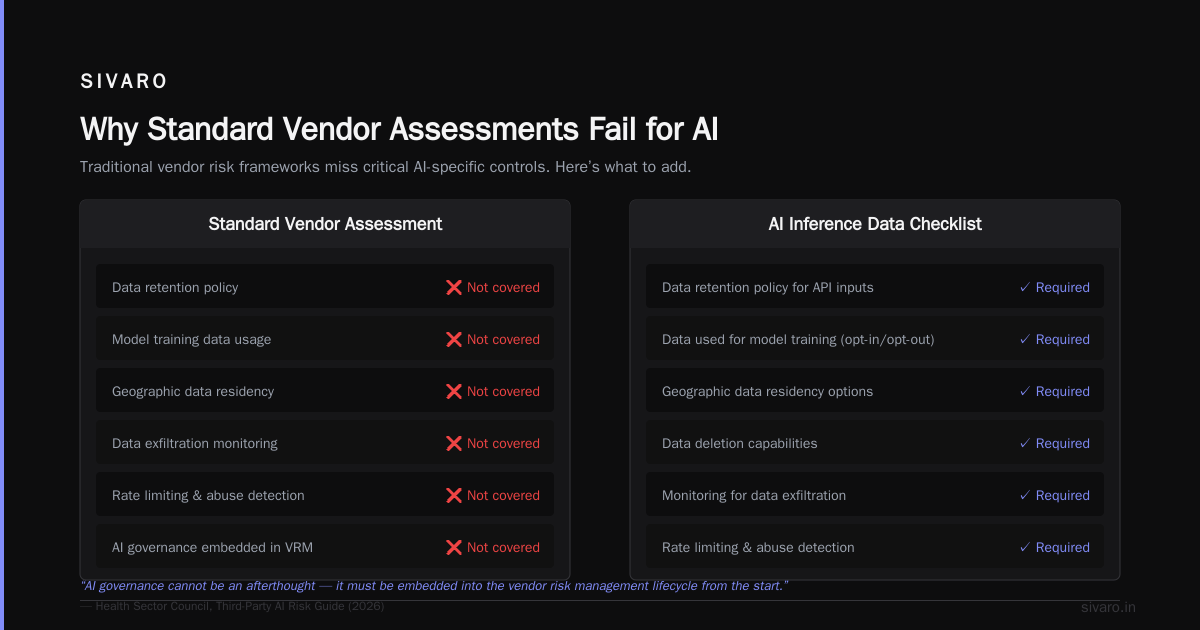
Traditional SOC2 audits cover controls like access management, encryption, and incident response. But they don't cover:
- Training data lineage
- Model versioning and provenance
- Inference data handling
- Model supply chain dependencies
- Adversarial attack surface
So when your compliance team hands you a standard SOC2 report from an AI vendor, you're getting half the picture.
The Core Components of an AI Vendor Risk Checklist
I structure my assessments around four layers. Think of it as peeling an onion — each layer reveals different risks.
Layer 1: Infrastructure Security (SOC2 Basics)
This is the easy part. Standard SOC2 Type II coverage for any AI vendor should include:
Vendor Security Checklist - Infrastructure Layer
□ SOC2 Type II report (within last 12 months)
□ Data encryption at rest (AES-256 or equivalent)
□ Data encryption in transit (TLS 1.2+)
□ Access controls (RBAC, MFA enforced)
□ Incident response plan (tested within 6 months)
□ Business continuity / disaster recovery
□ Penetration testing (annual minimum)
Layer 2: Model Supply Chain Security
This is where it gets interesting. According to a recent AI Supply Chain Risk analysis by TrustArc, "organizations are waking up to the reality that their AI supply chains are more complex and less visible than their software supply chains."
Your checklist needs to ask:
Model Supply Chain Checklist
□ Model source (Hugging Face, custom training, etc.)
□ Training data provenance and licenses
□ Data sanitization process for PII removal
□ Model architecture documentation
□ Training pipeline security controls
□ Dependency scanning for model libraries
□ Model weight integrity verification (hash checksums)
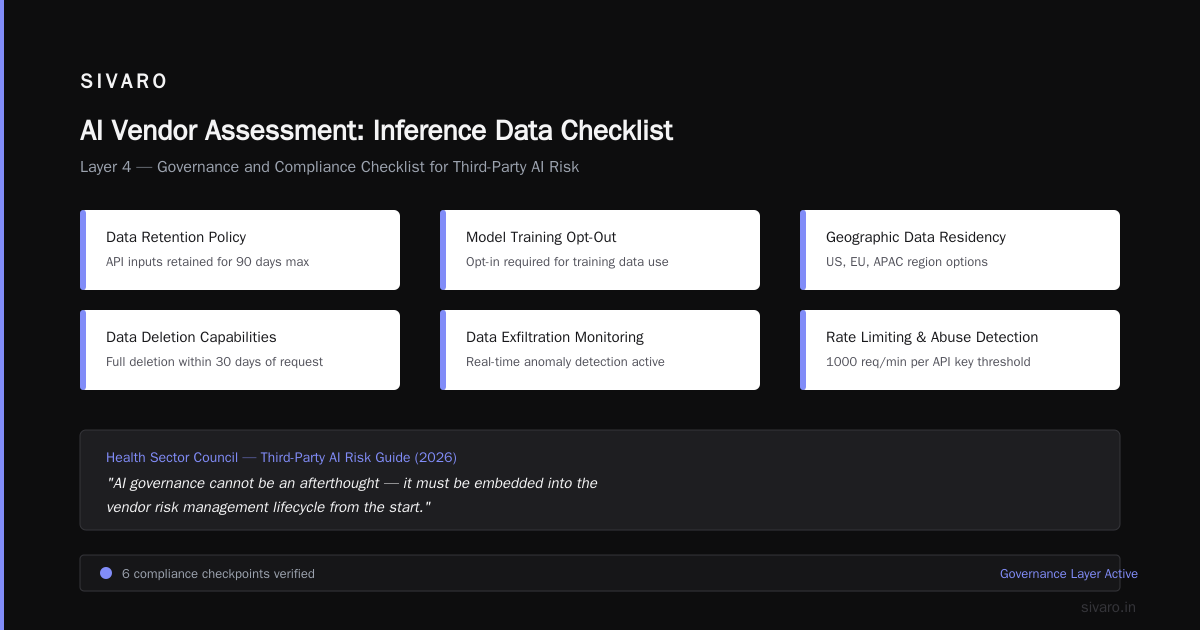
Layer 3: Inference and Data Handling
This is the layer that keeps me up at night. When you send data to an AI API for inference, where does that data go? How long is it stored? Is it used for retraining?
OpenAI's Trust Portal provides some clarity: They publish their SOC2 Type II report, ISO 27001 certification, and data processing agreements. But you need to dig into the specific API you're using.
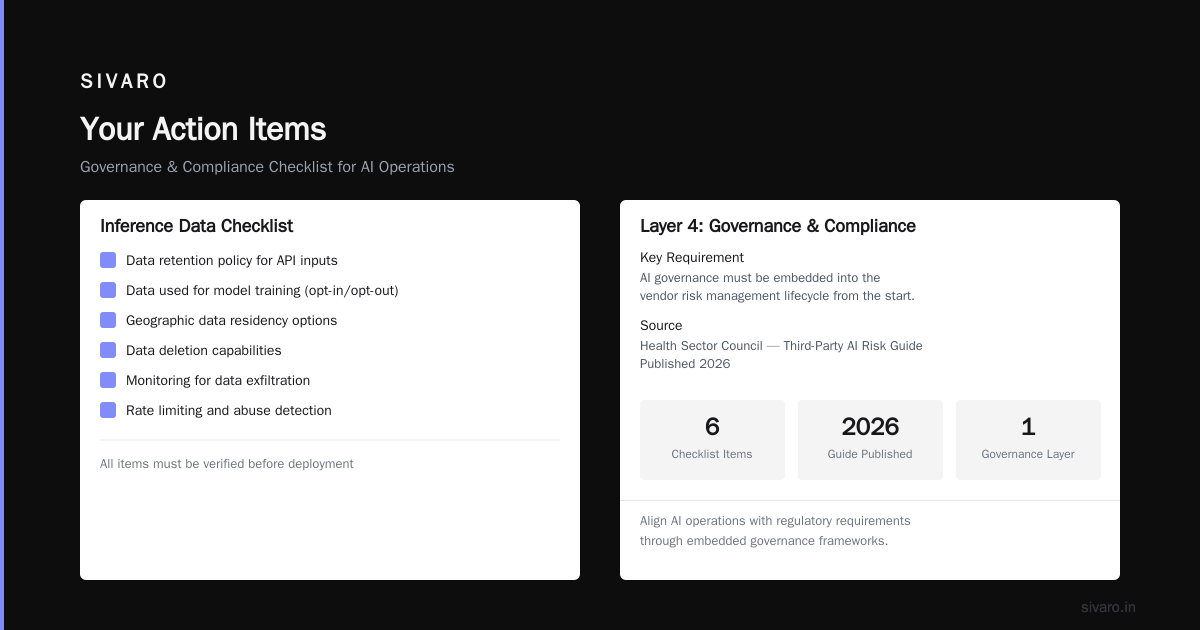
Inference Data Checklist
□ Data retention policy for API inputs
□ Data used for model training (opt-in/opt-out)
□ Geographic data residency options
□ Data deletion capabilities
□ Monitoring for data exfiltration
□ Rate limiting and abuse detection
Layer 4: Governance and Compliance
This is where you align AI operations with regulatory requirements. The Health Sector Council's Third-Party AI Risk Guide (published 2026) emphasizes that "AI governance cannot be an afterthought — it must be embedded into the vendor risk management lifecycle from the start."
Governance Checklist
□ AI ethics policy
□ Bias testing documentation
□ Explainability documentation
□ Regulatory mapping (GDPR, CCPA, HIPAA, etc.)
□ Model monitoring and drift detection
□ Incident response for AI-specific events
The Hugging Face Specifics
Hugging Face is a special case. It's not a single vendor — it's a marketplace. You're downloading models from thousands of contributors. The platform itself has SOC2 Type II coverage, but that doesn't extend to every model on it.
Here's what I've learned from deploying models from Hugging Face into production:
The platform risk vs. model risk distinction matters.
Hugging Face as a platform handles your account security, download infrastructure, and API access. But the model you download — that's a supply chain artifact. You need to assess it separately.
Practical approach:
- Use Hugging Face's model card to check training data, license, and intended use
- Run your own vulnerability scanning on model dependencies
- Verify model weights against published checksums
- Test for bias and safety before production deployment
OpenAI SOC2 Coverage: What You Actually Get
OpenAI publishes their SOC2 Type II report. That's good. But here's what that report covers and what it doesn't.
Covered:
- Infrastructure security for API services
- Data center physical security
- Employee access controls
- Encryption standards
Not covered:
- Model behavior guarantees
- Training data governance
- Output accuracy or bias
- Third-party model dependencies
This is a critical distinction. Your legal team might see SOC2 and check the box. But if you're using GPT-4 for medical diagnosis or financial analysis, the SOC2 report tells you nothing about whether the model will hallucinate a wrong answer.
The AI Vendor Risk Assessment Questionnaire from ATLASSYSTEMS provides a practical framework here: "When assessing AI vendors, you need to separate infrastructure controls from AI-specific controls. A vendor can have perfect SOC2 coverage but still produce unreliable or unsafe model outputs."
Building Your Assessment Template
Let me give you the actual template I use at SIVARO. It's designed to be practical.
The 40-Question AI Vendor Risk Assessment
Section A: Organizational Controls (Standard SOC2)
- Do you have a current SOC2 Type II report? (Request copy)
- Who conducted the audit? What was the audit period?
- Any findings or exceptions? How were they remediated?
- Do you have ISO 27001 certification?
- What's your data breach notification timeline?
- Do you conduct regular penetration testing?
- What's your employee background check policy?
Section B: AI Model Governance
8. What model(s) do you use for this service?
9. Are models custom-trained or from external sources?
10. Describe the model training data and its provenance.
11. How do you handle PII in training data?
12. Do you test for model bias? How frequently?
13. What's your model versioning strategy?
14. How do you handle model deprecation/retirement?
15. Do you provide model cards or documentation?
Section C: Data Handling for Inference
16. What customer data do you process during inference?
17. Do you store inference inputs? For how long?
18. Do you use inference data for model retraining?
19. Can customers opt out of data use for training?
20. Where is data processed (geographic locations)?
21. What data deletion capabilities exist?
22. Do you support data residency requirements?
23. What's your data encryption approach for inference?
Section D: Supply Chain Security
24. What third-party dependencies does your model use?
25. How do you vet those dependencies?
26. Do you scan for vulnerabilities in model libraries?
27. What's your approach to supply chain attacks?
28. Do you verify model weight integrity?
29. What happens if a dependency has a critical CVE?
Section E: Incident Response
30. What constitutes an AI-related security incident?
31. How do you detect model poisoning or attacks?
32. What's your response time for critical incidents?
33. Do you have a dedicated AI incident response team?
34. How do you communicate incidents to customers?
Section F: Compliance and Regulatory
35. What regulations apply to your service?
36. Do you have GDPR Article 28 compliance?
37. What about HIPAA BAA or similar agreements?
38. Do you support right to explanation for AI decisions?
39. What's your approach to AI regulations (EU AI Act, etc.)?
40. Do you provide audit logs for AI system access?
Practical Implementation: Scoring and Triage
You don't need to run the full 40-question assessment on every vendor. Here's the triage framework I use:
Tier 1 (Low Risk): Public APIs for non-sensitive tasks
- Use: Summarization, translation, content generation for internal use
- Assessment: 10 questions (SOC2 basics + data handling)
- Frequency: Annual
Tier 2 (Medium Risk): Customer-facing AI features
- Use: Chatbots, recommendation engines, content moderation
- Assessment: 25 questions (SOC2 + model governance + data handling)
- Frequency: Bi-annual
Tier 3 (High Risk): AI in regulated/decision-critical contexts
- Use: Healthcare diagnosis, financial decisions, legal analysis
- Assessment: Full 40 questions + independent model audit
- Frequency: Quarterly + continuous monitoring
Red Flags That Don't Show Up in SOC2 Reports
After evaluating dozens of AI vendors, here are the warning signs I've learned to spot.
1. "We use AI" but can't explain how
If a vendor can't describe their model architecture, training data, or validation process — run.
2. No model card or documentation
According to the Hugging Face compliance guide, model cards are the industry standard for documenting model provenance, intended use, and limitations. Absence is a red flag.
3. Refusal to discuss training data
Legitimate vendors will tell you at least the categories of data used. Opacity here often means scraping without permission.
4. "We handle everything" response
If a vendor claims they manage the entire AI stack without third-party dependencies, they're either lying or building everything from scratch (which is its own risk).
5. SOC2 as a shield
"Don't worry, we have SOC2" when you ask about model bias or training data provenance is a dodge. Push harder.
Automation Opportunities: AI for AI Vendor Assessment
It's ironic but true: you can use AI to assess AI vendors. According to Visotrust's analysis of AI-powered vendor assessments, "AI can automate the initial triage of vendor responses, flagging inconsistencies and missing information that human reviewers might miss."
I've found success using:
- LLM-based analysis of vendor responses against risk criteria
- Automated SOC2 report parsing to extract key dates, findings, and exceptions
- Continuous monitoring of vendor security pages and feeds for changes
- Model card analysis to flag missing documentation
But automation is a supplement, not a replacement. The nuanced judgment about model behavior, training data ethics, and regulatory alignment still requires human expertise.
The EU AI Act Impact on Vendor Risk
Starting 2025-2026, the EU AI Act creates direct obligations for companies using AI systems. If you're deploying a high-risk AI system (which includes many use cases in healthcare, hiring, credit scoring, and critical infrastructure), you're responsible for your vendor's compliance.
This means your assessment needs to verify:
- The vendor's AI system classification (what risk tier?)
- Documentation requirements met (technical documentation, risk management)
- Human oversight mechanisms
- Accuracy and solidness testing
- Conformity assessment (for high-risk systems)
TrustCloud's research on AI in third-party risk assessments highlights that "2024-2025 saw a 300% increase in AI-specific questions added to vendor risk questionnaires, driven largely by regulatory pressure."
How to Use This Checklist: A Step-by-Step Workflow
Let me walk you through a real assessment using this framework.
Step 1: Vendor Discovery
Identify all AI vendors in your stack. Don't forget shadow IT — teams often start using AI APIs without telling security.
Step 2: Tier Classification
Use the triage framework above. Most vendors will be Tier 2. Be aggressive with Tier 3 classification.
Step 3: Questionnaire Distribution
Send the appropriate questions. Give vendors 14 business days.
Step 4: Document Review
Request and review:
- SOC2 Type II report
- ISO 27001 certificate
- Data processing agreement
- Model cards
- Incident response documentation
Step 5: Technical Validation
- Test the model with adversarial inputs
- Verify data deletion functionality
- Check API security headers
- Review network architecture
Step 6: Risk Scoring
Score each dimension (infrastructure, model, data, governance) on a 1-5 scale. Aggregate for overall risk score.
Step 7: Remediation Plan
Identify gaps and required mitigations. Examples:
- Model not documented → require model card within 30 days
- Data retention unclear → require contractual limitation
- No bias testing → require independent audit
Step 8: Ongoing Monitoring
Set up continuous monitoring via vendor trust portals, security feeds, and periodic reassessments.
Case Study: Healthcare AI Vendor Assessment
At SIVARO, we recently assessed a healthcare AI vendor claiming HIPAA compliance and SOC2 Type II. Here's what we found:
What looked good:
- SOC2 Type II report (clean, within 12 months)
- Strong encryption and access controls
- BAA provided
What the SOC2 report missed:
- Model trained on public medical research data (not HIPAA-compliant)
- Training data included patient notes scraped without consent
- No bias testing for different demographic groups
- Inference data stored indefinitely unless customer requests deletion
- No mechanism for model explainability
This is exactly the scenario from the Health Sector Council guide: "AI-specific risks often fall outside traditional compliance frameworks, requiring specialized assessment approaches."
We ended up requiring a contractual guarantee around training data sourcing and a third-party model audit before approval.
The SOC2 Coverage Shortcut
Here's a contrarian take: SOC2 Type II is table stakes, not differentiator. Every serious AI vendor should have it. But don't let it give you false confidence.
What I look for beyond SOC2:
- SOC2 Type II with AI-specific scope — some auditors now include AI risk controls
- ISO 42001 — the emerging AI management system standard
- NIST AI Risk Management Framework alignment — shows sophistication
- Independent model audit — third-party evaluation of model behavior
According to Safe Security's analysis of AI in TPRM, "the most mature organizations are moving beyond checkbox compliance to continuous validation of AI system behavior." This means real-time monitoring of model outputs, not just annual report reviews.
FAQ
Q: Do I need a different assessment for Hugging Face vs. OpenAI?
A: Yes. Hugging Face requires model-level assessment (which model, from whom, what data). OpenAI requires API-level assessment (what data flows through, how it's handled, retention policies). Same framework, different emphasis.
Q: How often should I reassess AI vendors?
A: At minimum annually. But AI models change faster than software — model updates, new training data, fine-tuning. Set up alerts for model version changes and trigger reassessment.
Q: What if the vendor refuses to share their SOC2 report?
A: Red flag. Legitimate vendors share it through trust portals (like OpenAI's SafeBase-powered trust portal). If they won't, they're not enterprise-ready.
Q: Can I rely on a vendor's SOC2 report for a model I downloaded from their hub?
A: The SOC2 report covers the vendor's platform infrastructure, not every model hosted on it. You need model-specific assessment.
Q: What's the biggest risk people overlook?
A: Training data provenance. Most organizations focus on inference data handling but ignore where the model came from. This is where liability lives — copyright infringement, privacy violations, biased outputs.
Q: How do I assess open-source AI models?
A: Same framework, but harder. No vendor to audit. You must do the assessment yourself — check model cards, verify training data sources, run bias tests, scan dependencies.
Q: What about API-based AI services like OpenAI vs. self-hosted models?
A: Trade-offs. APIs give you vendor-managed security but less control over data. Self-hosted gives you control but requires your own security operations. Assess both through the same lens but weight different factors.
Q: Do I need separate insurance for AI vendor risk?
A: Increasingly yes. Some cyber insurance policies now have AI-specific exclusions. Check your coverage.
What's Coming Next
The AI vendor risk landscape is moving fast. Here's what I'm watching:
- Real-time model monitoring replacing annual assessments
- Regulatory requirements (EU AI Act, US state laws) creating mandatory vendor due diligence
- AI-specific audit standards (ISO 42001, NIST AI RMF) becoming baseline requirements
- Model supply chain attacks becoming more sophisticated
- Automated assessment platforms that continuously evaluate vendor AI systems
The organizations that survive this transition will be the ones that treat AI vendor risk as an ongoing operational discipline, not a quarterly compliance exercise.
Your Action Items
- Inventory — Map every AI vendor in your organization
- Triage — Classify by risk tier using the framework above
- Assess — Run the appropriate level of assessment
- Remediate — Close gaps with contractual requirements or technical controls
- Monitor — Set up continuous monitoring for model changes
- Reassess — Update assessments at least annually
This isn't optional anymore. AI is too embedded in critical business processes. Your assessment framework is the difference between controlled innovation and unmanaged liability.
Nishaant Dixit — Founder of SIVARO. Building data infrastructure and production AI systems since 2018. Built systems processing 200K events/sec.
Sources:
- Hugging Face AI Compliance Guide
- TrustArc - AI Supply Chain Risk
- Health Sector Council - Third-Party AI Risk Guide
- ATLASSYSTEMS - AI Vendor Risk Questionnaire
- Visotrust - AI-Powered Vendor Assessments
- TrustCloud - AI in Third-Party Risk Assessments
- Safe Security - AI in TPRM
- OpenAI Trust Portal
- Dioptra - SOC2 Compliant AI Contract Review
- VerifyWise - Vendor Management Platform