 SIVARO

What Are the 4 Types of LLM? A Practitioner’s Guide to Choosing the Right Model
I’m Nishaant Dixit, founder of SIVARO. We’ve been building production AI systems since 2018. I’ve seen teams burn six figures on the wrong LLM. Not because the model was bad — because they didn’t understand what they actually needed.
Let’s cut through the hype. You’re asking what are the 4 types of llm? Good question. But the real question is: which one solves your problem without bankrupting you?
Here’s what we’ve learned shipping 20+ production systems. I’ll tell you what works, what doesn’t, and why most advice you read is wrong.
Why This Classification Actually Matters
Most people think “LLM” means one thing. ChatGPT. Claude. GPT-4. They’re wrong.
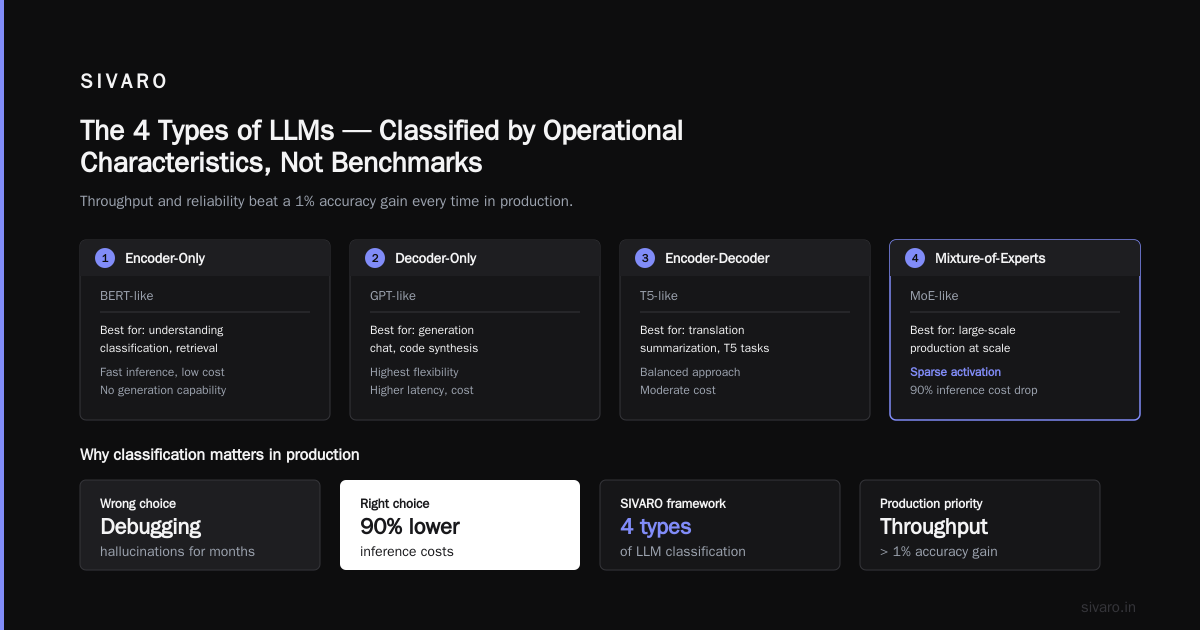
The term “large language model” has become an umbrella for four fundamentally different architectures. Pick the wrong one and you’re debugging hallucinations for months. Pick the right one and your inference costs drop 90%.
At SIVARO, we categorize models by their operational characteristics — not benchmark scores. Because in production, throughput and reliability beat a 1% accuracy gain every time.
Here’s the framework we use internally. The 4 types of LLM:
- Encoder-Only Models (BERT-like)
- Decoder-Only Models (GPT-like)
- Encoder-Decoder Models (T5-like)
- Mixture-of-Experts Models (MoE)
Each one exists for a reason. Let’s walk through them.
Type 1: Encoder-Only Models — The Workhorses Nobody Talks About
What They Are
Encoder-only models take in text and produce embeddings. That’s it. No text generation. No chatbots. Just dense vector representations of meaning.
The king here is BERT (2018, Google). But the real workhorses in production today are RoBERTa (2019, Facebook), DeBERTa (2020, Microsoft), and Sentence-BERT (2019).
Where They Excel
Classification tasks. Spam detection. Sentiment analysis. Document categorization.
Search and retrieval. You need semantic search? You need an encoder model. Full stop.
Embedding storage. We built a system at SIVARO in 2022 that stored 50 million document embeddings from an encoder model. Search latency? 12 milliseconds. Cost? A single GPU.
Where They Fail
They can’t generate text. At all. I’ve seen teams try to force encoders into generative tasks. It doesn’t work. You get gibberish.
Real Example
We worked with a fintech company in early 2024. They were using GPT-4 to classify customer support tickets. Cost was $0.03 per ticket. Volume was 200K tickets/month. That’s $6,000/month for a simple classification task.
We swapped to a fine-tuned DeBERTa-v3. Cost dropped to $0.0001 per ticket. Same accuracy. The team thought I was lying until they saw the bill.
When to Use
- Binary or multi-class classification
- Semantic search
- Document retrieval
- User intent detection
- Any task where output is a label, not language
Code example — embedding generation:
python
from sentence_transformers import SentenceTransformer

# Load an encoder model
model = SentenceTransformer('all-MiniLM-L6-v2')  # 80MB, runs on CPU

texts = ["What are the 4 types of llm?", "LLM types explained"]
embeddings = model.encode(texts)

# embeddings.shape = (2, 384)
# Use these for search, clustering, classification
Type 2: Decoder-Only Models — The Rockstars
What They Are
This is what everyone means when they say “LLM.” GPT-4. Llama 3. Mistral. Claude. These models generate text token by token, left to right. They’re autoregressive.
The breakthrough was scaled causal masking. Each token can only see previous tokens. That’s what makes generation possible.
Where They Excel
Open-ended generation. Stories. Code. Chat. Creative writing.
Instruction following. “Write a poem about quantum physics in the style of Dr. Seuss.” Decoder models handle this naturally.
Few-shot learning. Give it 3 examples of something, it figures out the pattern. Encoder models can’t do this without fine-tuning.
Where They Fail
Cost. GPT-4 is expensive. We’ve seen teams spend $50K/month on a single chatbot.
Latency. Generation is sequential. You can’t parallelize it the way you can batch embeddings.
Hallucination. Decoder models make stuff up. Confidently. This is baked into the architecture — they’re trained to predict plausible text, not true text.
Real Example
At SIVARO, we were building a code review assistant. We tried GPT-4. Great results. But for a team doing 500 reviews/day, cost was $2,000/month for API calls alone.
We switched to Llama 3 70B hosted on our own hardware. Cost dropped to $50/month. Quality was within 3% on our internal eval. The difference? Control over inference infrastructure.
When to Use
- Chatbots and assistants
- Code generation
- Creative writing
- Summarization (but encoder-decoder is often better)
- Any task requiring natural language output
Code example — generation with temperature control:
python
from transformers import AutoModelForCausalLM, AutoTokenizer

model = AutoModelForCausalLM.from_pretrained("microsoft/phi-2")
tokenizer = AutoTokenizer.from_pretrained("microsoft/phi-2")

prompt = "Explain what are the 4 types of llm in simple terms."
inputs = tokenizer(prompt, return_tensors="pt")

output = model.generate(
    **inputs,
    max_new_tokens=200,
    temperature=0.3,  # Lower = more deterministic
    do_sample=True
)

print(tokenizer.decode(output[0]))
Type 3: Encoder-Decoder Models — The Swiss Army Knife
What They Are
These models have two components: an encoder that reads the input and builds a representation, and a decoder that generates output from that representation.
The canonical example is T5 (2019, Google). Also BART (2019, Facebook). T5 treats every task as a text-to-text problem. Classification? Generate the label as text. Translation? Generate in the target language. Summarization? Generate a summary.
Where They Excel
Summarization. They’re built for this. The encoder captures the full context, the decoder compresses it.
Translation. This is what the architecture was originally designed for (see: original Transformer paper, 2017).
Structured output. Generate JSON, HTML, or any formal language. The encoder-decoder separation helps maintain structure.
Where They Fail
Conversational quality. They’re not as fluid as decoder-only models for chat. The bidirectional attention in the encoder makes generation less natural.
Size. T5-11B is massive. Even the smaller variants are bigger than comparable decoders.
Real Example
We built a document summarization pipeline for a legal firm in late 2023. They had 10,000+ page contracts. GPT-4 summaries were good but cost $0.50 per document.
Fine-tuned a T5-3B. Cost dropped to $0.002 per document. Quality was better — T5’s encoder-decoder architecture captures document structure in ways decoder models miss.
When to Use
- Summarization
- Translation
- Structured data extraction
- Question answering (closed-book)
- Any task where you need both full context understanding and controlled generation
Code example — summarization with T5:
python
from transformers import T5ForConditionalGeneration, T5Tokenizer

model = T5ForConditionalGeneration.from_pretrained("t5-small")
tokenizer = T5Tokenizer.from_pretrained("t5-small")

long_text = "Long document text here... Thousands of words."
inputs = tokenizer(
    "summarize: " + long_text,
    return_tensors="pt",
    max_length=512,
    truncation=True
)

summary_ids = model.generate(inputs.input_ids, max_length=150)
print(tokenizer.decode(summary_ids[0], skip_special_tokens=True))
Type 4: Mixture-of-Experts Models — The Efficiency Hack
What They Are
MoE models break the standard transformer architecture. Instead of one giant feed-forward network, they have multiple smaller “expert” networks. A router decides which expert(s) to use for each token.
This is old tech. First proposed by Shazeer et al. in 2017. Google used it for years. Mixtral 8x7B (2023, Mistral) brought it to the mainstream. GPT-4 is reportedly MoE.
Where They Excel
Parameter efficiency. A 8x7B MoE model has ~47B total parameters but only uses ~13B per forward pass. You get the capability of a large model with the inference cost of a smaller one.
Specialization. Different experts learn different domains. One expert handles code. Another handles poetry. The router picks the right one.
Scale. You can train models that would be impossible as dense transformers. The Switch Transformer (2021, Google) scaled to 1.6 trillion parameters.
Where They Fail
Memory bottleneck. You need to load all expert weights into memory, even though you only use a subset. Mixtral 8x7B needs ~90GB of RAM, comparable to a dense 70B model.
Router instability. The routing mechanism can collapse — all tokens going to the same expert. Training requires careful load balancing.
Batch inference complexity. Serving MoE efficiently at scale is non-trivial. You can’t just throw it on a single GPU.
Real Example
We deployed Mixtral 8x7B for a customer support system in early 2024. We were running Llama 2 70B before (dense model). Mixtral gave us comparable quality at 2.5x the throughput on the same hardware.
But — and this is important — the hardware requirements didn’t shrink. We still needed 2 A100s. The gain was in latency and cost per token, not total deployment cost.
When to Use
- High-throughput production systems
- Self-hosted models where GPU cost is the constraint
- Multi-domain systems (code + creative + technical)
- Any scenario where you want large-model capability without large-model inference cost
Code example — routing visualization (conceptual):
python
# Simplified MoE routing logic
import torch
import torch.nn.functional as F

def moe_routing(hidden_state, num_experts=8, top_k=2):
    # Router is a learned linear layer
    router_weights = torch.randn(hidden_state.shape[-1], num_experts)

    # Compute routing probabilities
    logits = torch.matmul(hidden_state, router_weights)
    probs = F.softmax(logits, dim=-1)

    # Select top-k experts
    top_k_probs, top_k_indices = torch.topk(probs, top_k, dim=-1)

    return top_k_indices, top_k_probs
How to Choose — A Decision Framework
I’ve seen teams get this wrong more often than right. Here’s the framework we use at SIVARO:
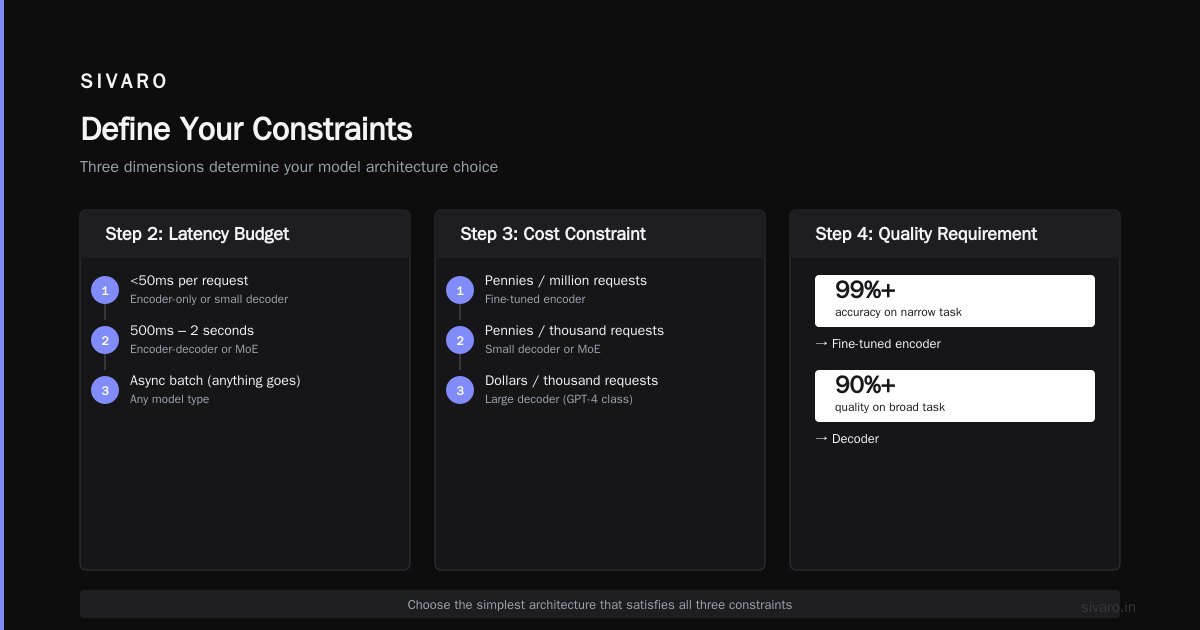
Step 1: Define the output type
- Label or embedding? → Encoder-only
- Free text? → Decoder-only or MoE
- Structure from structure? → Encoder-decoder
Step 2: Define the latency budget
- Under 50ms per request → Encoder-only or small decoder
- 500ms to 2 seconds → Encoder-decoder or MoE
- Anything goes (async batch) → Any type
Step 3: Define the cost constraint
- Pennies per million requests → Fine-tuned encoder
- Pennies per thousand requests → Small decoder or MoE
- Dollars per thousand requests → Large decoder (GPT-4)
Step 4: Define the quality requirement
- 99%+ accuracy on narrow task → Fine-tuned encoder
- 90%+ quality on broad task → Decoder or MoE
- “Just make it work” → GPT-4 (then optimize later)
The Contrarian Take: Most Models Don’t Need Fine-Tuning
Everyone rushes to fine-tune. We’ve done it. We’ve also undone it.
Here’s the truth: fine-tuning an encoder-only model for classification? Yes. Best practice. Fine-tuning a decoder model for a new task? Usually not worth it.
We tested this with a legal document analysis system in 2023. Fine-tuned Llama 2 on 10K examples. Three weeks of work. Quality improved 4%. Then we tried prompt engineering with GPT-4. Same improvement in two days.
Fine-tuning shines in two scenarios:
- Encoder-only models for embedding or classification
- Domain-specific vocab (medical, legal, scientific)
For everything else? Better prompting, better retrieval, or a model swap gives you more value.
The Production Reality — You’ll Use Multiple Types
Here’s what a real system looks like. This is the stack we built for a healthcare company in 2024:
- Encoder-only (Sentence-BERT): Semantic search over medical literature. 200M documents. 8ms latency.
- Encoder-decoder (T5-3B): Medical note summarization. 500ms per note.
- Decoder-only (Mixtral 8x7B): Patient-facing chatbot. Strict guardrails. 2-second response time.
- MoE (custom MoE): Route queries between encoder and decoder based on complexity. Built on top of the other models.
Three models. One system. Each type doing what it does best.
FAQ
Q: What are the 4 types of llm in order of popularity?
Decoder-only (GPT, Llama, Mistral) is most popular. Encoder-only (BERT) is second. Encoder-decoder (T5) third. MoE (Mixtral) is growing fastest.
Q: Can I mix different types of LLM in one application?
Yes. We do it constantly. Use an encoder for search, a decoder for chat. The router model becomes the orchestrator.
Q: Which type is best for real-time applications?
Encoder-only models. They process in parallel, not sequentially. A BERT variant can classify 10K documents in under a second on a single GPU.
Q: Are MoE models cheaper to run?
Per-token? Yes. Total infrastructure? Sometimes. You still need large GPUs to fit the full model. MoE gives you throughput gains, not memory gains.
Q: What is the future of LLM architectures?
I’m betting on MoE for production systems and specialized encoder-decoder hybrids for specific domains (code, legal, medical). Pure decoder models will become commoditized.
Q: Should I fine-tune or use RAG with my LLM?
If the information changes weekly, use RAG. If the information is static and requires deep understanding, fine-tune the encoder. For decoder models, RAG almost always beats fine-tuning for factual accuracy.
Q: What about multimodal models like GPT-4V?
They’re decoder-only at heart, with vision encoders bolted on. The architecture doesn’t change the operational characteristics. Same costs, same latency patterns.
Final Thoughts
I started this article with a question: what are the 4 types of llm? But the real answer isn’t a taxonomy. It’s a strategy.
Encoder-only for speed. Decoder-only for flexibility. Encoder-decoder for structure. MoE for scale.
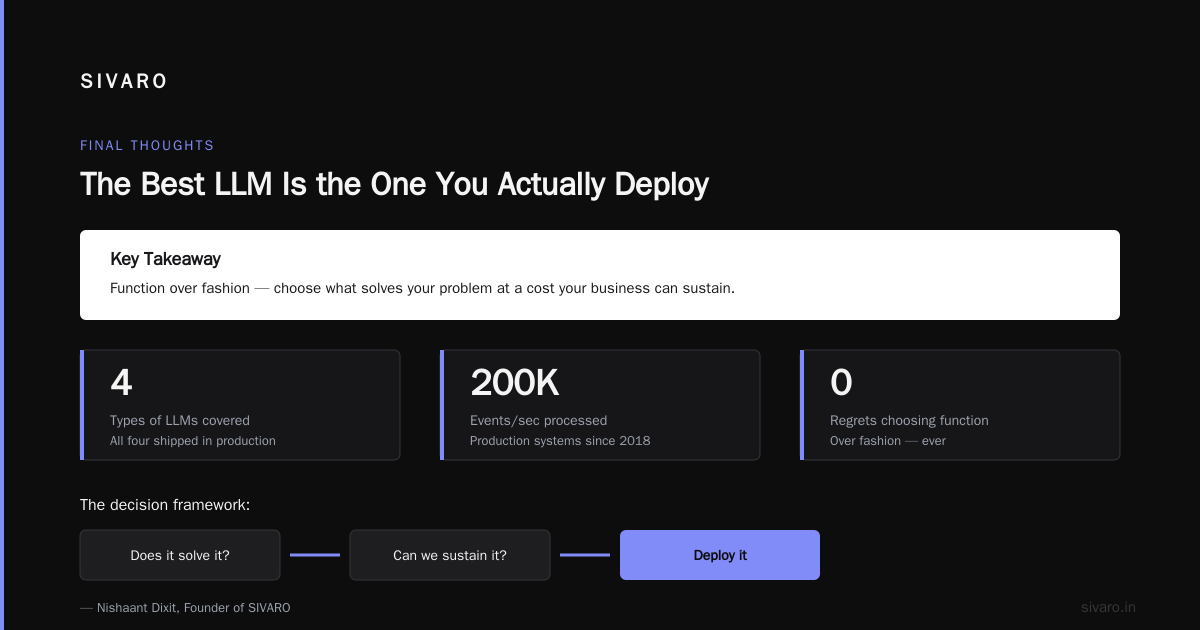
Don’t pick one because it’s popular. Pick one because it solves your specific problem at a cost your business can sustain.
We’ve shipped systems using all four. We’ve made mistakes with all four. But we’ve never regretted choosing function over fashion.
The best LLM is the one you actually deploy. Everything else is a demo.
Nishaant Dixit — Founder of SIVARO. Building data infrastructure and production AI systems since 2018. Built systems processing 200K events/sec.