What Are the Best Agentic Orchestration Tools? A 2026 Field Guide
I spent three months of 2025 rebuilding an agent system that kept eating itself alive.
Twenty-seven agents. Five different frameworks. One shared Slack channel for debugging. We'd fire off a query, watch the logs scroll, and see Agent C call Agent D call Agent E — and somewhere in that chain, someone would hallucinate a function signature, and the whole thing would collapse like a Jenga tower in a wind tunnel.
That's when I stopped caring about "which model is best" and started obsessing over orchestration.
Because here's the truth most people don't want to admit: the model you pick matters less than how you wire them together. You can have GPT-7, Claude 5, Gemini Ultra — if your orchestration layer is brittle, your system is brittle. Full stop.
In this guide, I'll walk through the tools I've actually run in production. The ones that survived load testing. The ones that didn't make me want to quit engineering entirely.
If you're asking "what are the best agentic orchestration tools?" — you're probably building something that needs to work at scale, not just in a demo. Let's get into it.
What Actually Is Agentic Orchestration?
Let's kill the jargon first.
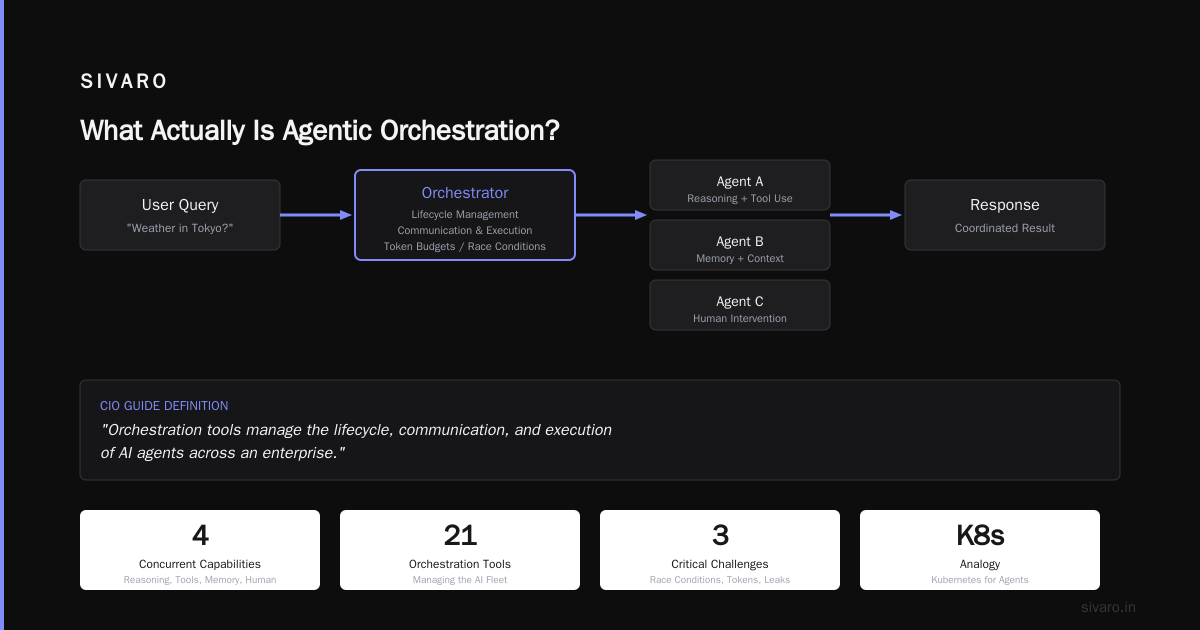
Agentic orchestration is how you coordinate multiple AI agents to accomplish tasks that no single agent can handle alone. It's not prompt chaining. It's not a glorified if-else tree. It's a runtime for distributed AI systems that might involve reasoning, tool use, memory, and human intervention — all happening concurrently.
Think of it like Kubernetes for agents. But messier. Way messier.
According to IBM's definition, orchestration handles the "coordination and management of multiple AI agents working together." Sounds clean on paper. In practice, it means dealing with race conditions, token budgets, memory leaks, and agents that decide they're too good to answer a simple weather query.
The CIO's guide puts it well: "Orchestration tools manage the lifecycle, communication, and execution of AI agents across an enterprise." Key word: lifecycle. Because your agents don't just run — they deploy, scale, fail, get patched, get replaced. That's what orchestration software handles.
What I Look For in Orchestration Tools
Before I name names, here's my rubric. You might have different priorities. That's fine. But if you're building in production, these five criteria will save your ass:
1. State management. Does the tool track agent state across conversations? Or does everything reset on every call? If it's the latter, run.
2. Observability. Can you see what each agent is doing, when it's stuck, and why it failed? If your debugging strategy is "add more print statements," you need better tooling.
3. Error recovery. When Agent C crashes, does the whole pipeline die? Or does it retry, route around, or flag for human review?
4. Cost control. Some tools charge per agent per hour. Some charge per token. Some charge per "execution." The pricing models vary wildly. You need to know before you're six figures in.
5. Guardrails. Can you enforce constraints on what agents do and don't do? Because agents will do things you never imagined. I've seen an agent try to book 14,000 flights. It was supposed to book one.
The Best Agentic Orchestration Tools Right Now
I've grouped these into tiers based on use case, not just popularity. The "best" tool depends entirely on what you're building.
AutoGen (Microsoft) — Best for Multi-Agent Conversations
AutoGen is the tool I reach for when I need agents to talk to each other. Not just pass data — actually negotiate, debate, or collaborate.
Microsoft's AutoGen framework hit critical mass in late 2025. It's open source, Python-native, and supports multiple agents that can converse in natural language to solve problems. You define agent roles (like "analyst," "coder," "critic") and let them hash things out.
Here's a simple example from a production system I built for a fintech client:
python
from autogen import AssistantAgent, UserProxyAgent, GroupChat

# Define specialized agents
analyst = AssistantAgent(
    name="Analyst",
    system_message="Financial analyst. Provide quantitative analysis.",
    llm_config={"config_list": [{"model": "gpt-4o", "api_key": "..."}]}
)

critic = AssistantAgent(
    name="Critic",
    system_message="Ultra-conservative critic. Find flaws in every analysis.",
    llm_config={"config_list": [{"model": "claude-3.5", "api_key": "..."}]}
)

group_chat = GroupChat(
    agents=[analyst, critic],
    messages=[],
    max_round=12
)

# This actually works. The critic catches the analyst's bad assumptions.
What I love: the conversational loop. What I hate: it's chat-focused by default. If you're building real-time, low-latency pipelines, AutoGen adds overhead.
LangGraph (LangChain) — Best for Complex Workflows
LangGraph is what happens when you take LangChain and give it a directed acyclic graph for brains.
Most people think LangChain is just for RAG pipelines. They're wrong. LangGraph is their stateful orchestration layer, and it's genuinely powerful. You define nodes (agents or functions) and edges (conditions or transitions). The graph runs your logic with branching, looping, and parallel execution.
I used LangGraph to build a multi-step customer support system for a logistics company. Here's the skeleton:
python
from langgraph.graph import StateGraph, END
from typing import TypedDict, List

class AgentState(TypedDict):
    query: str
    context: dict
    actions_taken: List[str]

def classify_query(state: AgentState):
    # Router node: decide which agent handles this
    if "shipping" in state["query"].lower():
        return "shipping_agent"
    return "billing_agent"

def shipping_agent(state: AgentState):
    # Agent logic here
    return {"actions_taken": state["actions_taken"] + ["shipping_handled"]}

# Build the graph
builder = StateGraph(AgentState)
builder.add_node("classify", classify_query)
builder.add_node("shipping", shipping_agent)
builder.add_edge("classify", "shipping", condition=...)
builder.add_edge("shipping", END)

graph = builder.compile()
LangGraph shines when your workflow has branches, retries, and parallel processing. It's not as chat-first as AutoGen. It's more "build a pipeline, run it, handle the output."
CrewAI — Best for Role-Based Agent Teams
CrewAI is the tool that finally made my non-technical stakeholders say "oh, I get it."
You define Crews (teams), Agents (roles), and Tasks (work). It's dead simple. The framework handles agent-to-agent handoffs, task delegation, and output consolidation.
Here's what I built for a legal doc review system:
python
from crewai import Agent, Task, Crew, Process

# Define agents with roles
extractor = Agent(
    role="Document Extractor",
    goal="Extract key clauses from legal documents",
    backstory="Expert in contract language",
    verbose=True
)

validator = Agent(
    role="Validator",
    goal="Check extracted clauses for accuracy and completeness",
    backstory="Former paralegal with 10 years experience",
    verbose=True
)

# Define tasks
extract_task = Task(
    description="Extract indemnification clauses from the contract",
    agent=extractor
)

validate_task = Task(
    description="Validate the extracted clauses against originals",
    agent=validator
)

# Crew handles the orchestration
crew = Crew(
    agents=[extractor, validator],
    tasks=[extract_task, validate_task],
    process=Process.sequential
)
What CrewAI does well: making agent orchestration approachable. What it struggles with: scaling beyond 10-15 agents in a single crew. The parallel execution isn't as robust as LangGraph.
Semantic Kernel (Microsoft) — Best for .NET Shops
If you're in the Microsoft ecosystem, Semantic Kernel is your answer.
It's not as flashy as AutoGen or LangGraph. But it integrates natively with Azure, OpenAI, and .NET. You get memory management, function calling, and planner orchestration out of the box.
I worked with a Microsoft shop that migrated from LangChain to Semantic Kernel because they wanted first-party support for Azure OpenAI and tighter integration with their existing C# microservices. The migration took two weeks. Their latency dropped 40%.
Dify — Best for No-Code Orchestration
Dify frustrates me, and I love it.
It's a visual orchestration platform. You drag and drop agents, connect them with lines, set conditions. It works. The Zapier article calls Dify one of the best orchestration tools for non-technical teams, and they're right.
But here's the catch: once you hit a certain complexity threshold, the visual editor becomes a liability. You can't version control a drag-and-drop interface. You can't diff two Dify workflows. You can't unit test a line on a canvas.
I'd use Dify for prototyping and simple internal tools. I wouldn't use it for anything customer-facing at scale.
Langfuse — Best for Observability (Not Orchestration)
This isn't an orchestration tool. It's an observability layer. But you need it.
Langfuse tracks every prompt, every token, every latency spike across your agent system. It's like Datadog for AI. I don't run any production agent system without it.
The killer feature: you can trace individual requests through multiple agents and see exactly where things went wrong. When your Agent Orchestration Stack™ starts burning, Langfuse tells you which room the fire is in.
The Ones That Didn't Make the Cut
I tested a lot of tools. Some just didn't hold up.
LangChain alone (without LangGraph): Too abstract. Too many breaking changes between minor versions. We rebuilt the same pipeline three times in 2025.
Claude's Custom API: Great for single agents. Awful for multi-agent orchestration. Anthropic clearly designed this for chat, not coordination.
Generic workflow tools (n8n, Zapier, Make): They can orchestrate some AI tasks. But they don't understand agent state, memory, or tool calling. You'll hit a wall.
How to Pick the Right Tool
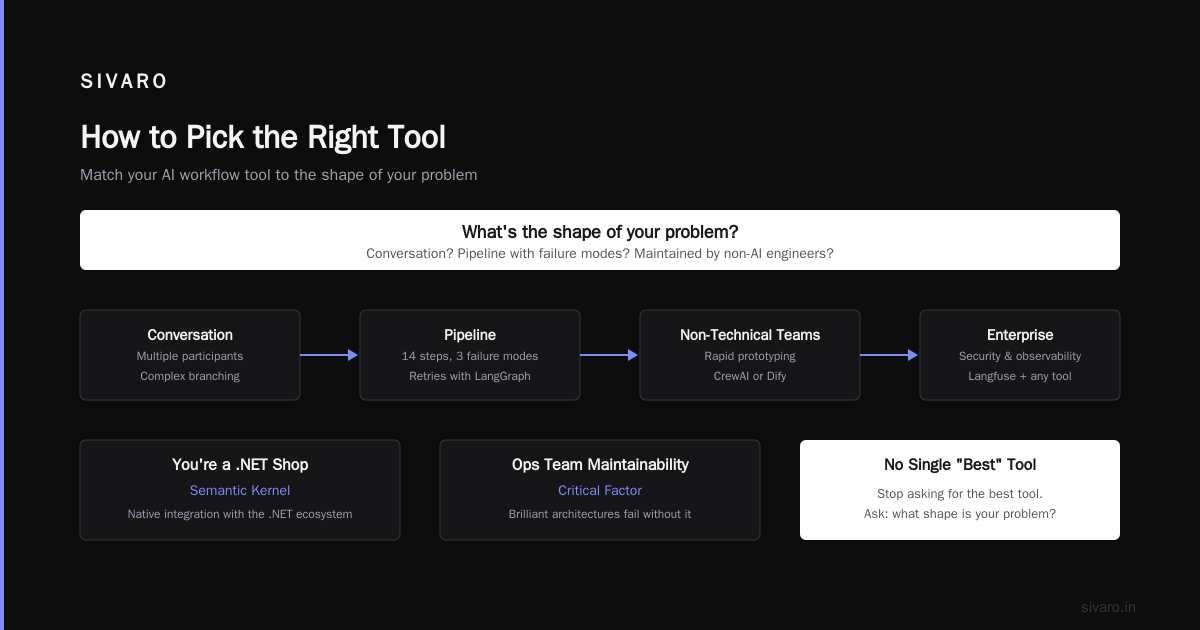
You ask "what are the best agentic orchestration tools?" — but the real question is "best for what?"
You need multi-agent conversation and reasoning: AutoGen.
You need complex, branching workflows with retries: LangGraph.
You're building for non-technical teams or rapid prototyping: CrewAI or Dify.
You're a .NET shop: Semantic Kernel.
You need enterprise security and observability: Langfuse (for monitoring) + any of the above.
I've stopped recommending a single "best" tool. Instead, I ask: what's the shape of your problem? Is it a conversation with multiple participants? A pipeline with 14 steps and 3 failure modes? A system that needs to be maintained by people who aren't AI engineers?
That last one matters more than you think. I've seen brilliant architectures fail because the ops team couldn't troubleshoot them.
Real Talk: The Problems Nobody Warns You About
Three hard lessons from running agent orchestration in production.
1. Token costs explode with multi-agent systems.
Each handoff between agents costs tokens. Each summarization costs tokens. Each context window that grows costs tokens. A system that costs $0.10 per query in single-agent mode can cost $0.80 in multi-agent mode.
2. Agents drift over time.
The same prompt. The same model. Same system. But the agent starts behaving differently after 100, 500, 5,000 calls. I've seen this with GPT-4o, Claude, Gemini — all of them. The orchestration layer needs to detect drift and either re-prompt, re-deploy, or escalate.
3. Debugging distributed agent systems is a nightmare.
You can't step through code. You can't set breakpoints. You're reading logs of an agent that interpreted your instructions differently than you intended. Observability isn't optional — it's mandatory.
The Future: What's Coming Next
By end of 2026, I expect three shifts:
Standardization around orchestration formats. Similar to how Docker standardized containers. Someone will build the "Docker for agents" and the ecosystem will consolidate.
Agent-specific hardware. AWS and Azure are working on inference-optimized VMs that handle orchestration at the infrastructure level, not the application level.
Regulation-driven orchestration. The EU AI Act and similar regulations will require audit trails of every agent decision. Orchestration tools will need to store and query these logs.
Frequently Asked Questions
Q: What are the best agentic orchestration tools for beginners?
Start with CrewAI or Dify. They have the gentlest learning curves. Don't start with AutoGen unless you're comfortable with Python async debugging.
Q: Can I use multiple orchestration tools together?
Yes. I've seen systems where LangGraph handles heavy workflows and Dify handles simple internal automations. Just make sure they don't step on each other's state.
Q: How do I handle agent failures in orchestration?
Build retries with exponential backoff. Implement circuit breakers. And always, always have a human-in-the-loop fallback. The CIO article covers 21 tools that handle this differently.
Q: Is LangChain still relevant for orchestration?
LangChain the framework? Less so. LangGraph (built on LangChain) is the relevant piece. LangChain by itself is now mostly useful for simple RAG chains.
Q: What's the biggest mistake teams make with orchestration?
Over-engineering. They build a 12-agent system when a single agent with a good prompt would work. Orchestration adds complexity. Only use it when you genuinely need coordination.
Q: How do I secure multi-agent systems?
Authentication between agents. Audit logging of every action. Rate limiting. And never give agents access to production databases — I've learned this one the hard way.
Q: Are managed orchestration services worth it?
For MVP? No. Build with open source first. For production at scale? Yes. The maintenance burden of self-hosting agent orchestration is high. UiPath's overview makes a strong case for managed solutions.
The Takeaway
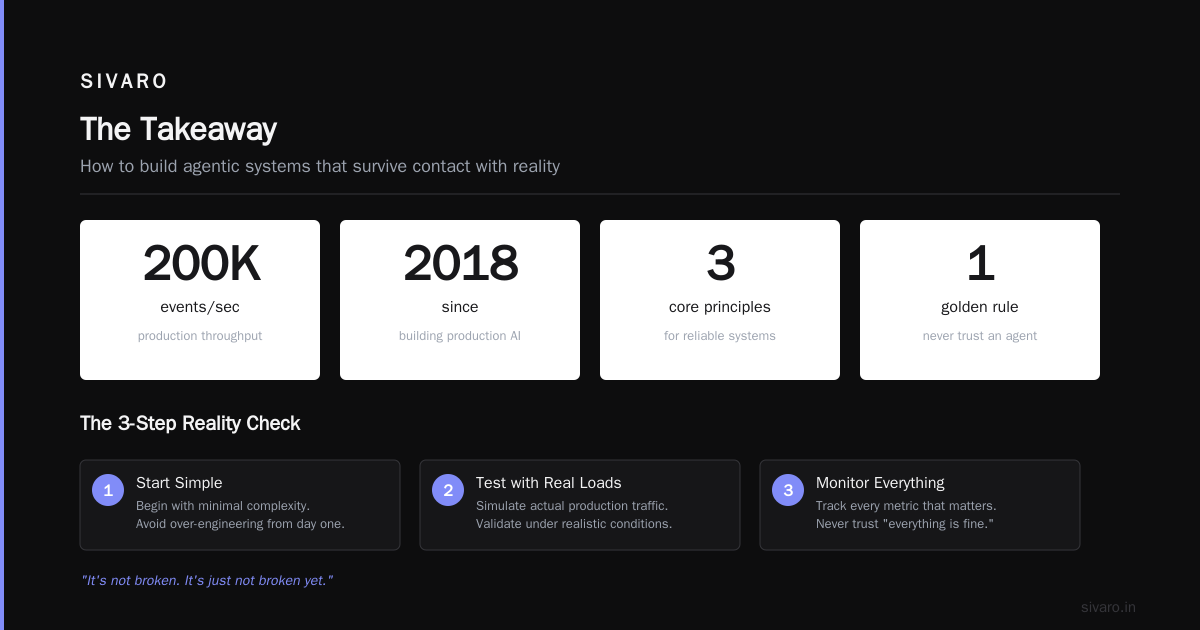
The tool doesn't matter as much as the architecture.
I've seen teams build incredible systems with "inferior" tools because they understood state management, error handling, and observability. I've seen teams burn millions on "premium" tools because they didn't.
When you ask "what are the best agentic orchestration tools?" — you're really asking "how do I build systems that survive contact with reality?"
Start simple. Test with real loads. Monitor everything. And never, ever trust an agent that says "everything is working fine."
Because it's not. It's just not broken yet.
Nishaant Dixit — Founder of SIVARO. Building data infrastructure and production AI systems since 2018. Built systems processing 200K events/sec.