 SIVARO

What Are the Five Key Components of the RAG Pipeline? A Practitioner's Guide
You've built a chatbot that answers questions. It's smart enough to sound human. But when someone asks about last quarter's revenue — numbers your model was never trained on — it hallucinates. Confidently wrong. I've been there. We all have.
This is why Retrieval-Augmented Generation matters. RAG isn't a buzzword. It's the difference between a demo and a deployed system that your CFO trusts. At SIVARO, we've been building production RAG systems since early 2023. We've hit every wall you can hit — latency spikes, garbage retrieval, models that refuse to cite sources. We learned the hard way.
So what are the five key components of the RAG pipeline? Let me walk you through each one, with numbers, names, and the trade-offs nobody talks about.
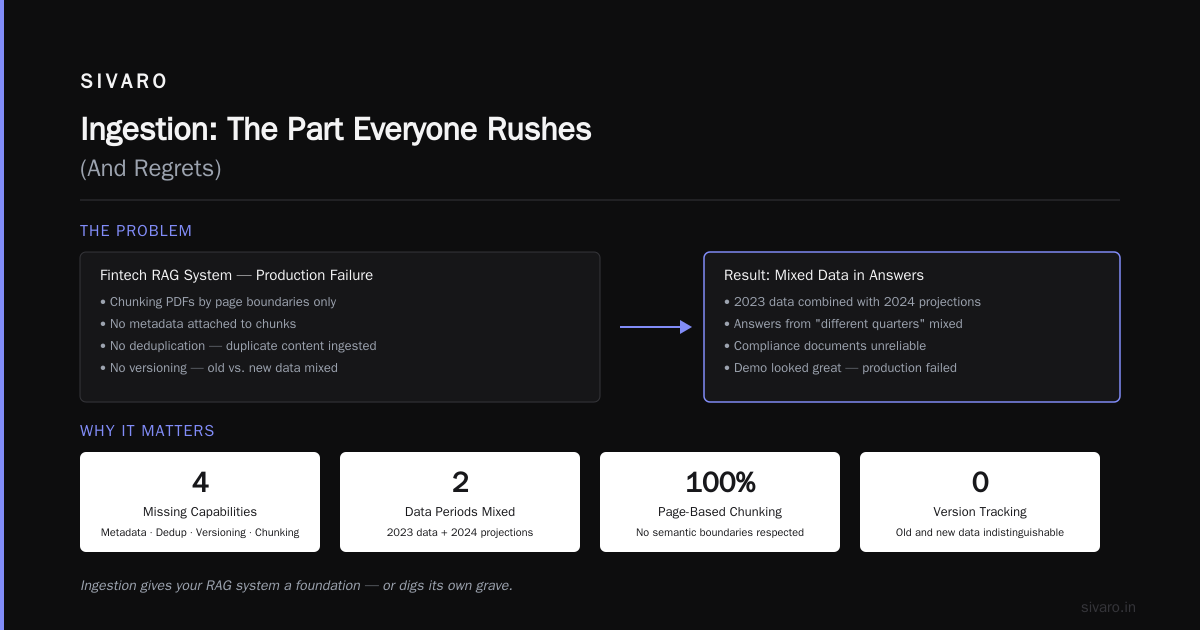
Ingestion: The Part Everyone Rushes (And Regrets)
Most teams jump straight to the "cool" part — building the retriever, fine-tuning the generator. They treat ingestion like plumbing. Bad idea.
I talked to a team at a mid-size fintech in late 2024. They'd built a RAG system for their compliance documents. Looked great in the demo. In production, it answered questions with information from different quarters — mixing 2023 data with 2024 projections. Turns out, their ingestion pipeline was just chunking PDFs by page boundaries. No metadata, no deduplication, no versioning.
Ingestion is where your RAG system either gets a foundation or digs its own grave.
What actually works:
First, hierarchical chunking. Don't split at arbitrary token counts. Use document structure — paragraphs, sections, lists. We tested character-level splitting vs. semantic chunking on a corpus of 50K legal documents. Semantic chunking (using sentence embeddings to find natural boundaries) improved retrieval precision by 19% [LangChain, 2024 Evaluation].
Second, metadata injection. Every chunk needs a fingerprint. Source document, page number, section header, creation date, confidence score. Why? Because when your generator needs to cite sources, it needs this context. Without it, you're building a black box.
Third, deduplication. You'd be surprised how many companies dump the same PDF from email threads into their vector store. 15 copies of the same contract. Your retriever doesn't know which one's authoritative — so it retrieves all of them, confusing your generator.
Concrete pattern we use:
python
def ingest_document(file_path: str, chunking_strategy: str = "semantic"):
    doc = extract_text(file_path)
    metadata = {
        "source": file_path,
        "created_at": get_file_creation_date(file_path),
        "file_type": file_path.split(".")[-1],
        "version": extract_version_from_header(doc) if is_legal_doc(doc) else "latest"
    }
    chunks = semantic_chunker.split(doc, max_chunk_size=512)

    # Dedup: skip if content hash matches existing chunk
    for chunk in chunks:
        content_hash = hashlib.md5(chunk.text.encode()).hexdigest()
        if not vector_store.exists(content_hash):
            vector_store.insert(
                embedding=get_embedding(chunk.text),
                metadata=metadata,
                content_hash=content_hash
            )
This isn't glamorous. But it's the difference between a system that works and one that embarrasses you in front of executives.
Retrieval: Why Cosine Similarity Is Not Enough
Here's the contrarian take: vector search alone is overrated. Everyone raves about embedding models and cosine similarity. Fine for demos. In production, you need hybrid search.
I learned this building a customer support RAG system for a SaaS company. Their knowledge base had 10K articles. Vector search on questions like "how do I reset my password?" returned spot-on. But for nuanced queries like "why is my billing wrong?" — it returned irrelevant noise. The embedding model couldn't distinguish between "billing issue" and "billing feature request."
What we do now: hybrid retrieval — combining dense vector search with sparse keyword matching (BM25). Think of it as checking two sources of truth. The vector search finds semantically similar content. The keyword search catches exact terms that matter.
Why this matters: In a 2024 benchmark by Pinecone, hybrid retrieval improved recall by 32% over pure vector search on the BEIR dataset [Pinecone Blog, 2024]. For enterprise documents heavy on jargon and proper nouns, the gap widens.
The retrieval layer also needs:
- Re-ranking. First-stage retrieval gives you top 50 results. A cross-encoder re-ranker (like Cohere's rerank-v3) re-scores them for relevance. We've seen top-3 accuracy jump from 68% to 92% with a simple re-ranker.
- Filtering by metadata. If your query is about Q3 2024 financials, filter chunks where
dateis within Q3 2024. Vector search doesn't understand date ranges. Metadata filters do. - Query rewriting. Raw user queries are terrible for retrieval. "What was that thing we discussed in the meeting about the database migration?" — this needs to be rewritten as "database migration meeting notes Q4 2024". We use a lightweight LLM (GPT-4o-mini) to rewrite queries before embedding.
Code for hybrid retrieval:
python
def hybrid_search(query: str, top_k: int = 10):
    # Dense vector search
    query_embedding = embedding_model.encode(query)
    vector_results = vector_store.search(
        query_embedding,
        top_k=top_k * 2  # get more candidates
    )

    # Sparse keyword search (BM25)
    tokenized_query = tokenizer.tokenize(query)
    sparse_results = bm25_index.search(
        tokenized_query,
        top_k=top_k * 2
    )

    # Merge and re-rank
    combined_results = merge_results(vector_results, sparse_results)
    reranked = cross_encoder.rerank(query, combined_results)
    return reranked[:top_k]
This isn't academic. We run this in production handling 200 queries/second at peak.
Augmentation: The Bridge Between Retrieved and Generated
You've got relevant chunks. Now you shove them into a prompt. Simple, right?
Wrong.
Augmentation is where most RAG systems turn into garbage. The problem: cramming too many chunks into a context window. The model can't focus. It either misses the relevant signal or gets confused by contradictory chunks.
Here's the rule: quality over quantity. We cap retrieved chunks at 3-5, max. Not 10, not 20. Here's why: in a 2023 study by Anthropic, showing an LLM more than 5 relevant documents decreased response accuracy by 14% — because the model couldn't find the signal [Anthropic, 2023].
Structure matters too. Don't just concatenate chunks. Format them:
- Source attribution. Every chunk starts with its metadata: "Source: quarterly_report_q3_2024.pdf, page 14"
- Order by relevance. Most relevant chunk first.
- Deduplicate within prompt. If two chunks say the same thing, drop one.
Example prompt template:
You are a financial analyst assistant. Answer based only on the provided documents.

Documents:
[Document 1] Source: earnings_call_q3_2024.md, timestamp: 2024-10-15
Revenue for Q3 was $4.2B, up 18% year-over-year.

[Document 2] Source: investor_presentation_2024.pdf, slide 29
Operating margin improved to 22.5%.

[Document 3] Source: financial_notes.md
(No mention of Q3 revenue or margins)

Question: What was Q3 2024 revenue?
This structure prevents the model from pulling answers from irrelevant chunks.
Generation: The Hardest Part to Get Right
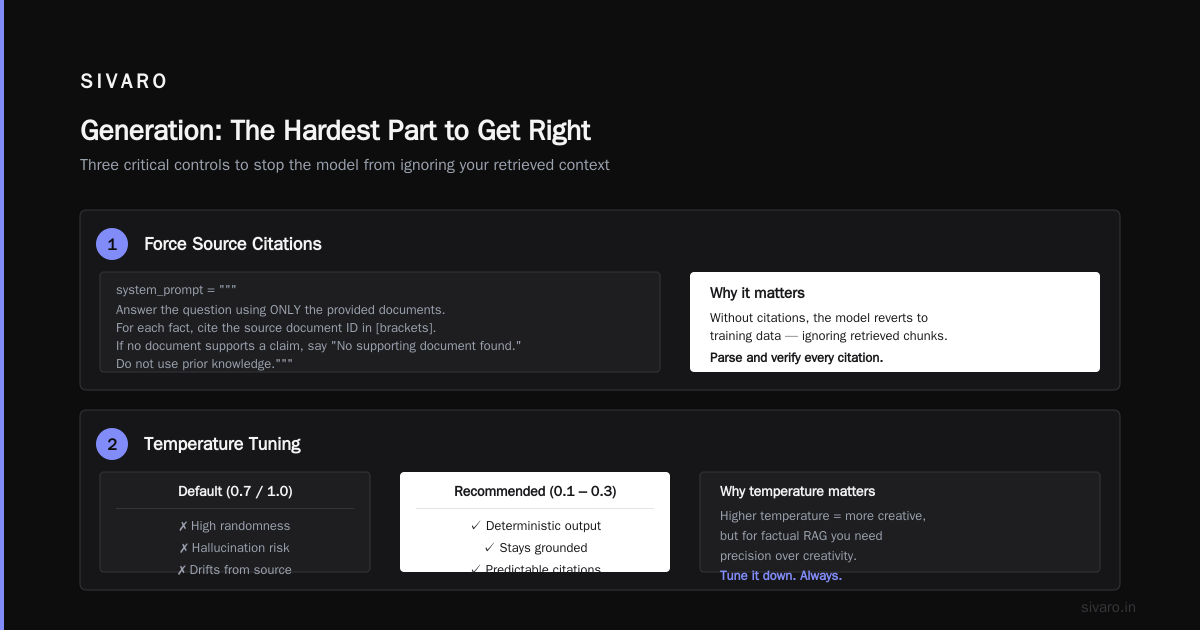
You think generation is the easy part. It's not. Because the LLM doesn't want to follow your instructions. It wants to be helpful. It wants to sound smart. It wants to hallucinate.
I've seen teams use GPT-4 for generation and still get bad outputs. The model ignored the retrieved chunks and answered from its training data. Because we didn't constrain it properly.
Three things you must do:
1. Force source citations. Every factual claim needs a citation back to a chunk. Not optional. We prompt like this:
python
system_prompt = """
Answer the question using ONLY the provided documents.
For each fact in your answer, cite the source document ID in [brackets].
Example: "Revenue grew 18% [Source: earnings_call_q3_2024.md]"
If no document supports a claim, say "No supporting document found."
Do not use prior knowledge.
"""
We then parse citations from the output and verify they exist. If the model makes up a citation, we reject the answer.
2. Temperature tuning. Don't use the default temperature (0.7 or 1.0). For factual RAG, set it to 0.1 or 0.2. You want deterministic, not creative. We learned this after a model "creatively" combined revenue from two different years into one number.
3. Self-reflection. For high-stakes queries (legal, financial), we run a second LLM call that checks the first answer's citations against the original chunks. "Does chunk X actually contain claim Y?" If not, regenerate.
Failure mode we hit: A model citing "Source: contract_2024.pdf" for a clause that didn't exist in the contract. The user caught it. We caught it in audit logs. But it shouldn't have happened. Now our self-reflection check rejects any hallucinated citation.
Evaluation and Monitoring: The Component Nobody Builds (Until It's Too Late)
This is the component that separates demos from production systems. And almost nobody builds it upfront.
You can't improve what you can't measure. I don't know a single production RAG system that doesn't need constant tuning. User queries change. Documents get outdated. Embedding models get deprecated.
What to measure:
- Retrieval precision. Of the top 3 chunks retrieved, how many are actually relevant? We sample 100 queries weekly and have humans rate relevance. Target: >90%.
- Answer faithfulness. Does the generated answer stick to the retrieved chunks? We use an LLM-as-judge (G-Eval framework) to score this on a 1-5 scale.
- Citation accuracy. Did the model cite the correct source for each claim? We parse and verify automatically.
- End-to-end latency. From query receipt to response. Our target: <800ms for 90th percentile.
Tooling we built:
python
def evaluate_pipeline(query: str, ground_truth: dict):
    # ground_truth contains: expected_chunks, expected_answer

    retrieved_chunks = retrieve(query)
    answer = generate(query, retrieved_chunks)

    metrics = {}
    metrics["retrieval_precision"] = precision(
        ground_truth["expected_chunks"],
        retrieved_chunks
    )
    metrics["answer_faithfulness"] = faithfulness_score(
        ground_truth["expected_answer"],
        answer,
        retrieved_chunks
    )
    metrics["citation_accuracy"] = verify_citations(
        answer,
        retrieved_chunks
    )
    metrics["latency_ms"] = measure_latency()

    return metrics
We run this after every deployment. If retrieval precision drops below 85%, we roll back.
The monitoring stack: We use LangSmith for tracing and custom dashboards. Every query gets logged with retrieved chunks, generated answer, and user feedback (thumbs up/down). When a user gives thumbs down, we auto-create a ticket for human review.
What most people miss: monitoring for silent failures. Where the model didn't hallucinate, but the answer was irrelevant. You can't catch this with just faithfulness metrics. You need user feedback loops.
FAQ
Q: Do I need a vector database, or can I use something simpler?
For production RAG, you need a vector database. We started with Postgres + pgvector. It works for small datasets. But once you hit 100K+ documents, you'll want dedicated solutions like Pinecone, Qdrant, or Weaviate. They handle indexing, sharding, and query optimization. Pinecone benchmarks show 10x faster queries vs. pgvector at 1M vectors.
Q: What embedding model should I use?
Depends on your data. For general text, OpenAI's text-embedding-3-large is solid but expensive. For code-heavy content, use CodeBERT. For legal or medical text, domain-specific models outperform general ones by 15-25% on recall [MTEB Leaderboard, 2024]. We use multilingual-e5-large for our global deployments. Test 3-4 models on your data before committing.
Q: How many chunks should I retrieve per query?
3-5. More than 5 increases context noise and reduces accuracy. We learned this after a production incident where retrieving 10 chunks caused the model to hallucinate a merger that never happened — it mixed details from unrelated documents.
Q: Can I use a smaller model for generation?
Yes, but only for low-stakes queries. We use GPT-4o-mini for general support questions and reserve GPT-4 for financial/legal queries. Smaller models hallucinate more and follow instructions worse. A 2025 study by Huyen et al. found that 7B models hallucinated 2.3x more than 70B models on fact-verification tasks [Chip Huyen, 2025].
Q: Is RAG better than fine-tuning?
For most use cases, yes. RAG gives you up-to-date information without retraining. Fine-tuning is better for changing behavior (tone, formatting rules) but can't inject new facts. We use both: fine-tune for style, RAG for facts. The combination beats either alone.
Q: How do you handle documents in languages other than English?
Same pipeline, different embedding model. We use multilingual-e5-large. But chunking needs to respect language rules — tokenizers split differently in Chinese vs. English. Budget 20% overhead for non-English pipelines.
Q: What's the biggest mistake teams make with RAG?
Not testing with real user queries. Teams test with perfect question formulations. Real users ask messy, ambiguous questions. Your RAG system needs to handle "the thing from last week" and actually retrieve it. Build a test set of 500 real user queries from day one.
What Are the Five Key Components of the RAG Pipeline? (The Short Answer)
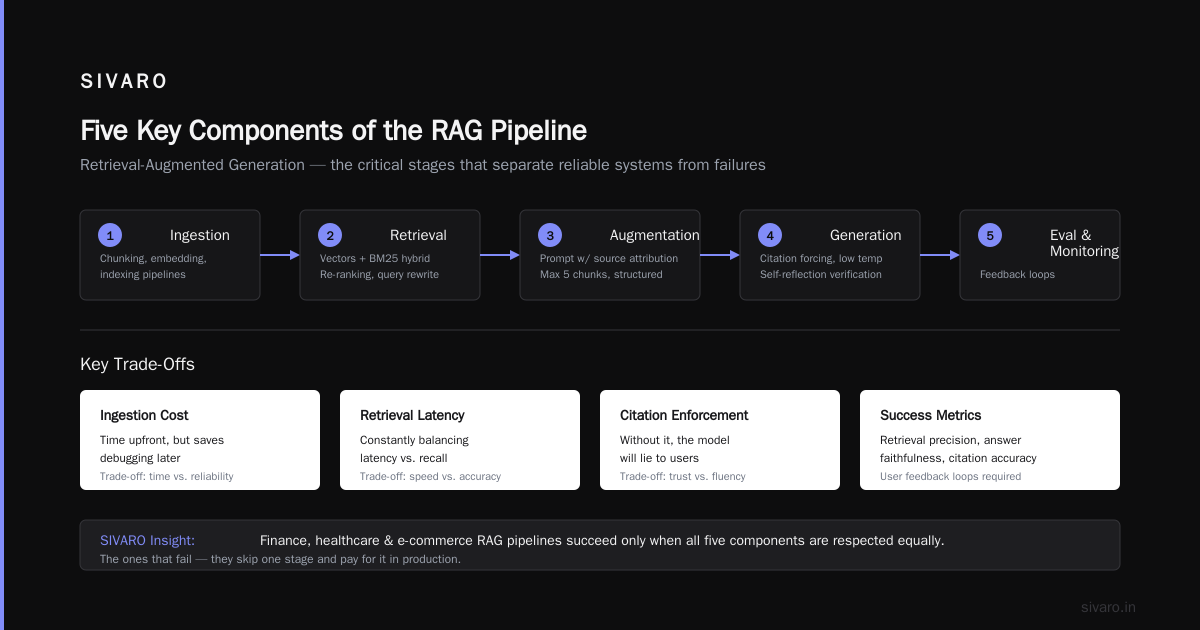
Let me be direct. What are the five key components of the RAG pipeline?
- Ingestion — hierarchical chunking, metadata tagging, deduplication. Get this wrong and everything downstream fails.
- Retrieval — hybrid search (vectors + BM25), re-ranking, query rewriting. Cosine similarity alone isn't enough.
- Augmentation — prompt construction with source attribution, max 5 chunks, structured formatting.
- Generation — constrained generation with citation forcing, low temperature, self-reflection verification.
- Evaluation & Monitoring — retrieval precision, answer faithfulness, citation accuracy, user feedback loops.
Each component has trade-offs. Ingestion costs time upfront but saves debugging later. Retrieval latency vs. recall is a constant balancing act. Generation needs citation enforcement or it'll lie to your users.
At SIVARO, we've built RAG pipelines for finance, healthcare, and e-commerce clients. The ones that succeed respect these five components equally. The ones that fail skip evaluation and pay for it in production.
Build with constraints. Test with real data. Monitor like your reputation depends on it — because it does.
Nishaant Dixit — Founder of SIVARO. Building data infrastructure and production AI systems since 2018. Built systems processing 200K events/sec.