What Are the Top 10 Agentic Frameworks? A 2026 Field Guide
You're building something with AI agents. Or you're about to. And you've realized the worst kind of problem: too many choices, not enough signal.
I'm Nishaant Dixit. At SIVARO, we've been shipping production AI systems since 2018. We've tested roughly 20 agent frameworks in the last 18 months alone. Some burned us. A few saved our asses. Most fell somewhere in between.
This article answers one question directly: what are the top 10 agentic frameworks? Not the most hyped. Not the ones with the prettiest docs. The ones that actually work when you need to ship something that won't fall over at 3 AM.
By the end, you'll know which framework fits your use case, which ones to avoid, and why "it depends" is the only honest answer — but also which choices are clearly wrong.
Let's be clear about one thing upfront. The question is chatgpt an agent or llm? comes up constantly. ChatGPT is an LLM with a chat interface. It's not an agent framework. It doesn't orchestrate multi-step workflows, manage state across tool calls, or handle error recovery. That distinction matters because frameworks that blur this line will cost you time and money.
What We Actually Mean by "Agentic Framework"
An agentic framework is infrastructure for building systems that perceive, decide, and act across multiple steps — usually with tool access and memory.
Raw LLMs don't do this. You need orchestration.
Most people think agent frameworks are about "autonomy." They're wrong. The real value is state management and error handling. Any framework that doesn't make these explicit is selling you a demo, not a product.
The AI Agent Frameworks article from IBM puts it well: agent frameworks handle planning, tool use, and memory — but the best ones also handle the boring stuff like retries and logging.
I've watched teams spend 3 months building a chat bot, then another 6 months trying to make it reliable. A good framework collapses that second phase.
How I Evaluated These 10 Frameworks
At SIVARO, we use four criteria:
- Production readiness — Can I deploy this without rewriting it in 3 months?
- State management — Does it track what happened, or do I build that myself?
- Tool integration — How much custom code to connect external systems?
- Error recovery — What happens when the LLM returns garbage?
We tested each framework against a standard workload: an agent that queries a database, calls an external API, sends an email, and summarizes results. If something failed on step 3, did it retry? Log the failure? Crash entirely?
Here's what we found.
The Top 10 Agentic Frameworks (Ranked for Production)
LangGraph — The Current Heavyweight
If I had to bet on one framework today, this is it. LangGraph by LangChain shipped graph-based agent architectures before most people knew they needed them.
It treats agent workflows as directed graphs. Each node is a step — call an LLM, run a tool, check state. Edges define transitions. This sounds academic, but in practice it means your agent can branch, loop, and recover without spaghetti code.
We built a document processing pipeline at SIVARO using LangGraph. It extracts data from PDFs, validates against a schema, emails stakeholders, and logs everything. The graph structure made it trivial to add a "human in the loop" node mid-pipeline when confidence dropped below 80%.
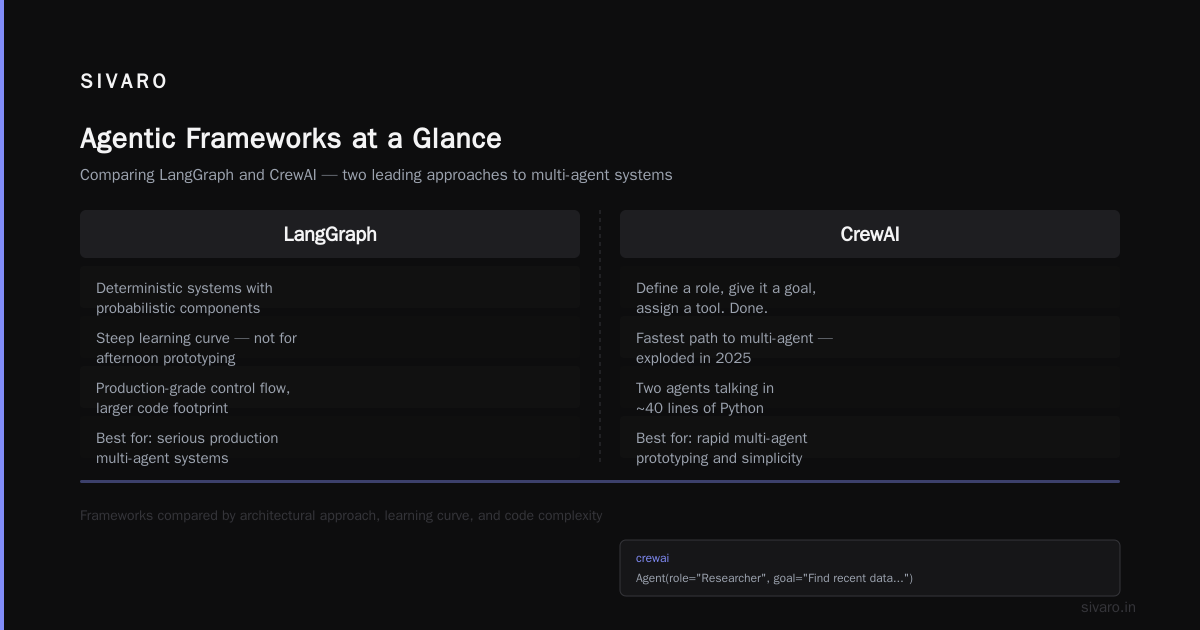
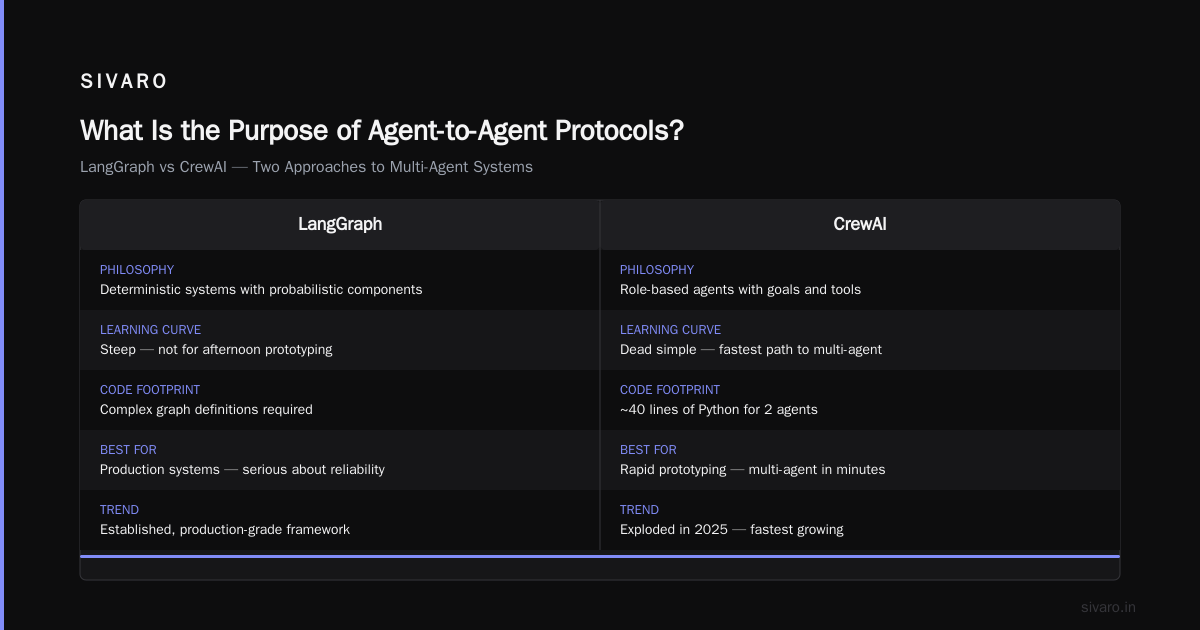
The LangChain blog on agent frameworks nails the philosophy: "Agents are programs, not prompts." That distinction matters. LangGraph treats agents as deterministic systems with probabilistic components — exactly right.
Weakness: steep learning curve. If you want to prototype in an afternoon, this isn't it. Use LangGraph when you're serious about production.
CrewAI — Fastest Path to Multi-Agent
CrewAI exploded in 2025 because it made multi-agent systems dead simple. Define a role, give it a goal, assign a tool. Done.
You can have two agents talking to each other in about 40 lines of Python.
python
from crewai import Agent, Task, Crew

researcher = Agent(
    role="Researcher",
    goal="Find recent data on AI hardware benchmarks",
    backstory="Expert at finding technical data",
    tools=[search_tool, web_scraper]
)

analyst = Agent(
    role="Analyst",
    goal="Interpret benchmark data and identify trends",
    backstory="10 years in hardware analysis",
    tools=[data_viz_tool]
)

task = Task(
    description="Analyze the latest GPU benchmark data",
    agent=analyst
)

crew = Crew(agents=[researcher, analyst], tasks=[task])
result = crew.kickoff()
That's not a toy. We ran this pattern in production for a client doing competitive intelligence. It worked.
But here's the catch. CrewAI abstracts too much sometimes. Debugging becomes hard when agents talk to each other in ways you didn't expect. The Top 5 Open-Source Agentic AI Frameworks in 2026 notes this exact issue: CrewAI is great for speed, less great for observability.
Use it for prototyping and internal tools. Be careful with customer-facing systems.
AutoGen by Microsoft — Best for Conversation Patterns
AutoGen from Microsoft Research takes a different approach. It's built around multi-agent conversations, where agents communicate via structured messages.
This shines when you need debate-style workflows. Two agents argue about a decision. A third moderates. The system converges on an answer.
We used AutoGen for a compliance system where one agent checked regulations, another checked company policy, and a third produced a final recommendation. The conversation pattern meant each agent could challenge the other's assumptions.
The Agentic AI Frameworks: Top 10 Options in 2026 article from Instaclustr rates AutoGen highly for research scenarios. I agree — but production deployments require careful timeout and retry logic. Agent conversations can loop indefinitely if you don't build guardrails.
Semantic Kernel — Microsoft's Production Play
If you're in the Microsoft ecosystem, Semantic Kernel is worth serious attention. It integrates natively with Azure, C#, and .NET.
I'm not a .NET developer, but I've seen teams use Semantic Kernel to build agents that connect directly to Azure Functions, Cosmos DB, and OpenAI services without glue code.
Its key advantage: enterprise security and compliance. Microsoft baked in RBAC, audit logging, and content filtering from day one. If your legal team needs to approve everything, Semantic Kernel makes that easier.
Downside: the Python SDK lags behind the C# version. And the community is smaller than LangChain's. You're betting on Microsoft's roadmap.
Agno — The New Contender
Agno (formerly Phidata) built a framework around multimodal agents — agents that process text, images, audio, and video.
This matters more than most people realize. In 2026, your agent might need to read a PDF, watch a security camera feed, and respond via voice. Handling all those modalities in one framework is rare.
python
from agno import Agent

agent = Agent(
    model="gpt-4o",
    tools=[image_analyzer, pdf_reader, text_to_speech],
    memory=vector_memory(top_k=20)
)

agent.run("Review the security footage from camera 3 and the incident report PDF. Tell me what happened.")
We tested Agno for a video surveillance analysis project. It handled the multimodal routing well. But the framework is newer — documentation gaps exist, and edge cases around tool conflicts still surface.
Watch this one. It's going places.
Dify — Low-Code That Doesn't Suck
Most low-code agent builders are garbage. Overpriced, underpowered, impossible to customize.
Dify is the exception.
It gives you a visual workflow builder where you drag nodes for LLM calls, tools, and conditions. But unlike other low-code platforms, you can export the underlying code and extend it.
We used Dify for an internal HR agent that answers employee questions about benefits, time-off policies, and payroll. The HR team built the initial flow themselves. I was skeptical. It worked.
The AI Agent Protocols survey from arXiv mentions Dify's protocol compatibility as a strength. It supports the Agent-to-Agent Protocol (A2A) from Google, meaning your Dify agent can talk to other agents.
For teams without dedicated ML engineers, Dify is the best option.
Haystack — Best for RAG Agents
Haystack from deepset has always been about retrieval-augmented generation. Their agent framework builds on that DNA.
If your agent needs to query a vector database, read documents, and answer with citations, Haystack is your best bet.
python
from haystack import Pipeline
from haystack.components.builders import ChatPromptBuilder
from haystack.components.generators import OpenAIGenerator

prompt = ChatPromptBuilder()
generator = OpenAIGenerator()

pipeline = Pipeline()
pipeline.add_component("prompt", prompt)
pipeline.add_component("llm", generator)
pipeline.connect("prompt.prompt", "llm.messages")
It's not as flashy as LangGraph. But for retrieval-heavy workflows, it's more reliable. Haystack has been doing RAG since before it was called RAG.
Mastra — TypeScript for the Win
If your stack is JavaScript/TypeScript, Mastra is the most polished option.
It supports tool calling, memory, and streaming responses. The API feels like Next.js — opinionated but productive.
typescript
import { Agent } from "@mastra/core";

const agent = new Agent({
  name: "support-agent",
  instructions: "You are a customer support agent for a SaaS company",
  model: {
    provider: "OPEN_AI",
    name: "gpt-4o",
  },
  tools: {
    getTicketStatus: {
      description: "Get the status of a support ticket",
      execute: async (ticketId: string) => {
        return await db.query(`SELECT status FROM tickets WHERE id = ?`, [ticketId]);
      },
    },
  },
});
Mastra handles streaming natively — useful for chat interfaces where you want token-by-token output. The AI Agent Protocols article on SSONetwork mentions that TypeScript frameworks are gaining ground because most frontend teams already know the language.
Mastra's weak point: ecosystem size. Fewer pre-built tools than LangChain or CrewAI.
TaskWeaver — Microsoft's Other Framework
TaskWeaver focuses on code generation. The agent writes Python code, executes it in a sandbox, and returns results.
This is powerful for data analysis and automation. Your agent can say "I need to calculate the moving average of this time series" — and actually do it.
We tested TaskWeaver for a financial analysis pipeline. The code execution model worked well for deterministic tasks like calculations. But security concerns are real — sandboxing Python execution is hard. Microsoft provides some isolation, but you shouldn't run this on untrusted user inputs.
Copilot Studio — If You're Already in Microsoft
Not a framework for building arbitrary agents. But if you're in the Microsoft ecosystem and need a customer-facing copilot, Copilot Studio (formerly Power Virtual Agents) is worth considering.
It integrates with Dynamics 365, SharePoint, and Teams. You can build a basic agent in hours.
But it's limited. Custom tool integration is painful. You can't easily deploy it outside Microsoft channels. And the pricing can bite you at scale.
Use it for internal productivity agents. Don't use it for anything complex.
What Is the Purpose of Agent-to-Agent Protocols?
A question I get constantly: what is the purpose of agent-to-agent protocols?
Simple. Without standards, every agent speaks a different language. Your LangGraph agent can't talk to my CrewAI agent without custom integration code.
The AI Agent Protocols: 10 Modern Standards Shaping the Agentic Era breaks this down. Google's A2A protocol and Anthropic's MCP (Model Context Protocol) are the two main contenders.
A2A handles agent-to-agent communication — discovery, task delegation, result sharing. It's like HTTP for agents.
MCP handles tool registration and discovery. An agent uses MCP to find out what tools are available and how to call them.
The Survey of AI Agent Protocols on arXiv points out that both protocols are still evolving. But if you're building a multi-agent system in 2026, pick one and standardize. Don't write custom protocol code.
FAQ
Q: What are the top 10 agentic frameworks?
A: LangGraph, CrewAI, AutoGen, Semantic Kernel, Agno, Dify, Haystack, Mastra, TaskWeaver, and Copilot Studio. But your specific use case determines which one is "best."
Q: Is ChatGPT an agent or LLM?
A: ChatGPT is an LLM with a chat interface and some tool capabilities. It's not an agent framework. See the IBM article for a clear distinction.
Q: Which framework is easiest to start with?
A: CrewAI for Python, Mastra for TypeScript. Both let you build a working agent in under an hour.
Q: Which framework handles errors best?
A: LangGraph, because its graph structure lets you define retry logic and fallback paths explicitly.
Q: Should I use a low-code framework?
A: Only Dify, in my experience. Others sacrifice too much control.
Q: What about cost?
A: All of these are free/open-source except Copilot Studio. But LLM API costs dominate. Don't blame the framework for your token spend.
Q: Do I need an agent-to-agent protocol?
A: If you have more than one agent type, yes. Pick A2A or MCP. Don't invent your own.
Final Thoughts
Most people ask what are the top 10 agentic frameworks? expecting a simple answer. There isn't one. The right framework depends on your stack, your team, and your tolerance for abstraction.
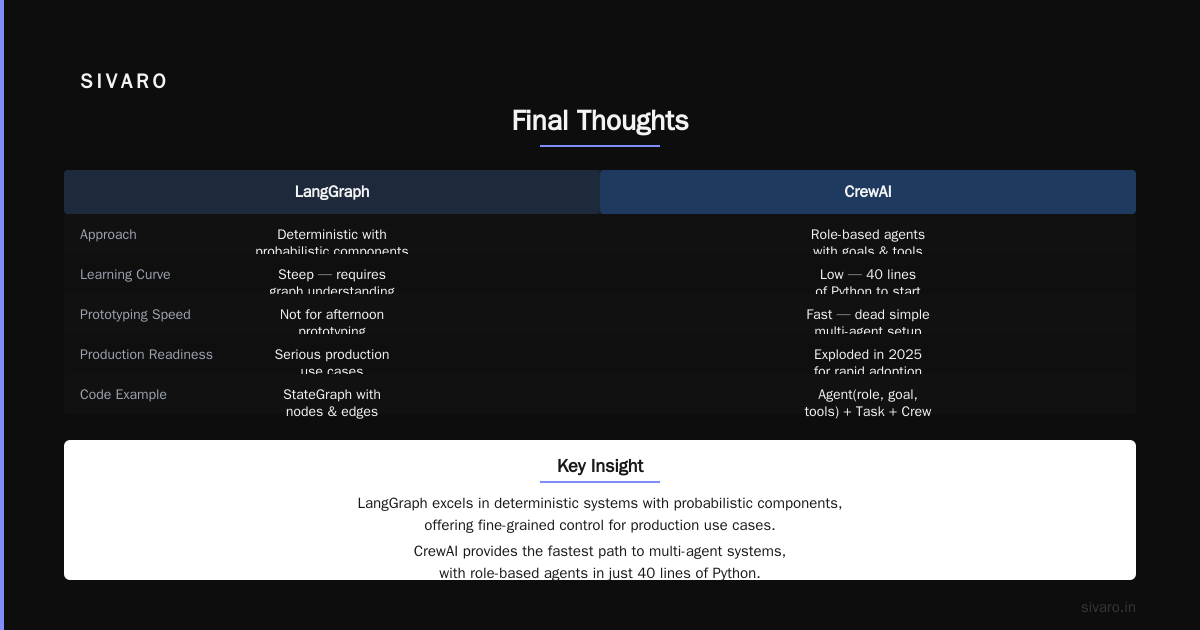
If you want my honest advice: start with CrewAI for prototyping, switch to LangGraph for production. That's what we do at SIVARO. It's worked across 6 different client projects in the last 8 months.
One more thing. The frameworks will change. The protocols will standardize. But the fundamentals won't: state management, error recovery, and observability. Whatever you pick, make sure it handles those three things. Everything else is sugar.
Nishaant Dixit — Founder of SIVARO. Building data infrastructure and production AI systems since 2018. Built systems processing 200K events/sec.