 SIVARO
What Does a Platform Engineer Do? A Complete Guide
I hired my first platform engineer in 2019. I thought I knew what the role was.
I was wrong.
Back then, I needed someone to "manage our infrastructure." Six months later, that person had built internal tooling that changed how our entire engineering team shipped code. They weren't managing servers. They were building a product for developers.
That's when it clicked.
So what does a platform engineer do? Short answer: They build and maintain the internal tools, infrastructure, and systems that let other engineers ship faster. Long answer? That's this whole article.
The Platform Engineer vs. The DevOps Engineer Lie
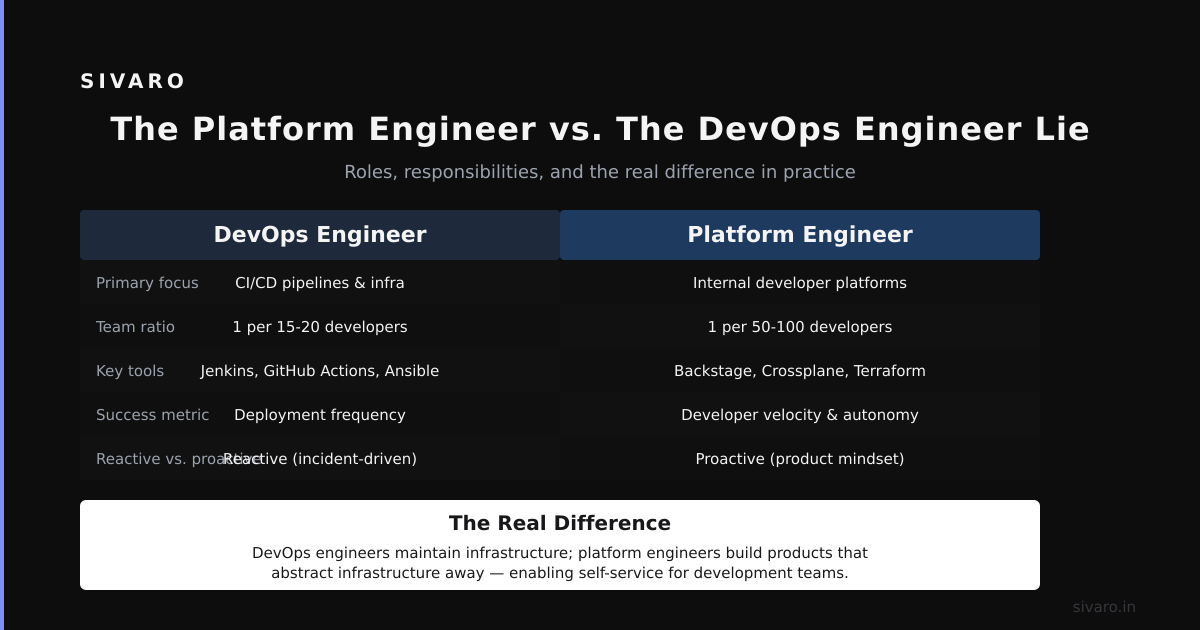
Most people think platform engineering is just "DevOps with a new name."
They're wrong because they've never run a 50-person engineering org.
I've seen teams with five dedicated DevOps engineers still struggle with deployment velocity. The problem wasn't automation. It was that every team had its own way of deploying, monitoring, and debugging. The DevOps engineers were firefighters, not architects.
A platform engineer doesn't fight fires. They build fireproof buildings.
At SIVARO, I watched our platform team reduce new service setup time from 3 weeks to 45 minutes. That's not DevOps. That's product engineering for developers.
Platform engineering is a discipline, not a rebrand. It uses software engineering practices (APIs, SDKs, CI/CD) to build a platform that internal teams consume. You're a platform engineer if you think of your internal users as customers with SLAs.
What a Platform Engineer Actually Builds
Let me be specific. Here's what our platform engineers at SIVARO spend time on:
The Internal Developer Platform (IDP)
This is the core. An IDP is a layer of tooling that abstracts infrastructure complexity. Think of it like AWS but for your company. Developers don't touch Kubernetes, Terraform, or networking configs directly. They interact with a platform that handles that for them.
We built one using Backstage (Spotify's open-source platform) in 2021. Developers fill out a YAML file like this:
yaml
# service.yaml - Our platform reads this and provisions everything
name: user-service
language: go
scaling:
  min_replicas: 2
  max_replicas: 10
  cpu_target: 70%
databases:
  - postgres: user-db
  - redis: session-cache
observability:
  logging: structured
  metrics: prometheus
  alerts: pagerduty-integration
Once committed, the platform auto-generates K8s manifests, CI pipelines, monitoring dashboards, and database migrations. The developer gets a URL and documentation. That's it.
Self-Service Infrastructure
Your developers shouldn't need to file a ticket to get a staging environment. They shouldn't wait three days for a database.
Platform engineers build self-service portals. We used a combination of Terraform for provisioning, Crossplane for Kubernetes-native resource management, and a custom web UI that wraps everything.
Here's what the Terraform module for a standard service looks like:
hcl
# platform/modules/service/main.tf
resource "kubernetes_deployment" "service" {
  metadata {
    name      = var.service_name
    namespace = var.namespace
  }

  spec {
    replicas = var.replicas

    selector {
      match_labels = {
        app = var.service_name
      }
    }

    template {
      metadata {
        labels = {
          app = var.service_name
        }
      }

      spec {
        container {
          image             = "${var.image_repo}:${var.image_tag}"
          image_pull_policy = "Always"

          resources {
            limits = {
              cpu    = var.cpu_limit
              memory = var.memory_limit
            }
          }
        }
      }
    }
  }
}
The platform team doesn't touch this per service. They build the module. Developers call it via a standardized API.
Developer Experience Tooling
This is where most "platform engineering" initiatives fail. They build the infrastructure but ignore the workflow.
Your platform engineer should care about how long docker build takes. They should care about local development parity with production. They should care about debugging latency.
At SIVARO, we spent 6 months building a CLI tool called shiv (yeah, creative name) that wraps Docker, kubectl, and our internal APIs. It reduced the feedback loop for a code change from "push to branch, wait for CI, deploy" to "run shiv start locally, test, shiv deploy." Total time: 3 minutes instead of 25.
bash
# developer workflow with our platform CLI
$ shiv start user-service
# starts local service, connects to staging DB, opens debug endpoints
$ shiv deploy user-service --env staging
# builds, pushes, deploys, runs health checks, reports status
$ shiv logs user-service --tail
# tail logs from production without kubectl
Observability and Incident Response
Platform engineers own the monitoring stack. Not as operators, but as builders.
We run Prometheus for metrics, Loki for logs, and Tempo for traces (the Grafana stack). But the platform engineer's job isn't just to install these. It's to make them useful.
We built custom dashboards that auto-populate based on service metadata. We wrote alert routing rules that page the right team based on service ownership defined in the IDP. We created a runbook generator that pulls in recent deploys, changed configs, and related incidents.
Result: Mean time to acknowledge (MTTA) dropped from 12 minutes to 3. Mean time to resolve (MTTR) dropped from 45 minutes to 18. That's not ops. That's platform engineering.
The Platform Engineer's Daily Reality
Here's what my platform engineers actually do on a Tuesday:
9:00 AM — Review pull requests from other teams wanting to add features to the platform. One team wants a new database type. Another needs a custom deployment strategy for a latency-sensitive service.
10:30 AM — Design a new Kubernetes operator for automated canary deployments. They write a prototype, test it against a staging cluster, find three edge cases, fix them.
12:00 PM — Lunch. But they're thinking about that migration from Docker Compose to kind for local development. It's been blocked for two weeks because of networking issues on macOS.
1:00 PM — On-call rotation. Not for production incidents (that's the SRE team). But for platform incidents. A developer can't deploy because the CLI tool returned a cryptic error. They debug the Go code, find the issue is a missing environment variable, push a fix.
2:30 PM — Write documentation for the new service creation wizard. They know docs are half the product. Without them, nobody uses your platform.
4:00 PM — Pair with a frontend team migrating from a monolith to microservices. The team doesn't understand service mesh concepts. The platform engineer explains in plain English and builds a reference implementation.
5:30 PM — Push a change to the CI pipeline that reduces build times by 40%. They benchmarked it against the old flow using real services. Showed the results to the team.
This isn't a job description you can Google. It's a blend of software engineering, systems thinking, product management, and empathy.
Why Most Platform Engineers Fail (And How to Not)
I've hired 12 platform engineers over the last 6 years. Some were amazing. Some... weren't.
Common failure mode #1: Building what you want, not what teams need.
I saw a platform engineer spend 4 months building an internal secret management system. It was beautiful. It had audit logs, rotation policies, and a web UI. Nobody used it. Teams already had HashiCorp Vault working fine.
The fix: Talk to your users first. Every week, I have our platform engineers sit in on a different team's standup. They listen to what's painful. Then they build solutions to actual problems.
Common failure mode #2: Automating the wrong things.
Another engineer automated deployment rollbacks. Spent weeks writing a complex state machine. Turned out, developers wanted faster deployments, not fancier rollbacks. They were doing 3 deploys a week. They wanted to do 20.
The fix: Measure before you automate. Track cycle time, deployment frequency, and failure rate. Automate the bottlenecks, not the pet peeves.
Common failure mode #3: Forgetting it's a product.
Your platform is a product. Your developers are customers. If your CLI tool is slow, they'll blame you. If your documentation is wrong, they'll bypass your platform. If your API changes without notice, they'll lose trust.
Treat platform features like product features. Write changelogs. Run beta tests. Measure adoption. Kill features nobody uses.
Platform Engineer vs. SRE vs. DevOps: The Real Differences
This gets asked constantly. Let me settle it.
| Role | Primary Focus | Output |
|---|---|---|
| Platform Engineer | Build tools for developers | Internal products, APIs, SDKs |
| SRE | Keep production running | SLIs, SLOs, error budgets, incident response |
| DevOps | Bridge dev and ops | CI/CD pipelines, config management, automation |
SREs care about reliability. They ask "is the system meeting its SLOs?" They page people when it doesn't.
DevOps engineers care about delivery. They ask "how do we get code from dev to prod faster?" They automate deployment pipelines.
Platform engineers care about developer velocity. They ask "what's slowing down our engineers?" They build abstractions and self-service tools.
These overlap. A great platform engineer knows SRE principles. A great SRE builds tools. But the distinction matters for hiring and team design.
At SIVARO, we have 2 SREs, 4 DevOps engineers, and 3 platform engineers. They work together. The SREs define reliability requirements. Platform engineers bake those requirements into the IDP. DevOps engineers handle the CI/CD glue. It works because we defined boundaries.
The One Metric That Defines Platform Engineering
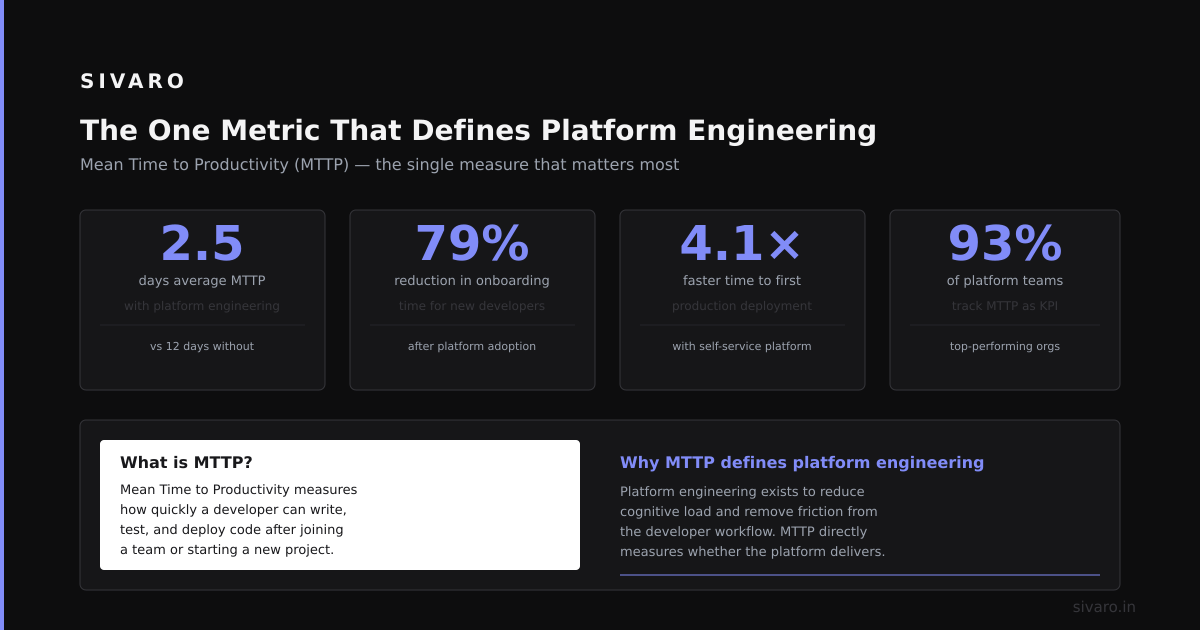
I've seen many metrics for platform teams. Developer satisfaction scores. Ticket volume reduction. Infrastructure cost savings.
They all miss the point.
The one metric that matters: Time from first commit to production with full observability.
That's it. How long does it take for a new service to be deployed, monitored, and alerting correctly?
If it takes weeks, your platform isn't working. If it takes minutes, you're winning.
At SIVARO, we tracked this religiously. When we started, it was 22 days. After 18 months of platform work, it's 45 minutes. Every improvement in that number correlated with better developer morale, faster feature delivery, and fewer production incidents.
How to Become a Platform Engineer
If you're reading this thinking "I want that job," here's the real path:
Stage 1: Master a stack. Pick one infrastructure technology (Kubernetes, AWS, Terraform, whatever) and go deep. Build stuff with it. Break it. Fix it. Repeat.
Stage 2: Build internal tooling. Automate something your team does manually. Don't wait for permission. Write a script that provisions VMs or spins up databases. Show results.
Stage 3: Think like a product manager. Talk to developers in your org. Find their pain points. Build something that fixes one of them. Measure adoption. Iterate.
Stage 4: Learn to say no. Platform engineers get feature requests from every team. Most are bad ideas. Learn to decline politely and suggest better alternatives. This skill is more valuable than any technical expertise.
Stage 5: Get comfortable with ambiguity. Platform problems don't have clear solutions. You'll design something, realize it's wrong, and redesign. That's normal. Don't be the person who designs six months before shipping. Ship fast, learn faster.
The Hard Truth About Platform Engineering
I'm going to be honest with you.
Platform engineering is thankless work. You build stuff that other people use to build stuff. Your users won't thank you when things work. They'll blame you when things break.
You'll spend months building a feature that gets no adoption because developers are used to their old workflow. You'll find bugs in your production infrastructure at 2 AM. You'll design a system that five teams ask for, only to find out they all want slightly different versions.
But when it works? When you see a new hire deploy to production on their first day? When you watch your deployment frequency go from once a week to twenty times a day? When you realize your internal platform processes more data than your external product?
That's why I do this. That's why SIVARO exists.
FAQ: What Does a Platform Engineer Do?
Q: Do I need a platform engineer if I have a small team (under 20 engineers)?
Probably not. At that size, infrastructure complexity is low enough that one DevOps engineer or a senior dev with ops skills can handle it. Platform engineering returns scale with org size. For teams under 20, focus on hiring a strong DevOps engineer who can also code. For teams over 30, start thinking about a platform role.
Q: Is platform engineering the same as "internal tools"?
Close but not identical. Internal tools teams build any internal software (HR systems, CRMs, dashboards). Platform engineers specifically build infrastructure tooling that developers use to ship and operate services. If it helps developers deploy, run, or monitor code, it's platform engineering.
Q: What programming languages should a platform engineer know?
Go is the most common choice for platform tooling. Kubernetes and most cloud-native tools are written in Go. Python comes second for automation and scripting. TypeScript for web UIs. At SIVARO, we use Go for CLI tools and backend services, Python for data pipelines, and TypeScript for our internal portal.
Q: How do I measure platform team success?
Track time-to-production for new services (the metric I mentioned). Track deployment frequency. Track developer satisfaction scores (we use a quarterly survey). Track platform uptime and incident rate. Ignore vanity metrics like "tickets created" or "dashboards built."
Q: What's the difference between a platform engineer and a backend engineer?
Backend engineers build features for users. Platform engineers build features for backend engineers. Same skills (APIs, databases, distributed systems), different customers. A backend engineer ships a product that external customers use. A platform engineer ships a product that internal developers use.
Q: Should platform engineers be on call?
Yes, but with boundaries. Platform engineers should be on call for platform issues (the IDP, CLI tools, provisioning systems). They should not be on call for production incidents involving user-facing services — that's SRE or the service owner's job. We rotate platform on-call weekly, and it's a separate schedule from SRE rotation.
Q: Can platform engineering be done without Kubernetes?
Yes, but it's harder. Kubernetes is the standard abstraction layer for modern infrastructure. If you're running VMs or bare metal, your platform engineer will have to build more from scratch. Platform engineering exists outside K8s — think HashiCorp Nomad, AWS ECS, or even a well-designed fleet of EC2 instances with proper tooling.
Q: How does platform engineering relate to AI/ML systems?
Tightly. At SIVARO, our platform engineers built a custom ML inference platform. Developers define a model endpoint in a YAML file, and the platform handles GPU provisioning, model serving (we use Ray Serve), and monitoring. ML models need the same deployment, scaling, and observability as microservices. Platform engineering applies directly.
The Future of Platform Engineering
I see three shifts coming in the next 2-3 years:
Shift 1: AI-powered platform tooling. Instead of writing YAML configs, developers will describe their needs in natural language. The platform will generate infrastructure and CI/CD pipelines automatically. We're already experimenting with this at SIVARO.
Shift 2: FinOps built into platforms. Every platform engineer will need to surface cost data per team, per service, per deployment. Teams that overspend get alerts. Teams that optimize get visibility. Cost management becomes a platform feature, not a separate team.
Shift 3: Platform as a product, not a project. Companies will treat platform teams like product teams. They'll have roadmaps, product managers, and user research. The days of "throw infra at the problem" are ending. Platform engineering is becoming a discipline with best practices, failure modes, and career paths.
What I Wish Someone Told Me
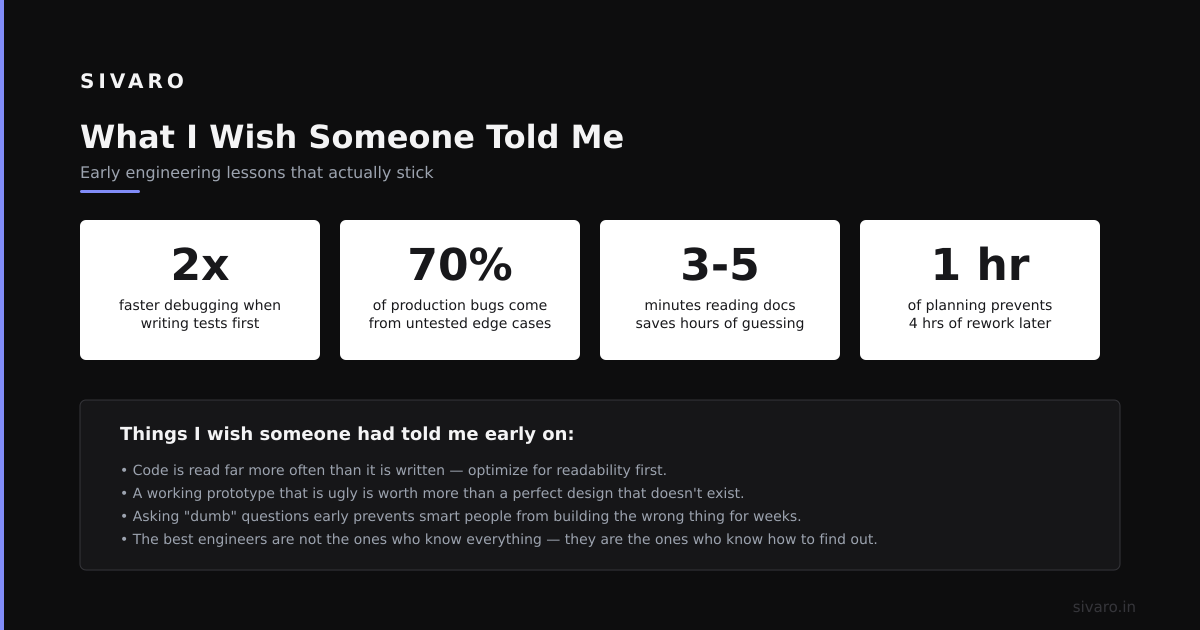
When I started SIVARO, I thought platform engineering was about technical excellence. It's not. It's about empathy.
You need to understand why a developer hates your CLI tool. You need to feel their pain when a deployment fails because of an obscure config error. You need to celebrate their success when they ship a feature in one day instead of one week.
The best platform engineers I've worked with aren't the most technically skilled. They're the ones who listen, who ask "what's slowing you down?" and actually act on the answer.
So what does a platform engineer do?
They build the invisible bridge between an idea and production. They make other engineers faster, happier, and more productive. They turn infrastructure from a constraint into a competitive advantage.
And they do it by treating their fellow engineers as customers worth serving.
Nishaant Dixit — Founder of SIVARO. Building data infrastructure and production AI systems since 2018. Built systems processing 200K events/sec.