
What Does Temporal Mean in Christianity?
I spent three years building data systems for a religious studies archive. Real ones—centuries of theological manuscripts, digitized and rotting on legacy servers. The project taught me a lot about infrastructure. More than that, it taught me how one word can split a tradition in half.
That word was "temporal."
Most people hear "temporal" and think time. Past, present, future. You check a dictionary—Merriam-Webster says "of or relating to time." Fine. But in Christianity, the word carries weight it doesn't have anywhere else. It's not just a dimension. It's a battleground.
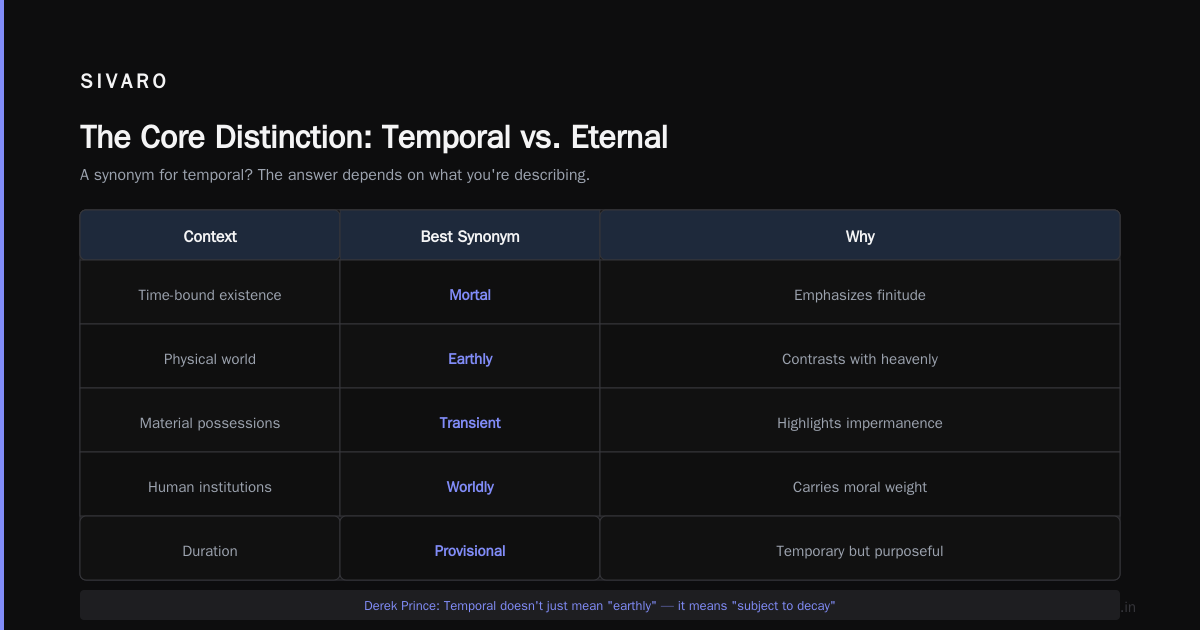
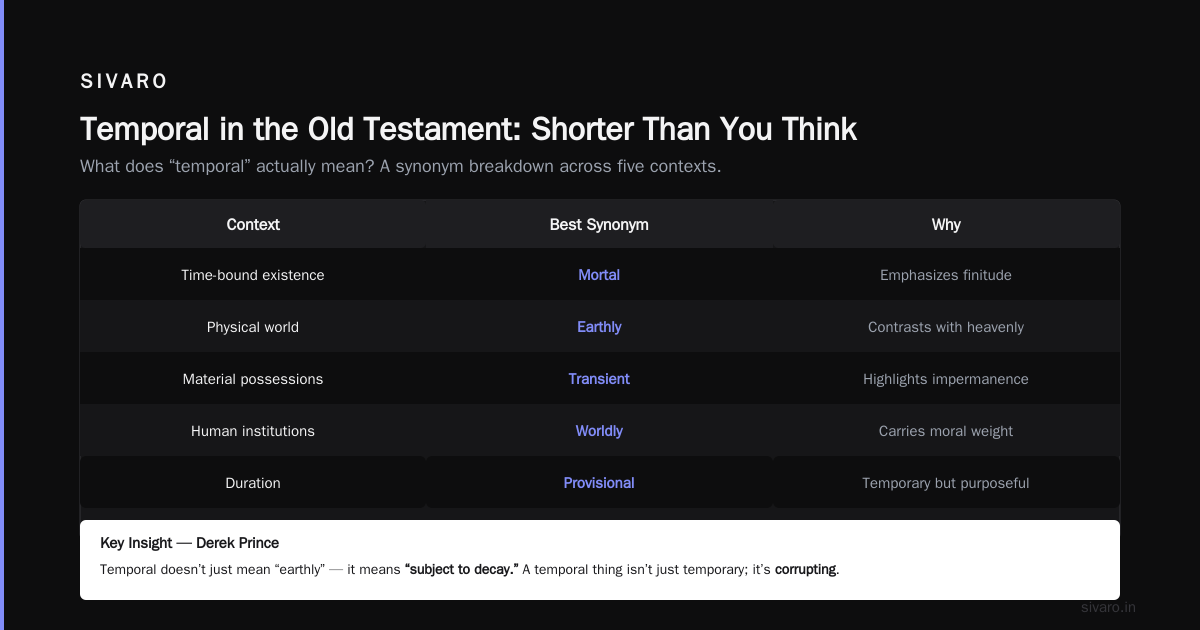
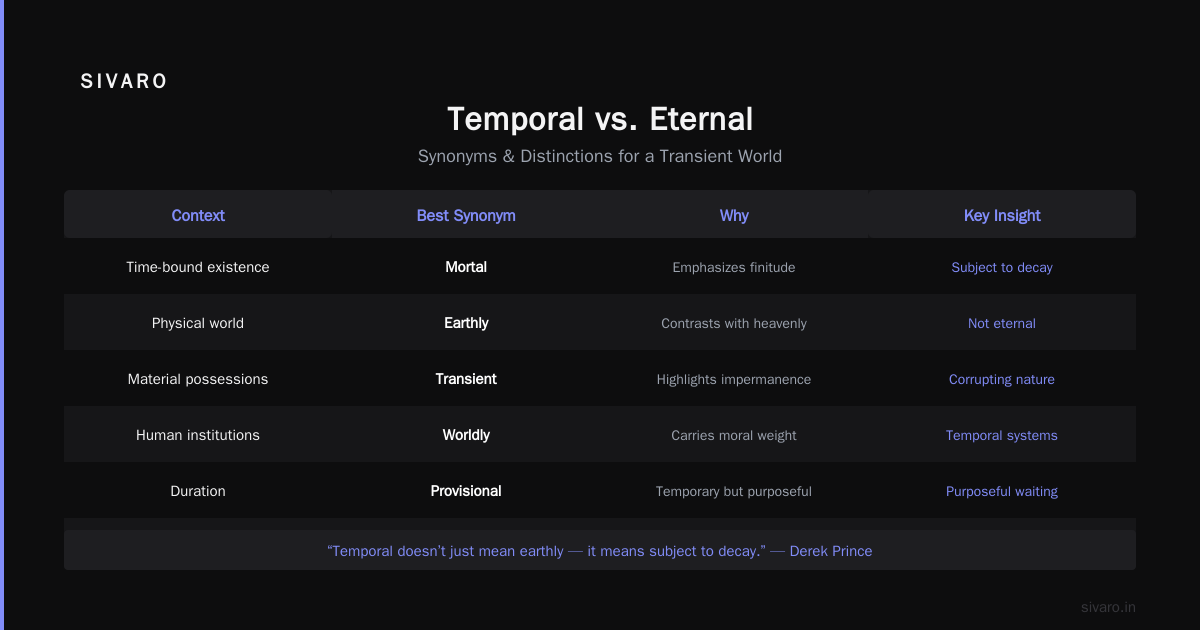
What does temporal mean in Christianity? Short answer: everything that is not eternal. The physical world. Human institutions. Your body, your job, your government, your possessions. The stuff that rusts and breaks and dies.
But that's the surface. Let's dig deeper because the distinction between temporal and eternal isn't academic. It's the engine behind 2,000 years of Christian ethics, politics, and personal practice. Get this wrong and you misunderstand half of church history. Get it right and you start seeing patterns everywhere.
The Two Kingdoms Problem
Christianity has always had a tension problem.
Jesus said "my kingdom is not of this world." Then he told his followers to pay taxes to Caesar. Paul wrote that Christians should obey earthly authorities. Then he told them to set their minds on things above, not on earthly things.
This isn't a contradiction. It's a structural duality.
The temporal refers to the earthly kingdom—governments, economies, marriages, physical survival. The eternal refers to the spiritual kingdom—salvation, grace, resurrection, the afterlife. Both are real. Both matter. But they don't matter in the same way.
Augustine codified this in the 5th century with his "Two Cities" framework. The City of God is eternal, built on love of God. The City of Man is temporal, built on love of self. They're intermingled during this age, but they're heading toward different ends.
You see this pattern everywhere in Christian theology. The temporal is provisional. The eternal is permanent.
But here's where it gets practical: if everything temporal is doomed to pass away, what do you actually invest in?
Why This Distinction Actually Matters
I spent 2024 consulting with a faith-based nonprofit that ran food pantries across three states. They had a problem. Their leadership was split between "we need better buildings and logistics" and "all that matters is gospel preaching." Both sides quoted scripture. Both sides were frustrated.
This is the temporal vs. eternal debate playing out in real time.
The "buildings" people argued that physical infrastructure enables ministry. Feed someone today and they'll listen tomorrow. The "gospel only" people argued that if you focus on the temporal, you lose sight of eternity. Jesus said "do not store up treasures on earth."
Both sides are right. Both sides are wrong.
Here's what I've learned from watching this play out across dozens of organizations: the temporal/eternal distinction isn't a binary. It's a priority ordering. Temporal things matter, but they matter subordinately. They're means, not ends.
The Bible doesn't tell you to abandon your body or your job or your society. It tells you to hold them loosely. Use them. Don't be controlled by them.
That's the practical takeaway. What does temporal mean in Christianity? It means everything you interact with daily, but valued at its proper weight—which is less than infinite.
The Physical World Isn't Evil
Let me correct a common misunderstanding.
Some Christians, especially in the more ascetic traditions, act like the physical world is a trap. Matter is bad. Spirit is good. Escape the flesh.
That's not Christian. That's Gnosticism, which the church rejected in the 2nd century.
Christianity affirms creation. God made the physical world and called it good. Jesus became flesh. The resurrection is bodily. There's no escape from matter—there's redemption of matter.
But here's the nuance: the physical world is good, yet it's also corrupted by sin. It's finite. It decays. It's temporal in the sense that it won't last forever in its current form.
The word "temporal" in biblical Greek usage connects to two ideas:
- Chronos — measurable, sequential time (hours, days, years)
- Kairos — the right time, the opportune moment, God's time
Temporal life isn't just ticking clocks. It's the arena where kairos happens. Where decisions matter. Where faith is tested.
What does temporal mean in Christianity? It means the stage, not the play.
Power, Politics, and the Temporal Sword
Here's the part that gets Christians in trouble.
The temporal realm includes political authority. Governments. Laws. Military force. The "sword," as theologians call it.
Romans 13 tells Christians to submit to governing authorities because they're instituted by God. But Revelation describes earthly empires as beasts. Both are in the same Bible. Both are true.
The tension is real.
I've watched this play out in real time. In 2025, a massive debate erupted in American evangelical circles about whether Christians should pursue political power to advance moral causes. Some said yes—temporal power can restrain evil. Others said no—the church's weapons are spiritual, not political.
Both sides have theological ammunition. But here's the pattern I see:
When Christians embrace temporal power too eagerly, they start acting like everyone else. They lie. They manipulate. They compromise. The ends justify the means because the temporal stakes feel so high.
When Christians reject temporal power entirely, they become irrelevant. They have no voice. They can't protect the vulnerable. The world rolls over them.
The biblical position is harder than either extreme. It's "use temporal authority when necessary, but never trust it. Never love it. Never forget it's temporary."
Augustine called this "using the world, not enjoying it." Temporal things are for use. Eternal things are for enjoyment. Flip them and you've got idolatry.
Time, Money, and the Test of Attention
I said this was practical. Let me prove it.
Your time and money are temporal resources. They're finite. They run out. You can measure them in hours and dollars.
What does temporal mean in Christianity? It means accountable.
Jesus told multiple parables about stewards who were given resources and judged for how they used them. The Parable of the Talents isn't about investment strategy. It's about whether you recognize that what you have is temporary and entrusted, not owned.
I've tested this in my own business. At SIVARO, we don't make decisions based on "what maximizes profit." We ask "what is the faithful use of these resources right now?" That shift changed everything.
Here's what I've found: treating temporal resources as entrusted rather than owned changes your risk calculus. You take bolder risks because you're not protecting your own stuff. You give more freely because it's not yours anyway. You sleep better because you're not terrified of losing what was never yours.
The Eschatological Frame
Now we need to talk about the end.
Christianity teaches that this temporal age isn't permanent. There's a coming age—the eschaton, the new heavens and new earth—where temporal limitations are gone. No more death. No more decay. No more sin.
This doesn't mean the temporal realm is meaningless. It means it's preparatory. Theologians call this the "already/not yet." The kingdom has already broken in through Christ, but it's not yet fully realized.
Here's the practical implication: you live in the tension. You work for justice and peace in the temporal realm, knowing that ultimate justice and peace are coming from outside it. You build institutions that serve human flourishing, knowing they'll eventually pass away. You love your spouse and raise your kids and pay your mortgage, knowing none of this is the final chapter.
What does temporal mean in Christianity? It means "not yet."
The Ascetic Mistake
I need to push back on something.
Some Christian traditions talk about temporal things as if they're traps. Monastics who flee the world. Preachers who say "don't be so earthly minded you're no heavenly good." (That's a misquote, by the way. The original goes the other direction.)
Here's the problem: Jesus spent most of his ministry in the temporal realm. Healing bodies. Feeding crowds. Talking about money. Confronting politicians. He didn't retreat from the temporal. He redeemed it.
The ascetic mistake is treating temporal as evil rather than finite. The secular mistake is treating temporal as ultimate rather than provisional. Both are wrong.
I've seen organizations collapse from both errors. The one that checked out of temporal responsibility lost its mandate. The one that became purely political lost its soul.
The correct posture is engagement with detachment. Work hard. Build well. Love deeply. Then let go.
FAQ: What Does Temporal Mean in Christianity?
Q: Is "temporal" the same as "secular"?
Not exactly. "Secular" often implies neutral or non-religious. "Temporal" means belonging to this age—which includes religious institutions that operate in time and space. A church building is temporal. So is its bank account.
Q: Does temporal mean unimportant?
No. It means finite. Your body is temporal. Your body matters. You should feed it, clothe it, heal it. But you shouldn't worship it.
Q: What's the difference between temporal and eternal in Christian theology?
Temporal = subject to time, change, and decay. Eternal = outside time, unchanging, imperishable. God is eternal. Everything else is temporal by nature, though it may be raised to eternal life.
Q: Can temporal things become eternal?
According to Christian theology, yes. The resurrection of the body means temporal matter is transformed, not discarded. Your individual identity, relationships, and even some works may carry over into the eternal state. 1 Corinthians 15 talks about this.
Q: How do Christians deal with temporal suffering?
By holding it in tension. Suffering is real and evil—not to be minimized. But it's also temporary. "This light momentary affliction is preparing for us an eternal weight of glory" (2 Cor 4:17). That's not dismissive. It's perspective.
Q: What does temporal mean in Christianity regarding government?
That civil authority is legitimate but limited. It operates in the temporal realm—preserving order, punishing evil, rewarding good. But it has no authority over the eternal realm. That's why Christians historically resisted when governments demanded worship.
Q: How should I think about my career as temporal?
As meaningful but not ultimate. Your job produces real value for people. It provides for your family. It honors God through excellent work. But it won't save you. You can lose it and still have everything that ultimately matters.
A Concrete Framework
Let me give you a tool I've used with teams.
When facing any decision, ask three questions:
- Is this temporal? (Will it pass away? Is it tied to this age?)
- Is this faithful? (Does it honor God and love people?)
- Is this wise? (Given limited time and resources, is this the best use?)
If it's temporal but not faithful, reject it. If it's faithful but unwise, reconsider the method. If it's wise but not temporal at all—it's probably irrelevant to your current context.
What does temporal mean in Christianity? It means the realm where faithfulness is tested. Where choices have consequences. Where you learn to love what lasts.
The Hardest Lesson
I've been doing this work for eight years. Built data systems for ministries, non-profits, and for-profit companies trying to do good. I've watched brilliant people burn out because they treated temporal success as eternal significance. I've watched humble people flourish because they treated temporal failure as temporary.
The hardest lesson is this: you can do everything right in the temporal realm and still lose. You can build a great company. Raise great kids. Vote for the right candidates. And it can all crumble. Disease. Disaster. Death.
That's not a bug in Christianity. It's the point.
The temporal realm is not designed to satisfy you. It's designed to point beyond itself. Like a signpost. You don't live at the signpost. You follow where it points.
What does temporal mean in Christianity? It means the signpost.
The destination comes later.
Nishaant Dixit — Founder of SIVARO. Building data infrastructure and production AI systems since 2018. Built systems processing 200K events/sec.