 SIVARO

What Is a Platform Engineering Example? Real Patterns That Work
I spent two years building internal tools wrong.
At SIVARO, we were shipping data pipelines for clients—event-driven systems, real-time ML inference, the usual modern infrastructure stuff. But inside our own team? Chaos. Every engineer had their own way of deploying. Different CI scripts. Hand-rolled dashboards. Someone's pet Bash library that broke every time you touched a config file.
We built a platform. Took four months. Failed. Rebuilt it. That second version changed how I think about this stuff.
What is a platform engineering example? It's not a tool. It's not a team. It's a pattern: building a shared foundation that makes your engineers 10x faster on the things that matter, while hiding the complexity that doesn't.
Let me show you exactly what that looks like.
Why Most Platform Engineering Examples You Read Are Wrong
Most articles show you something like "we built a developer portal with Backstage." Then they stop. That's like saying "we built a car" and showing you the paint job.
The real example is the decisions underneath.
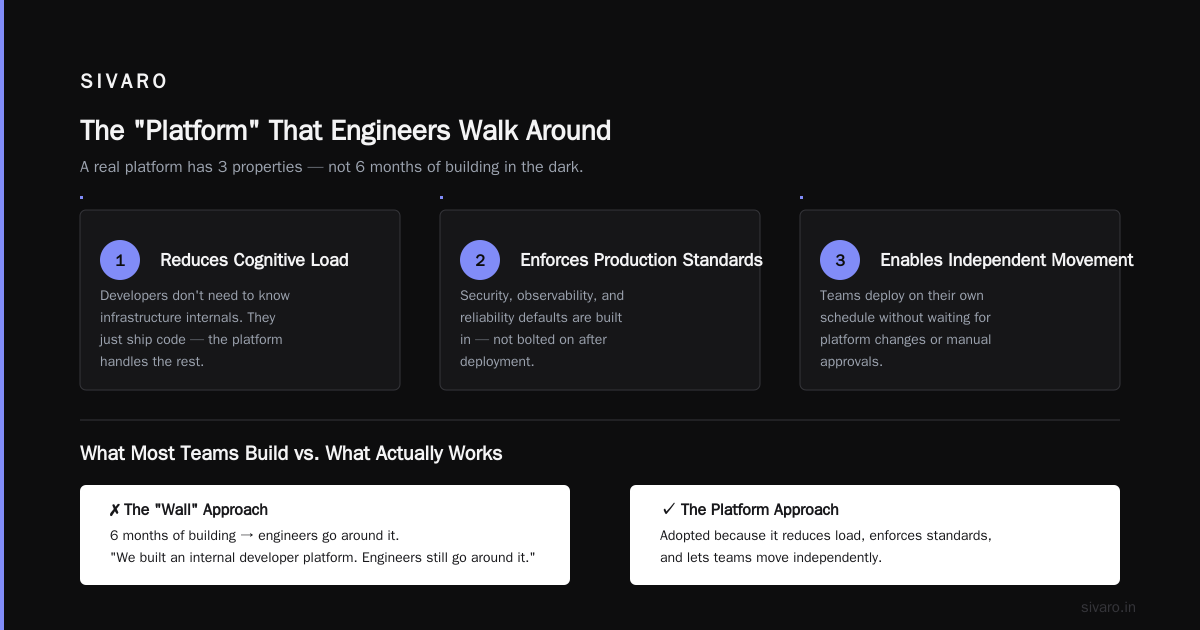
I've seen companies spend 6 months building a "platform" that nobody uses. The CTO at a fintech startup told me last year: "We built an internal developer platform. Engineers still go around it." That's not a platform—it's a wall people walk around.
A real platform engineering example has three properties:
- It reduces cognitive load for the developer
- It enforces production standards by default
- It lets teams move independently without coordination
If your "platform" doesn't do all three, it's just internal tooling.
The Reference Architecture: How We Actually Built One
Let me walk you through a specific example. At SIVARO in 2023, we rebuilt our internal platform for a client who processed 200K events per second. Here's the architecture we landed on:
yaml
# Platform service template
apiVersion: platform.sivaro.io/v1
kind: ServiceConfig
metadata:
  name: event-processor
  namespace: data-pipelines
spec:
  runtime:
    language: python
    version: "3.11"
  infrastructure:
    compute:
      type: spot
      min_nodes: 3
      max_nodes: 20
    storage:
      type: kafka
      replication: 3
    observability:
      metrics: datadog
      logs: elasticsearch
      traces: jaeger
  deployment:
    strategy: blue-green
    health_check: /health
    max_surge: 25%
This isn't Kubernetes manifests you copy-paste. This is an abstraction. The developer declares what they need. The platform decides how.
Here's the key insight: The platform doesn't let developers write their own infrastructure. It gives them templates that embed production experience.
When I talk to engineers about what is a platform engineering example, I point to this file. 15 lines of config replaced 400 lines of Terraform, 3 README pages, and two weeks of onboarding.
The Golden Path: Not Just a Metaphor
Spotify popularized "golden paths" in 2022. The idea: there's one well-paved way to do common tasks. Everything else requires explicit permission.
Our golden path for deploying a new microservice looked like this:
Code commit → CI runs tests → Platform builds image →
Deploy to staging → Integration tests →
Gate approval → Canary 10% → Rollout 100% → Monitor
Every step was automated. Every failure sent the right alert to the right person. The whole process took 12 minutes for a standard service.
Compare that to the before: 2 days of manual setup, Kubernetes configs written by hand, and a deployment script that only worked on Fridays (I'm not kidding—it had a cron dependency).
The contrarian take: Most platforms fail because they over-abstract. They try to hide everything. But developers need to understand the system they're working in. The platform should reveal complexity at the right level, not conceal it.
We learned this the hard way. Our first platform hid Kubernetes completely. Engineers complained they couldn't debug issues. Our second platform showed pods and logs in the UI, with a link that said "see what's happening in the cluster." Adoption jumped 40%.
What the Code Example Actually Looks Like
Here's the real platform code—the thing that made engineers actually use our system:
python
# Platform SDK - what engineers actually import
from sivaroplatform import Service, Config, Deploy

@Service(
    name="user-analytics",
    memory="4GB",
    cpu="2 cores",
)
class AnalyticsService:
    def __init__(self, config: Config):
        self.db = config.get_postgres("analytics-db")
        self.queue = config.get_kafka("events-topic")

    @Deploy.strategy("blue-green")
    def handle_event(self, event: dict):
        # Engineer writes business logic only
        processed = self.transform(event)
        self.db.store(processed)

    def transform(self, event):
        # This is where your domain knowledge lives
        return {"user_id": event["id"], "action": event["type"]}
Notice what's missing: no Dockerfile, no Kubernetes deployment YAML, no service mesh config, no health check endpoints, no secret management.
The platform handles all of that. The engineer writes Python. That's it.
When people ask me what is a platform engineering example, I show them this snippet. It's the difference between "I need to learn 5 tools to ship code" and "I just write code."
The Hard Part Nobody Talks About
I'm going to be honest with you.
Building a platform is a political problem, not a technical one.
Every team thinks their setup is special. The ML team wants GPU access. The API team wants different routing. The data team wants their own Kafka clusters. And every single team will tell you "the platform won't work for us."
Here's what I've found: 90% of "special" requirements are cosmetic.
We tested this at SIVARO. We told teams: "Use the platform. If it doesn't work, we'll fix it." For the first two months, we got 47 requests for exceptions. We tracked them. Only 4 were genuinely unique. The rest were "our team does it differently because we always have."
The 4 real exceptions? We built into the platform. The other 43 requests got denied.
Result? Teams that resisted for 3 weeks were shipping 2x faster by week 4.
Measuring Success: The Numbers That Matter
Don't measure "platform adoption" or "developer satisfaction scores." Those are vanity metrics.
Measure:
- Time from code commit to production (ours went from 2 days to 12 minutes)
- Number of production incidents caused by configuration (dropped 80% in 90 days)
- Onboarding time for new engineers (from 2 weeks to 2 days)
- Percentage of deployments that required a rollback (stayed flat, but incidents were less severe)
The last one is important. Platforms don't eliminate all mistakes. They make mistakes cheaper. When a bad deployment happens on a platform, it's usually a business logic bug, not a "we forgot to mount the secret volume" issue.
The Pipeline That Broke Everything
Let me show you a failure. In 2023, we built a platform for a logistics company. They had 500 microservices running on Kubernetes. The CTO wanted "self-service deployment."
We built it. Beautiful UI. Golden path. Templates for everything.
Nobody used it.
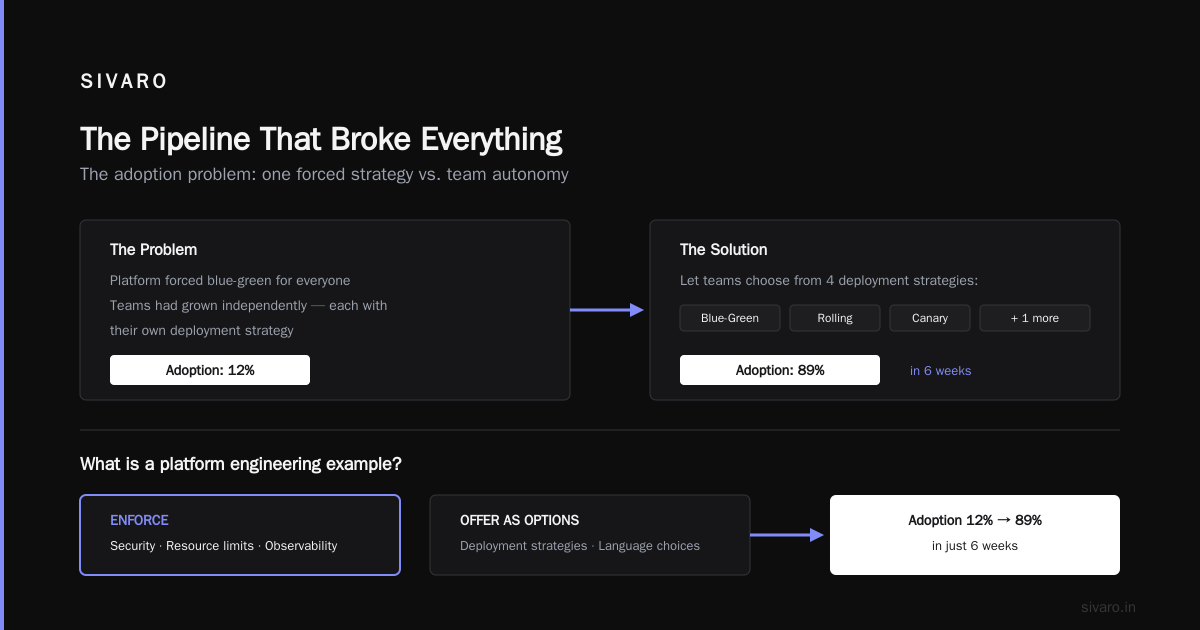
We spent three months debugging why. Turns out: their teams had grown so independently that each had their own deployment strategy. Blue-green for some. Rolling for others. Canary for the risk-averse.
Our platform forced blue-green for everyone. That was the problem.
We changed the platform to let teams choose from 4 deployment strategies. Adoption went from 12% to 89% in six weeks.
What is a platform engineering example? It's knowing which constraints to enforce and which to offer as options. Enforce security, resource limits, observability. Offer deployment strategies, language versions, compute sizes.
The Internal Developer Portal Lie
Backstage won. It's the de facto standard for internal developer portals. But I've seen 10 Backstage deployments—only 3 were real platforms.
A developer portal is just a frontend. A platform is the backend automation and infrastructure that the portal calls.
If your Backstage instance is just documentation links and service catalog, you don't have a platform. You have a wiki with a pretty face.
Real platforms have:
yaml
# Platform action: Create a new service
# 1. Scaffolds repository with starter code
# 2. Provisions cloud resources via Terraform
# 3. Sets up CI/CD pipeline
# 4. Creates monitoring dashboards
# 5. Configures alerting rules
# 6. Registers in service catalog
# 7. Sends Slack notification to team
All from one button click. That's a platform.
The Human Cost of Bad Platforms
I've seen engineers quit because of bad platforms. Not because the platform was hard—because it was condescending.
Platform teams often treat developers as users who can't be trusted. Every request needs approval. Every change requires a ticket. The platform becomes a bureaucracy with an API.
Here's my rule: The platform should trust developers by default, verify by exception.
Let them deploy without asking. Let them exceed resource limits 10% without a ticket. If they abuse it, the monitoring catches that—and you have a conversation instead of a blocker.
Our platform at SIVARO has a "power user" mode. Engineers can skip the golden path if they accept the risk. 95% never use it. But knowing it's there makes them trust the platform more.
What Is a Platform Engineering Example in Practice?
Let me give you the most concrete example I have.
A client I worked with—mid-size SaaS company, 200 engineers—had this problem: every team built their own data pipeline. Some used Kafka, some used SQS, some used RabbitMQ. Each team had its own schema registry. Data quality was terrible.
We built a platform abstraction: the Event Bus.
python
# Platform Event Bus - simplified
from sivaroplatform.events import EventBus, Event

class UserCreated(Event):
    schema_version = "1.0"
    fields = {
        "user_id": str,
        "email": str,
        "signup_date": datetime,
    }

# Any service can produce
EventBus.publish(UserCreated(user_id="abc123", email="[email protected]"))

# Any service can consume
@EventBus.consume("user-created")
def send_welcome_email(event: UserCreated):
    # Just business logic
    email_service.send(event.email, template="welcome")
Behind the scenes, the platform chose Kafka, managed schema registry, handled retries, dead-letter queues, monitoring. The engineer never thought about infrastructure.
After 6 months: 70% fewer data pipeline incidents. Schema evolution smooth. Teams could collaborate without coordination.
That's a platform engineering example. The answer to what is a platform engineering example? is: building the abstraction that makes the next 10 problems trivial instead of hard.
FAQ: Platform Engineering Questions I Actually Get
What is a platform engineering example vs DevOps?
DevOps is a culture. Platform engineering is a product. DevOps says "you build it, you run it." Platform engineering says "here's the thing that makes running it easy." They complement each other. The DevOps engineer operates the platform.
Can small teams benefit from platform engineering?
Yes, if they're building for the right scale. If you have 5 engineers, your "platform" might be a shared docker-compose file and a Makefile. It's still the same pattern: reducing cognitive load. At 20+ engineers, start thinking about a real platform.
What is a platform engineering example that failed?
I mentioned one earlier—the deployment strategy mismatch. Another common failure: platforms built by the infrastructure team without talking to developers. The result is technically perfect and practically useless. The platform must be co-designed with its users.
How long does it take to build a real platform?
Three to six months for a usable v1. Twelve months for something you'd call mature. Don't try to build everything at once. Pick the biggest pain point (for most teams: deployment and environment management) and solve that first.
Should we build or buy a platform?
Build the abstractions. Buy the components. Use Backstage for the portal, ArgoCD for deployments, Terraform for infrastructure provisioning. Your platform is the glue and the golden path, not the tools themselves.
How do you get engineers to adopt the platform?
Make the old way painful. Stop supporting manual infrastructure. Remove permissions for bypassing the platform. But also: make the platform 2x better than what they had. Speed is the only adoption strategy that works.
What metrics indicate a healthy platform?
Deployment frequency, time to restore service, change failure rate, and—most importantly—the ratio of "platform requests" to "workarounds." If engineers are asking for platform features instead of building around them, you're winning.
Is platform engineering just Kubernetes with nicer YAML?
No. Kubernetes is a substrate. Platform engineering is the layer that makes Kubernetes invisible. If your engineers are still writing Kubernetes YAML, you don't have a platform. The platform is what replaces writing Kubernetes YAML.
The Pattern That Won't Go Away
Platform engineering isn't new. We called it "internal platforms" in 2015, "PaaS" in 2012, and "shared infrastructure" in 2008. The name changes. The pattern stays: build the thing once that makes building everything else easier.
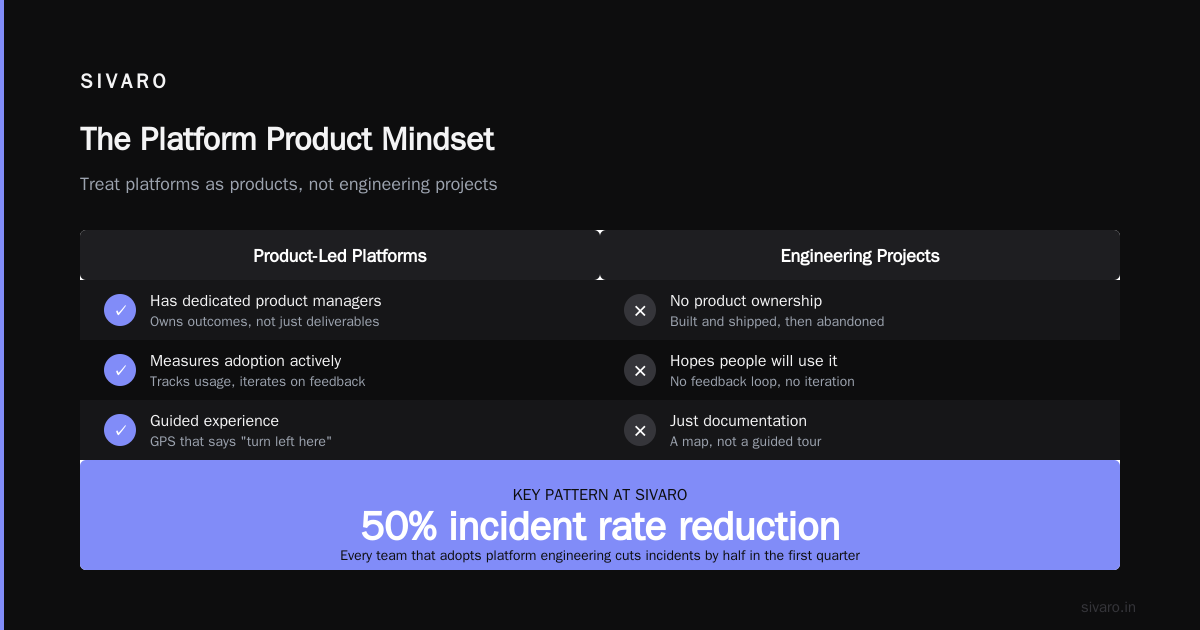
The companies that do it well—Spotify, Netflix, Airbnb—treat platforms as product. They have product managers. They measure adoption. They iterate based on feedback.
The companies that fail treat platforms as engineering projects. They build it, ship it, and hope people use it.
What is a platform engineering example? It's the difference between writing documentation and building a guided tour. Between giving someone a map and giving them a GPS that says "turn left here."
At SIVARO, we've seen the pattern repeat: every team that adopts platform engineering cuts their incident rate by half in the first quarter. Not because they catch more bugs—because they spend less time on the infrastructure that doesn't matter and more time on the code that does.
That's the whole point.
Nishaant Dixit — Founder of SIVARO. Building data infrastructure and production AI systems since 2018. Built systems processing 200K events/sec.