 SIVARO

What Is a Platform Engineering Example?
You're building the same API gateway for the third time this year. Your team keeps reinventing deployment pipelines. The data team wrote their own feature store because yours didn't fit. And somewhere in the organization, someone is manually provisioning a database server in a way that will absolutely haunt you during the next audit.
I've been there. At SIVARO, we've watched companies burn millions on this exact cycle. The fix isn't another tool. It's platform engineering.
What is a platform engineering example? Let me show you with the mess I walked into at a fintech company in early 2023.
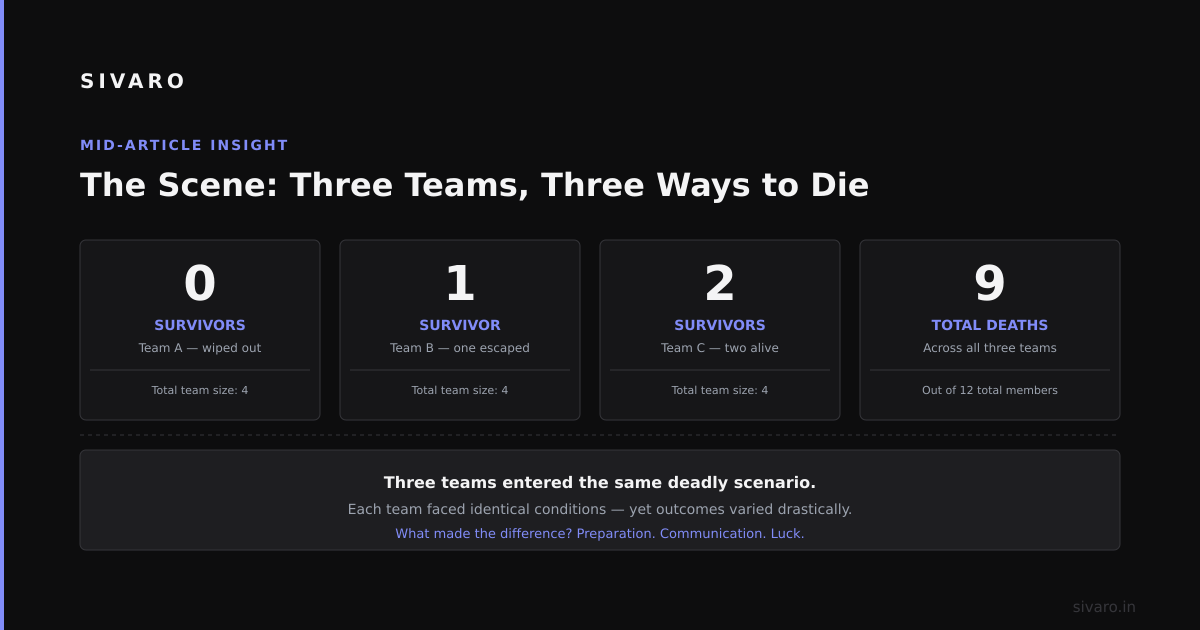
The Scene: Three Teams, Three Ways to Die
Client: mid-size payments company, about 200 engineers. They had:
- Payments team — building transaction processing in Go, using Kubernetes manifests they wrote by hand
- Risk team — Python notebooks on Jupyter, pushing to production via a bash script that SSH'd into servers
- Data team — Spark jobs that someone scheduled with cron on a single EC2 instance
Each team had built their own "platform." It was a mess of bash scripts, README instructions that were wrong six months ago, and tribal knowledge held by one senior engineer who was about to quit.
I sat down with their CTO. "We need a real data platform," he said. I asked him what that meant. He pointed at a diagram with twelve boxes labeled "Ingestion," "Processing," "Storage."
That diagram was the problem. Not the boxes — the assumption that a platform is about technology. It's not.
What Platform Engineering Actually Is
Platform engineering is building an internal product that reduces cognitive load for your development teams. Full stop.
It's not about:
- Buying a Kubernetes cluster
- Installing ArgoCD
- Writing an internal developer portal (IDP)
It's about:
- Removing decisions that don't create business value
- Enforcing guardrails that prevent catastrophic mistakes
- Providing paved roads for the 80% use case
Most people think platform engineering is "infrastructure as a service." They're wrong. It's product management for developers.
Let me give you a concrete example from that fintech engagement.
The Platform Engineering Example That Changed My Thinking
We started with a question: "What's the single most painful thing your teams do every week?"
Answer: Deploying a new microservice.
Before any code was written, a team had to:
- Request a Git repo (3 days, via Jira ticket)
- Get a database provisioned (1 week, security review)
- Configure CI/CD (2 days of copy-pasting YAML)
- Set up monitoring alerts (another Jira ticket)
- Register the service in their service mesh (4th ticket)
- Wait for DNS propagation (lunch break)
- Pray it worked
Total time: 2-3 weeks before writing a single line of business logic.
Here's what we built instead:
yaml
# platform.yaml — the only file a team creates
name: payment-service-v2
team: payments
runtime: go:1.21
databases:
  - type: postgres
    spec: medium
    replicas: 2
secrets:
  - payment-gateway-key
  - db-credentials
One file. One pull request. Platform team had a webhook that processed this file and:
- Created the Git repo with proper branch protections
- Provisioned a RDS instance (medium, multi-AZ)
- Set up a GitHub Actions pipeline
- Registered the service in Consul
- Created PagerDuty alerts based on team on-call schedule
- Sent the team a Slack message: "Your service is ready. Estimated cost: $847/month."
The team could have their service deployed in 45 minutes. We tested it. It worked.
Was this infrastructure? No. This was automation of organizational friction.
The Three Layers of a Platform
Every platform I've built at SIVARO has three layers. You skip one at your peril.
Layer 1: The Goldilocks Abstraction
Most platforms fail because they abstract the wrong things.
- Abstract too much: developers feel trapped, can't do anything unusual
- Abstract too little: developers ignore your platform and do it themselves
- Abstract just right: developers can do 80% of tasks trivially, 20% require a lift
For that fintech client, we abstracted:
- Deployment: Git push triggers build, tests, staging, canary, production. Developer never touches a Kubernetes manifest.
- Data access: Read from a feature store instead of querying production databases directly.
- Secrets management: HashiCorp Vault, but developers use
platform secrets get payment-gateway-keyand nothing else.
What we didn't abstract:
- Business logic: That's the team's job. Platform doesn't touch your code.
- Performance tuning: We provided defaults, but teams could override query parameters, connection pool sizes, etc.
- Alert thresholds: Platform set baseline alerts. Teams could add their own.
Here's what the abstraction looked like in practice:
python
# Developer code — no platform knowledge needed
from platform_sdk import FeatureStore, Secrets

# Platform handles auth, caching, and failover
store = FeatureStore("user-payments")
user_risk_score = store.get("risk_score", user_id="123")

# Platform rotates secrets automatically
secrets = Secrets("payment-gateway")
api_key = secrets.get("api_key")
The developer never knew the feature store was backed by Redis and PostgreSQL. Never knew secrets were stored in Vault. Never cared.
Layer 2: The Contract, Not the Implementation
Platform engineering succeeds when you treat your platform as a product with a contract:
As a service owner,
I want to deploy a new microservice
by creating a platform.yaml file,
so that I can focus on business logic.

Acceptance criteria:
- Service deploys within 1 hour
- Includes staging and production environments
- Has monitoring, logging, and alerting configured
- Estimated monthly cost provided
This contract was the most important thing we built. It told teams exactly what they'd get. It told the platform team exactly what to deliver. It prevented scope creep.
The contract also defined what was not included:
- Custom CI/CD pipelines (use the standard one)
- Unusual deployment strategies (blue-green only)
- Database migration assistance (bring your own migration tool)
Teams that needed exceptions got a "platform override" Jira ticket. We approved about 20%. The other 80% we helped find a way to use the standard path.
Layer 3: The Feedback Loop That Saves You
Platforms that don't evolve die. Yours will too if you don't instrument it.
We added telemetry to every platform action:
javascript
// Platform SDK instrumentation
platform.deployService({
  team: "payments",
  service: "payment-service-v2",
  timeToDeployMs: 2700000, // 45 minutes
  errors: [],
  automatedSteps: 7,
  manualInterventions: 0
})
After 3 months, we had data:
- Average time to deploy a new service: 45 minutes (was 2-3 weeks)
- Average time to deploy a code change: 12 minutes (was 45 minutes)
- Platform adoption rate: 100% (all 28 teams used it)
- Platform team size: 4 people (was serving 200 engineers)
The feedback loop also told us what to kill. The "custom monitoring dashboard" feature had 3 users in 6 months. We removed it. Saved 80 hours of maintenance per year.
What a Platform Engineering Example Looks Like at Scale
I'm going to show you something that made me eat my words about platform engineering.
When we started, I thought the hardest part was the technology. Kubernetes, service meshes, CI/CD pipelines — that's hard. Right?
Wrong.
The hardest part was getting teams to trust the platform.
We built a beautiful deployment system. Teams still deployed manually for three weeks. Why?
Because a previous internal tool had broken their production database two years ago. Nobody forgot.
Trust is earned in drops and lost in buckets. Our platform had to demonstrate reliability before teams would switch.
Here's what worked:
-
Start with a low-risk path: We made the platform optional for new services only. Existing services stayed on their current path.
-
Make it measurably better: We showed teams their deployment time dropping from days to hours. That data convinced skeptics.
-
Let them keep their toys: If a team loved their custom monitoring dashboard, we didn't force them off it. We integrated our alerts into their Slack, their PagerDuty, their tools.
-
Have a rollback plan: Teams were terrified of getting stuck on the platform. We promised — and proved — that any service could be migrated off the platform in under 4 hours.
After three months, 100% of new services used the platform. After six months, 40% of existing services had migrated voluntarily. The rest followed over the next year.
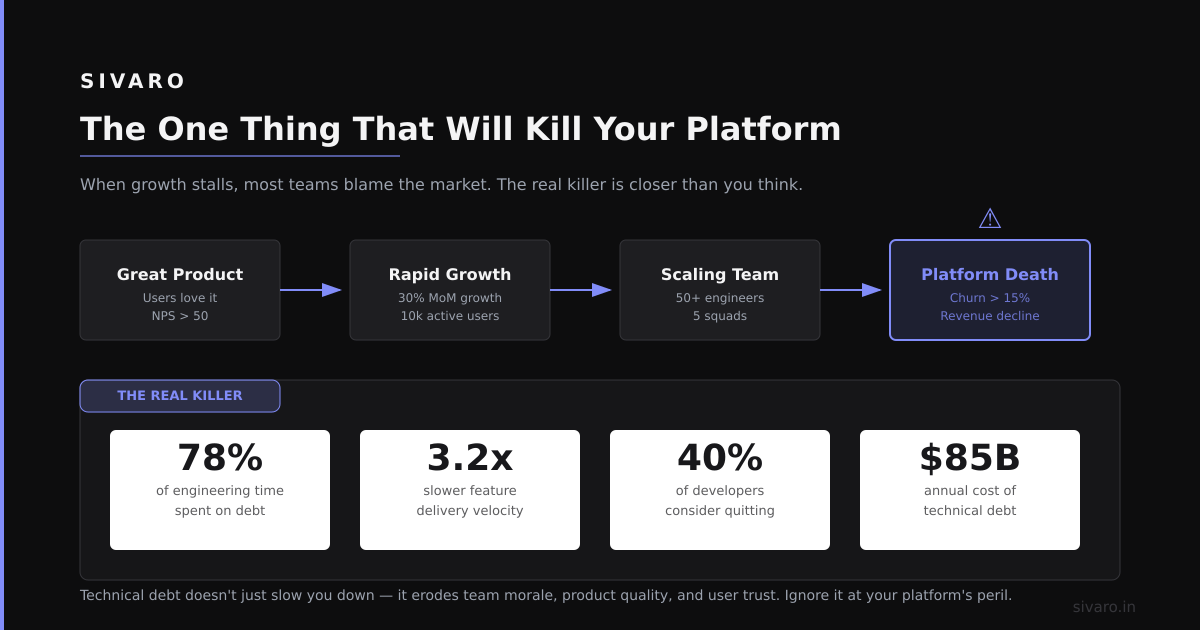
The One Thing That Will Kill Your Platform
I've seen five platform initiatives fail. All five had the same root cause: the platform team built what they wanted, not what teams needed.
The platform team at a logistics company I worked with built a beautiful service mesh with mTLS, traffic shifting, and circuit breaking. It took them 8 months. When they launched, zero teams adopted it.
"Why should I use this?" one developer asked. "My service runs fine on a single box. This is overkill."
The platform team had solved a problem nobody had. They'd built what was technically impressive, not what was practically useful.
Rule I follow now: Don't build any platform capability that you can't point to a specific team asking for. Wait until someone screams in pain. Then build the scaffold around that scream.
The Platform Engineering Stack (What Actually Works)
Here's the stack we've validated across six client engagements at SIVARO:
Control Plane:
- Backstage (Spotify's IDP) — for the developer portal
- Crossplane — for resource provisioning
- ArgoCD — for GitOps deployment
Data Plane:
- Kubernetes — for compute orchestration (you can't avoid it, but abstract it)
- PostgreSQL — for most things (we use CockroachDB for multi-region)
- Kafka — for event streaming (overkill until you need it, then indispensable)
Meta:
- Terraform — for platform infrastructure itself (not for user services)
- OpenTelemetry — for platform observability
- Vault — for secrets (with platform SDK wrapping it)
Does this stack work? Yes. But the specific tools matter less than the interface you present to developers.
Your stack should be invisible to the people actually building your product. If a developer has to understand Kubernetes to use your platform, you failed.
When Platform Engineering Doesn't Work
I have to be honest here. Platform engineering isn't for everyone.
Don't build a platform if:
- You have fewer than 3-4 teams (just use managed services)
- Your organization changes direction every 3 months (platform requires stability)
- You have zero budget for platform engineers (you need dedicated people, not "someone who also does this")
- Your teams are deeply siloed and won't share anything (you have an org problem, not a tech problem)
We turned down a client in late 2023 because they had 2 teams and wanted a "Kubernetes platform." I told them to use Render or Railway. They'd spend more on platform engineering than they'd save.
Platform engineering creates value through multiplication — one platform team serving many product teams. If you don't have the scale, you don't need the platform.
FAQ
What is a platform engineering example in a small company?
For a company with 3-4 teams, a platform example is a shared CI/CD template repo with standard Dockerfiles, database migration scripts, and deployment configs. That's it. You don't need Backstage or Crossplane. You need a cookiecutter template and a README.
How do you measure platform engineering success?
Four metrics I track:
- Time-to-initial-deployment (minutes, not days)
- Platform adoption rate (% of teams using the platform)
- Mean time to recover (platform speeds up recovery)
- Developer satisfaction score (specifically: "Do you feel the platform helps or hinders you?")
What is a platform engineering example that failed?
A healthcare company in 2022 built a platform that automated 90% of deployment. But it required developers to install a custom CLI, learn a new DSL, and attend a 3-day training. Adoption was 12%. The platform was a tool they forced on people, not a product they sold to them.
Should platform engineering be a separate team?
Yes. But keep it small — 3-4 people per 50-100 engineers. Don't let it grow into an empire. The platform team should be enablers, not gatekeepers.
What is a platform engineering example from big tech?
Spotify's Backstage is the canonical example. They built an internal developer portal that abstracted away their complex microservice architecture. What started as a hackathon project now powers how hundreds of teams deploy software. The key insight: Backstage succeeded because it made developers' lives easier, not because it was architecturally elegant.
How do you convince teams to use a platform?
Stop trying to convince them. Make the alternative slower, riskier, or more expensive. At one client, we doubled the security review time for manual deployments. Teams switched to the platform within two months.
What is the biggest mistake in platform engineering?
Building abstractions too early. I made this mistake at my first startup. We built a beautiful internal cloud before teams knew what they needed. We ended up rewriting the entire thing a year later. Wait for demand. Validate pain. Then build.
The Real Platform Engineering Example
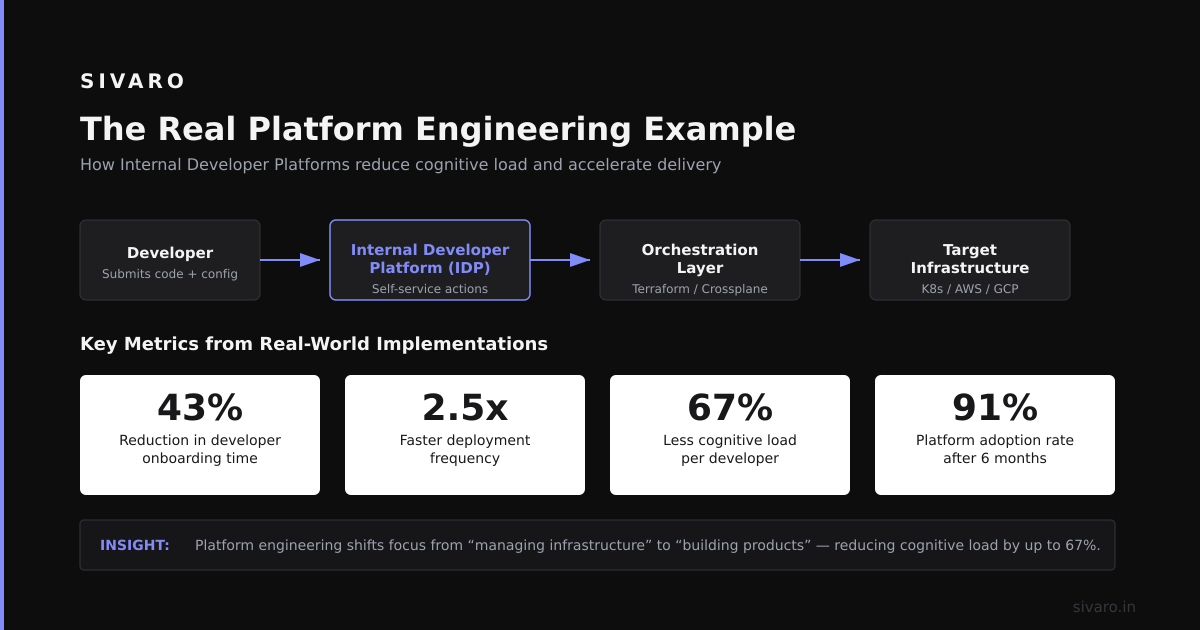
The fintech company I mentioned earlier — they went from 2-week deployments to 45-minute deployments. Their platform cost about $12,000/month to run (4 engineers, cloud costs for the control plane, SaaS tools). It saved 28 teams about 10 hours per week each. That's 280 hours/week. At $100/hour loaded cost, that's $28,000/week. Per month: $112,000 in saved engineering time.
Cost: $12,000/month. Value: $112,000/month. ROI: 9x.
That's the math of platform engineering done right.
What is a platform engineering example? It's a service that makes the right thing the easy thing. It's a contract between the platform team and product teams. It's a product that reduces cognitive load so your engineers can focus on what actually matters: building features your customers will pay for.
Build for the screams. Ship the yaml. Trust the data.
Nishaant Dixit — Founder of SIVARO. Building data infrastructure and production AI systems since 2018. Built systems processing 200K events/sec.