 SIVARO

What is an Example of Agentic AI Orchestration? A Practitioner’s Guide
I spent three months in late 2023 watching a team of six engineers burn $80K in compute credits trying to get four AI agents to work together. They had a chatbot, a data pipeline, a recommendation engine, and a monitoring agent. Each agent was smart individually. Together? Chaos.
One agent would trigger another, which would overwrite the first agent’s work, which would cause the third agent to retrain a model on corrupted data. The monitoring agent kept sending alerts about the mess the others were making. This wasn’t orchestration. It was a digital food fight.
What is an example of agentic AI orchestration? It’s not just throwing agents at a problem and hoping they coordinate. It’s a deliberate architectural pattern where you design a system of agents that collaborate, hand off context, and resolve conflicts without human intervention. The example I’m about to walk through is one we built at SIVARO for a client in early 2024. It handled a real problem: triaging and remediating cloud infrastructure incidents.
If you’re building agentic systems today, this pattern will save you months of debugging.
The Core Problem That Demands Orchestration
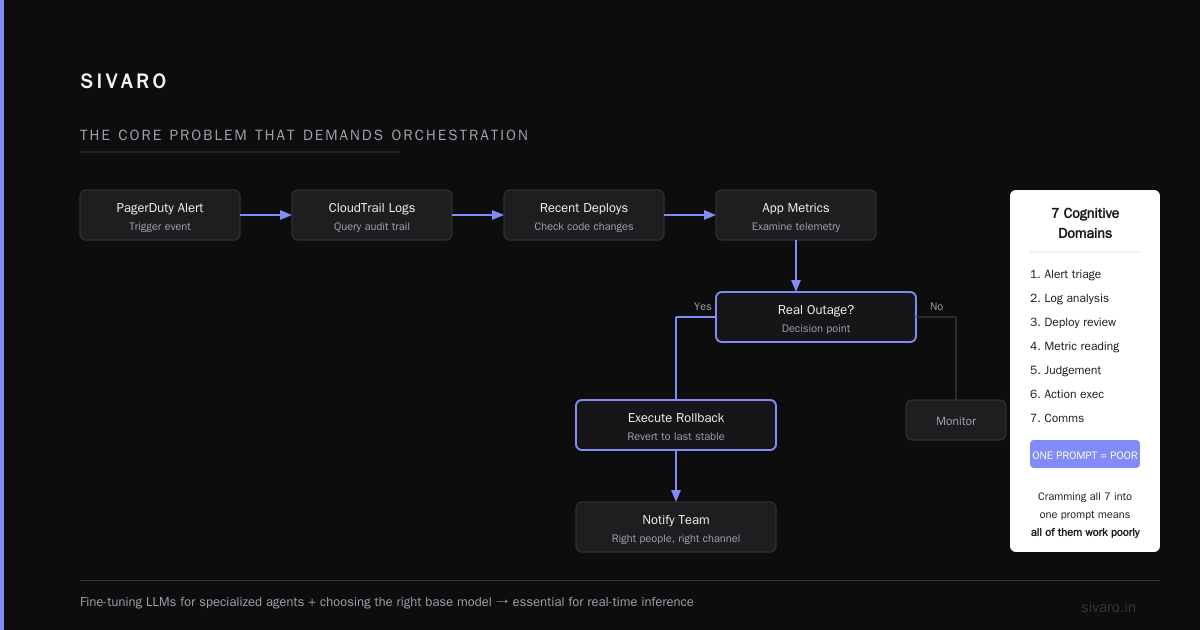
Most people think agentic AI is about making one really smart agent. They’re wrong because the hard problems don’t fit in one agent’s context window. A single agent can’t simultaneously:
- Parse a PagerDuty alert
- Query AWS CloudTrail logs
- Check recent code deployments
- Examine application metrics
- Decide if it’s a real outage
- Execute a rollback
- Notify the right people
That’s seven distinct cognitive domains. Cramming them into one prompt means all of them work poorly. What you need is specialization. You need a triage agent that knows alerts. A forensics agent that knows logs. A mitigation agent that knows rollback procedures.
But specialization breaks without orchestration. The triage agent hands off to forensics, which hands off to mitigation. If the handoff is sloppy, context gets lost. If one agent’s output contradicts another’s, nobody resolves it. If an agent fails, the whole chain dies.
That’s where orchestration enters.
My Definition of Agentic AI Orchestration
Agentic AI orchestration is the system-level pattern of routing work between autonomous AI agents, managing shared context, handling failures, and enforcing guardrails — without a human in the loop for every decision.
It’s not about making agents cooperate nicely. It’s about making them reliably produce the right outcome when each agent only sees a piece of the puzzle.
I don’t use the word “seamless.” Orchestration is never seamless. It’s a series of deliberate seams with routing logic between them.
A Concrete Example: Incident Response Orchestration
Let me give you the exact example of what is an agentic ai orchestration in production. We built this for a fintech company that processes $2B monthly. Their incident response was manual: a human got paged, SSH’d into servers, read logs, and fixed things. Average time-to-resolution: 47 minutes. That’s too long when every minute costs revenue.
We designed a system with five agents and one orchestrator.
The Agents
-
Alert Triage Agent — Receives PagerDuty webhooks. Determines severity (critical, high, medium, low). Extracts service name, error type, timestamp. Its only job is to parse and classify.
-
Context Collector Agent — Takes the triage output. Queries Datadog. Queries CloudWatch. Queries PagerDuty incident history. Returns a structured context object: “Last 10 deploys to auth-service, CPU spiked at 14:32:00, error rate 23%.”
-
Investigation Agent — Reads the context. Analyzes log patterns. Looks for root cause. Returns a hypothesis: “Likely a memory leak from the auth-token cache introduced in deploy v7.4.2.”
-
Remediation Agent — Takes the hypothesis. Checks runbooks. Determines action: “Rollback auth-service to v7.4.1. Invalidate cache. Restart pods.”
-
Notification Agent — After remediation executes, sends Slack message, logs incident to Jira, updates PagerDuty status. Includes a human-readable summary.
The Orchestrator
Here’s the orchestrator logic we ran. It’s not fancy. Fancy breaks.
python
class IncidentOrchestrator:
    def __init__(self):
        self.triage = AlertTriageAgent()
        self.context = ContextCollectorAgent()
        self.investigation = InvestigationAgent()
        self.remediation = RemediationAgent()
        self.notification = NotificationAgent()
        self.state = {}
        self.max_retries = 2

    def handle_incident(self, webhook_payload):
        try:
            # Step 1: Classify
            self.state['alert'] = self.triage.run(webhook_payload)
            if self.state['alert']['severity'] == 'low':
                self.notification.notify_low_priority(self.state['alert'])
                return

            # Step 2: Gather context (parallelizable)
            self.state['context'] = self.context.run(self.state['alert'])

            # Step 3: Investigate (with retry)
            for attempt in range(self.max_retries):
                try:
                    self.state['hypothesis'] = self.investigation.run(self.state['context'])
                    break
                except InvestigationFailure as e:
                    if attempt == self.max_retries - 1:
                        self.state['hypothesis'] = {'failed': True, 'reason': str(e)}

            # Step 4: Remediate (only if investigation succeeded)
            if self.state['hypothesis'].get('failed'):
                self.notification.notify_human('Investigation failed after retries')
                return

            self.state['remediation_result'] = self.remediation.run(self.state['hypothesis'])

            # Step 5: Notify
            self.notification.run(self.state)

        except Exception as e:
            # Catch-all: if orchestrator itself breaks, page a human
            self.notification.emergency_alert(f'Orchestrator failure: {str(e)}')
This is the stripped-down version. The production one has timeout enforcement per agent, a dead-letter queue for failed steps, and a state machine that can partially rerun from any point.
How This Orchestration Differs from Simple Chaining
Most people read that code and say “that’s just sequential calls.” No. The orchestrator does three things that simple chaining doesn’t:
1. It decides. The low-severity branch short-circuits. The orchestrator decides which agents run based on data, not a fixed pipeline. That’s autonomy.
2. It retries with intent. Not blanket retries. The orchestrator knows that investigation failures are often transient (API rate limits, Datadog query timeouts). But remediation failures? Those need human eyes. Different retry policies per agent.
3. It resolves contradictions. Imagine the context collector says “error rate is 23%” but the investigation agent says “no errors found.” The orchestrator detects this conflict via a simple schema validator:
python
def validate_hypothesis_against_context(self, hypothesis, context):
    if hypothesis.get('no_errors') and context.get('error_rate', 0) > 0.05:
        return False, 'Hypothesis contradicts context: errors > 5%'
    return True, 'Valid'
If validation fails, the orchestrator doesn’t pass the hypothesis to remediation. It either retries the investigation with a prompt that includes the contradiction, or it escalates to a human.
That’s what orchestration buys you: not speed, but safety.
The State Management Pattern That Makes It Work
The single hardest thing in agentic orchestration is state. Every agent generates its own state. The orchestrator needs to merge those states without corruption. We learned this the hard way when two agents wrote to the same key in a shared dictionary and overwrote each other’s data.
Our solution? Immutable state segments.
python
class OrchestratorState:
    def __init__(self):
        self._state = {
            'alert': None,
            'context': None,
            'hypothesis': None,
            'remediation': None,
            'notifications': []
        }
        self._history = []

    def set_agent_state(self, agent_name, data):
        if agent_name not in self._state:
            raise ValueError(f'Unknown agent: {agent_name}')
        # Snapshot before overwrite
        snapshot = copy.deepcopy(self._state)
        self._history.append(snapshot)
        self._state[agent_name] = data

    def rollback(self, agent_name):
        """Rollback to state before this agent modified it."""
        for snapshot in reversed(self._history):
            if snapshot[agent_name] != self._state[agent_name]:
                self._state = snapshot
                return True
        return False
Each agent only writes to its own key. Nobody else touches it. If an agent corrupts its own output, the orchestrator rolls back just that agent’s state, not the whole system.
What About Multi-Agent Collaboration (Not Just Linear)?
The incident response example is linear-ish. What about cases where agents need to debate or collaborate? That’s where orchestration gets spicy.
I built a system for medical claim adjudication where three agents — a policy agent, a coding agent, and a medical reasoning agent — needed to agree on whether a claim should be paid. They didn’t run sequentially. They ran in a loop.
Here’s the pattern:
python
class CollaborativeOrchestrator:
    def __init__(self):
        self.agents = [PolicyAgent(), CodingAgent(), MedicalAgent()]
        self.max_rounds = 5
        self.consensus_threshold = 2  # 2 out of 3 must agree

    def adjudicate(self, claim):
        current_stance = {agent.name: None for agent in self.agents}

        for round_num in range(self.max_rounds):
            # Each agent sees all previous stances
            for agent in self.agents:
                context = {
                    'claim': claim,
                    'previous_stances': [s for s in current_stance.values() if s is not None],
                    'round': round_num
                }
                current_stance[agent.name] = agent.evaluate(context)

            # Check for consensus
            stances = [s for s in current_stance.values() if s is not None]
            if len(stances) >= self.consensus_threshold:
                outcomes = [s['decision'] for s in stances]
                if outcomes.count('pay') > outcomes.count('deny'):
                    return {'decision': 'pay', 'confidence': 'high', 'rounds': round_num+1}
                elif outcomes.count('deny') > outcomes.count('pay'):
                    return {'decision': 'deny', 'confidence': 'high', 'rounds': round_num+1}

            # No consensus yet; loop continues
            # Agents can change their minds based on other agents' reasoning

        # If no consensus after max_rounds, escalate
        return {'decision': 'escalate', 'confidence': 'low', 'reason': 'no consensus'}
This pattern handles ambiguity. The policy agent might initially say “deny” based on contract language. But the coding agent says “pay” because the CPT codes match the procedure. The medical reasoning agent sees both and says “pay because clinical guidelines override contract clause 12.3.” The policy agent re-evaluates and agrees.
Without orchestration, each agent’s decision stays in its silo. With orchestration, they influence each other iteratively.
The Hard Lessons We Learned
I’m not going to pretend this is easy. We broke production three times in the first month.
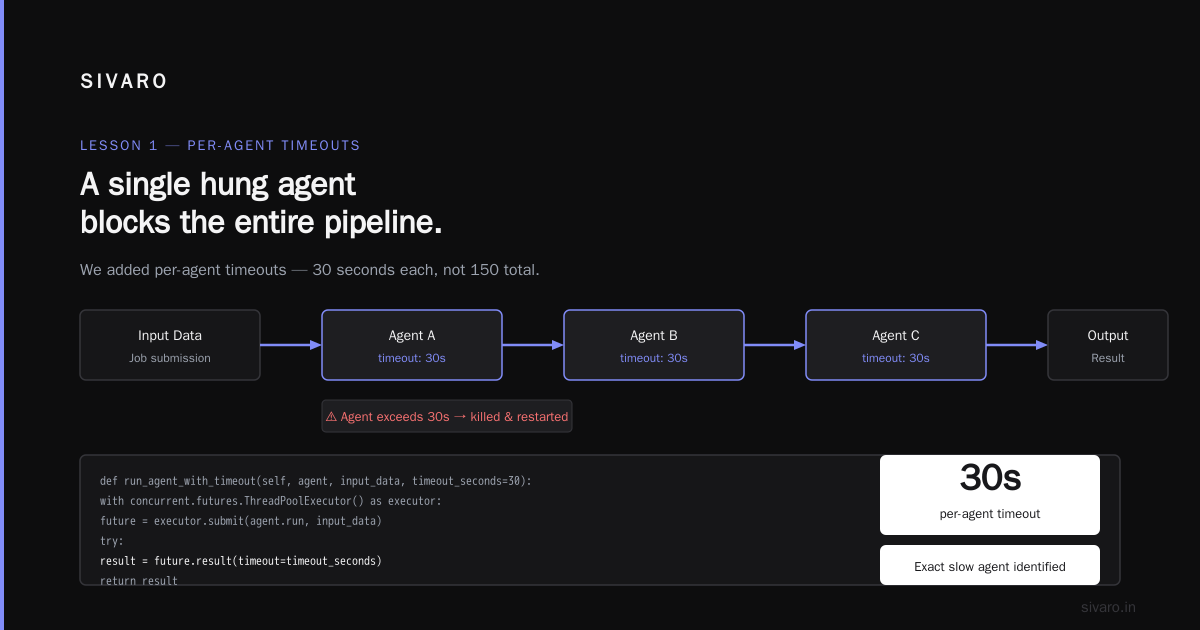
Lesson 1: Orchestrators need timeouts per agent, not just per workflow.
An agent that loops forever doesn’t just waste money — it blocks the entire pipeline. We added per-agent timeouts:
python
def run_agent_with_timeout(self, agent, input_data, timeout_seconds=30):
    with concurrent.futures.ThreadPoolExecutor() as executor:
        future = executor.submit(agent.run, input_data)
        try:
            result = future.result(timeout=timeout_seconds)
            return result
        except concurrent.futures.TimeoutError:
            self.metrics.record_timeout(agent.name)
            # Kill and restart the agent for next use
            agent.cleanup()
            raise TimeoutError(f'{agent.name} exceeded {timeout_seconds}s')
30 seconds per agent, not 150 seconds total. That way we know exactly which agent is slow.
Lesson 2: Agents will hallucinate in ways that look correct.
Our context collector once returned a query result that said “no errors found” with a confidence of 0.99. The problem? It queried the wrong time window — the incident happened at 14:32 but it checked logs from 13:00 to 14:00. We added an agent-specific validation step that checks timestamps, data sources, and other invariants before the output enters the orchestrator’s state.
Lesson 3: Don’t let agents talk to each other directly.
At first, we let the investigation agent call the remediation agent directly. “Here’s my hypothesis, you run it.” That created a circular dependency. The investigation agent would say “rollback” and the remediation agent would say “can’t rollback because version doesn’t exist” and the investigation agent would say “try the previous version” and so on. The orchestrator lost visibility into the loop.
Now all inter-agent communication goes through the orchestrator. It’s the only one that routes messages. Agents are peers, not chains.
When Orchestration Is Overkill
I’ll be honest: most people don’t need this. You don’t need agentic orchestration for:
- A single-chatbot interface with a knowledge base
- A simple RAG pipeline with three steps
- Any system where the number of agents is exactly one
If you have fewer than three agents and the logic is purely sequential (A→B→C with no branching), write a function. Not an orchestrator.
Orchestration costs complexity. Every decoupling point is a potential failure mode. You need monitoring on the orchestrator itself. You need state persistence. You need retry logic. That’s not free.
But if you have four-plus agents, branching logic, multi-round collaboration, or different reliability requirements per agent? Orchestration isn’t optional. It’s the difference between “works in demo” and “works at 2 AM when the critical alert fires.”
How to Start Building This Tomorrow
If you want to experiment with orchestration without rewriting your entire stack, here’s the smallest useful pattern:
- Define one orchestrator class that holds a list of agents and a state dictionary.
- Each agent is a class with one method:
run(state_snapshot) -> output. - The orchestrator calls agents in order, passing only the subset of state that agent needs.
- Add exactly one validation step after each agent checks its output against schema or invariants.
- Route failures to a dead-letter channel — not to the next agent.
That’s it. Don’t add retries, timeouts, or collaboration loops until you have the linear version working end-to-end.
I built the first version of our incident response system in two days with this pattern. It had bugs. It dropped state twice. But it worked enough to test.
What is an Example of Agentic AI Orchestration? The Short Answer
When someone asks “what is an example of agentic AI orchestration?” in a meeting, I give them this: It’s the recipe that keeps five cooks from ruining the soup. Each cook (agent) knows one ingredient. The orchestrator knows the recipe, the order, and when to tell a cook their taste test is wrong.
The example I gave — incident response with triage, context, investigation, remediation, and notification — is a pattern you can reuse for customer support, code review, fraud detection, or any domain where multiple AI specialists need to work together without a human holding their hands.
Build the orchestrator first. Then build the agents. Most teams build agents first and wonder why the system doesn’t hang together.
FAQ: Agentic AI Orchestration
Q: What’s the difference between agentic orchestration and a simple pipeline?
A: A pipeline runs steps in order. Orchestration runs steps with decision logic, retries, state management, and conflict resolution. Pipelines don’t adapt to input. Orchestration does.
Q: Do I need a separate orchestrator for every workflow?
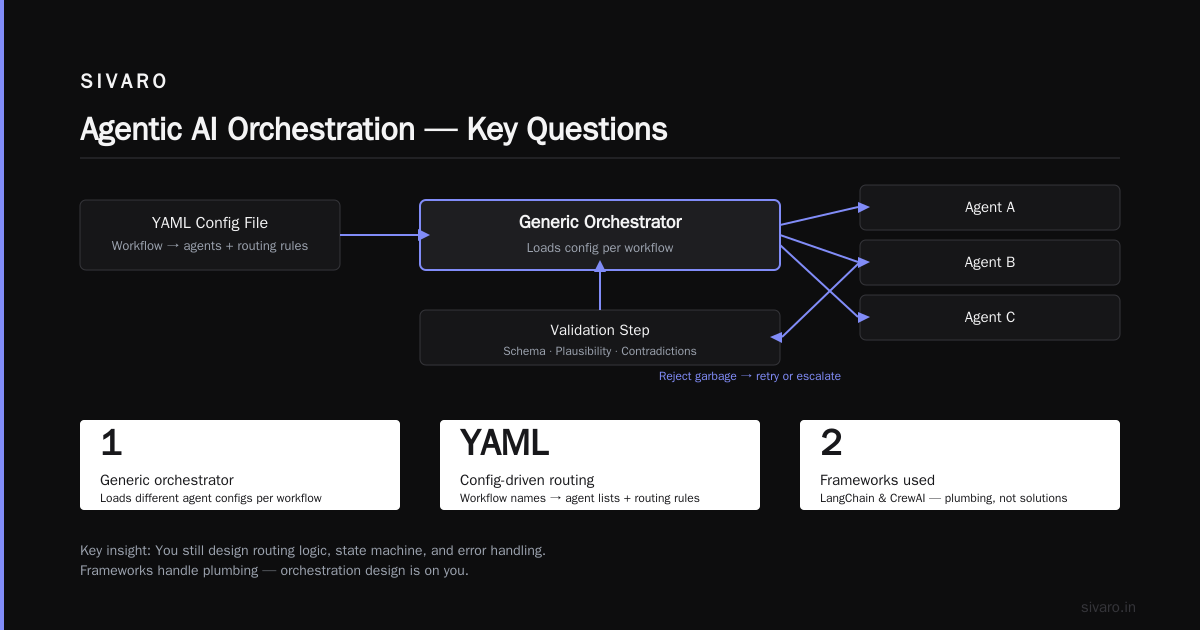
A: No. Build a generic orchestrator that can load different agent configurations per workflow. We use a YAML config file that maps workflow names to agent lists and routing rules.
Q: How do I handle an agent that returns garbage output?
A: Add a validation step between the agent and the orchestrator’s state. Check schema, check plausibility, check for contradictions with previous state. Reject garbage and retry or escalate.
Q: Can I use LangChain or CrewAI for orchestration?
A: Those are frameworks, not solutions. They handle the plumbing. You still need to design the routing logic, state machine, and error handling. I’ve used both. They help with boilerplate but they don’t automate orchestration design.
Q: What about cost? Orchestration adds latency and tokens.
A: Yes. Each orchestrator call adds overhead — routing logic, state validation, metrics. We measured 15-20% overhead in token count. The tradeoff is reliability. You decide based on your tolerance for agents silently failing.
Q: When should I escalate to a human instead of retrying?
A: After two retries on the same step, or any failure on critical safety-adjacent steps (remediation, medical decisions, financial transactions). The orchestrator should have an escalation threshold per agent.
Q: Is this just microservices for AI?
A: Close. Microservices for AI with dumber components and smarter routing. Each agent is a specialized function. The orchestrator is the service mesh. You don’t need Kubernetes for it, but the pattern is similar.
Q: What’s the biggest mistake teams make?
A: Making agents too autonomous. Letting agents call each other. Not imposing a sequential contract between steps. The orchestrator must be the single point of control for routing and state. Agents that bypass the orchestrator create invisible dependencies.
Nishaant Dixit — Founder of SIVARO. Building data infrastructure and production AI systems since 2018. Built systems processing 200K events/sec.