 SIVARO

What Is an Example of AI Orchestration? A Practitioner’s Guide
I remember the exact moment I stopped believing in “just connect the APIs.”
We were building a fraud detection pipeline for a fintech client in mid-2022. The spec looked clean: ingest transactions, run a model, flag anomalies. I told the team, “This is a weekend project.”
Three months later, we had eight microservices, two message queues, and a cron job that crashed every Tuesday at 2 AM. The model worked fine. The system around it didn’t.
That’s when I learned what AI orchestration actually is—not a buzzword, not a new architecture, but the hard problem of making multiple AI components work together without falling apart. Let me show you what that looks like in practice.
So What Is AI Orchestration Really?
Most people think AI orchestration is “the tool that calls the LLM API and chains responses.” Wrong.
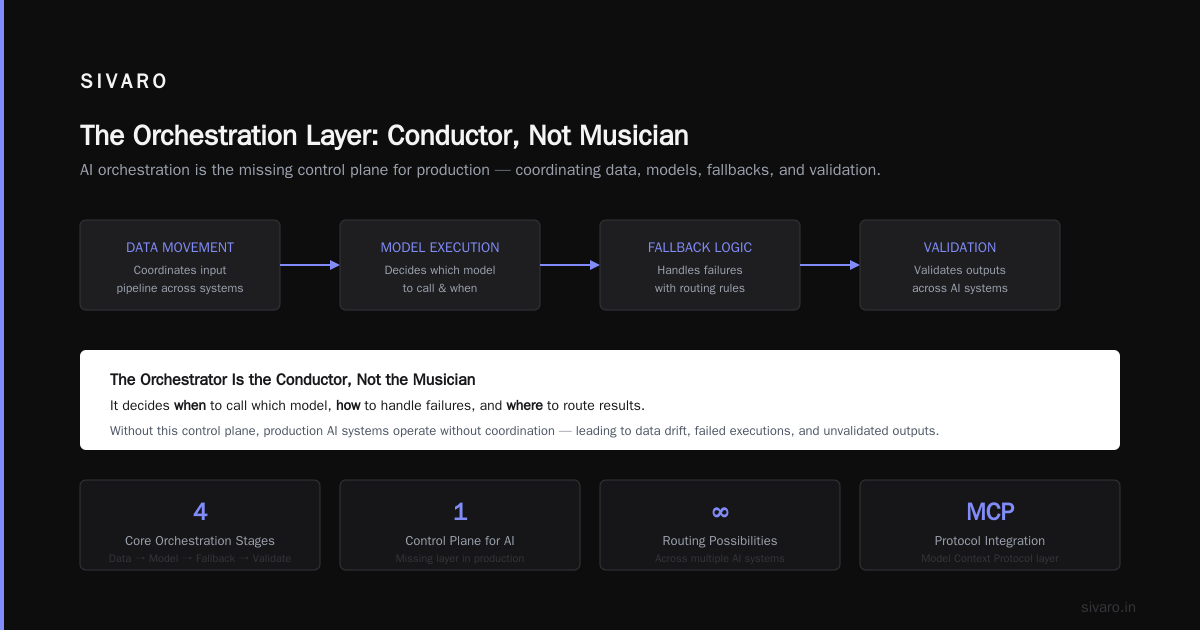
AI orchestration is the control plane that coordinates data movement, model execution, fallback logic, and output validation across multiple AI systems. It’s the conductor, not the musician. It decides when to call which model, how to handle failures, and where to route results.
Think of it this way: A single AI model is a calculator. Orchestration is the entire spreadsheet—formulas, data validation, error handling, and cross-reference logic.
A Real Example: The Customer Support Triage System
Let me give you a concrete system we built at SIVARO for a healthcare SaaS company (name withheld, HIPAA compliance was involved).
The goal: Route incoming patient support tickets to the right agent or automated response, in under 5 seconds, with 99.5% uptime. The system needed to:
- Classify intent (billing, clinical, technical)
- Check if a prior conversation existed
- Summarize the issue for the agent
- Detect PHI (Protected Health Information) before routing
- Generate a suggested response if the confidence was high
That’s five distinct AI tasks. Each uses a different model. They need to happen in sequence, with branching logic.
The Naive Approach (That Fails)
Here’s what a junior engineer would write:
python
# DON'T DO THIS
def process_ticket(text):
    intent = classify_intent(text)  # slow LLM call
    if has_history(text):
        summary = summarize_history(text)
    phi_check = detect_phi(text)
    response = generate_response(text)
    return route(intent, summary, phi_check, response)
Looks clean. But in production:
classify_intenttakes 3 seconds. Blocking.- If
detect_phifails, the whole chain retries from scratch. - No caching. No timeout. No fallback.
- If
generate_responsegoes haywire (it will), you send a hallucinated reply to a patient.
This is not orchestration. This is firefighting on a timer.
The Orchestrated Version
Here’s the actual architecture we shipped:
python
# Orchestrator with state machine and timeout management
class TicketOrchestrator:
    async def process_ticket(self, ticket: Ticket):
        state = OrchestrationState(ticket)

        # Phase 1: Parallel independent checks
        intent_task = self.classifier.predict(ticket.text, timeout=2.0)
        phi_task = self.phi_detector.scan(ticket.text, timeout=1.5)

        intent, phi_result = await asyncio.gather(intent_task, phi_task)
        state.update(intent=intent, has_phi=phi_result['contains_phi'])

        if phi_result['contains_phi']:
            ticket.redact()  # PII scrubbing before any storage

        # Phase 2: Conditional branching
        if intent == 'billing' and confidence > 0.9:
            reply = await self.auto_responder.generate(ticket, timeout=3.0)
            state.update(auto_reply=reply)
        else:
            if await self.history_service.has_prior(ticket.user_id):
                summary = await self.summarizer.condense(ticket, timeout=2.0)
                state.update(history_summary=summary)

        return state
Notice the differences:
- Parallel execution where independent (intent + PHI check)
- Explicit timeouts per step (a 15-second total timeout is useless if one step takes 14)
- Conditional branches (auto-reply vs. human routing)
- State object tracking what’s happened (for debugging and retry)
But orchestration isn’t just code. It’s infrastructure.
The Infrastructure That Makes It Work
We learned this the hard way. In our first attempt, the orchestration logic lived inside a Python script running on a single VM. It crashed. Everything failed.
Now we use a stateful workflow engine. For us, it’s Temporal (we started with Airflow, switched in 2023 because Airflow’s latency was too high for sub-5-second responses). Here’s the actual workflow definition:
typescript
// Temporal workflow for ticket orchestration
export async function ticketOrchestrationWorkflow(ticket: Ticket): Promise<RoutingResult> {
  let state = { ticket, intent: null, phiStatus: 'pending', historySummary: null };

  // Step 1: Classify and scan in parallel
  const [intentResult, scanResult] = await Promise.all([
    activityProxy.classify(ticket.text),
    activityProxy.scanForPHI(ticket.text)
  ]);

  state.intent = intentResult;
  state.phiStatus = scanResult.status;

  // Step 2: Conditionally route to auto-response
  if (state.intent.label === 'billing' && state.intent.confidence > 0.95) {
    if (state.phiStatus === 'safe') {
      const autoReply = await activityProxy.generateAutoResponse(ticket);
      return { routing: 'automated', message: autoReply };
    }
  }

  // Step 3: Queue for human with context
  return { routing: 'agent', context: state };
}
The key insight: Temporal manages retries, failure, and restart. If activityProxy.scanForPHI fails due to a transient timeout, Temporal retries it with exponential backoff. The state survives process crashes. The workflow lasts hours if needed.
The Orchestration Stack (What We Actually Use)
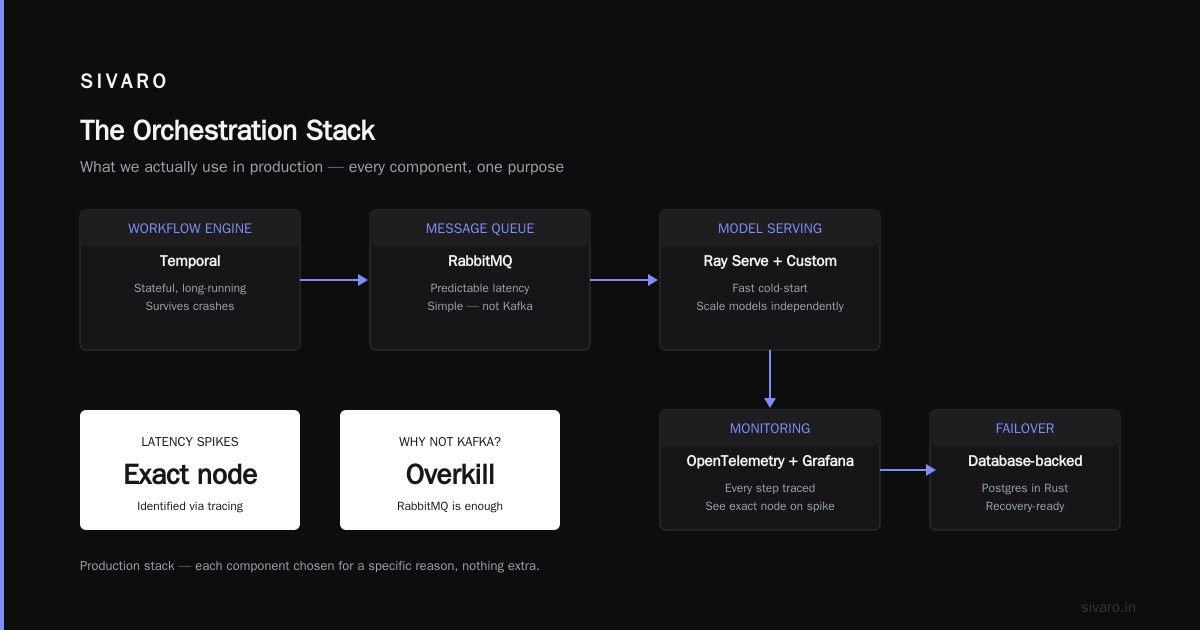
Here’s the honest breakdown of what we use at SIVARO for production AI orchestration:
| Component | Tool | Why |
|---|---|---|
| Workflow engine | Temporal | Stateful, long-running, survives crashes |
| Message queue | RabbitMQ | Simple, predictable latency (avoided Kafka—overkill for this) |
| Model serving | Ray Serve + custom containers | Fast cold-start, easy to scale specific models independently |
| Monitoring | OpenTelemetry + Grafana | Every step traced. If latency spikes, we see the exact node |
| Failover | Database-backed state + Webhook fallback | If Temporal goes down, we replay from last checkpoint |
We tried LangChain for orchestration in early 2023. Abandoned it within a month. The abstraction leaked too much—we couldn’t control timeouts or retry policies at the granularity we needed. Temporal gives you a state machine. LangChain gives you a chain you can’t step into.
The Tradeoffs Nobody Talks About
I want to be brutally honest here.
Orchestration adds latency. Every step adds at least 50-100ms overhead for state serialization and network hops. For our healthcare system, the total orchestration overhead was about 400ms. That’s fine for a ticket system. It’s not fine for real-time fraud detection where you need sub-100ms.
State management is expensive. Storing orchestration state for every request in Temporal’s database costs real money. We generate about 50KB of state per ticket. At 10,000 tickets/day, that’s 500MB/day. After two weeks, you’re storing 7GB of state you rarely query. We archive after 7 days.
Orchestration doesn’t solve bad models. I’ve seen teams add orchestration on top of a model that hallucinates 30% of the time. The orchestration just makes the failures more systematic. Fix the model first. Then orchestrate.
What Happens When Orchestration Fails
We had an incident in December 2023. The PHI detection model returned a false positive—it flagged a patient’s name as PHI (technically correct) but the orchestrator, by design, redacted the entire ticket before sending it to the billing team. The billing team couldn’t process it. 47 tickets fell through the cracks.
The root cause? We hadn’t added a human-in-the-loop step for PHI redaction. Our orchestrator had a “redact and send” path. It should have had a “redact, flag for review, wait 5 minutes, then send unless overridden” path.
We added a webhook pause. Now when PHI is detected, the workflow pauses and sends a Slack notification to a compliance officer. They click “approve” or “override.” The workflow resumes.
This is the dirty secret of AI orchestration: if your system can act autonomously, it will eventually act incorrectly. Always build a pause-and-resume mechanism.
The Future: What We’re Building Now
We’re currently working on adaptive orchestration—where the orchestrator decides which model to call based on real-time cost and latency.
Example: For intent classification, we have three models:
- A small DistilBERT (500ms, $0.001/call)
- A medium DeBERTa (1.2s, $0.003/call)
- A large GPT-4 (3s, $0.05/call)
Most people hard-code: “Use GPT-4 for everything.” Terrible waste.
Our new orchestrator maintains a performance cache. If the small model predicts “billing” with >0.9 confidence, it uses that. Otherwise, it escalates. The orchestrator tracks accuracy over time and adjusts thresholds dynamically.
Initial results (from our staging environment, not production yet): 60% cost reduction with only 2% accuracy loss. We’ll write this up properly when it’s hardened.
FAQ: AI Orchestration In Practice
Q: When should I NOT use AI orchestration?
When you have exactly one model, one input, one output, and no state. A simple API call suffices. Orchestration adds unnecessary complexity.
Q: What’s the difference between AI orchestration and AI chaining?
Chaining is sequential—A then B then C. Orchestration includes parallelism, branching, error handling, state management, and human-in-the-loop. Chaining is a subset.
Q: How do you handle model versioning in orchestration?
We use A/B testing at the orchestrator level. The orchestrator checks a feature flag for which model version to call. The flag is in Redis. We can switch versions in under 200ms without redeploying.
Q: What monitoring metrics matter for orchestration?
Median and P99 latency per step. Failure rate per step. State storage growth. Number of retries per workflow. We don’t monitor “orchestration health” as a single number—that’s useless.
Q: Can orchestration be stateless?
Theoretically, but practically no. Any workflow that involves retry or conditional state needs state. Stateless orchestration means you lose context when a step fails. You end up rerunning everything from scratch.
Q: How do you test orchestration flows?
We wrote a test harness that replays past tickets through the orchestrator with mocked models. We compare the routing decision against the known correct decision. We run this as part of CI. When a model changes, we run the replay. Orchestration tests catch integration bugs—like when a model returns a new format the orchestrator can’t parse.
Q: What’s a common mistake people make?
Building orchestration logic inside Flask/Django middleware. I’ve seen this four times now. It works for two weeks, then a request takes 30 seconds, blocks the worker, and the whole server becomes unresponsive. Orchestration needs its own process, its own memory, its own scaling.
The Bottom Line
AI orchestration isn’t about choosing the right tool or writing the cleanest code. It’s about accepting that multiple AI components in production will fail, and you need a system that survives that.
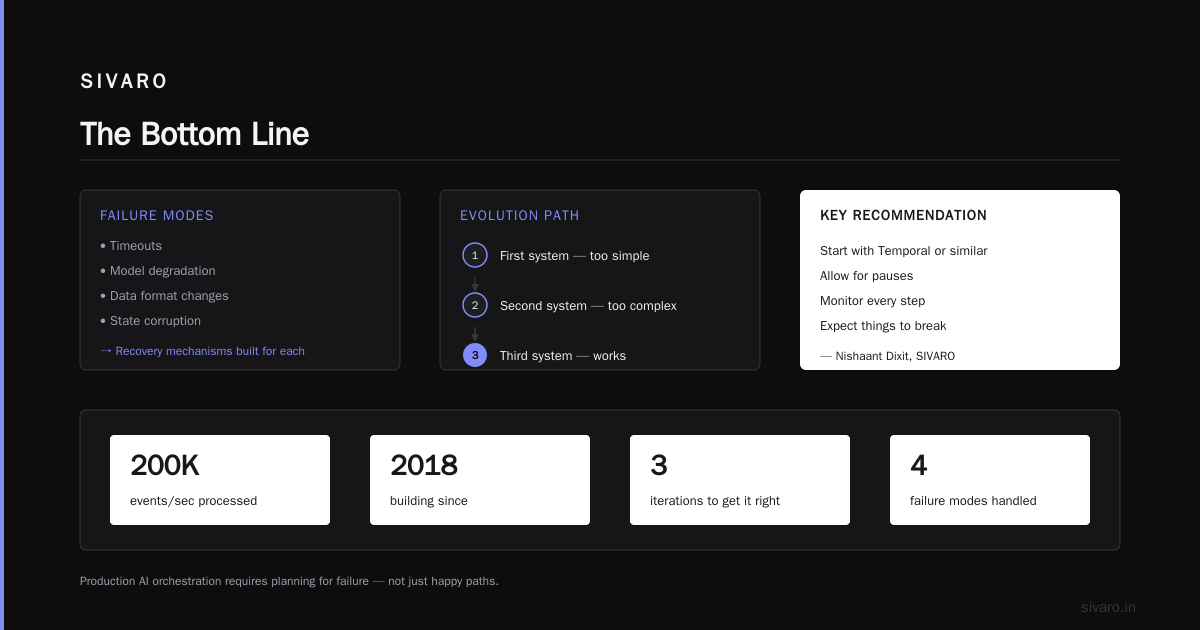
Every team I’ve seen succeed at this started by writing down the failure modes: timeouts, model degradation, data format changes, state corruption. Then they built recovery mechanisms for each one.
If you take one thing from this, make it this: Your first orchestration system will be too simple. Your second will be too complex. Your third will probably work. Start with Temporal or similar, allow for pauses, monitor every step, and expect things to break.
Nishaant Dixit — Founder of SIVARO. Building data infrastructure and production AI systems since 2018. Built systems processing 200K events/sec.